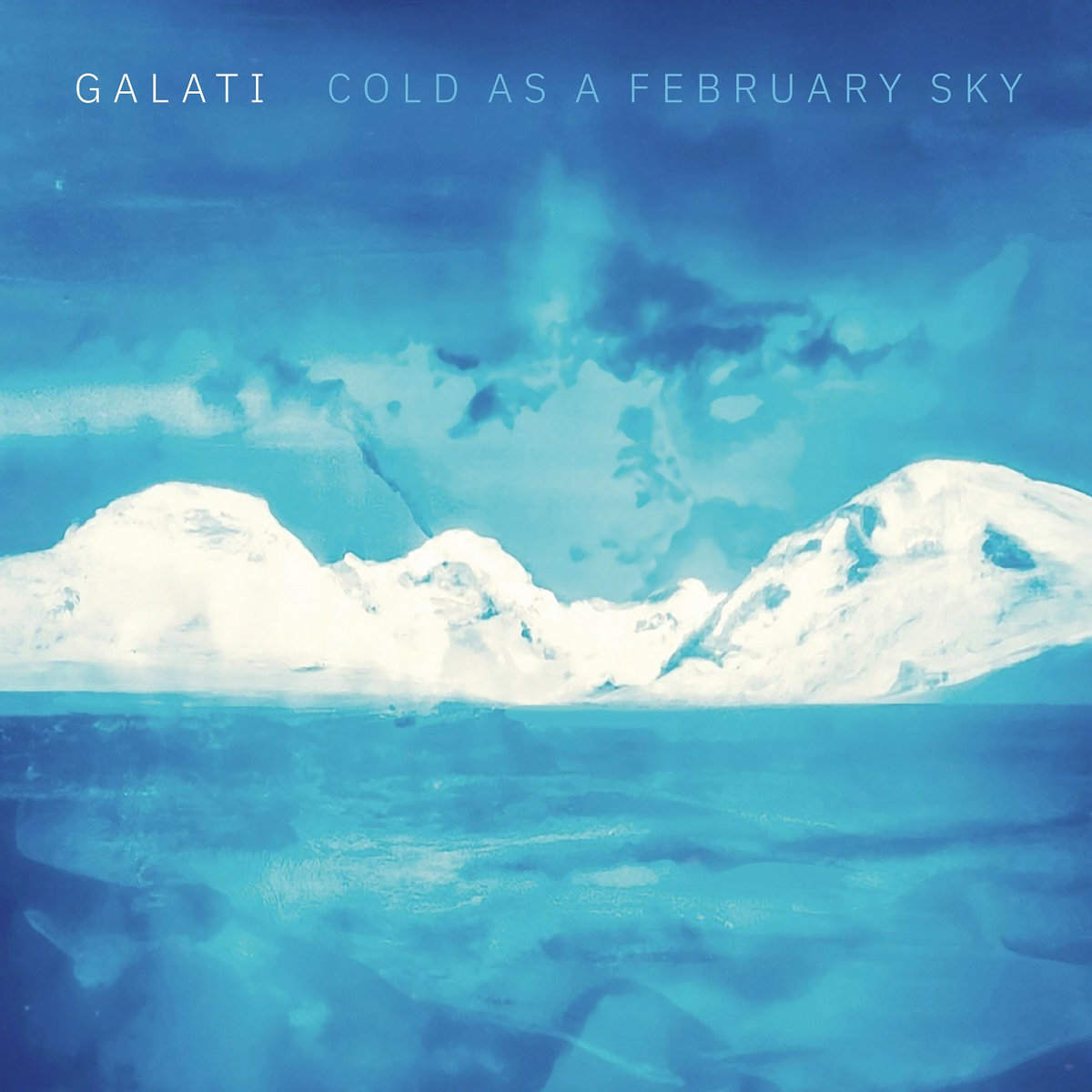
Galati is the moniker by which Roberto Galati is best known. The Italian producer has completed his first long player for the Glacial Movements label, writing in the shadow of the Karst Plateau in a blend of cold ambient music and a warmer post-rock.
What’s the music like?
Evocative – and certainly representing the album title. Many of Galati’s pieces are built on slowly shifting loops, with bright textures and fresh scoring.
Galati makes good use of the guitar early on, especially on As still as these high mountains.
After that, the music clouds over, and uncertainty and jeopardy are in play. That day exploded silentlyall around me is a dramatic about turn, its harmonies uncertain and the textures glowering in the half light. These are partially resolved on the following track, With wide, unbelieving eyes,with subtly wrought drama. After that the intensity subsides a little, though there are still vivid images that remain. Gradually the music comes to rest.
Does it all work?
It does. This is a dramatic album, best heard in one sweep so that the musical statements get to make their most powerful impact.
Is it recommended?
It is. This is a bold and lasting statement from a producer whose grasp of short and long structures is right on the money.
Mark Bebbington (piano, below), Czech National Symphony Orchestra / Steven Mercurio
Delius The Walk to the Paradise Garden (1906) Beethoven Piano Concerto no.5 in E flat Op.73 ‘Emperor’ (1809) Smetana Má vlast – Vltava (1874) Dvořák Symphony no.8 in G major Op.88 (1889)
Symphony Hall, Birmingham Tuesday 21 May 2024
Reviewed by Richard Whitehouse
Although it might not see the number of visiting orchestras that it once did, Symphony Hall still hosts a number of such concerts and the season’s representation ended tonight with this welcome appearance by the Czech National Symphony Orchestra and music director Steven Mercurio.
Opening with Delius’ The Walk to the Paradise Garden (from his opera A Village Romeo and Juliet) found these players evincing real affinity with its powerful if elusive idiom, Mercurio securing a poetic response from the woodwind and no mean ardour during its climactic stages.
Despite coming from and being based in or around Birmingham for most of his career, Mark Bebbington (above) is less known locally than he might be and his account of Beethoven’s Emperor Concerto confirmed a sure grasp of its expansive formal structure, with his secure and never inflexible technique more than equal to its pianistic demands. After those commanding initial exchanges, the initial Allegro felt just a little under-characterized until hitting its stride in the development; from where this reading proceeded with tangible conviction through to an agile ‘anti-cadenza’ then combative coda. The Adagio’s winsome variations could have had greater inner rapture, yet the eloquence of Bebbington’s response was not in doubt while the hushed transition into the Rondo produced an emotional frisson as carried through this finale overall.
Throughout the movement, Bebbington’s scintillating pianism duly galvanized the CNSO into a forthright response right up to the life-affirming close – after which, he acknowledged the enthusiastic applause with his limpid take on Chopin’s Nocturne (no.20) in C sharp minor.
Following the interval, Czech music not unreasonably took centre-stage. The players might have been surprised by reference to the ‘Moldau’, but Mercurio directed a fluent Vltava with such passages as its wedding dance or traversal of St John’s Rapids nothing if not evocative.
Having been at the helm of the CNSO since March 2019 (in succession to the much-missed Libor Pešek), Mercurio has certainly put his own stamp on its repertoire and presentation. He gave an account of Dvořák’s Eighth Symphony (sometimes referred to as the ‘English’ due to being published by Novello, but actually the most Czech-sounding of his mature symphonies) that, if affording few revelations, underlined its structural innovations as surely as its melodic immediacy. The opening Allegro made a virtue out of eliding the customary formal divisions on route to a resounding peroration, then the Adagio was even finer for the way that its pathos and grandeur were melded into a seamless and methodical yet cumulative design; one where the composer’s Romantic instincts and his Classical inclinations find especially potent accord.
The lilting Allegretto sees Dvořák at its most felicitous – Mercurio aptly taking its boisterous pay-off as a lead-in to the final Allegro, with its variations on an easeful theme for the strings that ingeniously shadow the outline of a sonata design prior to a coda of headlong brilliance.
Conductor and orchestra duly responded with two encores – a rhythmically incisive piece by Iranian-Canadian composer Iman Habibi, then a bossa nova as gave first trumpet and CSNO co-founder Jan Hasenöhrl the spotlight and brought the whole evening gently down to earth.
Clarinettist Stephen Black and pianist Paul Jones are back for a third album as Group Listening, but with a twist. Whereas the first two albums, Selected Works Vols. 1 and 2, were cover-based, Walks is an album of original compositions.
These include Frogs, inspired by an experience Jones had on holiday in Madeira, where a group of frogs were collected under a bridge, their croaks amplified and echoed in a chorus caught in a field recording.
Walks is also inspired by Robert Walser’s novella The Walk, and its recognition of the space achieved when out in the great wide open under your own steam.
What’s the music like?
Group Listening are really on to something here, the clarinet and piano base acting as a springboard for some imaginative compositions and sonic backdrops.
Field recordings continue to play a big part in their work, and the introductory 5 1°29 09.6 N 3°12 30.6 W sets the music in perspective with footsteps and birdsong, the Walks made real as though we are going somewhere outside. The steady pace is reflected also in New Brighton, where softly voiced thoughts unwind over an easy four to the floor beat, giving a sense of awakening.
Frogs is the standout composition, framed by the remarkable field recording but responding with a tender clarinet duet in play. Hills End is dubby but full of bloom, while Grey Swans, the longest composition on the album, has murmuring clarinets offset by a regular chime from higher piano. Old Reeds has a triple time lilt, hinting at a very different sort of dance.
To close, Pavane IX opens out into the airy Denge, with a deep electric piano sound suggesting the walk has reached a large body of water.
Does it all work?
It does. There is an appealing freshness about this music, made instinctively but realised with sensitivity in the editing too.
Is it recommended?
Yes indeed. Walks is a really enjoyable complement to the first two Selected Listening albums, but it suggests even more creative times lie ahead – and that Group Listening are only scratching the surface of what they might achieve in the future. Definitely a pair to keep an eye on.
Geneva Lewis (violin, above) and Georgijs Osokins (piano, below)
Brahms Violin Sonata no.2 in A major Op.100 (1886) Domenico Scarlatti Sonata in D minor Kk213 Elgar Violin Sonata in E minor Op.82 (1918)
Wigmore Hall, London Monday 20 May 2024 (1pm)
by Ben Hogwood
The Violin Sonata no.2 is one of Brahms‘s chamber music perennials, a popular recital fixture – but in this recital from BBC New Generation Artist Geneva Lewis and Latvian pianist Georgijs Osokins it was as though the work had received a fresh coat of paint.
The tempo marking Brahms applied to the first movement, Allegro amabile, is seldom found in classical music – ‘amabile’ meaning ‘lovely’. That was certainly the case in this performance, though Lewis and Osokins took a much slower tempo than is the norm. Their daring approach succeeded, however, for the melodic phrasing blossomed, the spring-like main tune given plenty of room to shine. The second theme was laid bare, but again the slow tempo allowed for greater insight, followed attentively by the Wigmore Hall audience.
The dynamic range of both players was also notable, Lewis very much aware of her surroundings in the quiet passages, the audience subconsciously leaning in to the music. At points the music was so quiet that Osokins’ pedalling could be heard…but conversely the pair were not afraid to put the pedal down and play out, as they did in the finale. In between came a tender and affectionate middle movement, its dreamy opening certainly tranquillo, before a most appealing central vivace section.
Elgar’s Violin Sonata was completed when the composer had just turned 60 – and although he would live for another 16 years, very few major works followed. To hear the sonata played by performers in their twenties was eye-opening indeed, with more youthful elements of the piece revealed and a different light shed on a work that often has autumnal reflections to cast.
The first movement was notable for its commanding first paragraph, Lewis setting the tone for the movement as she became immersed in Elgar’s broad phrasing. Osokins, for his part, mastered the full piano textures most impressively, before both performers drew back for a thoughtful second theme. The second movement became a fascinating mini-ballet between the two instruments, its shadowy colours a clue to the composer’s darker thoughts, though the bittersweet melodies were given extra charm by the dance-inflected rhythms.
The finale took flight immediately, the violin surging forward with penetrating melodies that led to a sense of sunlight breaking through the clouds in the closing phrases, Elgar allowing his thoughts to brighten as the music turned to the major key. The imaginatively chosen encore capitalised on this, Lewis and Osokins giving us the rustic finale of Busoni’s Violin Sonata no.2 in E minor, music which might have passed for one of Brahms’s Hungarian-influenced works were it not for some particularly scrunchy harmonies.
In between the two big sonatas, Osokins (above) had the chance to shine alone, one he took with a profound account of one of Domenico Scarlatti‘s many keyboard sonatas. The Sonata in D minor Kk213 is a bittersweet piece, a reminder of how forward looking this composer’s music can. Rooted in the 18th century it may be, but in reality we could have been listening to a Satie Gnossienne, especially with Osokins’ poetic licence drawing out the final harmonic resolution.
…from Josef Suk. Here is his Serenade for Strings in E flat major, an early work – performed by the Czech Philharmonic Orchestra, conducted by Jiří Bělohlávek in a recording from the 1990s:



 Arcana.fm