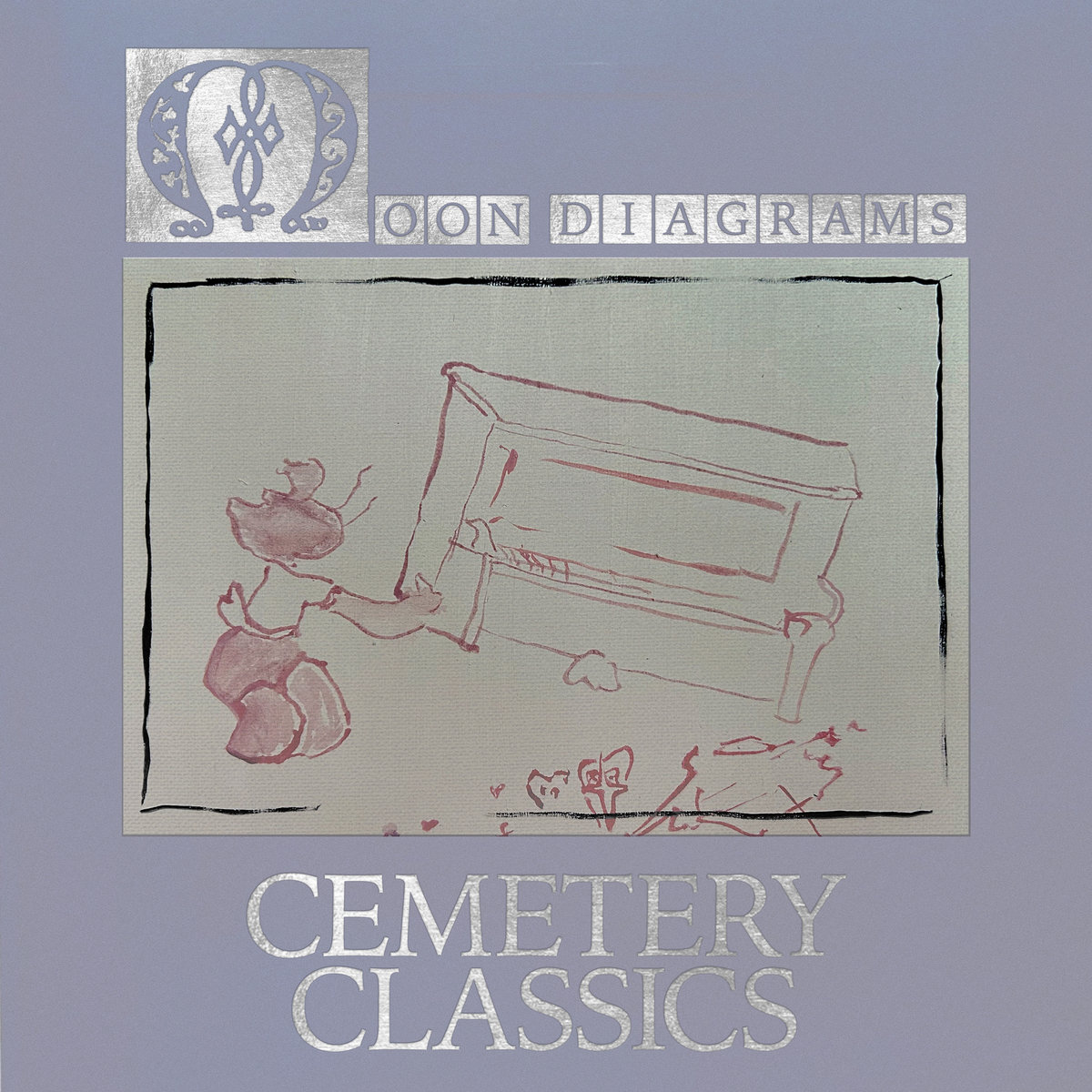
Moon Diagrams is the solo project of Deerhunter drummer Moses Archeluta – and Cemetery Classics is his second release, seven years after the acclaimed Lifetime Of Love, also on Sonic Cathedral.
Intriguingly, Moses’ description of the album is that “It’s about finding out your arms are too short to box with God…the inverse of a desert island disc – a graveyard disc. Songs to take into the afterlife.”
Cemetery Classics features guitar from Josh Diamond (Gang Gang Dance) and Patrick Flegel, along with vocals from Anastasia Coope – and, strikingly, keyboards and drum programming from James Ford.
What’s the music like?
The title may imply a gallows humour, but there is some dead good music here from Archeluta, and as Cemetery Classics progresses it delivers a bunch of excellent grooves and tableaus that vary from dark to uplifting.
On occasion his work resembles that of Andrew Weatherall, especially in the murmured vocals and smoky beat of Brand New Effie. The languid guitar and breezy mood of NRG hints at much sunnier climes, while Big Ref and Fifteen Shows At One time present irresistibly groovy music.
Listen To Me and Fragment Rock are compelling, widescreen grooves with more than a hint of dub, the latter featuring some disorientating brass and boomy, bassy vocals.
Does it all work?
It does. On occasion Archeluta’s work resembles Animal Collective or an outtake from an Adrian Sherwood session, but he can turn his work to so many styles, all of which knit together beautifully here.
Is it recommended?
It is, enthusiastically. One of those albums that impresses on first listen but gets you in a musical and emotional hold in the next few encounters. One of the sleeper albums of the year so far.
For fans of… Animal Collective, Andrew Weatherall, Adrian Sherwood
BBC Scottish Symphony Orchestra / Martyn Brabbins (Birthday Variations); Helsinki Philharmonic Orchestra / Pekka Kuusisto (Symphony)
Various Pictured Within: Birthday Variations for M.C.B. (2019) Jaakko Kuusisto (comp. Pekka Kuusisto & Eskola) Symphony Op.39 (2020-21)
BIS 2747 [66’32”] Producers Andrew Trinick (Variations), Robert Suff (Symphony) Engineers Graeme Taylor (Variations), Enno Mäemets (Symphony) Live recordings, 13 August 2019 at Royal Albert Hall, London (Variations); 8 December 2022 at Music Centre, Helsinki
Reviewed by Richard Whitehouse
What’s the story?
The BIS label issues one of the most fascinating among recent releases, one that juxtaposes a latter-day equivalent to Elgar’s Enigma Variations with a posthumously completed symphony by one of Finland’s leading conductors which now becomes a tribute to his untimely passing.
What’s the music like?
It was clearly a great idea that the BBC commission a piece to mark Martyn Brabbins’s 60th birthday, featuring 14 composers with whom this stylistically most wide-ranging of current British conductors has been associated. The outcome is Pictured Within: Birthday Variations for M.C.B. – each composer having provided a variation on the ‘anonymous’ theme for what here becomes an inverse take on Elgarian procedure in the latter’s Variations on an Original Theme; a work whose ground-plan also furnishes the formal framework of the present piece.
It is worth considering the ways in which these composers seem either inhibited or liberated by their placing (determined beforehand by Brabbins) within the overall scheme. Given this theme – understated to a fault – yields its potential more from the harmonic then melodic or rhythmic angle, the most successful tend to make a virtue of such constraints: thus the ‘Tact 60’ of Variation I finds Dai Fujikura hinting guardedly at ‘C.A.E.’. David Sawer capriciously conjures ‘H.D.S-P.’, while Sally Beamish offers a deftly ironic parallel to ‘R.B.T’ and Colin Matthews rumbustiously complements ‘W.M.B.’ Iris ter Schiphorst captures the pensiveness if not the geniality of ‘R.P.A.’, whereas violist-turned-composer Brett Dean proves a natural fit for the undulating poise of ‘Ysobel’ and Win Henderickx evokes ‘Troyte’ with real gusto.
His ruminative Variation VII finds Richard Blackford emulating more the connection with a country house than ‘W.N.’, while Harrison Birtwistle throws caution to the wind in a darkly inward contrast to ‘Nimrod’, and ‘Sixty Salutations’ finds Judith Weir in an engaging take on the halting charms of ‘Dorabella’. Gavin Bryars rouses himself to unexpected activity in his reading of ‘G.R.S.’, whereas Kalevi Aho is more suited to the sombre eloquence of ‘B.G.N.’ and Anthony Payne ably plumbs the inherent mysteries of ‘***’. John Pickard then takes on the daunting challenge of ‘E.D.U.’ in The Art of Beginning – the mingling of portentousness and humour appearing to make light of its Longfellow association, but whose organ-capped apotheosis confirms real appreciation of the ‘right ending’ as constituting an art unto itself.
The coupling is as unexpected as it proves apposite. Remembered as a notable violinist and a versatile conductor, Jaakko Kuusisto (1974-2022) turned increasingly to composition and, at his untimely death through brain cancer, had planned a symphony for Osmo Vänskä and the Minnesota Orchestra. Acting on behalf of his widow, his younger brother Pekka and copyist Jari Eskola realized this piece from several minutes of extant fragments such that Kuusisto’s Symphony takes its place as the last statement by one who ostensibly had much more to give.
Playing just over 25 minutes, the work falls into two separate movements. Shorter and more outwardly cohesive, the first of these emerges as imperceptibly as it evanesces – taking in a tersely rhythmic central episode, then a warmly expressive melody with more than a hint of American post-Minimalism. Almost twice as long, the Lento seems more discursive but no less absorbing – picking up where its predecessor left off as it builds to impulsive climaxes, separated by an eloquent span derived from a chorale-like theme. Nothing, though, prepares one for the ending – a sequence of quietly interlocking ostinato patterns, evidently inspired by light signals beamed in the Gulf of Finland and underpinned by undulating timpani. The effect is haunting and unworldly but, for these very qualities, wholly fitting as a conclusion.
Does it all work?
Pretty much always. Those expecting an Elgarian ‘re-run’ may be disconcerted by Pictured Within, but this only serves to reinforce the stylistic autonomy and variety of the composers involved (three of whom sadly no longer with us) in what is a tribute to Brabbins’s acumen for involving them in the first instance. Quirky and compelling, the Kuusisto is appreciably more than a labour of love on behalf of those who brought about its completion: both works deserving revival for their intrinsic merits rather than commemorating a particular occasion.
Is it recommended?
Absolutely. These live performances (that of Pictures Within being that of the premiere) have come up well as presented here, while there are detailed notes on each piece by John Pickard and Jaani Länsiö. This fascinating release more than justifies itself musically and artistically.
Rachmaninoff Symphonic Dances Op.45 (1940) Busoni Piano Concerto in C major Op. XXXIX (1902-4)
Benjamin Grosvenor (piano), The Rodolfus Choir (men’s voices), London Philharmonic Choir (men’s voices), London Philharmonic Orchestra / Edward Gardner
Royal Albert Hall, London Monday 5 August 2024
reviewed by Richard Whitehouse Photos (c) Andy Paradise
This centenary of Busoni’s death has not thus far seen a great deal of activity in the UK, so it was gratifying to find the Proms scheduling his most (in)famous work – the Piano Concerto tonight receiving its second performance at these concerts, 36 years to the day after its previous outing.
Back then, the first half featured Beethoven’s Fourth Symphony and a more apposite coupling than Rachmaninoff’s Symphonic Dances. Now firmly ensconced in the orchestral repertoire, it remains a stern test the London Philharmonic Orchestra did not quite meet on this occasion – despite such felicities as Martin Robertson’s eloquent alto sax in the first movement and Edward Gardner’s conjuring of a tangible malevolence in its successor. Impulsive but erratic in its outer sections, the finale’s evocative central span had a superficial quality typical of this performance overall.
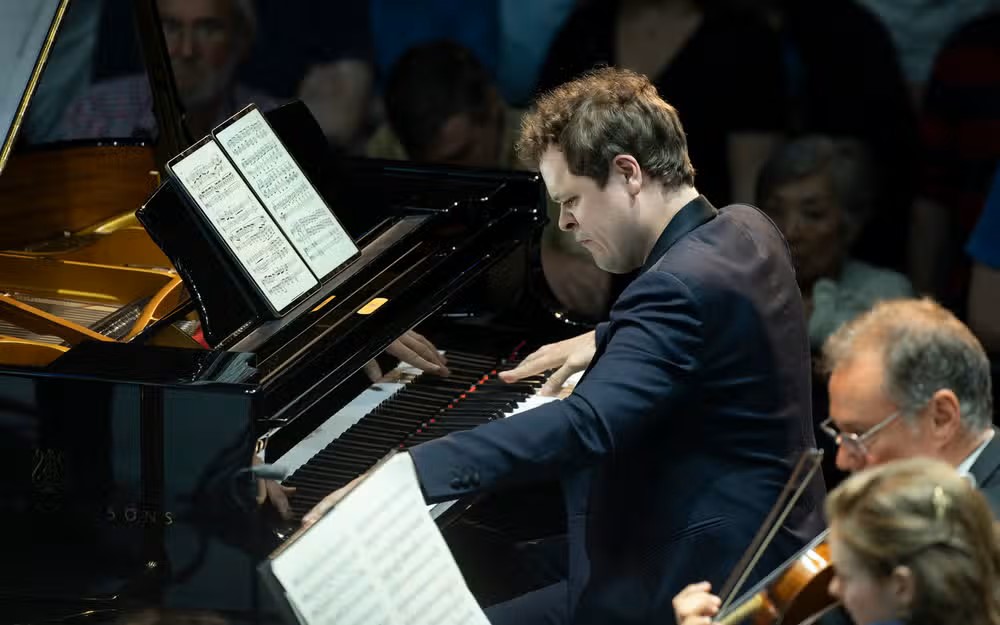
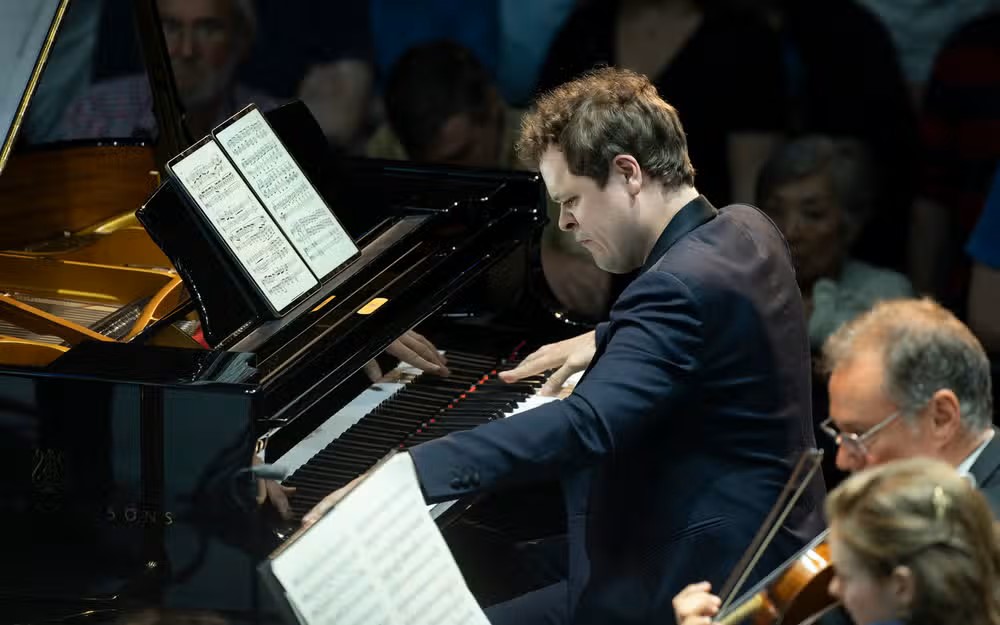
This was not the case in the Busoni. Benjamin Grosvenor (above) might not the first name who comes to mind for this concerto but, having already given performances in Reykjavik and Berlin, he was audibly attuned to an idiom not as elusive as often supposed in its canny amalgam of the Germanic and Italianate, while his playing was fully equal to its technical demands. That he is not a pianist looking to confront the orchestra head on ensured a more than usually close-knit coordination with players and conductor, which was almost always to the benefit of this piece.
Not least in Prologo e Introito, its orchestral introduction enticingly shaded by Gardner with Grosvenor integrating his unequivocal entry into what are essentially variations on the theme at the outset. Few pianists have weighted Busoni’s complex chords or his intricate harmonies with such translucency, not least the end of this movement where piano and orchestra melded to spellbinding effect. Straight into Pezzo giocoso, its capricious outer sections framing one of stealthy ambivalence as perceptively rendered as was that spectral angularity near its close.
Grosvenor managed the rare trick of making Pezzo serioso simultaneously cumulative and cohesive. He duly channelled the slow-burning momentum of its introduction into the rolled chords of its barcarolle-like first part – Gardner sustaining impetus across its successor to an imperious climax, during which the soloist never risked being obliterated. The lead-in to its third part had a poise equal to that at the end, where subtle rhythmic contrasts between piano and timpani against undulating strings had an enfolding calm to diffuse any lingering tension.
A general pause for retuning, then All’italiana burst forth – the underlying tarantella rhythm a springboard for its motley succession of vernacular elements initially humorous and latterly uproarious, held in check by the scintillating give-and-take of soloist and orchestra. Grosvenor almost topped these shenanigans with his electrifying cadenza – after which, Gardner prepared admirably for Cantico in which male voices (above) hymned Allah’s praises with mounting fervour; Grosvenor a largely passive observer until he belatedly returned for the headlong signing-off.
Quite a performance, then, that will hopefully be released commercially. Did Busoni offer an encore at that Berlin premiere? It could not have been more suitable than J.S. Bach’s Prelude in E minor BWV855, transposed and arranged by Alexander Siloti – three minutes of balm bringing us gently down to earth.
Benjamin Grosvenor (piano), The Rodolfus Choir, London Philharmonic Choir, London Philharmonic Orchestra / Edward Gardner
Royal Albert Hall, London Monday 5 August 2024
by Ben Hogwood Photo (c) Andy Paradise
A full review of Prom 23 will follow from Richard Whitehouse, but I wanted to register some thoughts on my first live encounter with one of the most extraordinary piano concertos you could ever hope to hear.
In the last few months pianist Benjamin Grosvenor has taken Ferruccio Busoni’s Piano Concerto on something of a concert tour, and has written of his love and admiration for the piece in a Guardian article, which proves a helpful guide for anyone not fully attuned to the piece.
The centenary of Busoni’s death falls this year, hence the first appearance of this piece at the Proms in 36 years, since a memorable occasion when Peter Donohoe squared up to the solo part in the company of the BBC Symphony Orchestra and Mark Elder. Oh, and the BBC Singers – for this work, unbelievably, has a male chorus in the finale, singing “Lift up your hearts to the Power Eternal”, a hymn to Allah from Adam Oehlenschläger’s Aladdin. Busoni’s quote in the score at this point is that “The Pillars of Rock begin to make soft and gentle music.”
Yet even before we got to that fifth movement the extraordinary power and individuality of Busoni’s music was shining through. The London Philharmonic Orchestra under Edward Gardner had a big part to play here, setting the scene in the Prologo e introito as though we were standing in a cathedral, awestruck at the architecture but still taking in a new sight with each about turn.
Grosvenor’s interpretation of his part was balletic, and the music really danced – swooping down from the heights or bubbling up from the depths, the pianist finding remarkable clarity in even the most complex passagework. Busoni, a formidable concert pianist himself, really tests his soloist, but retains a well-judged balance between piano and orchestra. Grosvenor and Gardner somehow found this equilibrium in the notoriously tricky acoustics of the Royal Albert Hall, where from the arena you could hear the clear communication of Busoni’s ideas. The orchestra were superb here – percussion ideally balanced, strings and wind interacting with the piano cleanly and the brass sensitively placing their chorale interventions. The clarinet and viola solos in the second movement had all the room they needed, while the orchestral colour that appears so unexpectedly and vividly in this work was richly shaded.
And what of the piece itself? In many ways it was like listening to a progressive rock album from the 1970s, which in itself is extraordinary when you think the Piano Concerto was completed in 1904. The sheer scope of Busoni’s imagination knew no bounds, then – taking on board more obvious influences from Bach, Beethoven, Chopin and Liszt, while using harmonic techniques to remind us that we were now in the age of Sibelius, Elgar and even Schoenberg.
The fourth movement was perhaps the most remarkable in this performance. With the gargantuan third completed, a kind of meditation in four parts, Busoni summons even greater invention for a Tarantella of remarkable energy, the solo part whirling round in a circle and brilliantly played here by Grosvenor. Just as it seemed all possibilities had been exhausted, the appearance of the male chorus was a masterstroke, their sonorous tones floating above much of the audience in the Royal Albert Hall. They leant a whole new dimension to the work, meaning that even those who might have been struggling 55 minutes into a piece found the new impetus and energy in Busoni’s exultation.
If you have not yet encountered this extraordinary piece I encourage you to without delay – but don’t stop there, for Busoni’s solo piano output, while very different, has many riches to impart in a fraction of the time. First, though, you have to try the Piano Concerto. It will knock your socks off!
You can listen to this concert on BBC Sounds – with the Busoni Piano Concerto beginning at 1:03:55. For more on this year’s festival, visit the BBC Proms website
In the last few days we have heard of the sad news of the death of cellist Antonio Meneses at the age of 66. There is a fitting tribute to Meneses in an obituary by The Strad magazine, but we wanted to pay tribute in the form of a playlist of some of his finest recordings.
The sequence, which you can listen to below, includes solo Bach – the Solo Cello Suite no.1 – followed by Brahms‘s Cello Sonata no.1 and the MendelssohnSong without Words Op.109, with pianist Gérard Wyss. Meneses made some very fine recordings for the AVIE label, of which Gaspar Cassadó‘s Solo Cello Suite was one – and this is followed by a short illustration of his time as cellist in the Beaux Arts Trio, a lovely movement from Dvořák‘s Dumky Trio.
Finally we get to hear Meneses in the orchestral arena, with a recent recording made for Naxos of the Villa-Lobos Fantasia for cello and orchestra, and one of his most famous recordings, the Brahms Double Concerto with Anne-Sophie Mutter and the Berliner Philharmoniker under Herbert von Karajan:






 Arcana.fm