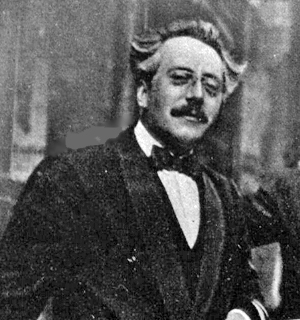
The gentleman in the fuzzy image above, Frank Bridge, died on this day in 1941. The importance of Bridge to English music continues to be underestimated, as indeed does his originality as a composer.
Bridge exerted a keen influence on his pupil, the young Benjamin Britten, but pushed his own music to the edge of tonality without losing its appeal. Compositions that are testament to his ability include Oration, for cello and orchestra, the pictorial orchestral works The Sea, Enter Spring, Summer and There is a willow grows aslant a brook, four string quartets and two piano trios.
Yet the piece I wanted to highlight today comes from earlier in his career, a winsome trio of Idylls for string quartet completed in 1906. The second provided Britten with a theme for his Variations on a theme of Frank Bridge some three decades later. If you listen to all three you get a strong dose of English charm, wit and romantic yearning, along with a little mystery. You can listen to these wonderful pieces below, played by the Maggini Quartet:
Published post no.2,763 – Saturday 10 January 2026
aJoyful Company of Singers; bAscolta / Peter Broadbent; cFinchley Children’s Music Group / Grace Rossiter with dChristine Hankin (flute); eImogen Barford (harp); fGavin Roberts, gJohn Evanson (pianos)
Havergal Brian Shall I compare thee to a summer’s day? (1903)a Soul Star (1906)a Come o’er the sea (1907)a Lullaby of an Infant Chief (1906)a Ah! County Guy (1919)cg Violets (1914)b Fair Pledges of a Fruitful Tree (1919)cg Grace for a Child (1914)cg A Song of Willow (1914)bf And will he not come again? (1914)bf Ye spotted snakes (1914)bf Fear no more the heat of the sun (1919)bf Under the greenwood tree (1919)bf Full fathom five (1921)bf Come away, death (1925)af The Blossom (1914)cg The Fly (1914)cg The Little Boy Lost (1914)cg The Little Boy Found (1914)cg Piping down the Valleys Wild (1914)cg The Chimney Sweeper (1914)bf The Little Black Boy (1914)bf Four Choral Songs from Prometheus Unbound (1937-44): From Unremembered Agesa; The Patha; There the Voluptuous Nightingalesade; There those Enchanted Eddiesa Spring – sound the flute (1914)cg Summer has come, Little Children (1914)cg Goodbye to Summer (1914)cg Blow, Blow thou Winter Wind (1925)a
Toccata Classics TOCC0395 [70’59’’] English texts included Producer Michael Ponder Engineer Adaq Khan Recorded a11 & 12 December 2021, c12 &13 March 2022 at St Jude on the Hill, Hampstead Garden Suburb, London; b26 November 2022 at St Silas, Kentish Town, London
Reviewed by Richard Whitehouse
What’s the story?
Toccata Classics releases this first in a two-volume survey of Havergal Brian’s choral songs, a versatile medium to which he contributed several dozen items and through which he first established his reputation, before effectively abandoning the medium a quarter-century later.
What’s the music like?
Although best known for his 32 symphonies, solo songs and choral songs dominate Brian’s earlier output. The latter have not fared well in recorded terms – two (the first and last here) being included on an LP from the Stoke-on-Trent Bedford Singers in 1982 (SAIN TRF239), who recorded a larger selection three years on for the Altarus label which only found limited release on cassette in 1991 (British Music Society Environs ENV016). This Toccata album is hence a timely redress for some of Brian’s most attractive and immediately appealing music.
The choral songs fall into three categories. The first consists of part-songs written mainly for the many choral societies from the Midlands and North in the earlier 20th century – reflected in a textural intricacy and harmonic richness which, between them, provide as stern a test of intonation as expected given their provenance in the competitions held regularly at this time. Shakespeare is especially prominent, as too is Robert Herrick, with the translucency of those settings from the 1900s in contrast to the astringency of those following the First World War.
The second category consists of songs, mostly for upper voices and often in unison, written for school or youth choirs. Many date from 1914 when Brian, having left Stoke for London after the collapse of his first marriage, was in financial straits yet their swift turnaround does not make them of lesser quality. William Blake is the main author, tackled with an emotional acuity and technical poise matched by few subsequent composers, while the poignant setting of Gerald Cumberland likely derives from a children’s operetta abandoned around this time.
The third category consists of four semi-choruses taken from a vast setting of Percy Shelley’s lyrical drama Prometheus Unbound (or at least the first two acts) Brian wrote largely during the Second World War. Its full score is long missing, but the vocal score gives due indication of its underlying ambition and overall technical difficulty not least for the chorus. That said, the three unaccompanied items confirm such demands as integral to the musical conception, while the fourth (track 25) features contributions from flute and harp of diaphanous elegance.
Does it all work?
Indeed it does, both in the technical sophistication of part-songs featuring Joyful Company of Singers or the disarming naivety of unison-songs with Finchley Children’s Music Group; directed with assurance by Peter Broadbent or Grace Rossiter, with Gavin Roberts and John Evanson equally adept in their very different piano writing. Moreover, the track sequencing affords a pleasurable listen on its own terms through emphasizing the consistency of Brian’s response to texts which, in themselves, amount to an ‘unofficial’ anthology of English verse.
Is it recommended?
Very much so, not least given the excellent sound with John Pickard contributing a typically authoritative booklet note. Maybe he might yet be persuaded to oversee a re-orchestration of Prometheus Unbound? In the meantime, the second volume of this survey is keenly awaited.
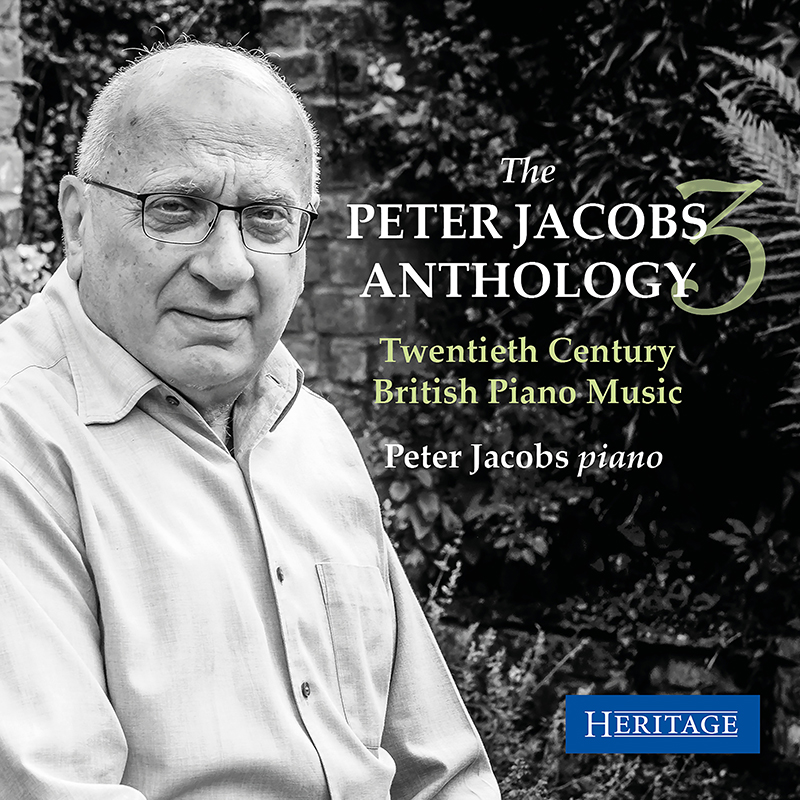
Allum Nocturne in C sharp minor; Prelude No. 24 in D minor (both c.1950) Bantock (arr. composer) Omar Khayam (1906-09) – Prelude and March Fenney Au Printemps (pub. 1915) MacDonald Waste of Seas (1976) Purcell arr. Stevenson The Queen’s Dollour (pub. 1710, arr. 1958) Simpson Variations and Finale on a Theme of Haydn (1948) Truscott Prelude and Fugue in E flat minor; Prelude and Fugue in C major (1957)
Heritage Records HTGCD127 (67’25”) Recorded live at London College of Music, April 1979
Reviewed by Richard Whitehouse
What’s the story?
Heritage continues adds to its extensive Peter Jacobs discography with this recital focussing on music by British composers mainly of the early and mid-twentieth century, each rendered with that combination of fluency and insight which this pianist brings to all his performances.
What’s the music like?
According to his booklet note, Jacobs gave this recital at an Annual General Meeting for the Havergal Brian Society in 1979, though the present writer remembers a pretty much identical programme being given at this event in 1982. The seeming unavailability of works by Brian (Four Miniatures then Prelude and Fugue in C minor) played on this occasion is regrettable, but these are easily available elsewhere while the recital’s purpose in drawing together music by various of Brian’s contemporaries, colleagues or advocates remains essentially unchanged.
Granville Bantock’s choral epic Omar Khayam has numerous excerpts worthy of autonomous status – not least its evocative Prelude and quizzical March. Apparently written in a weekend, Harold Truscott’s brace of Preludes and Fugues – that in E flat minor as methodical as that in C is impetuous – makes one regret he did not attempt a complete cycle. An amateur composer in the most professional sense, Walter Allum’s piano music wears its indebtedness to Chopin but deftly – witness his intricately designed Nocturne or Prelude in D minor which brings to a vividly decisive end a cycle likely worth hearing in its entirety. William J. Fenney enjoyed a modest reputation just after the First World War with Au Printemps (also known as ‘In Early Spring’) a trilogy the more affecting in its emotional restraint – ‘light’ music but never facile.
Forward to what was then the present, Malcolm MacDonald’s Waste of Seas (also known as Hebridean Prelude) sustaining a plangent atmosphere and of a pianistic resourcefulness to suggest his modest output as worth further investigation. A relatively early work, Variations and Finale on a Theme of Haydn has Robert Simpson drawing a wide but integrated range of moods from the innocuous Minuet of Haydn’s 47th Symphony (its palindromic aspect more intensively mined in Simpson’s Ninth Quartet), prior to an extended final section more akin to the iconoclastic fugal writing in late Beethoven. Such exhilaration needs a brief touchdown such as Jacobs supplies in Ronald Stevenson’s lucid take on one of Purcell’s most poignant inspirations; a reminder the former is often at his most creative in the realm of transcription.
Does it all work?
Indeed so, not least when those pieces by Bantock, Allum, Fenney and MacDonald have yet to receive commercial recordings. Jacobs himself has recorded the Truscott (Heritage) while there are studio accounts of the Simpson by Raymond Clarke (Hyperion) and of the Purcell/ Stevenson transcription from Murray McLachlan (Divine Art) or Christopher Guild (Toccata Classics). To hear these works in close proximity and so perceptively realized is, of course, its own justification and no one interested in this music need hesitate to acquire this release.
Is it recommended? Very much so. Whatever its provenance, the recording sounds entirely satisfactory thanks to Heritage’s expert remastering and one only hopes further such releases from Peter Jacobs’s doubtless extensive archive will be possible. This latest anthology is warmly recommended.
As the new Craven Faults album Sidings nears release, The Leaf Label have teased another of its eight tracks. Yard Loup is much shorter than the previous single Far Closes, but gives an indication of the sonic world in which the producer is operating.
What’s the music like?
Picturesque – in that it paints many images in the mind’s eye. Craven Faults has a way of working that combines long drone phrases and quicker, less defined movements, in this case a gently shimmering treble. In this case the image conjured up is a wintry, watery scene.
Does it all work…and is it recommended?
It does, though I suspect it will work a lot better in the context of the album. It certainly whets the appetite.
Listen & Buy
You can listen to the two tracks from Sidings below:
Published post no.2,760 – Wednesday 7 January 2026
This is the second single from Nathan Fake‘s forthcoming album Evaporator, due for release on 20 February on InFiné. Although called Slow Yamaha, it features a musical depiction of evaporation at the end.
What’s the music like?
Hypnotic, and ultimately compelling. The start is deceptive, with a minimal approach but gradually the track develops and the horizons start to shimmer, with lovely warm synthesizers starting to dominate.
Big blocks of sound surround the listener, so that when the music disappears in a puff of air at the end the effect is similar to the sensation of taking off.




 Arcana.fm