

In concert – Cédric Tiberghien, CBSO / Eduardo Strausser: Beethoven ‘Emperor’ Concerto & Prokofiev Symphony no.5

Wagner Lohengrin – Prelude to Act One (1846)
Beethoven Piano Concerto no.5 in E flat major Op. 73 ‘Emperor’ (1809)
Prokofiev Symphony no.5 in B flat major Op. 100 (1944)

Cédric Tiberghien (piano), City of Birmingham Symphony Orchestra / Eduardo Strausser

Symphony Hall, Birmingham
Wednesday 25 January 2023 2.15pm

Reviewed by Richard Whitehouse Picture of Eduardo Strausser (c) Peter Wallis

Is there a more evocative way to begin a concert than the Prelude to Wagner’s Lohengrin? The opera itself may fail (for the most part) to live up to the precedent set, but the quality of this piece has never been in doubt – with composers as distinct as Berlioz and Verdi having been captivated by its almost tangible atmosphere and counterpoint redolent of Palestrina in its supple inevitability. Under the assured direction of Eduardo Strausser, it made a fitting curtain-raiser to this afternoon’s concert by the City of Birmingham Symphony Orchestra.

It also provided a telling foil to Beethoven’s Fifth Piano Concerto that followed in the first half. Still the most popular of its composer’s such pieces, it is also nowadays the hardest to bring off – particularly the initial Allegro with its unabashed emotional rhetoric and overtly symphonic conception. Playing down the former aspect and rationalizing the latter, Cédric Tiberghien opted for a tensile and unaffected traversal which emphasized cohesion at the expense of grandeur – underlining just why Beethoven never again completed a concerto.

There was little to fault in Tiberghien’s take on the Adagio (save for a few errors to remind one that Beethoven’s slower music is by no means easier to play), and if the transition into the finale was less than spellbinding, that latter movement for the most part brought out the best in the rapport between pianist and conductor. The CBSO responded with the necessary rhythmic agility, and Tiberghien responded to the applause with excerpts from the Eroica Variations he has recently recorded as part of an edition of Beethoven’s works in this genre.

The engaging director of last year’s Viennese New Year concert, Strausser (above) clearly enjoys a rapport with this orchestra as was a hallmark of Prokofiev’s Fifth Symphony following the interval. Itself the most often heard of a diverse and often diffuse cycle (the ‘Classical’ more often encountered on recording than in concert), it presents notable difficulties of balance and pacing – notably the initial Andante, whose accumulating momentum needs careful handling so as not to congeal. Strausser duly had its measure, maintaining focus through to a seismic peroration – the impact from which carried over into a scherzo whose outer sections seemed more than unusually acerbic. Nor did this preclude a more genial response in the trio, its main theme held over from Romeo and Juliet and as captivating a melody as any by this composer.

That the Adagio is the emotional heart of this work only increases the need to prevent it from dragging, and Strausser’s sense of proportion ensured that the sense of dread made explicit at its climax was balanced by the serene eloquence towards its close. Heading (rightly) straight into finale, he steered a secure course through a movement whose poise is constantly being undercut by disruptive elements as take control in the coda – the composer’s perspective on imminent Soviet victory in the ‘Great Patriotic War’ remaining ambivalent even at the close.

A fine reading of a work whose stature is still questioned (and a reminder that Prokofiev’s Second Symphony still awaits its CBSO debut). Chief Conductor-designate Kazuki Yamada returns next week for an unlikely though appealing double-bill of Tchaikovsky and Holst.

You can read all about the 2022/23 season and book tickets at the CBSO website – and head to this page for the Tchaikovsky and Holst programme. Click on the artist names for more on Eduardo Strausser and Cédric Tiberghien
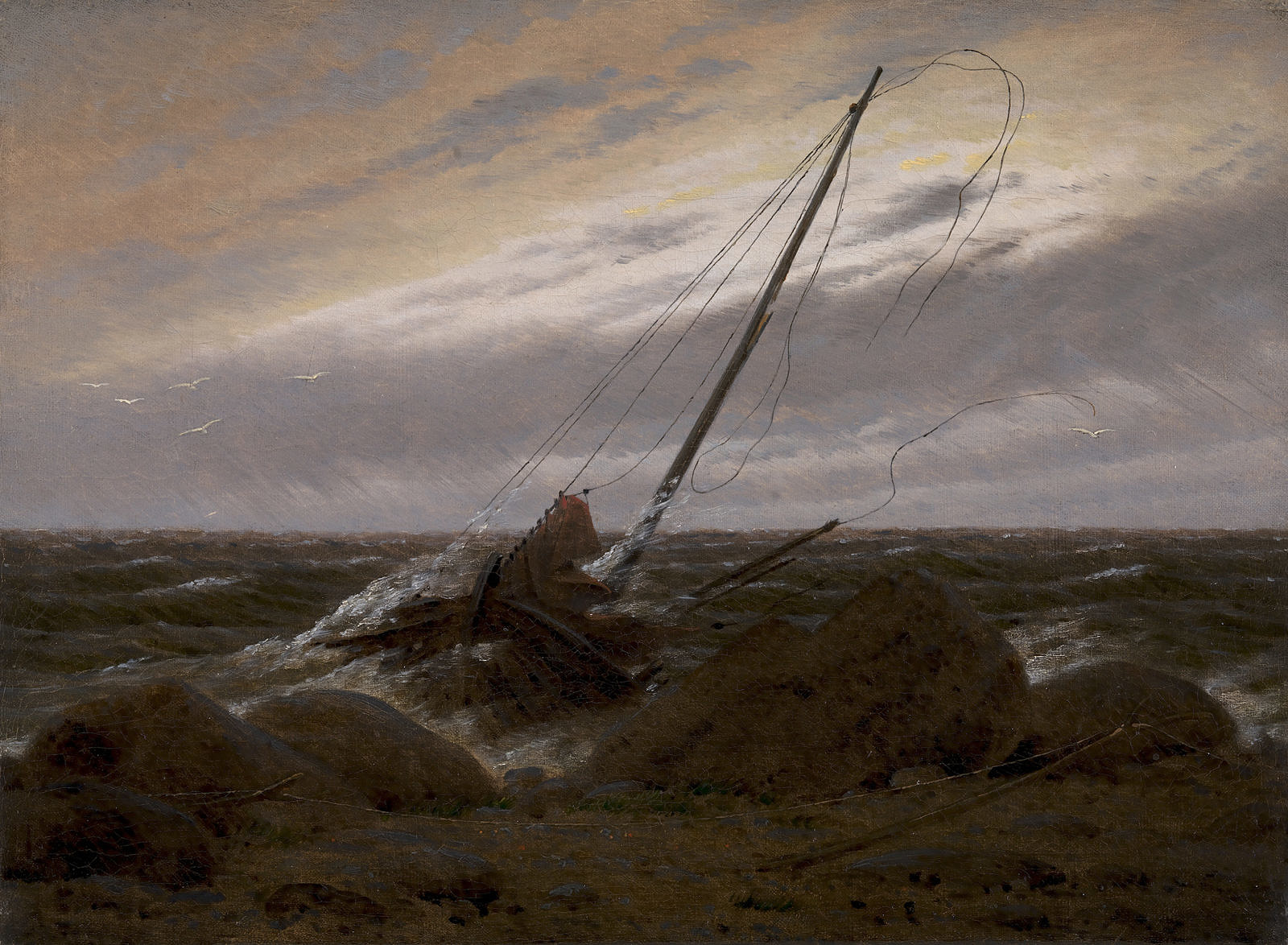
Listening to Beethoven #216 – Piano Sonata no.23 in F minor Op.57 ‘Appassionata’

After the Storm by Caspar David Friedrich (1817)

Piano Sonata no.23 in F minor Op.57 ‘Appassionata’ for piano (1804-5, Beethoven aged 34)

1. Allegro assai
2. Andante con moto
3. Allegro ma non troppo – Presto

Dedication Count Franz von Brunswick

Duration 23″

Listen

written by Ben Hogwood

Background and Critical Reception

Even within Beethoven’s output, the Appassionata sonata is seen as a landmark. As Angela Hewitt writes in the booklet note for her recording of the work on Hyperion, it is a central part of Beethoven’s ‘heroic’ period, sat in publication order between the Eroica symphony and the Piano Concerto no.4, and at a time where Beethoven was taking risks.

Beethoven’s fellow composer and friend Ferdinand Ries recorded how he watched Beethoven at work in Baden. The two composers went for a walk, where Ries described a striking melody on the shawm – which Beethoven could not hear because of his rapidly advancing deafness. It turned out that he was preoccupied in any case, for on their return he immediately went to the keyboard, and played through the newly composed finale of the new sonata, Ries recounting a performance of ‘irresistible fire and mighty force’.

Writing in The Beethoven Companion, Harold Truscott asserts that ‘technically, apart from one or two passages, the work is not difficult to play…yet can still sound very brilliant. Its real difficulty, however, is control of its varied elements and of the great expressive power which is their sum.’

Angela Hewitt notes Beethoven’s holding back of this power until the finale – an increasingly notable feature of his writing. As Jan Swafford writes, ‘Beethoven had an incomparable skill for raising a movement to what seems an unsurpassable peak of excitement or tension, then to surpass it.’

Thoughts

In the Appassionata the risk taking can be seen everywhere you turn. It can be found in the work’s opening phrase, going down to the low ‘F’ exploiting the bigger range of Beethoven’s new Erard piano. It can be found in the stormy middle section of the first movement and the whirlwind figurations of the last, where the right hand is playing so fast it threatens to go off the end! It can also be found in the structural design, Beethoven writing a slow movement that acts initially as an equivalent to the hymnal slow movement in the Pathetique sonata, but ends up as a bridge to the finale. The consolation it was beginning to provide is wholly lost.

Its opening three notes give an immediate idea of the gravitas of the piece. They may be the notes of the F minor triad but they carry great weight – as Beethoven’s works in this key were wont to do. The first movement is compelling, the main theme littered with interruptions as though a battle is being waged between war and peace. The latter breaks out in the second movement, the hymnal motive both simple and moving, but soon gathering momentum as Beethoven finds he cannot stand still.

All is headed for a last movement of formidable power, unlike anything we have heard on the piano so far. The torrent of notes fly in the face of Truscott’s assertion that the piece is not difficult to play – but the language for the listener is unremitting and straightforward. At the end the Appassionata sets its listener down in a heap, all emotion spent.

Recordings used and Spotify links

Alfred Brendel (Philips)
András Schiff (ECM)
Angela Hewitt (Hyperion)
Paul Badura-Skoda (Arcana)
Stephen Kovacevich (EMI)
Igor Levit (Sony Classical)
Claudio Arrau (Philips)
Daniel Barenboim (Deutsche Grammophon)

There are some towering interpretations of Beethoven’s masterpiece in this playlist, not least those by Emil Gilels, Claudio Arrau and Alfred Brendel. Andras Schiff and Angela Hewitt are also very fine. Paul Badura-Skoda secures authentic drama from his Broadwood piano, dating from a mere decade after the piece was written.

You can hear clips of Angela Hewitt’s recording at the Hyperion website

You can chart the Arcana Beethoven playlist as it grows, with one recommended version of each piece we listen to. Catch up here!

Also written in 1805 Cherubini Faniska

Next up tbc!

On Record – James Yorkston, Nina Persson & The Second Hand Orchestra: The Great White Sea Eagle

by Ben Hogwood

What’s the story?

James Yorkston had no plans for a sequel to his 2021 album with The Second Hand Orchestra – but on writing new songs on his piano, and sharing them with the orchestra’s leader Karl-Jonas Winqvist, they realised the opportunity was ripe for a guest singer to enhance the music – and Winqvist suggested The Cardigans’ singer Nina Persson.

The pairing operated in relatively relaxed conditions, with no overriding concept other than the wish to sing a collection of folk-based songs. The orchestral parts are fresh, semi-improvised by the players on the day of recording.

What’s the music like?

This is a joyous collaboration, one that finds the singers and musicians finishing each other’s sentences as though they have been working together all their lives.

Both Yorkston and Persson are natural storytellers, and from Nina’s first verse on Sam and Jeanie McGreagor, the listener hangs on each tale and musical nuance. As the album progresses we get to know their vulnerable sides, but also some touches of light humour, the two singers bouncing off each other’s musical qualities. Try Mary and you will see how well their voices are matched.

There are singalong refrains in a lot of the songs, with the communal Peter Paulo Van Der Heyden a favourite, and in Keeping Up With The Grandchildren an extended guitar soliloquy to complement the vulnerable vocals. Most of the songs have the sort of childlike simplicity you might associate with folk music at its most raw, but the arrangements can propel these through unexpectedly complex forms, as they do in The Heavy Lyric Police.

As for The Second Hand Orchestra, their fresh contributions are beautifully delivered – notably the violin in An Upturned Crab, and Karl-Jonas Winqvist ensures total respect for the lyrical material throughout, moving from a single, plaintive instrument to the full force of an orchestra rich with woodwind colour.

“This is the time”, they sing on the winsome Hold Out For Love – the most wonderful, singalong moment, where everything is suddenly right with the world.

Does it all work?

Yes – mostly because the collaboration is so unforced, and the music making relaxed. That shouldn’t, however, be mistaken for complacency, for both singers deliver deeply felt songs, their voices ideally matched. The orchestrations are beautiful and consistently rewarding.

Is it recommended?

It is – an ideal match of musicians from the northern territories, doing what they do best – and clearly enjoying it immensely.

Listen

Buy

In concert: Steven Isserlis, Orchestra of the Age of Enlightenment / Maxim Emelyanychev – Saint-Saëns Cello Concerto no.1 & ‘Organ’ Symphony

Saint-Saëns
Phaéton Op.39 (1873)
Cello Concerto no.1 in A minor Op.33 (1873)
Danse macabre Op.40 (1874)
Symphony no.3 in C minor Op.78 ‘Organ’ (1885-6)

Steven Isserlis (cello, below), Matthew Truscott (violin), Orchestra of the Age of Enlightenment / Maxim Emelyanychev (above)

Royal Festival Hall, London
Thursday 26 January 2023

Reviewed by Ben Hogwood Steven Isserlis picture (c) Satoshi Aoyagi

Top marks to the planning team of the Orchestra of the Age of Enlightenment, for scheduling a night of Saint-Saëns in January! They chose a rousing quartet of works as part of the orchestra’s Sounds For The End Of A Century series, in what may have been a first live encounter for the orchestra with the French composer’s music.

They were matched with a suitably dynamic conductor, Maxim Emelyanychev throwing heart and soul into the music as we explored numerous links between Saint-Saëns and Liszt. This was done through a pair of symphonic dramas, one to open each half, the Cello Concerto no.1 and the Symphony no.3, the Organ, dedicated to Liszt himself.

The first drama told the story of Phaéton. Drawn from Greek mythology, it tells how the child of sun god Helios drives his chariot recklessly across the sky – from which he is felled by Jupiter’s lightning bolt. The action was thrillingly conveyed here, the vehicle veering wildly from the start in the quickfire violin lines. The warm second theme offered a little respite but all too quickly the thunderbolt arrived, delivered with maximum drama by three timpanists, Adrian Bending, Florie Fazio and Tom Hunter.

The second drama was Danse macabre, originally a song but now a seasoned favourite in its orchestral guise. The devilish solo violin role was taken up by orchestra leader Matthew Truscott with some relish, playing with vigour from his position just behind the woodwind. Emelyanychev’s pacing was ideal, and while the dance initially felt a little soft it transpired he had been saving the full fury of the orchestra for the final rendering of the theme, unleashed in a thoroughly satisfying blast.

Steven Isserlis joined the notably reduced orchestral forces for the Cello Concerto no.1, another popular piece full of melody and incident. Isserlis has championed the music of Saint-Saëns throughout his career, and this performance found him in his element, lovingly attending to the tender second theme of the first movement and the opulent Allegretto, while fully opening up to the virtuoso demands of the outer sections. Dialogue with the orchestra was brisk and full of smiles, while the structure of the concerto – a single movement in line with the piano concertos of Liszt – was expertly handled in league with Emelyanychev.

As a thoughtful encore Isserlis marked what would have been the 78th birthday of Jacqueline du Pré, choosing the most appropriate encore – The Swan from Saint-Saëns Carnival of the Animals. Accompanied by Emelyanychev on the orchestra piano, the cellist gave a serene yet searching account.

Finally we had the rare chance to hear the Organ Symphony in period instrument guise, with a blast from the Royal Festival Hall organ and James McVinnie. While the third is by some distance Saint-Saëns’ most popular symphony, it should be noted that a concert of either the fine Symphony no.2 or the work titled Urbs Roma would not go amiss before too long.

Here, however, was a piece written in dedication to Liszt at the surprising invitation from the Royal Philharmonic Society, and premiered at the long-demolished St James’s Hall near Piccadilly in London. It is easy to forget just how original a piece this is, with a large orchestra including not just organ but a piano (with two pianists), two harps and more. There is also an impressive resourcefulness on the part of the composer with his thematic material, which Emelyanychev took the chance to illustrate throughout.

The nervy first movement harked back to the motion of Phaéton’s chariot, albeit now riddled with anxiety, its syncopated nature leaving room for doubt. Consolation was on hand in the form of the substantial section marked Poco adagio, a noble utterance whose poise unexpectedly anticipates Elgar in style. The entrance of the organist here was expertly handled by McVinnie, whose familiarity with the Royal Festival Hall instrument enabled him to achieve an ideal balance with the orchestra. He did this through some wholly rewarding registration choices.

As a consequence the slow movement was deeply emotional, its quiet moments accentuated by Emelyanychev and the soft strings, played with little vibrato. The hurried Scherzo was a vivid contrast to this, and brilliantly played, before the doors were flung open for the famous finale.

McVinnie led with authority, securing a lovely, grainy sound from his instrument for the thunderous C major chord at the start. The two pianists, playing what seemed to be a modern instrument, caressed the upper reaches of the texture with delicate arpeggios. Emelyanychev steered clear of sentimentality in his interpretation, a move which actually heightened the impact of the piece and carried us to a thrilling conclusion.

A blast of C major to see January into the long grass was most welcome – what more could a concert goer want?!

You can read all about the 2022/23 season and book tickets at the Orchestra of the Age of Enlightenment website.

Switched On – numün: Book Of Beyond (Shimmy-Disc)

by Ben Hogwood

What’s the story?

numün have a rich musical pedigree. The trio are based in New York, and comprise Gamelan Dharma Swara‘s Joel Mellin and Christopher Romero and Bob Holmes of SUSS. Their first album in 2020, Voyage au Soleil, received wide acclaim for its marriage of a wide range of ambient musical forms.

The new record builds on the explorations made by Voyage au Soleil. Produced by Kramer, it includes a fusion of Eastern and Western musical stylings and instrumentation, listed on the press release to include Balinese gamelan, gender wayang, and cumbuz (a 12-string fretless banjo). These exist alongside the country and folk music-based instruments of slide guitar, baritone, mandolin and violin.

Adding to the musical pot are guest appearances from members of Brooklyn Raga Massive, Dharma Swara and Black Sea Hotel.

What’s the music like?

Trippy, in a good way!

Beyond sets out the colourful stall, with shimmering textures and pitches fluttering in harmony above the drone note. The open strings of the violin help present a rustic, outdoor picture. The following Steps picks up an easy, walking pace rhythm, led by guitar, and this same pace transfers to the lazy thrum of a mandolin for Sideways. Around the main melodic parts there are other hazy instrumental lines, complementing the rhythm while maintaining a heady atmosphere.

The use of bells on Eyes Open creates a richly coloured dream sequence which is sustained through Vespers, though here the colour comes from guitars and drones. The woozy Voices is like an aural mirage, shapes dancing on the horizon, while Lighter is led by softer flute tones. Arguably the most evocative track of all is left until last, the lower register of the violin providing velvety cushion as the lead for Lullaby.

Does it all work?

Yes – as a colourful musical backdrop rewarding different levels of Immersion on the part of the listener.

Is it recommended?

It is. Book Of Beyond staves off the winter chills with music of an appealing warmth, creating exotic pictures as it does so.

Listen

Spotify link tbc

Buy