Switched On – Blanck Mass: The Rig (Original Series Soundtrack) (Invada)

by Ben Hogwood

What’s the story?

This is the first TV soundtrack by Benjamin Power, aka Blanck Mass – a surprising state of affairs, given Power’s prolific output as a composer. It would seem he has been biding his time, for as part of the duo Fuck Buttons he released three albums, as well as providing a good deal of music for the opening ceremony of the Olympic Games in London 2012.

Since then he has turned to solo work as Blanck Mass, building a reputation for electronic music of unusual and uncompromising power, with a further five albums under his belt. The Rig is heading up Amazon Prime’s selection of January viewing, a six-part season with a stellar cast directed by Line of Duty stalwart John Strickland. In it, the crew of a North Sea oil rig encounter unseen forces that cut them off from the mainland, with far reaching consequences for their environment and the crew on board.

What’s the music like?

As with all the best soundtracks, Power’s response is one that vividly captures the environment. The weighty main theme is ideally pitched, punching through with concrete-heavy beats that capture the industry, the majestic yet brutal outlines of the right.

The early numbers draw the listener in, setting the scene as the main characters are revealed and established, and conveying the mysterious circumstances the crew find themselves in. Inevitably some of these sketches are short, and work best in the context of the full album, but the disorientation of both personnel and environment proves unnerving for the listener too.

At the same time the ongoing industrial processes are reflected in the clattering percussion (Flesh Meets Floor), the dripping pipes, the echoing chambers and the misty outlines of the vast structure. The unseen menace of the sea is there, too. Sometimes we fall back to companionship, often laced with uncertainty (Ghost), while key scenes such as Helideck build momentum. Power responds to the scenes in kind, moving between the claustrophobic corridors and dimly lit offices of the rig to the vast open reaches of the North Sea.

There are some striking moments. No Fore Without Flare captures the drama of that particular sequence, while We’ll Bring Him In is loaded with emotion. Charlie sends out wails of anguish, realised fully in the extended portrayal of The Wave. This is where the bottom drops out of the music, Power using subtle but striking pitch variations to maximise the discomfort. The story ends in relative comfort but the lasting dread remains.

Does it all work?

Yes. Inevitably there are descriptive elements to the score that are short and undeveloped, but when listened to as a whole the music for The Rig contains a great deal of substance. Power paints a vivid picture of the surroundings without ever resorting to cliché, and there are moments of keen emotion as the characters take over.

Is it recommended?

Wholeheartedly. His previous albums as Blanck Mass suggested Benjamin Power would take to the small screen like a duck to water – and The Rig is proof positive that he has.

Listen

Buy

In concert – CBSO / Gergely Madaras: Mahler Symphony no.1

Mahler Blumine (1884)
Larcher Symphony no.3 ‘A Line above the Sky’ (2018-19) [CBSO Centenary Commission: UK Premiere]
Mahler Symphony no.1 in D major (1887-88. rev. 1898)

City of Birmingham Symphony Orchestra / Gergely Madaras

Symphony Hall, Birmingham
Thursday 12 January 2023

Reviewed by Richard Whitehouse Pictures below (c) Hannah Fathers

Following on its customary Viennese New Year concert, the City of Birmingham Symphony Orchestra continued 2023 with this coupling of Austrian symphonies – Mahler’s first such effort being juxtaposed with one of the most substantial among the orchestra’s Centenary Commissions.

Chamber and vocal pieces having established his name, Thomas Larcher has since tackled the symphonic genre with a vengeance – his Third Symphony, inspired by the ultimately tragic exploits of mountaineer Tom Ballard, considering notions of the elevated and sublime across two (more or less) continuous movements as articulated by an orchestra awash with untuned percussion plus an arresting ‘keyboard’ section of piano, celesta, cimbalom and accordion. The timbral and textural range was accordingly wide, though the tendency to veer between passages of amorphous pitch and those where an insipid modality too often failed to afford resolution or fulfilment – whether in those abrupt contrasts of the initial movement or more cumulative unfolding of its successor – meant the whole felt less than the sum of its parts.

Not in doubt was the excellence of the performance, the CBSO audibly attuned to the many expressive nuances of Larcher’s writing with Gergely Madaras (above) securing a traversal which endowed the piece with a logic and cohesion as might otherwise have been more apparent than real. Already performed in Brno, Bregenz, Amsterdam and Valladolid, this marks a further intriguing stage in its composer’s symphonic odyssey and certainly asks the right questions even if the answers seem, at least on a first hearing, to be less than convincing.

Much the same was doubtless levelled at Mahler’s ‘Symphonic Poem in Two Parts’ on its Budapest premiere in 1889 and while what had become his First Symphony almost a decade later does away with even a vestigial programme, it remains a difficult piece to make cohere. Madaras succeeded admirably for the most part – adroitly negotiating the first movement’s quirky unfolding from shimmering miasma, via folk-like geniality, to ecstatic arrival; then imbuing the scherzo with an appealing rusticity, though not even such subtle inflections of phrasing could make the trio sound less mundane than it is. As so often, the highlight was a ‘funeral march’ whose gaunt double-bass melody (eloquently rendered by Anthony Alcock) launched a movement whose intermingled irony and pathos was judiciously characterized.

Madaras duly had the measure of an infernal finale whose martial opening stage brought a visceral response from the CBSO (above), its strings heard to enticing effect in the languorous (but not too cloying) melody that follows. The central climax was finely prepared, and if more might have been made of that otherworldly passage where the main motifs are recalled as though through the ether, the approach to the peroration was vividly sustained – standing horns and trombones adding to the impact of the closing pages in their unabashed overkill.

It was astute programming to open with Blumine, salvaged by Mahler from earlier incidental music as second movement in early hearings of this symphony only to be excised thereafter. With trumpeter Jason Lewis heard to enticing effect, it here made for an atmospheric entrée.

You can read all about the 2022/23 season and book tickets at the CBSO website. Click on the artist names for more on conductor Gergely Madaras and composer Thomas Larcher

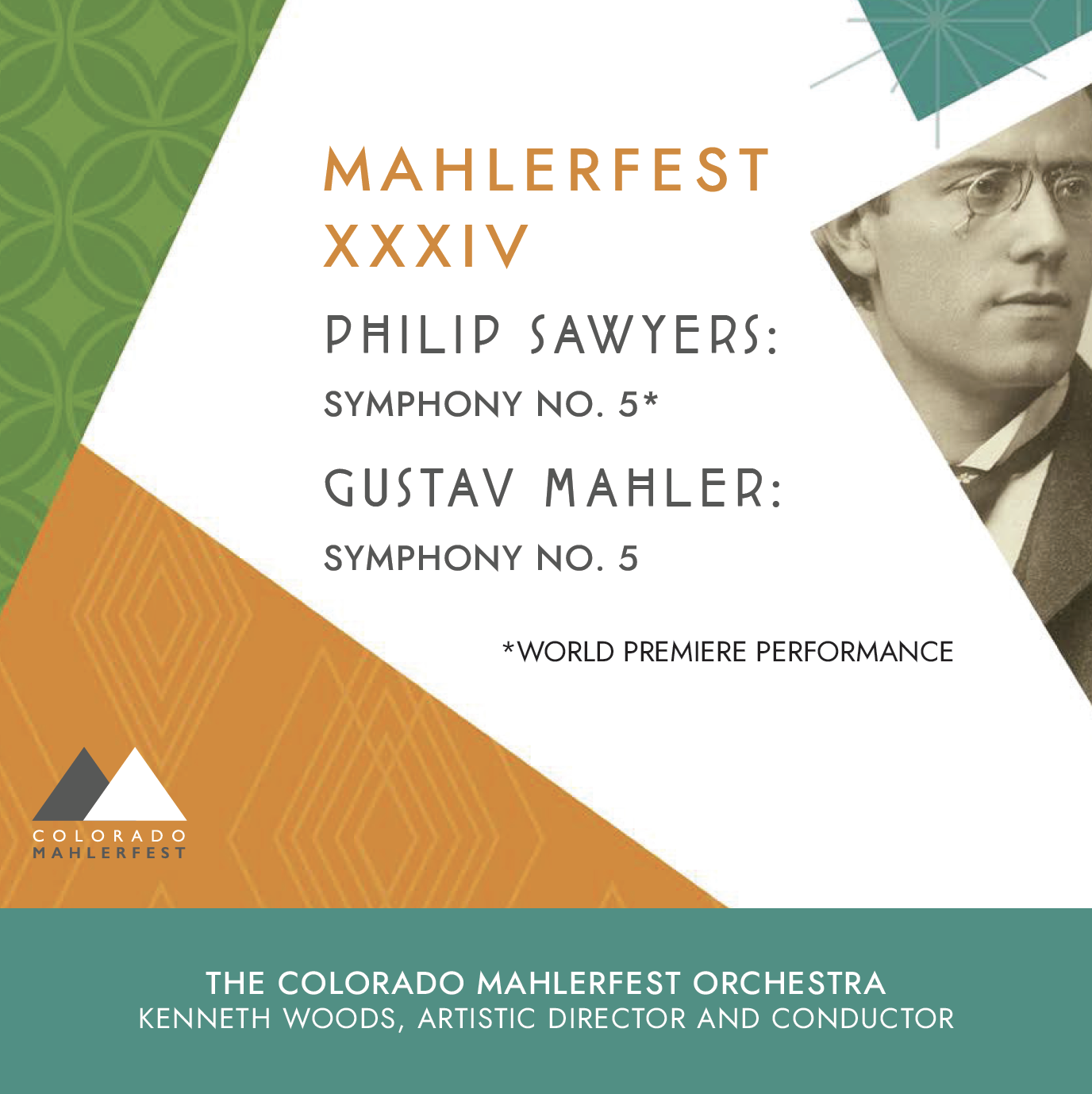
On Record: Colorado MahlerFest Orchestra / Kenneth Woods – MahlerFest XXXIV: Sawyers & Mahler: Fifth Symphonies (Colorado MahlerFest)

Sawyers Symphony no.5 (2021) [World premiere]
Mahler Symphony no.5 in C# minor (1901-02)

Colorado MahlerFest Orchestra / Kenneth Woods

Colorado MahlerFest 195269164287 [two discs, 111’45”]

Recorded Live performances at Macky Auditorium, Boulder, Colorado, 28 August 2021

reviewed by Richard Whitehouse

What’s the story?

Two five-movement Fifths brought the 34th Colorado MahlerFest to an impressive ending. Mahler’s cycle is often seen as ‘end of the line’ for the symphony, yet its further evolution is not hard to discern, and Kenneth Woods is rightly making this a crucial aspect of his tenure.

What’s the music like?

Philip SawyersFifth Symphony pursues a stylistic path comparable to those two before it. Its predecessor ended with an expansive Adagio, and this work continues from such inward seriousness in a Moderato that overrides clear-cut sonata procedures for a gradual unfolding whose thoughtful initial theme takes on greater emotional intensity as it builds to an ominous climax, before closing in a mood of no mean ambivalence. The writing, for an orchestra with fifth horn and harp though no percussion other than timpani, is never less than resourceful.

From here an Allegro increases the tempo to capering and, in its middle stages, wistful effect. The central Lento pursues a sustained course over cumulative paragraphs, the latter climaxing with the work’s most anguished music, before an affecting coda. The ensuing Presto affords greater expressive contrast between impulsive outer sections and a chorale-like trio of musing poise. The final Allegro is the most orthodox movement in its energetic and reflective themes, taking in an intensive development and subtly modified reprise prior to a decisive apotheosis.

Pacing is crucial in Mahler’s symphonies, his Fifth being no exception. The opening Funeral March is ideally judged – its development not too histrionic, then a coda whose eruptive force subsides into numbed uncertainty. Proceeding without pause, its successor steers securely to a climactic yet ill-fated chorale, and if the final return of its initial music lacks vehemence, the pulsating expectancy of the closing bars is tangibly rendered. Woods’ handling of the central Scherzo contrasts a rustically evocative trio with the ländler-infused coyness and contrapuntal contrivance either side, the coda wrapping up this overlong movement with real decisiveness.

The remaining two movements are finely realized, the Adagietto taken at a flowing if flexible pace that enables its inherent rapture to emerge without any risk of indulgence. The deftest of transitions duly prepares for a finale whose elaborate interplay of rondo and sonata elements is replete with a cumulative impetus here carried through to a fervent peroration, the chorale blazing forth during a close in which affirmation and nonchalance are irresistibly combined.

Does it all work?

Almost always. Sawyers’ Fifth symphony is a cohesive and absorbing piece – less arresting in overall content than either of its predecessors, though with an unfailing formal logic and expressive eloquence that are not to be gainsaid. Interesting, moreover, that this Fifth marks something of a rapprochement with ‘classical’ tonality, whereas Mahler’s Fifth sets in motion a fractious discourse which informs almost all this composer’s subsequent symphonic works.

Is it recommended?

Certainly. The playing of the Colorado MahlerFest Orchestra is of a high standard, testifying to the excellence of these musicians in their collective responsiveness to Woods’ technical acumen and interpretive insight. To hear this work so authoritatively realized and within the context of a major new symphonic statement says much for the significance of MahlerFest.

Listen & Buy

Online concert – English String Orchestra / Kenneth Woods: Elgar Festival 2022

Elgar arr. Fraser Nursery Suite (1931 arr. 2022) World premiere of this arrangement
David Matthews Shiva Dances Op.161 (2021) World premiere

English String Orchestra (soloists Zoë Beyers, Suzanne Casey (violins), Carl Hill (viola) and Joely Koos (cello) / Kenneth Woods

Filmed at the Guildhall, Worcester, Friday 3 June 2022

by Richard Whitehouse

Welcome listening for the new year provided by the English String Orchestra, as taken from a programme at this year’s Elgar Festival and which featured the premiere of that composer’s last notable work in what is an idiomatic and often perceptive arrangement by Donald Fraser.

His previous Elgar arrangements ranging from miniatures to the Piano Quintet, Fraser duly captured the wistful charm of the initial Aubade then discreet pathos of The Serious Doll. The ESO steered a secure course through the headlong intricacy of Busy-ness, with the deft profundity of The Sad Doll afforded full rein. Solo strings against an implacable rhythmic ostinato offset any lack of visceral impact in The Waggon (sic) Passes, then the high spirits of The Merry Doll were jauntily in evidence. The extended finale, Dreaming is a threnody of tangible emotional import and a resume of earlier themes on its way to a forthright if not a little regretful coda. Kenneth Woods ensured this had gravitas without losing focus, while a bravura showing from Zoë Beyers was but the last in a sequence of solos all admirably taken.

Solos are by no means absent from Shiva Dances by David Matthews. The combination of string quartet and string orchestra has potent Elgarian connotations, of which the composer avails himself in this continuous sequence inspired as much by Aldous Huxley’s description of the Hindu god Shiva as by Indian classical music. Moving from a slow introduction given piquancy by its modal intonations, the work comprises four dances that between them outline the four elements: an impetuous workout representing ‘earth’, a quixotic interplay for soloists and ensemble that of ‘water’, the scherzo-like agility of ‘air’, and an animated waltz for ‘fire’. This latter builds to a forceful restatement of the opening theme, before a coda intensifies the overall expression such that what came before is rendered from a more ethereal perspective.

It says much for the prowess of the ESO that this first hearing betrayed few signs of caution or uncertainty, Woods directing a confident account with which Matthews must have been well pleased. Those listening to this online programme can also hear an encore in the guise of Nimrod from Elgar’s Enigma Variations, taken from a performance during last year’s Elgar Festival and which exudes a searching eloquence as seems to look beyond forthcoming celebrations to that overtly commemorative atmosphere from only a matter of weeks later.

This concert could be accessed free until 1 January 2023 at the English Symphony Orchestra website, but remains available through ESO Digital by way of a subscription. Meanwhile click on the names for more on the English Symphony Orchestra and Kenneth Woods, or on composer David Matthews

Happy Christmas… with César Franck

In this year’s final post from Arcana, we would like to take the chance to wish you a very Happy Christmas and a peaceful New Year – in the company of anniversary composer César Franck. His choral favourite Panis Angelicus is ideal for the season, especially in this version from the King’s College Choir Cambridge:

So, too, is the majestic Pièce Héroïque, played here in a vintage recording by the organist-composer Marcel Dupré:

Thank you so much for being our readers this year, and we look forward to bringing you all sorts of musical goodness in 2023!

Ben Hogwood, editor