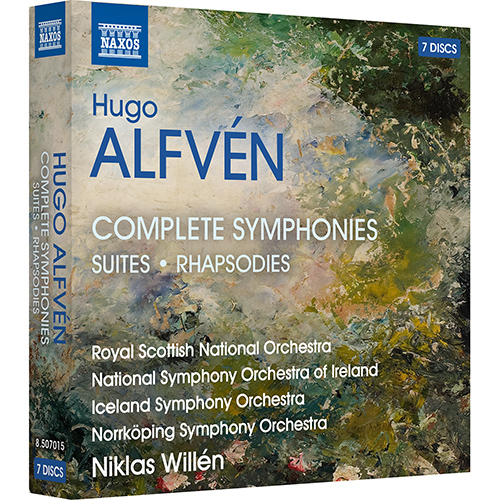
Royal Scottish National Orchestra, National Symphony Orchestra of Ireland, Iceland Symphony Orchestra, Norrköping Symphony Orchestra / Niklas Willén
Naxos 8.507015 [7 discs, including a bonus of Swedish Orchestral favourites]
Reviewed by Ben Hogwood
What’s the story?
Swedish composer Hugo Alfvén was born 150 years ago this year, and this attractive box set from Naxos celebrates the anniversary by bringing together the five symphonies recorded under the baton of fellow countryman Niklas Willén. They are presented alongside a number of Alfvén’s suites and orchestral works.
What’s the music like?
Attractive, airy and extremely enjoyable. Before Alfvén came along, Sweden had very few symphonic composers of note, Berwald excepted, and this cycle of substantial musical structures helped bring the symphony to a new audience.
Listening to each of the five works plots a course through Alfvén’s career, revealing him to be a gifted melodist and orchestrator. He writes with a clarity suggesting he studied the music of Mendelssohn and Schumann, but the orchestral works have an opulence closer to Richard Strauss and Wagner.
The Symphony no.1 in F minor Op.7 is laden with drama, if not yet fully confident in its structural steps. The Symphony no.2 in D major Op.11, which firmly established Alfvén as a composer, finds a glowing, lyrical approach. The Symphony no.3 in E major Op.23 is a joy, celebrating love and nature in the brightest E major, with richly tuneful episodes and rapturous outpourings from the strings. The Symphony no.4 in C minor Op.39, subtitled From The Outermost Skerries, has impressive depth, its four movements running continuously as they tell of the unique landscape of the Stockholm archipelago. Finally the Symphony no.5 in A minor Op.54 has a broader melodic platform, darker in some respects but loaded with extra resolve.
The accompanying suites show off Alfvén’s affinity with the stage and a natural aptitude for storytelling – The Prodigal Son, Synnöve Solbakken and A Country Tale all have good tunes and clear, bright orchestration. The shorter pieces included here should be better known, too – the Swedish Rhapsodies are winsome pieces, while the Festival Overture rises well above its functional role and the Elegy is equally meaningful.
Does it all work?
Yes, thanks to vibrant performances from each of the four orchestras used by Naxos in the gradual assembly of this cycle, all under the expert guidance of Niklas Willén. His choices of tempo are instinctively right, backed by an innate understanding for the flow of this music. An extra disc of Swedish orchestral favourites, featuring works from Alfvén, Larsson, Peterson-Berger, Söderman, Stenhammar and Wirén, is a considerable bonus.
Is it recommended?
Yes, with enthusiasm. While other composers may be ahead of him in the symphonic popularity contest, Alfvén’s music is highly attractive and full of good things for the casual or the attentive listener. Take this chance to explore further and you will not be disappointed!
Listen / Buy
You can find out more about this recording, and explore purchase options, on the Naxos website
Arcana has time with celebrated Norwegian pianist Leif Ove Andsnes, appearing via Zoom from his home in Bergen. A recent winner of the ‘Special Achievement’ at the Gramophone Awards for his inventive Mozart Momentum series for Sony Classical, Andsnes is now extolling the virtues of a discovery he made during lockdown, which forms his latest release on the label.
To many listeners and fans of classical music, Antonin Dvořák is best-known for his symphonies (especially the Ninth, the New World), other orchestral works and then perhaps his chamber output, headed by the American string quartet. He certainly hasn’t – until now, at least – received many column inches devoted to his piano music.
Yet this is the realisation made by Andsnes over the last couple of years, that Dvořák’s set of Poetic Tone Pictures, published in 1889, are long-lost gems of the Romantic piano repertoire. Before we get to the pieces specifically, the pianist tells me how they represented an unlikely first encounter with the composer’s music. “Funnily enough I think my introduction might have been with these pieces, which is strange because they are so neglected in the world. It so happened that my father brought with him a random collection of LPs once he was in London. He was just shopping, and I don’t think he knew what had come home with really – although one of the LPs was the Dvořák Tone Pictures, with the pianist Radoslav Kvapil. I listened to these pieces when I was very little, and I mostly listened to the first three or four. I liked them very much, and played the first one in a youth competition when I was 12. Strangely enough, that might be my first memory of Dvořák. I might have played the famous Humoresque when I was seven or eight, but before I got to know his famous music this was part of my world, though I didn’t think of playing the whole cycle until three or four years ago.”
Until now, Dvořák’s entire solo piano output has languished in the shadows, with other character pieces, waltzes and a Theme and Variations barely played. This doesn’t seem right to Andsnes. “For me, this cycle is exceptionally good”, he says. “It really stands out. Some of the other music is also interesting, but you do feel sometimes that maybe the piano wasn’t his natural idiom. Dvořák was not a natural pianist. When you come to these pieces, though, it’s like his imagination is freed. One theory is that it has to do with the idea of programme music, because he started writing much more of that around this time. I am thinking of the Eighth Symphony, which was originally going to have a program, and then later come all the symphonic poems. He is much more about imagery and stories, and so it is like he is finding his real personal voice at the piano.”
The personal significance is artistic, too. “For me, it’s a real joy that I find consistently through the 13 pieces. I was so happy than to find this quote from him a few years ago, where he said that he had tried to be a poet in the form of Schumann, though it didn’t sound like Schumann, and he hoped that somebody would play all 13 pieces of this cycle together – though he doubted anybody would have the courage to do that. So I took it up! He meant it as a cycle, for sure – and even if they are 13 short stories, and very different pieces, he builds it very cleverly, so that you have some of the climactic pieces towards the end and this wonderful farewell with the last piece, At The Holy Mountain. It is a wonderful journey as a whole, even if there are many, many different characters.”
The characteristics of Dvořák revealed here are very different to those found in his orchestral or chamber works. “I think so”, Andsnes agrees. “It’s like he is opening a book and saying, “Let me tell you a story. I have something interesting to tell you.” It’s a very intimate and magical world, and he was right in the way that it is reminiscent of Schumann, with something you open – along the lines of a cycle such as Kinderszenen.”
One of the pieces in this cycle is The Old Castle – which draws parallels with another cycle to use this imagery around the same time, Mussorgsky’s Pictures at an Exhibition. “It has this bell like quality”, enthuses Andsnes, “and the kind of space it gives brings out the grandeur of the castle. At the same time it’s full of pedal, and you could imagine it in the fog or mist. It’s interesting you mention Mussorgsky, I hadn’t really thought about that. I’ve been thinking more about the piece called Tittle Tattle, which I was thinking could be a little reminiscent of the woman at the marketplace in Pictures. Who knows? It would be interesting to know, if he knew those pieces.”
Is it too far-fetched to hear premonitions of 20th century Czech piano music, such as Janáček, in the distance of Dvořák’s writing? “I think that is true. Of course the folk music is always there. I haven’t been thinking so much about the direct connection to Janáček, but it’s there also, I had a Czech piano teacher when I was a student, who was really important to me – Jiří Hlinka, who lives in Bergen. He came here in the 1970s and was on a contract from the communist regime in Prague, and had 10 years before deciding to stay and become a Norwegian citizen He’s still with us here, and he’s been a very crucial part of my life. I suddenly discovered Janáček through him, but he was also very much in to Dvořák’s piano music. I remember he would have certain pieces like the Silhouettes. He would emphasise more of Smetana’s piano music, and as a student I played several of the pieces. The big Concert Etude and On The Seashore were two of the pieces I played – and with his piano music it is clearly written by a very accomplished pianist. They are wonderful things, but maybe not with the same strong signature of Dvořák.
Leif has been able to play the cycle as part of a European tour, and when we spoke he was contemplating the upcoming performance at the Rudolfinium in Prague. “I’m actually playing the pieces until the middle of February, so it is spread out a little bit. These pieces are in the second half in each concert, so in three or four months I will have very much more experience on how it works for the audience. Before I made the recording I had the opportunity to play a few times for audiences in Scandinavia, and it was very heartwarming to see how they reacted to hearing the whole cycle. There is something special about having time to get into that world, which I felt the audience really appreciated. That convinced me that it really works as a as a cycle, even if it’s a long one at 55 minutes.
Typically for Dvořák, the cycle contains a great deal of memorable melodic content. “It’s fantastic”, agrees Andsnes, “and for me it’s the blend of textures and colours. The chamber music of Dvořák that I have played the most is the Op.81 Piano Quintet, which is also written around this time by the way, it’s one or two years before. Often I ask why it is so extremely attractive, and I think it is the blend of the instrument, the way he uses them together. It is very imaginative, using these bell like qualities and fluid qualities of the treble of the piano, which mixes with the strings in a very original way.”
He gives examples. “I have to say he achieves that in several of these pieces for solo piano – there are very original textures. The second piece called Joking has a middle section which is so fluid and wonderful, and there is something very original about that sort of writing from him for the piano. In other places you feel that he is taking from other composers things that he knows will work, like the Spring Song. You could imagine that is a very Mendelssohnian or Lisztian way of developing the piano texture, the accompaniment and the melody. In the Bacchanale it is very clear that he was inspired by Chopin, the Third Scherzo in the trio section, it is very reminiscent of that. You can see that he takes from things he knows will work for the piano, but there is a very original voice there in the piano writing itself. Part of the attraction, in addition to the melodies and these wonderful harmonies, is the blend of voices and the textures he creates, even on the solo piano.
Andsnes has recorded solo piano music by composers such as Nielsen and Sibelius, bringing forward these private aspects of composers not necessarily known with the piano as their primary form of expression. “I recorded the Sibelius a few years ago”, he recalls. “There I did feel that I had to very consciously select pieces that represented him in the best way. He wrote at least 150 piano pieces, most of them short character pieces, and I have to say it is very uneven. He didn’t particularly like the piano himself, he said terrible things about it! But he wrote all those pieces, and of course you can’t deny that he was a great composer. I think the 25 pieces or so that I chose really represent him in a wonderful way.”
“This is so different though, because there is a whole cycle of pieces that are ‘prime time’ Dvořák, the best period. It’s very strange that you have such a famous composer, with such a cycle, and that it’s not known in the world. We have piano students, sitting in their practice rooms playing the same Beethoven sonatas and the same Chopin pieces over and over again. You can ask 1,000 of them, and maybe two or three would know these pieces. That’s a kind of mystery and shows how imaginative we are sometimes.”
Does this highlight a lack of imagination in concert programmes? “Sure. We all want to play the great music, and I had this Mozart project recently where I dive into the really famous and most incredible piano concertos. But that’s only so much, and I was always thinking that it has an added value to bring forward something that people don’t know. There is such a wealth of repertoire that you can have something totally underrated like this to bring forward. I’m very grateful that I’m playing this instrument and have the possibilities to find these works.”
With the Mozart releases, Andsnes has presented the concertos with contemporaneous pieces, allowing different explorations of how Mozart writes with the piano. The series wrapped up with a concert in Salzburg, completing an examination of 1785 and 1786. “We had three cancelled tours during the pandemic”, he reveals, “but we were also able to do things. When it came to recording we had already done the chamber pieces, but we were able to miraculously meet in Berlin and do the first recordings of the 1785 concertos.”
Andsnes clearly drew much creative impetus from the project. “It was very interesting thing to look at just these two years and see what happened in Mozart’s life, to see the diversity and see how things were affecting his writing, particularly with the piano concertos and the operas. He was writing The Marriage of Figaro at the time, and you see how operatic the piano concertos become after a while. In the Piano Concertos nos. 22-24 the use of wind instruments is like singers, and bringing the clarinet into the orchestration. We also learned about the relationship with Freemasonry and how the music is influenced by it. I think the C minor fantasy, the Funeral Music for orchestra – this is a very different side of Mozart, not the seductive melodies but more about an atmosphere. It’s been really interesting to play the different music from these years.”
Is Mozart as difficult to play as is often famously claimed? “I think the piano concertos are the greatest joy to play”, he says, “and especially these concertos, because they are so alive and there are always things happening. There is not a foreground and background only approach, there are middle voices with things for the viola, the bassoon. It is bubbly and full of ideas, and is such a joy to work on. Of course Mozart is sometimes challenging in terms of finding the right expression, he can be more ambiguous than Beethoven. With Beethoven you always feel that he has a goal in sight, and we go through a struggle and find answers, but with Mozart, there is more theatre, and it is psychologically more complicated. Sometimes there is a feeling that you just need to trust, you know? I liked the expression ‘heavenly boredom’, because it is part of his music – simply it is just beauty. How do you define beauty, and how do you give expression to it? Sometimes there is a childlike quality to that which one just has to trust. Earlier I found that difficult but now on stage I feel these are some of the great musical moments.”
Extra insight came from Andsnes’ decision to conduct the concertos from the keyboard. “For me that is the best way of doing these concertos, because they are so full of dialogue, and one has to be so conscious of who is talking with whom. If you are sitting in the normal soloist position, with a conductor in between the orchestra and yourself, it can work wonderfully, but you are further away from each other and the orchestra don’t hear you so well. When I sit inside the orchestra, with the piano lid off, there is a heightened awareness of what the other one is doing, and the sort of quicksilver response that you need in Mozart is easier to achieve.”
Dvořák wrote a single, large-scale piano concerto in 1876, which Andsnes has also encountered. “My teacher, Jiří Hlinka, played a recording of that when I was 16 and in his class. He played the Firkusny recording, and got very teary about it because he was missing Prague and everything. I got to love that music so much, and I got to know the famous recording with Richter and Kleiber, where he plays the original version:
The others used to play modified versions of it, because again that comes down to Dvořák having this strange reputation as not writing really well for the piano. I do think it’s wonderful music, but I never got around to studying it. I think I have also have been slightly afraid of that piece! Of course it does have its challenges, with the piano writing having to cut through the orchestra and to make sense with an orchestra. I do remember also hearing Richter having said that he hadn’t thought it would be such a problem to study this piece, but it took him half a year just to learn it because it was so complicated pianistically. He compared it to Bartok second piano concerto which he thought would be very challenging, and which he learned in three weeks! That made an impact on me, and I really have respect for that piece. You should never say never, but the Poetic Tone Pictures became the project. I do like it a lot though, and I think it’s an underrated piece, as is the Violin Concerto which is an absolutely fantastic piece.
As to future projects, Andsnes is in dialogue with Sony about what to do next. “It has been rather productive with recordings, so I am taking a little bit of time to think about what to do next. I don’t have any projects in mind for the next few years, but there is a great freedom in that as well. I am thinking about several things but too early to tell where we will end up. It can be a good thing!” For now, though, he has the Dvořák to play live. “So much colour in the music, so you can come in from the rain and enjoy it!”
Leif Ove Andsnes’ recording of Dvořák’s Poetic Tone Pictures is out now on Sony Classical. To listen and for purchasing options, go to the Presto website
Martin Fröst (clarinet), Roland Pöntinen (piano), Sébastien Dubé (double bass)
Debussy Première rhapsodie (1909-10) Chausson Andante and Allegro (1881) Poulenc Sonata for clarinet and piano (1962) Night Passages – A musical mosaic (with arrangements by the performers) Domenico Scarlatti Sonata in D minor Kk32 Chick Corea Children’s Song no.15 (1978) Rameau Les Indes galantes: Air pour les Sauvages (1735-6) Purcell Incidental music for Oedipus, King of Thebes Z583: Music for a while (1692) J.S. Bach Sinfonia no15 in B minor BWV801 (c1720) Chick Corea Armando’s Rumba (1976) Purcell Hornpipe in E minor Z685 Handel Menuet in G minor (1733) Traditional Polska från Dorotea Göran Fröst Klezmer Dance no.2 (2011)
Wigmore Hall, London Wednesday 21 December 2022
Reviewed by Ben Hogwood
In 2019, Arcana was at the Wigmore Hall to see Martin Fröst and Roland Pöntinen give a concert of largely French music for clarinet and piano. Their encore hinted at an intriguing sequence of arrangements exploring connections between classical music and jazz. Three years on, that sequence has grown in stature, realised in recorded form as the Sony Classical album Night Passages, and given meaningful content by personal and world events.
Through lockdown, Fröst experienced intense bouts of Ménière’s disease, whose symptoms include unexpectedly severe bouts of vertigo and tinnitus. The clarinettist experienced one such bout while driving his car, which he thankfully negotiated without injury, but which bred a number of accompanying fever dreams. Expressed in the program notes, they lent a vivid written complement to the music.
Since 2019 the double bass of Sébastien Dubé has been added to the instrumental thinking, an essential musical component taking the arrangement style towards Jacques Loussier without ever resorting to parody. Unexpectedly, the group’s colourful arrangements did not always include the piano, allowing Fröst and Dubé the chance to explore the rewarding combination of clarinet and double bass through imaginative techniques and compelling improvisation.
The course of Night Passages led from a solemn sonata by Domenico Scarlatti to a Klezmer dance from Fröst’s brother Göran, by way of arrangements exploring the versatility of Baroque music. These were matched by jazz-inflected work from Chick Corea, with Armando’s Rumba presenting some vibrant syncopations, along with a celebration of the Swedish polska.
Frost’s artistry was almost beyond criticism, the clarinettist able to make even the most demanding technical passages appear nothing more than a walk in the park, airily improvising or running through sharply edged cadenzas. Dubé was no less impressive, and a remarkably wide range of colours issued from the double bass, whether bowed or plucked. His chemistry with Fröst was compelling, and the occasional use of vocals added to the mix. Roland Pöntinen also made the most of his chances to shine, providing the rhythmic verve to the dances but also a welcome, cleansing clarity which ran through the Baroque arrangements, tastefully and affectionately realised.
Prior to the interval we heard three short pieces by French composers for clarinet and piano. Debussy’s Première rhapsodie tells its story through a set of contrasting thoughts, initially set out in a humid atmosphere but becoming more outward facing as it gains in confidence. Fröst and Pöntinen had its many twists and turns instinctively under their fingers, finishing each other’s sentences as they did in the romantic, lyrical writing of Chausson’s Andante and Allegro, played with evident affection.
Yet it was Poulenc’s Sonata for clarinet and piano, completed in the year before his death, that made the most lasting impression. What a profound work this is, paying tribute to his friend and fellow composer Arthur Honegger. The slow movement holds the emotional centre of the work, with melancholy on occasion spilling over into outright sadness. Fröst’s quieter asides encouraged the audience to lean closer to the music, but these intimate thoughts were swept away by the exuberant finale, throwing caution to the winds. Fröst and Pöntinen played with great feeling throughout, typifying the approach of a concert that may not have been generous in length but which amply compensated through musical quality.
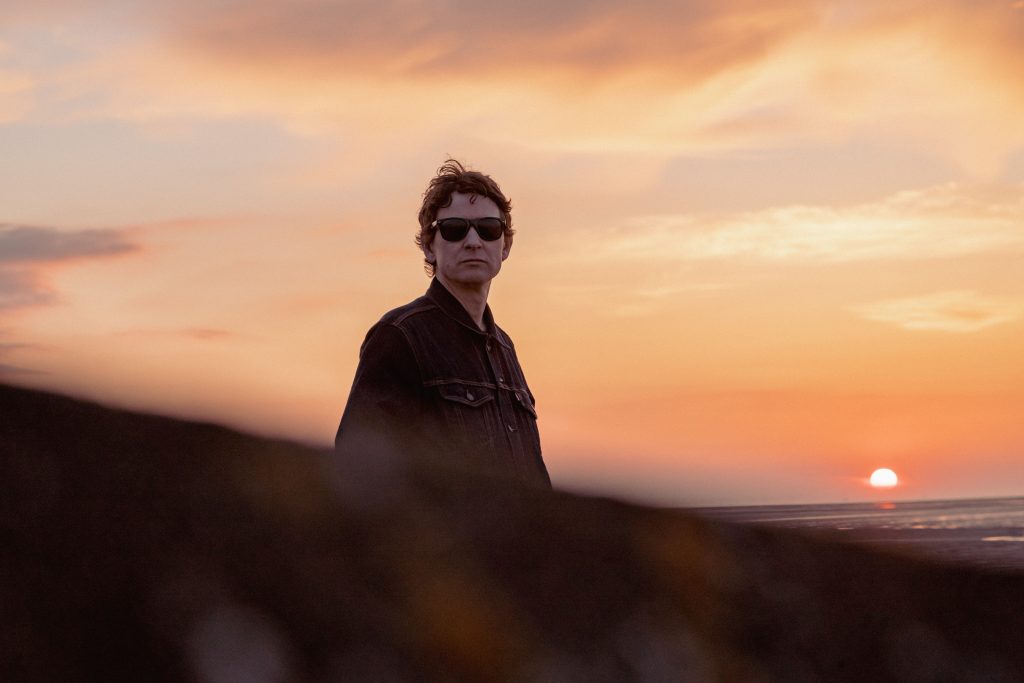
Mark Peters has enjoyed a richly creative year. A key member of the band Engineers, he has seen his own solo work flourish for the Sonic Cathedral label. His 2018 album Innerland made a strong impression, and now it has a complementary work in this year’s release Red Sunset Dreams, creating sonic vistas from the other side of the Atlantic Ocean.
Arcana sat down to talk about the new album, its sense of time and place, its guest musicians – and how Peters has sparked creatively from them. It is a record working on several levels – on one hand you could bask in its Mediterranean warmth, while on the other it creates vivid imagery of a British summer. “It’s probably no accident,” says Peters, “as a lot of it was done at the back end of last year in the UK, and some of the tracks – the title track and one called Tamaroa that was done quite quickly, were done just as Autumn started.” Music experiences a resurgence as the seasons change. “It’s funny”, he says. “I think my music definitely suits the autumn, and I feel you get more attuned to your rhythms as an artist. It has a lot to do with visual aspect, and how we naturally hunker down.”
Peters grew up in Wigan, where he still lives – and where he had his musical epiphany. “I think the key moment for me was in a science class, and someone played me a record which I don’t regard as the greatest record ever, The Delicate Sound of Thunder by Pink Floyd. It was so different to anything I knew. I was into pop music like every other kid, towards more indie music like Echo & The Bunnymen. It really struck me as a wow moment, where things changed. It was the combination of a frivolous band name and the stark, gloomy presentation – and how relatable the lyrics were, with me being at school and questioning everything! It was “Oh, right – I’m not alone.”
This gateway moment led to the purchase of a guitar. “Wigan was a really fertile area for music then, with a lot of crate-digging. I think a lot of that culture gets attributed with funk and soul, but I was listening to Can at the age of 16, and Aphrodite’s Child, the band Vangelis was in. The doors opened and it’s carried on ever since as a massive melting pot!”
Peters’ music has a strong sense of time and place – which can be said for Innerland as well as Red Sunset Dreams. Does he have an image in his head when writing music? “I don’t know, but I am a very visual person, and I get a lot out of imagery and the natural world. Just looking at the sky, it does have a massive influence on me and my mood. It motivates me to write, record and mix, which is a big part of it for me – for some people it’s a more prosaic part of the process. Rather than a particular image in my head I think it’s more of a feeling, and then I start to work on something.”
The feelings can be personal in other ways. “These days I start to think about a feeling that others may have had, an essence of something or things that I’ve read or seen historically. Those things have quite a big influence on me. I did a project with Ulrich Schnauss in response to local landmarks, and I really got into the research, looking at things locally and in more depth rather than the everyday person in the car. That’s honey to the bees for me for creativity, those black and white photographs and seeing how people had to live. I feel tuned into the essence in places, which is something I would like to do that again. I’ve explored and formulated that with Nat from Sonic Cathedral.”
Red Sunset Dreams is essentially an Americana instrumental album, presented naturally and without cliché. “It’s about the stuff in our innate consciousness. I enjoy the kitschy thing that we’ve kind of explored on the artwork. It should be fun, and I don’t want to be pompous but at the same time I started to think about it. When I found out there was a local cinema showing Westerns purely from the late industrial revolution, that was massively popular, and that was a really evocative situation. You’ve got all these people working in mills all the time, who couldn’t see the hills because of the smog. They were going into the cinema to experience this vastness and freedom that had once been there, a generation earlier when it was all farmlands. That clicked with me, and I realised it may have been the reason that all the aspects of Americana came into the country.”
Was there a particular place that appealed in America? “There was one particular day I used for a video for Switch On The Sky that sadly got lost in time, just around San Francisco. There was a particular day where we drove from just north of San Diego, a place called Del Mar, up alongside the Sierra Nevada mountains up to a place called Bishop. The reason I took the title Silver River was because it was filmed near there. We drove all day, with loads of ambient tracks on – Brian Eno, Boards of Canada, and some things like David Crosby, It was a really evocative day, and the light was amazing – the sunset seemed to last from late afternoon. It was a real actualization of all those things you experience on TV – the sizes of the curbs, the fire hydrants. That day really stuck with me and gave it a mythical quality that really appealed to me and was enchanting.” He really enjoyed San Francisco. “I think it’s got a good atmosphere. The real journey for us though started once we got on the road out of the we just stuck to the coast road through Big Sur and right the way down, which was astonishing – especially compared to Los Angeles, which we now know as ‘Hot Warrington’!
Silver River was made with legendary slide guitarist BJ Cole. “I’d like to have a better story about this, but he just has an online service! It’s ridiculously cheap, and you send him the tracks. We had a chat about who I was, and we had some people in common. Being from Wigan, I know the guys from The Verve, and he briefly joined the band in the late 1990s. He wasn’t on any recordings with them but is on Richard’s first solo album. We talked mainly about that, and that was it really – he’s a busy guy and still doing a lot of really cool stuff. He sent me a guide track, and we made him the lead instrument. I felt I should show a due amount of respect. He sent me six takes of improvisation, and as with all those some were successful and beautiful, and others you go a bit wrong. I edited it to keep all the good bits. When I heard it all together as a collage I was blown away – it was so fluid, with a watery feel, and when I found out the title it felt ideal.”
Peters’ other guest, Dot Allison, is also a natural fit. “I’ve been working with Nat from Sonic Cathedral for many years now, and I said it would be great to have a singer on this. I don’t want to make the same album as Innerland. He said, “If you could choose anyone, who would you go for?” I said Dot – and then some months later she heard Innerland and thought it would be a great idea. I think the reason why I wanted her to do it, aside from having the perfect vocal sound, was that I think it’s really important to choose people who are really going to get what you’re doing. I can’t think of anyone who would get it more! On our first conversation we talked about Gram Parsons, Emmylou Harris and Gillian Welch, and I realised it would flow incredibly easily – and it did. She actually worked with BJ Cole herself, on a track called Tomorrow Never Comes, which is such a good song.
Sonic Cathedral is the ideal match for Peters’ music. “I’ve known Nat since Engineers played a couple of shows for him in 2005. We’ve been friends and in regular contact since then. I don’t know why it took so long to do stuff like this, I think it was because I was used to being on big labels like Echo and K-Scope. I was maybe a bit spoilt, maybe not having the right priorities, but as you get older you realise it’s all about the A&R really. I couldn’t think of a better home in terms of having someone who understands me and has ideas that mean I never have to worry about how things are presented. We have so many current interests, and share music naturally, and that sort of thing can be contrived at major labels. I’m really proud of him for sticking to his guns like he does. Trust is the key word with a label, and that’s exactly what we have.”
Peters’ work is much more solo-based these days, though he does have a little contact with his fellow-Engineers. “I am in touch with Dan MacBean on a pretty regular basis. We made an album in lockdown called Pictobug, which we released under the Engineers name. It was a great experience because although we did manage to do a lot of experimental stuff on those early Engineers albums, we always felt like a lot of our time was spent trying to try and please the label. I can’t complain – it wasn’t a horror story – but when you are signed to a larger label, they’ve got certain criteria you are bound to try and fulfil. We always felt that the untethered, exploratory aspects were left aside. For Dan and I to make that record was really good. It was four pieces ranging from 8 to 13 minutes, just jams that we did as an online release – and people were enjoying it. I haven’t generally seen others from the band apart from when we got our publishing back last year.”
With an open musical mind, Peters is still open to collaboration. “Some things just naturally occur, and sometimes the universe is just pointing at you – you don’t need to think too much. When we did the tracks that are on my album, Dot and I agreed it had happened so quickly and so well that we should do some more. We’ve done two more tracks, and I’ve got a few more ideas to send to her too. With the live band, that’s been really enjoyable – and we’ve started to do some improvisation-based stuff that I’d like to pick up a bit more and record. We’ve got the live sound honed so now we can see what they have to offer as composers, and let them have some creative input. That’s a start of a nice little project.”
You can browse Mark Peters’ music at his Bandcamp site – which includes this Christmassy EP from 2019:
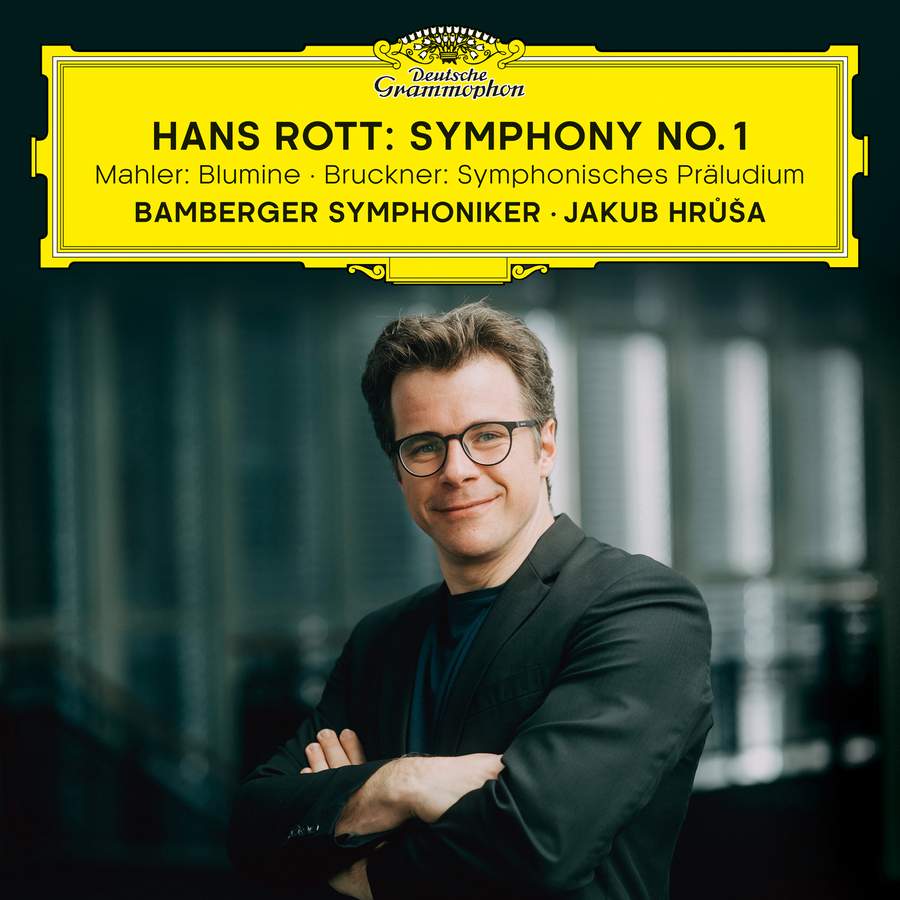
Rott Symphony [no.1] in E major (1878-80) Mahler Andante allegretto in C major ‘Blumine’ (1884) Bruckner Symphonic Prelude in C minor WAB297 (1876)
Bamberger Symphoniker / Jakub Hrúša
DG 486 2932 [70’11”]
ProducersSebastian Braun (Rott, Bruckner), Johannes Gleim (Mahler) EngineersMarkus Spatz (Rott), Christian Jaeger (Mahler), Thorsten Kuhn (Bruckner)
Recorded September and October 2021 (Rott), December 2021 (Mahler), March 2022 (Bruckner) at Joseph-Keilberth-Saal, Konzerthalle, Bamberg
reviewed by Richard Whitehouse
What’s the story?
Jakub Hrúša makes its debut on Deutsche Grammophon with a new account of the Symphony by Hans Rott (1858-84), whose belated premiere some 33 years ago prompted a reassessment (still ongoing) as to the evolution of this genre during those final decades of the 19th century.
What’s the music like?
Much time and space has been expended on the indebtedness (or otherwise) of Mahler to this work – elements from which can be found in at least five the younger composer’s symphonies – yet equally fascinating is the audible influence it had upon those who came before and after; hence the first movement from Bruckner’s Seventh and the second movement from Schmidt’s First – both of which are similarly grounded in E major). Without seeking to present it as an unalloyed masterpiece, Hrúša makes a persuasive case for a piece that Rott would doubtless have overhauled had his mental state not deteriorated soon after its completion. He finds the right balance between grandeur and introspection in the preludial Alle breve, as between that raptness which briefly though pointedly erupts into anguish in the Sehr langsam that follows.
The Scherzo is the most convincingly realized movement and Hrúša has the measure of its animated main theme with undertones of polka, broadening into the ländler-derived suavity of its trio before regaining its earlier vigour vis an ostinato-like impetus barely held in check – the accelerando not necessary in this instance. Nor does he disappoint in the finale. Much the longest movement, this is easily criticized for diffuseness but, as Hrúša makes plain, the formal ground-plan – prelude-chorale-fantasia-fugue-stretto-postlude – (such as the organist Rott likely extemporized before committing to paper) is readily perceivable and is invested with cumulative momentum sustained to the beatific concluding bars. That the composer so nearly brought off this ambitious conception is surely more significant than any shortcoming.
Couplings have been judiciously chosen to open-out the context of the main work. Included in early hearings of his First Symphony, Blumine is a remnant from Mahler’s early orchestral projects lost to history and Hrúša brings out those expressive ambiguities as offset the lilting trumpet melody. Once attributed to Mahler, Symphonic Prelude is now believed an exercise from Bruckner’s composition class and Hrúša, adhering to the original orchestration rather than that by Albrecht Gürsching, duly makes the most of its ominous and plaintive musings.
Does it all work?
It does. In his accompanying booklet observation, Hrúša reflects on the musical and historical relevance of Rott’s Symphony and there can be little doubt that, among the dozen or so other recordings of this piece, this is the most convincing in terms of all-round cohesion as also the excellence of the playing by the Bamberg Symphony (whose chief conductor Hrúša has been since 2018). A little too forwardly balanced in tuttis, sound otherwise reflects the excellence of the orchestra’s home-venue – Rott’s extensive use of triangle kept within sensible bounds.
Is it recommended?
It is. Those coming to the main work for the first time should certainly makes its latest release their first port-of-call, and it would be worthwhile DG continuing this association with Hrúša and the Bamberg in other mid-European music from the late Romantic and early Modern era.



 Arcana.fm