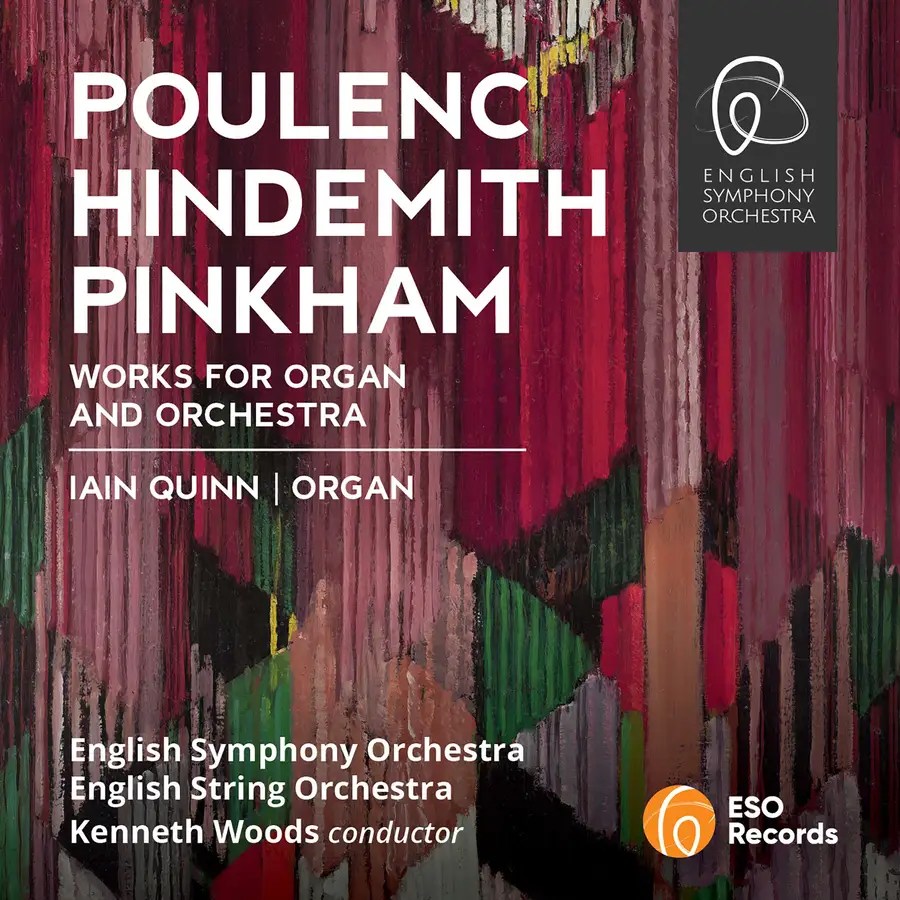
On Record – Iain Quinn, English Symphony & String Orchestras / Kenneth Woods: Works for Organ and Orchestra (ESO Records)

Iain Quinn (organ), English Symphony Orchestra (Hindemith), English String Orchestra / Kenneth Woods

Hindemith Kammermusik no.7 Op.46/2 (1927)
Pinkham Sonatas for Organ and Strings: no.1 (1966); no.2 (1966); no.3 (1987)
Poulenc Concerto in G minor for Organ, Strings and Timpani FP93 (1934-8)

ESO Records ESO2601 [62’44”]
Producer Phil Rowlands Engineer James Walsh

Recorded 1-3 April 2025 at Merton College Chapel, Oxford

Reviewed by Richard Whitehouse

What’s the story?

The English Symphony Orchestra (and its ‘String Orchestra’ incarnation) continues releases on its ESO Records label with a collection of works for organ and orchestra featuring the industrious Iain Quinn, and which includes the first recordings of two organ sonatas by Daniel Pinkham.

What’s the music like?

Much the most often heard organ concerto (as opposed to organ symphony), that by Poulenc never fails to entertain and provoke: a judicious synthesis of musical past and present, high- and low-art, the serious and skittish – all given focus by its composer’s tendentious sense of style. It certainly sounds cohesive on this persuasive recording, Quinn alive to those reckless expressive contrasts and Kenneth Woods shaping its seven continuous sections into a logical yet purposeful whole. The relatively lengthy third section emerges as a ‘slow movement’ of encroaching pathos, and only the sixth disappoints with its ‘music-hall’ aspect rather muted. What is never in doubt is the seriousness of Poulenc’s response to tragic circumstances and his aspiring towards a transcendence that is cursorily denied by those fateful final gestures.

Interestingly, the seventh and final of Hindemith’s Kammermusik itself finds its composer at something of an aesthetic crossroads as regards that trenchant objectivity of the music from his early maturity then the greater emotional range of what followed. Certainly, its opening movement has a vigour but also self-containment duly leavened in the slow movement with its eloquent enfolding of the soloist into the orchestral texture; the finale fusing elements of the preceding on route to a peroration whose expressive force is a sure marker for the future.

Interest naturally alights on music by Daniel Pinkham (1923-2006), the American composer and organist who, based largely in Boston, wrote extensively in most genres while being best known for his choral and organ music. The three works heard here are ‘Church Sonatas’ akin to those from the Baroque and Classical eras, notably the 17 such pieces Mozart wrote in the 1770s. While the First Sonata is an appealing Andante, the Second Sonata contrasts its more inward Andante with a capering Allegro; the Third Sonata duly extended to four movements with its ingratiating Allegro and animated final Vivace framing a quizzical Allegretto and an Andante whose wistful poignancy makes it the highlight from among these pieces. Music for which Quinn evidently feels real affinity, rendered here with the necessary poise and finesse.

Does it all work?

Almost always. Among the most inclusive of present-day organists in terms of his repertoire, Quinn is an assured exponent throughout while receiving steadfast support from Woods and the ESO. Sound does full justice to the Dobson Organ of Merton College Chapel, even if the reverberant acoustic is not ideally suited to the Hindemith as this affects the music’s textural pungency or its overall assertiveness. Even so, both this and the Poulenc can hold their own with earlier recordings, while that of the Pinkham should prove difficult to surpass in future.

Is it recommended?

Indeed so. The booklet features detailed notes about each work by Guy Rickards, along with pertinent observations about this organ in the context of those ‘Neoclassic Instruments’ built in quantity, most notably North America, following the Second World War. Fascinating stuff!

Listen / Buy

You can listen to excerpts and explore purchase options at the Presto Music website. Click on the names to read more about organist Iain Quinn, conductor Kenneth Woods, the English String / Symphony Orchestra and composer Daniel Pinkham

Published post no.2,890 – Sunday 17 May 2026
On Record – Sarah Beth Briggs: Small Treasures (AVIE)

by Ben Hogwood

What’s the story?

Small Treasures presents a typically inventive programme compiled by pianist Sarah Beth Briggs. In it she presents works by a trio of inseparable Romantic composers, with late-ish Robert Schumann, lesser-heard Clara Schumann and very late Brahms, his final compositions for solo piano.

Complementing these are thoughts from two members of Les Six, Germaine Tailleferre and Francis Poulenc – with the bonus of a cheeky encore from Mozart.

What’s the music like?

In a word, lovely. Briggs is a strong communicator, and finds the personal heart of Schumann’s Waldszenen – which is actually quite a Christmassy set of pieces. She particularly enjoys the intimacy of character pieces like Einsame Blumen (Lonely Flowers) and the delicate but rather haunting Vogel als Prophet (The Prophet Bird), beautifully played here.

A tender account of Robert’s Arabeske is a welcome bonus, an intimate counterpart to the more extrovert Impromptu of Clara. Written in c1844, the piece floats freely on the air in Briggs’s hands. By contrast the Larghetto, first of the Quatre Pièces Fugitives, inhabits a more confidential world, one furthered by a restless ‘un poco agitato’. The Andante espressivo, easily the most substantial of the four, is more serene, and it is tempting to draw a link between this and the mood of Robert’s Traumerei, from Kinderszenen. The Scherzo with which the quartet finishes is charmingly elusive, with clarity the watchword of this interpretation,  

Poulenc’s Trois Novelettes are typically mischievous and elegant by turn, spicy harmonies and bittersweet melodies complementing each other, before Tailleferre’s Sicilienne, a charming triple-time excursion with a bittersweet edge.

The Brahms Op.119 pieces are serious but have plenty of air too, and the final majestic Rhapsody is grand but not over-imposing, Briggs resisting the temptation to go for volume over expression.

Does it all work?

It does – and the album is easy to listen to the whole way through, the lightness of the Mozart Eine Kleine Gigue complementing the Brahms at the end. Some of the classic recordings of the Brahms and Schumann pieces arguably find more angst, but these finely played accounts are a treat, especially in context.

Is it recommended?

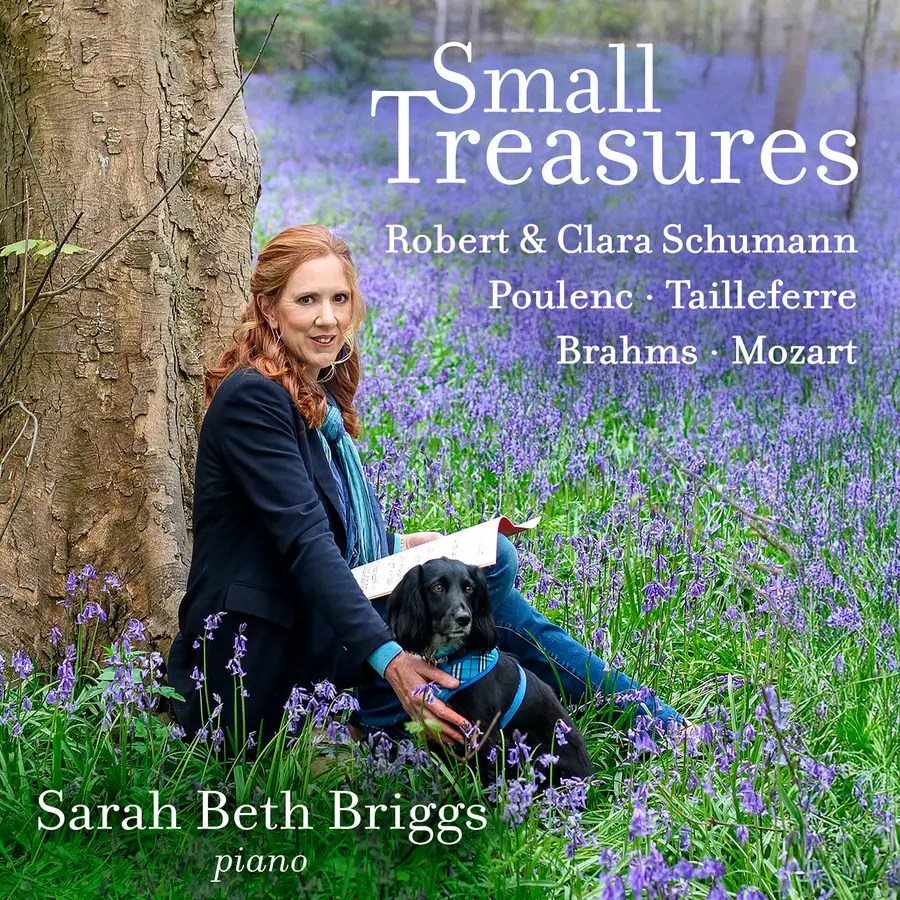
It is. Rather than visit a playlist on your go-to streaming service, you can just put this album on to create a very satisfying recital. Small Treasures, indeed – as is Sarah’s dog, who joins her on the album artwork!

Listen / Buy

You can listen to Small Treasures on Tidal here, while you can explore purchase options on the Presto website

Published post no.2,756 – Monday 22 December 2025

In concert – Charlotte Saluste-Bridoux & Joseph Havlat @ Wigmore Hall: Szymanowski, Poulenc & Schubert

Charlotte Saluste-Bridoux (violin, above) and Joseph Havlat (piano, below)

Szymanowski 3 Myths Op.30 (1915)
Poulenc Violin Sonata (1943)
Szymanowski arr. Havlat 3 Kurpian Songs (from Op.58) (1930-32)
Schubert Rondo Brillant in B minor D895 (1826)

Wigmore Hall, London
Tuesday 10 April 2024 (1pm)

by Ben Hogwood

This recital was given under the umbrella of YCAT (Young Classical Artists Trust), the organisation supporting promising classical talent celebrating their 40th anniversary this year. Violinist Charlotte Saluste-Bridoux is one of the current roster, and with pianist Joseph Havlat she gave a captivating recital.

The two began with the highly perfumed 3 Myths of Karol Szymanowski, ideal concert material that can show off a performer’s virtuosity but also their descriptive potential and range of tonal colour. These pieces, written as part of a highly productive partnership Szymanowski enjoyed with violinist Pawel Kochanski, were declared by the composer to have created ‘a new…mode of expression for the violin’.

There was a sense of the new in this performance, notable for its wide range of instrumental colour. The first ‘myth’, La fontaine d’Aréthuse, was strongly characterised, the fountain vividly evoked by Havlat’s opening phrases before Saluste-Bridoux took control with fearless virtuosity. Both musicians were notable for their convincing melodic phrasing, the violin sound strikingly beautiful both with and without the mute. The musical links back to Wagner and Franck were clear, most notably in Narcisse, where the performers brought clarity to the dense counterpoint. This was descriptive music indeed, and Szymanowski’s sound world – unusually advanced for 1915 – took the audience far from the hall. The hollow piano towards the end of Dryades et Pan was notable, Havlat responding to the ghostly harmonics from the violin.

The excesses of Szymanowski were countered by one of Poulenc’s most substantial chamber works. The Violin Sonata has a very different profile to its more famous counterparts for wind instruments, being a troubled work bearing the imprint of the Second World War and personal bereavement. Completed in 1943, it is a work riddled with dark anxiety, though this performance brought out the bittersweet lyricism of the first movement. The nocturnal Intermezzo evoked the guitar, suggesting the influence of Debussy but soon holding the audience in suspense before the finale took off at quite a pace, as though looking to evade capture. Once again this was a performance of high technical standard, one that got beneath the surface to reveal the loss at the heart of Poulenc’s writing – the composer lamenting the Spanish poet Federico Garcia Lorca, who died in the Spanish Civil War.

We then heard three highly effective arrangements from Joseph Havlat of Szymanowski’s Kurpian Songs, selected from the twelve Polish folk texts set by the composer for singer and piano in 1932. As Prokofiev showed with his arrangements of 5 Poems of Anna Akhmatova for violin and piano, such a transcription can be extremely effective – and Havlat’s arrangements were just that, ideally balanced and equally spread between violin and piano. Saluste-Bridoux played with notable dexterity, the two performers enjoying the rustic Bzicem kunia and the sharp outbursts, tinged with regret, of A pod borem siwe kunie.

The musical outlook changed notably for Schubert’s Rondo brilliant, which was effectively an extended encore. The violin was arguably too full bodied to start with, the piano back in the mix, but as the Rondo progressed the balance was restored and we were able to enjoy Schubert’s humour, expressed through an oft-repeating, stop-start theme. This was successfully lodged in our heads by the end, capping an extremely fine recital. These are two artists to watch out for – especially with the Schubert recorded for Delphian Records.

Published post no.2,144 – Wednesday 10 April 2024

In concert – Thomas Trotter, CBSO / Pierre Bleuse: Saint-Saëns ‘Organ’ Symphony; Ravel, Poulenc & Holmès

Thomas Trotter (organ, above), City of Birmingham Symphony Orchestra / Pierre Bleuse

Ravel Le Tombeau de Couperin (1914-17, orch. 1919)
Poulenc Organ Concerto in G minor FP93 (1934-8)
Holmès La Nuit et l’Amour (1888)
Saint-Saëns Symphony no.3 in C minor Op.78 ‘Organ’ (1885-6)

Symphony Hall, Birmingham
Wednesday 20 September 2023 (2.15pm)

Reviewed by Richard Whitehouse

It hardly seems 40 years since Thomas Trotter took on the post of Birmingham City Organist in succession to the venerable George Thalben-Ball, and it was good to see his local orchestra marking the occasion with a programme which featured two staples from the organ repertoire.

Some 85 years on and it might be hard to imagine just how radical (or, better still, subversive) Poulenc’s Organ Concerto was through its juxtaposing elements both serious and populist in a continuous sequence that comes together precisely because of this stylistic incongruity. Not that Trotter betrayed any such doubts in what proved a tautly cumulative reading; aspects of the Baroque and Classical colliding with a sombre if never wantonly earnest Romanticism in which strings melded seamlessly with the soloist while timpani underpinned climactic points. Pierre Bleuse ensured a steady gathering of tension over the lengthy central span of slow(ish) music, with the final stages making the most of that music-hall element as makes the fateful ensuing recessional then baleful closing cadence more decisive in its stark emotional impact.

Organ transcription of Ravel’s Le Tombeau de Couperin is not unknown, but this afternoon’s performance was of the composer’s familiar orchestral version. Bleuse (below) conveyed the reticent elation of the Prélude, and while his expressive emphases made the Forlane overly studied in its knowingness, the wistful elegance of the Minuet sounded as disarming as was Yurie Aramaki’s oboe playing. Nor was any lack of poise in the central sections of the Rigaudon, even if Bleuse’s slightly stolid tempo in those either side sacrificed some of the music’s elan.

Composer, artist and feminist Augusta Holmès left a substantial output whose ambition may outstrip its attainment but includes such gems as La Nuit et l’Amour. Originally an interlude in her symphonic ode Ludus pro patria, it had established itself as an autonomous item well before becoming a staple of late-night music programmes – its canny amalgam of sensuous harmonies and heady lyricism recalling such contemporaries as Massenet and Godard, albeit with her engagingly personal twist which communicated itself readily in this performance.

Saint-Saëns was guarded with his assessment of Holmès, but his remark on her ‘flamboyant orchestration’ feels no less applicable to the Organ Symphony such as constitutes his greatest orchestral achievement and of which the City of Birmingham Symphony has given numerous memorable outings. While not among these, this account still left little to be desired – Bleuse launching the first part with keen expectancy before steering a purposeful if slightly dogged course through the ensuing Allegro. Seated up high at the organ console (rather than adjacent to the orchestra as with the Poulenc), Trotter made the most of the Adagio’s luminous timbral registrations which complemented the similarly burnished orchestration, while there was no lack of vigour or vivacity in the ‘scherzo’ section that bursts in at the start of the second part.

It is easy to make the ‘finale’ overbearing in its grandiloquence, but Trotter resisted any such temptation – he and Bleuse conveying the impetus and excitement of this music as it headed through passages of chorale and fugue toward a peroration as satisfying as it was irresistible.

You can read all about the 2023/24 season and book tickets at the CBSO website. Click on the artist names for more information on organist Thomas Trotter and conductor Pierre Bleuse

BBC Proms 2023 – Glyndebourne Festival Opera, London Philharmonic Orchestra / Robin Ticciati – Poulenc: Dialogues des Carmélites

Prom 30 – Poulenc: Dialogues des Carmélites

Blanche de la Force Sally Matthews (soprano), Madame de Croissy (Old Prioress) Katarina Dalayman (mezzo-soprano), Madame Lidoine (New Prioress) Golda Schultz (soprano), Mother Marie of the Incarnation Karen Cargill (mezzo-soprano), Sister Constance of St Denis Florie Valiquette (soprano), Mother Jeanne of the Child Jesus Fiona Kimm (mezzo-soprano), Marquis de la Force Paul Gay (bass-baritone), Chevalier de la Force Valentin Thill (bass-baritone), Father Confessor Vincent Ordonneau (tenor, Jailer Theodore Platt (baritone), First Commissary Gavan Ring (tenor), Second Commissary Michael Ronan (bass-baritone), Thierry (a footman) Jamie Woollard (bass), M. Javelinot (a physician) Matthew Nuttall (baritone), Sister Mathilde Jade Moffatt (mezzo-soprano), Officer Michael Lafferty (baritone), The Glyndebourne Chorus, London Philharmonic Orchestra / Robin Ticciati

Directed at the Proms by Donna Stirrup

Royal Albert Hall, London
Monday 7 August 2023

by John Earls photos by Sisi Burn / BBC; John Earls (panorama pic)

Semi-staged performances of operas can be tricky. Especially if given in the cavernous space that is the Royal Albert Hall.

Glyndebourne Opera’s production of Francis Poulenc’s Dialogues des Carmélites (Dialogues of the Carmelites) this summer had already received some excellent reviews so it was with some excitement and nervousness that I approached this Proms performance directed by Donna Stirrup, based on Barrie Kosky‘s Glyndebourne production.

It was a breathtaking evening combining sensitive and thoughtful staging, outstanding playing of the magnificent score by the London Philharmonic Orchestra under Robin Ticciati, and some stunning individual performances.

Poulenc’s 1957 opera is a fictionalised version of the story of the Martyrs of Compiègne, Carmelite nuns who, in 1794 during the closing days of the Reign of Terror during the French Revolution, were guillotined in Paris for refusing to renounce their vocation. Whilst rooted in this harrowing story this production also touches on the theme of persecution more generally.

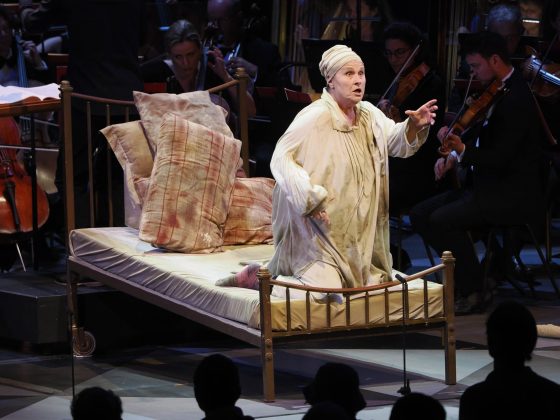
There were a number of outstanding solo performances. Sally Matthews (Blanche), Katarina Dalayman (Madame de Croissy, Old Prioress, above), Golda Schultz (Madame Lidoine, New Prioress), and Karen Cargill (Mother Marie of the Incarnation). But I was particularly taken with Florie Valiquette whose portrayal of Sister Constance of St Denis was gripping throughout and singing incredibly moving – “We die not for ourselves alone, but for one another, or sometimes even instead of each other” (it was good to have surtitles of George Bernanos’ impressive text).

But if the solo performances were captivating, the playing of the London Philharmonic Orchestra conducted by Robin Ticciati was exceptional. The range in colours and timing was just enthralling with Ticciati measuring silences to magical effect.

The concluding march to the scaffold and Salve Regina with accompanying guillotine-drops were affecting and unforgettable. This was a remarkable performance of a remarkable piece.

This concert is available on BBC Sounds until early October. For more on the 2023 BBC Proms, visit the festival’s website at the BBC

John Earls is Director of Research at Unite the Union and tweets at @john_earls