
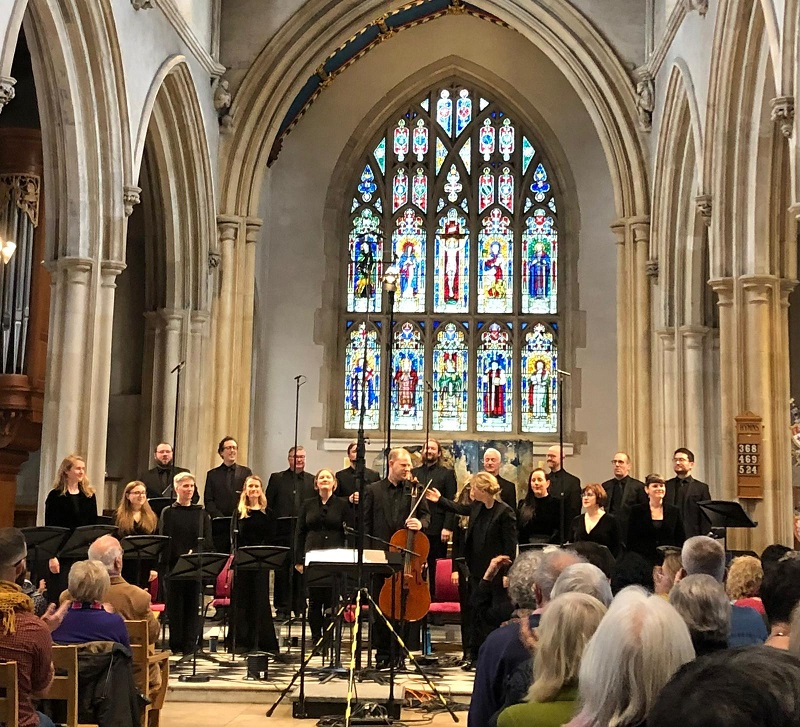
In Concert – BBC Singers @ St Giles’ Cripplegate & St Paul’s Knightsbridge

by John Earls

It has been quite a time for the BBC Singers recently. As this world-renowned choir approaches its 100th anniversary, the past few weeks have seen the BBC announce their closure, and magnificent campaign against it in response (including more than 700 composers writing to the BBC director general in condemnation) Here on Arcana you can get a glimpse of their recorded worth, with an appreciation and a BBC Singers playlist.

Thankfully a temporary reprieve has since been issued, with the BBC issuing a statement on an “alternative funding solution”.

All of this was book-ended by two concerts of sacred music broadcast on BBC Radio 3 for Holy Week, both demonstrating what a unique and valuable choir they are.

On 17th March they gave their first concert following the BBC’s shameful axing announcement at St Giles’ Cripplegate in London. It was inevitably a special and emotional occasion. The programme of choral and cello music went under the bitterly ironic title of All Will Be Well (after Roxanna Panufnik’s piece of the same name which concluded the programme). “I’m still the producer of the BBC Singers” said Jonathan Manners in his introduction to much applause.

The concert was a fitting example of the range and depth of the choir’s repertoire in terms of time (it opened with Hildegard von Bingen’s O cruor sanguinis from the 12th Century) and style. It displayed impressively their ability to convey a sense of comfort and balm such as in Lesia Dychko’s short piece Blessed be the name (Emma Tring a beautiful solo soprano) as well something more unsettling like Fac me tecum pie flere by Sven-David Sandström.

But this was a programme of choral and cello music and cellist Benjamin Hughes was individually expressive as well as combining powerfully with the choir, both in evidence in Knut Nystedt’s Stabat Mater.

A magnificent encore of Maurice Duruflé’s motet Ubi Caritas was followed by a rapturous and moving ovation (below)

The concert was broadcast on BBC Radio 3 on Palm Sunday and is available online for a limited period.

Less than three weeks later, and following the BBC statement announcing a suspension of the closure, the group performed a Music for Maundy Thursday concert of sacred pieces on the theme of ‘contemplation, sorrow and reflection’ for live broadcast on BBC Radio 3 at St Paul’s Church, Knightsbridge, London (above).

Yet again the programme highlighted the sweep of their repertoire opening with a meditative motet from the 1590s, Vittoria Aleotti’s Miserere mei, Deus (from the first published book of sacred music by a woman) and also featuring sacred pieces from the 21st Century (Karin Rehnqvist’s I raise my hands and Judith Bingham’s Watch with Me), as well as William Byrd’s 14th Century The Lamentations of Jeremiah.

But there were two pieces where the group really shone to spectacular effect. Domenico Scarlatti’s Stabat Mater à 10, with Richard Pearce on chamber organ, was stunning and utterly compelling in its detailed delivery. Francis Poulenc’s Quatre motets pour un temps de penitence made a glorious finale.

One must also acknowledge the key role of Chief Conductor, Sofi Jeannin, always assured yet empathetic. To watch her conduct is a mesmerising experience in itself.

The extent to which the BBC Singers and Jeannin develop and promote a diverse repertoire (they have a 50:50 gender policy for composers whose music they perform), engage in learning and community work, regularly perform commissions and broadcast on Radio 3 (making their phenomenal output available to such a wide audience) is all part of what makes them so unique.

I have seen them many times over many years and they never fail to move me. These two concerts only served to prove just why they are irreplaceable.

John Earls is Director of Research at Unite the Union and tweets at @john_earls

Click on this text to find out more about the Musicians’ Union campaign to protect the BBC Singers after September and action to stop job cuts at BBC Orchestras

In Concert – Martin Fröst, Roland Pöntinen & Sébastien Dubé @ Wigmore Hall: Night Passages – A Musical Mosaic

Martin Fröst (clarinet), Roland Pöntinen (piano), Sébastien Dubé (double bass)

Debussy Première rhapsodie (1909-10)
Chausson Andante and Allegro (1881)
Poulenc Sonata for clarinet and piano (1962)
Night Passages – A musical mosaic (with arrangements by the performers)
Domenico Scarlatti Sonata in D minor Kk32
Chick Corea Children’s Song no.15 (1978)
Rameau Les Indes galantes: Air pour les Sauvages (1735-6)
Purcell Incidental music for Oedipus, King of Thebes Z583: Music for a while (1692)
J.S. Bach Sinfonia no15 in B minor BWV801 (c1720)
Chick Corea Armando’s Rumba (1976)
Purcell Hornpipe in E minor Z685
Handel Menuet in G minor (1733)
Traditional Polska från Dorotea
Göran Fröst Klezmer Dance no.2 (2011)

Wigmore Hall, London
Wednesday 21 December 2022

Reviewed by Ben Hogwood

In 2019, Arcana was at the Wigmore Hall to see Martin Fröst and Roland Pöntinen give a concert of largely French music for clarinet and piano. Their encore hinted at an intriguing sequence of arrangements exploring connections between classical music and jazz. Three years on, that sequence has grown in stature, realised in recorded form as the Sony Classical album Night Passages, and given meaningful content by personal and world events.

Through lockdown, Fröst experienced intense bouts of Ménière’s disease, whose symptoms include unexpectedly severe bouts of vertigo and tinnitus. The clarinettist experienced one such bout while driving his car, which he thankfully negotiated without injury, but which bred a number of accompanying fever dreams. Expressed in the program notes, they lent a vivid written complement to the music.

Since 2019 the double bass of Sébastien Dubé has been added to the instrumental thinking, an essential musical component taking the arrangement style towards Jacques Loussier without ever resorting to parody. Unexpectedly, the group’s colourful arrangements did not always include the piano, allowing Fröst and Dubé the chance to explore the rewarding combination of clarinet and double bass through imaginative techniques and compelling improvisation.

The course of Night Passages led from a solemn sonata by Domenico Scarlatti to a Klezmer dance from Fröst’s brother Göran, by way of arrangements exploring the versatility of Baroque music. These were matched by jazz-inflected work from Chick Corea, with Armando’s Rumba presenting some vibrant syncopations, along with a celebration of the Swedish polska.

Frost’s artistry was almost beyond criticism, the clarinettist able to make even the most demanding technical passages appear nothing more than a walk in the park, airily improvising or running through sharply edged cadenzas. Dubé was no less impressive, and a remarkably wide range of colours issued from the double bass, whether bowed or plucked. His chemistry with Fröst was compelling, and the occasional use of vocals added to the mix. Roland Pöntinen also made the most of his chances to shine, providing the rhythmic verve to the dances but also a welcome, cleansing clarity which ran through the Baroque arrangements, tastefully and affectionately realised.

Prior to the interval we heard three short pieces by French composers for clarinet and piano. Debussy’s Première rhapsodie tells its story through a set of contrasting thoughts, initially set out in a humid atmosphere but becoming more outward facing as it gains in confidence. Fröst and Pöntinen had its many twists and turns instinctively under their fingers, finishing each other’s sentences as they did in the romantic, lyrical writing of Chausson’s Andante and Allegro, played with evident affection.

Yet it was Poulenc’s Sonata for clarinet and piano, completed in the year before his death, that made the most lasting impression. What a profound work this is, paying tribute to his friend and fellow composer Arthur Honegger. The slow movement holds the emotional centre of the work, with melancholy on occasion spilling over into outright sadness. Fröst’s quieter asides encouraged the audience to lean closer to the music, but these intimate thoughts were swept away by the exuberant finale, throwing caution to the winds. Fröst and Pöntinen played with great feeling throughout, typifying the approach of a concert that may not have been generous in length but which amply compensated through musical quality.

On Record – BBC Concert Orchestra / Bramwell Tovey – Poulenc: Les Animaux modèles, Sinfonietta (Chandos)

Poulenc
Sinfonietta (1947-48)
Two movements from ‘Les Mariés de la Tour Eiffel’ (1921, revised 1957)
Pastourelle from L’Éventail de Jeanne (1927)
Les Animaux modèles (complete ballet) (1940-42)

BBC Concert Orchestra / Bramwell Tovey

Chandos CHSA5260 [74’22″’]
Producer Brian Pidgeon Engineers Ralph Couzens, Alexander James
Recorded 10-12 March 2022 at Watford Colosseum

Reviewed by Ben Hogwood

What’s the story?

This collection of colourful works for orchestra by Francis Poulenc has as its main work the ballet Les Animaux modèles, based on The Fables of Jean de la Fontaine. A vibrant work, it clearly had huge significance for the composer, who started on its composition after the Nazi occupation of Paris in 1940, his aim ‘to find a reason to hope for the future of my country’. It received its first performance at the Paris Opera in 1942.

The ballet is symbolic, summarised in Nigel Simeone’s excellent booklet note about ‘a celebration of France’s past at its most lustrous’ than a collection of charming animal stories. It does however bring the story to life from the outset, with a vivid description of the dawn cutting to sharply characteristic portrayals of The Bear and The Two Companions, the former portrayed through an excellent horn solo, The Grasshopper and the Ant, The Amorous Lion, The Middle-aged Man and His Two Mistresses, Death and the Woodcutter, The Two Cockerels and finally The Midday Meal.

Complementing the ballet is the Sinfonietta, written for the BBC Third Programme and first heard in 1948. Initially the main themes of the work were to be part of a String Quartet that Poulenc was working on in 1945, but after its abandonment his friend and fellow-composer Georges Auric recognised the potential of the musical material. The work is dedicated to him in acknowledgement.

Completing the disc are two movements from Les Mariés de la Tour Eiffel, a collaborative single act ballet with Auric and the other members of composer collective Les Six, of which Poulenc was a leading member. There is also a soft-centred Pastourelle from another such collaborative piece, L’Éventail de Jeanne.

Very sadly this is the final recording made by the BBC Concert Orchestra’s principal conductor, Bramwell Tovey – completed just four months before his sad death from cancer at the age of 69.

What’s the music like?

In a word, colourful. Les animaux modèles is unquestionably the star turn, brilliantly played and characterised in this recording. Poulenc’s music is richly tuneful and beautifully orchestrated, often showing the influence of Stravinsky but realised with his own flair and mischievous humour. The central section of The Grasshopper and The Ant is a case in point, where a thrillingly brisk section cuts to an enchanting violin cadenza, the music briefly held in a spell until its release by shrill trumpets.

The Amorous Lion is a scene of great contrasts, with orchestral outbursts and volleys of percussion cutting to tender asides from string and woodwind choirs. The most substantial section – and arguably music – can be found in The Two Cockerels, where Poulenc realises music of great power and depth to portray the combat of the two birds. The surging climactic point, halfway through, is music of particularly strong feeling and resolve, Poulenc’s sentiments against the war reaching their heartfelt climax – before powerful exchanges between brass and the final toll on low piano. With passions largely spent, The Midday Meal provides a regal epilogue.

The slighter movements are no less fun, and The Middle-aged Man and his Two Mistresses scurries along furtively. Following Poulenc’s synopsis is enormously helpful, signposting the composer’s pictorial responses to the storyline as well as emphasising his wit.

In spite of its name, the Sinfonietta is one of Poulenc’s most substantial compositions. Far from being a slight, frothy work, it has a big-boned structure easily outdoing those dimensions, lasting nearly half an hour. Its convincing melodic arguments are led by the assertive first theme, drawing parallels with the Organ Concerto for its bite and resolve, while the second theme, beautifully realised here, brings mellow woodwind colouring. The second movement is a lively scherzo, balanced with tender asides that are fully realised in the slow third movement, a lyrical and colourful Andante cantabile. The brisk finale signs off with a flourish.

The two movements from Les Mariés de la Tour Eiffel are short but mischievous and entertaining, with humourous trombone interventions, while the Pastourelle is a charming addition.

Does it all work?

Yes. These are fresh, vibrant performances given with evident affection by the BBC Concert Orchestra. Bramwell Tovey brings out the colourful orchestrations, allows the lyrical melodies a bit of heart-on-sleeve approach where appropriate, and brings rhythmically sharp responses too. Poulenc’s colourful writing is brought to the fore, along with the melancholic undertones his music often carries.

Is it recommended?

Yes, on many levels. The quality of the music, the excellent Chandos recordings from Watford Colosseum and some very fine performances from which Bramwell Tovey takes his lead. The icing on the cake is the choice of Henri Rousseau’s Monkeys and Parrot in Virgin Forest as cover art. It is the ideal complement for a wonderful album.

Listen

Buy

For more information and purchasing options on this release, visit the Chandos website

In concert – CBSO Centre Stage: Poulenc Chamber music

cbso-centre-stage

Poulenc Sonata for Clarinet and Bassoon, FP32 (1922); Trio for Oboe, Bassoon and Piano, FP43 (1924-6); Sextet for Wind Quintet and Piano, FP100 (1931-2, rev. 1939-40)

City of Birmingham Symphony Orchestra Members: Marie-Christine Zupancic (flute),Emmet Byrne (oboe), Oliver Janes (clarinet), Nikolaj Henriques (bassoon), Elspeth Dutch (horn), Robert Markham (piano)

CBSO Centre, Birmingham
Friday 21 January 2022 2pm

Written by Richard Whitehouse

It made sense to devote a programme in the Centre Stage series – put on by musicians of the City of Birmingham Symphony Orchestra – to the chamber music of Poulenc, which is hardly less representative than those vocal and choral pieces that likewise run throughout his output.

Increasing in size and substance, the three works this afternoon were also a viable overview of the composer’s evolution during the interwar period. The Sonata for Clarinet and Bassoon finds Poulenc teasing out the expressive potential of Stravinsky’s often inscrutable chamber music from the previous decade; its Allegro and Final movements pursuing an agile dialogue whose harmonic astringency is offset by the wistful insouciance of its central ‘Romance’, in which the interplay between Oliver Janes and Nikolaj Henriques was at its most persuasive.

Stravinsky evidently had a direct output into the composition of the Trio for Oboe, Bassoon and Piano which, cut from similar stylistic cloth to the earlier piece, reveals greater emotional range. Not least in the opening movement’s pointed contrast between its wistful introduction and headlong Presto, or the Andante’s haunted charm – here emphasized by plaintive oboe playing from Emmet Byrne – whose ‘vulnerability behind the façade’ is duly swept away by a finale in which the breezy humour of the ballet Les biches comes unmistakably to the fore.

The Sextet cost Poulenc fair effort before reaching definitive form at the start of the Second World War but is arguably his most representative work at that stage. Not least in the way its animated opening Allegro makes a virtue of any imbalance between piano and wind quintet – Robert Markham keeping matters securely grounded – or sheer timbral and textural variety of the Divertissement with piquant contributions from flautist Marie-Christine Zupancic and horn player Elspeth Dutch. Nor was there any lack of verve in a Finale whose recollection of the work’s opening, now suffused with greater pathos, must surely be a comment on the times.

Eloquently realized, it brought to an end an admirable showcase for both music and musicians. Next week sees a no less engaging programme of Kodály and Korngold by the CBSO strings.

Further information on future CBSO Stage concerts can be found here

On record – Peter Dickinson: Lockdown Blues (Somm Recordings)

lockdown-blues

Barber (arr. Dickinson) Canzonetta Op. 48 (1977-8)*
Berkeley
Andante Op.23/6 (1945)
Cage
In a Landscape (1948)
Dickinson
Blue Rose (1978); Freda’s Blues (2016); Lockdown Blues (2020)
Ellington (arr. Dickinson)
Twelve Melodies (1932-43)*
Gershwin
Three-Quarter Blues (c1925); Who Cares? (1931)
Goossens
Lament for a Departed Doll Op.18/10 (1917)
Lambert
Elegiac Blues (1927)
MacDowell
To a Wild Rose Op.51/1 (1896)
Poulenc
Pastourelle IFP69 (1927); Bal fantôme IFP64/4 (c1934)
Satie
Trois Gymnopédies IES26 (1888); Trois Gnossiennes IES24 Nos.1-3 (1889-90)

Peter Dickinson (piano)

SOMM Recordings SOMMCD0644 [68’24”]

Producer & Engineer Peter Newble

Recorded 16 and 17 April 2021 at Potton Hall, Westleton, Suffolk. * indicates first recordings

Written by Richard Whitehouse

What’s the story?

Peter Dickinson here turns the third phase of lockdown to his – and our – advantage with this collection of piano music touching on the blues and jazz which have long been a mainstay of his careers as performer and composer, and which also includes two notable first recordings.

What’s the music like?

The programme commences with the pensive sadness of Dickinson’s Freda’s Blues, written in memory of the widow of Lennox Berkeley, continuing with a poised and refreshingly non-mawkish take on MacDowell’s perennial To a Wild Rose – its blues and rag idioms made the basis of Dickinson’s Blue Rose. The empathetic feel of Lambert’s Elegiac Blues in memory of singer Florence Mills is affectingly caught, while Dickinson’s marrying of blues and Bach in Lockdown Blues recalls George Shearing’s pioneering such fusions. After the drollery of Poulenc’s Bal fantôme, Dickinson’s reworking of the Canzonetta which Barber intended for his unrealized Oboe Concerto proves a focal-point in its searching pathos. Such a quality is also to the fore in Berkeley’s limpid Andante, as is the alluring charm of Gershwin’s Three-Quarter Blues – and to which the whimsy of Poulenc’s Pastourelle provides a pertinent foil.

Whether as solo pianist or in recital with his sister Meriel, Dickinson has been unstinting in his advocacy of Satie and his reading of the original Gnossiennes (not those three published decades after the composer’s death) lacks for nothing in perception. Such is equally the case when, after the insinuating charm of Gershwin’s Who Cares? then the wistful eloquence of Goossens’s Lament for a Departed Doll, he renders Satie’s evergreen Gymnopédies with an objectivity that not unreasonably plays down the mystical aura often attributed to this music.

Perhaps the highlight here is Twelve Melodies that Dickinson has arranged from Ellington’s big-band numbers in what proved a veritable ‘golden age’ for such music and not previously recorded in this guise. Picking out a selection might hardly seem necessary, but the yearning of Solitude, eloquence of Lost in Meditation, questing emotions of Azure then the expressive warmth of Mood Indigo stand out in a sequence which concludes with the phlegmatic charm of Day-Dream then haunting atmosphere of Prelude to a Kiss. Moreover, Dickinson has one final trick up his sleeve with an elegant rendering of Cage’s In a Landscape – music in which this most recalcitrant of composers comes closest to his beloved Satie with its ineffable grace.

Does it all work?

Very much so, thanks not merely to the range of music covered but also through Dickinson’s insight. Into his 87th year when these recordings were made, his technique remains as fluent as his understanding and enjoyment are audible. Long able to accommodate the populist and the experimental within his own music, such inclusiveness extends to the idiomatic aspect of his interpretation and the deftness of his touch. Surely nothing can now prevent the Ellington set being taken up by pianists everywhere, with the numerous shorter pieces ideal as encores.

Is it recommended?

Indeed. The piano sound has a naturalness and clarity ideal for this music, while few writers other than Dickinson would be equally aware of technical details and chart standings. Here is looking forward to further releases by this always resourceful pianist in his ‘Indian summer’.

Listen & Buy

You can discover more about this release and listen to clips at the SOMM Recordings website, where you can also purchase the recording. For more information on Peter Dickinson, click here.