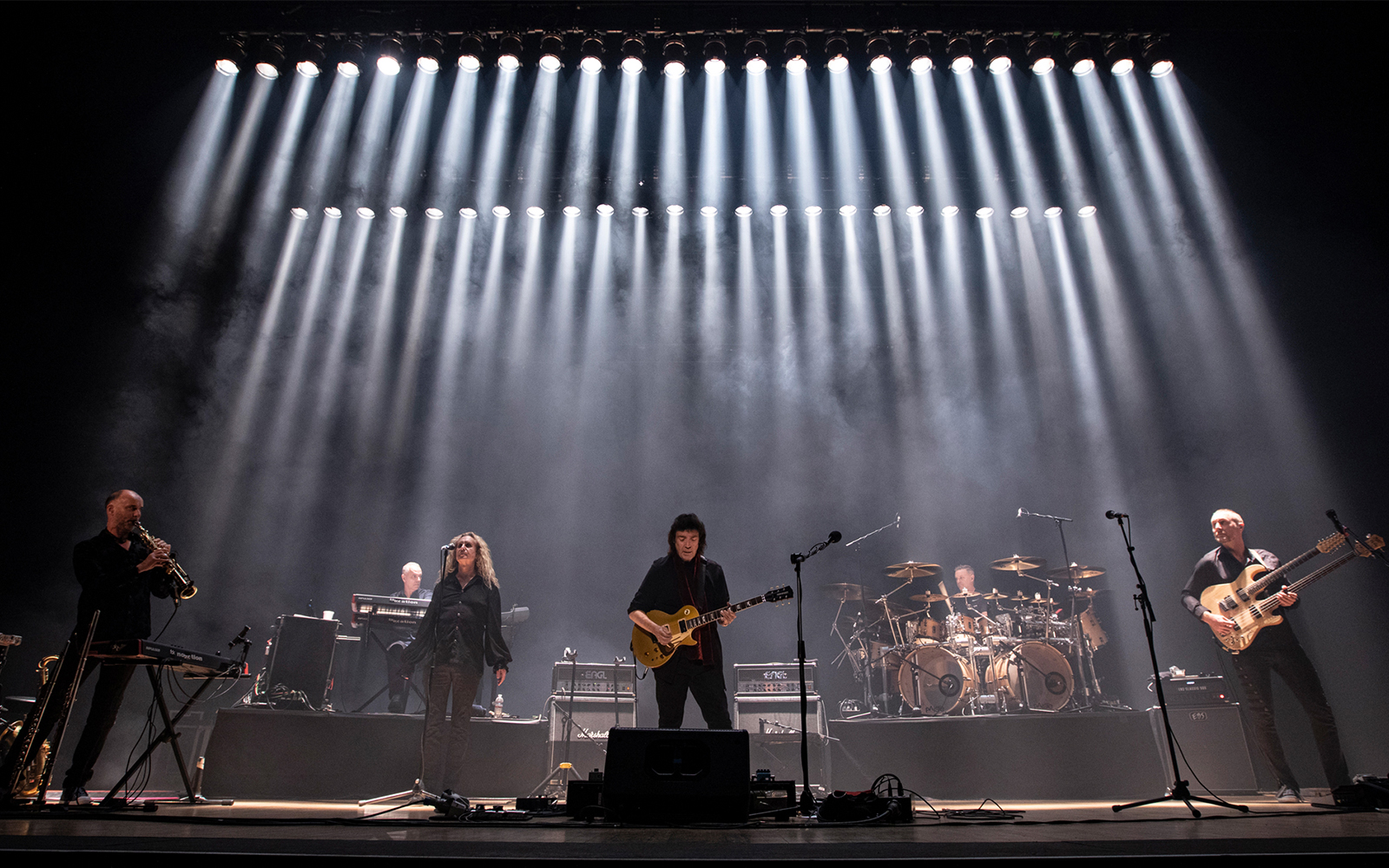
In Concert – Steve Hackett: Genesis Revisited @ Bournemouth – Foxtrot at Fifty + Hackett Highlights

Steve Hackett (vocals, guitar), Nad Sylvan (vocals), Roger King (keyboards, vocals) Rob Townsend (saxophone, flute, keyboards, percussion, vocals, Jonas Reingold (bass guitar, vocals), Craig Blundell (drums), Amanda Lehmann (additional guitar, vocals)

Reviewed by Ben Hogwood

Nearly 50 years to the day after it was released, Genesis‘ album Foxtrot is back for another turn. With Peter Gabriel as lead vocalist, it proved one of many peaks from the group’s defining line-up on its release, and to this day retains an air of exploration – both musically and lyrically – and a sense of peculiarly English mystery.

Steve Hackett was an integral part of the group when it was recorded, his role as principal lead guitarist a key driver for the music’s melodic content, sonorous acoustics and semi-classical demeanour. Since he left Genesis in 1977, Hackett has maintained a richly productive solo career notable for its consistency and elegance. We heard a number of excellent examples in the first half of this concert, some of them springing from the sessions for the Foxtrot album itself.

Nowadays, Hackett’s live band speak as he does, with little fuss made during their virtuosic contributions – save perhaps for multi-instrumentalist Rob Townsend, prodigiously talented through turns on saxophone, flute, keyboard, vocals and percussion – and the first to get the audience on side as part of the theatre. Behind him sat Roger King, an authoritative presence on keyboards who brought new orchestral elements to A Tower Struck Down along with the deep-throated roar of the organ sound on a thrilling performance of The Devil’s Cathedral.

Bassist Jonas Reingold was part of a solid foundation with the fluid drumming of Craig Blundell, and both were afforded lengthy solos in the concert which, while impressive, didn’t always complement the material. Less was definitely more here, as we found out even when Amanda Lehmann joined as an extra guitarist and vocalist. As a seven piece the band delivered one of Hackett’s calling cards, Spectral Mornings, with a mixture of mystery and grace. This segued nicely into the bright pop of Every Day, its five-part vocal harmonies dressing a tune with more than a passing resemblance to Beethoven’s Ode to Joy.

The first hour made a strong impression, Hackett’s solo material unquestionably up to the task, though many of the audience sat up noticeably after the interval for a second half account of Foxtrot. Now it was vocalist Nad Sylvan’s turn to take the lead, which he did impressively, his voice intriguingly balanced between early Phil Collins and Peter Gabriel – a nice fluke, since he sang naturally throughout. There was some theatre, too – a telescope pointed emphatically to the heavens at the end of a powerful Watcher Of The Skies, where laser eyes were also in play. His attention to detail was commendable, while never trying to imitate his predecessors.

The band allowed plenty of room for the weird and wonderful lyrical content of Foxtrot to come through, still drawing sharp parallels to the current situation in the UK, where little about human nature has changed in 50 years. Get ‘em Out by Friday was sharply observed, with its references to the new town of Harlow and property evictions around. The more reserved Time Table, found King’s piano ideally weighted, Sylvan’s voice emotive in response. The singer also held Can-utility And The Coastliners in his grasp, initially wistful but handling the song’s unusual melody with commendable control. The guitar sound, spearheaded by the modest Hackett from centre stage, was a constant joy, a lovely blend of acoustic and electric with intricate detail to bring out the album’s slightly pastoral leanings. The syncopations and changes of time signature were expertly handled by the band, to whom this album is now second nature.

The album’s key track, Supper’s Ready, was a fitting summit the band scaled with poise and intensity. A firm fan favourite after all this time, its ebb and flow was compelling, Hackett clearly enjoying himself with a wry smile now and then. The blistering finale turned everything up to eleven, Sylvan nailing the high notes if slightly backward in the audio mix.

A Genesis encore double included Firth Of Fifth, where King excelled on electric piano once again, and Los Endos / Slogans / Los Endos, starting languorously but growing to a flurry of colourful activity, and showing in the process how adventurous this music still sounds, five decades on.

Hearing the whole of Foxtrot without a break was a thrill, like sitting through an orchestral symphony, and witnessing Steve Hackett’s satisfaction was a considerable boon too. With his 25-date tour now complete, he continues as one of the hardest working man in progressive rock. This particular instalment showed him to be a modest and deeply caring musician, at his happiest when playing guitar centre-stage. That kind of thrill looks set to stay with him for a long while yet.

For more on Steve Hackett, visit his website
Deepchord returns!

As you will see from the last few days, Arcana has been interviewing and reviewing music by Deepchord – aka Rod Modell. You can read more about it

Switched On – Deepchord: Functional Designs (Soma Recordings)

by Ben Hogwood

What’s The Story?

Detroit musician, producer and field recorder Rod Modell returns from a relative sabbatical with Functional Designs, hid first album in five years.

Remaining with Glasgow label Soma Recordings, Modell has taken an enforced absence (see our interview with him) but one which has led to him coming back with more musical intent than ever. While it might sound strange to say that about an artist who makes very ambient music, Modell’s brand of ambience has an otherworldly intensity at its core.

What’s The Music Like?

This is indeed music on a deeply ambient plain. On first glance not a lot has changed in the Deepchord world – but given the earthy, weather beaten vistas we associate with him that is not a bad thingat all.

Amber sets the scene, with sheets of rain sweeping across the sonic picture, a wide open and comforting view if not completely settled. A four to the floor rhythm is established at the start of Darkness Falls, which is thick with outdoor ambience. Strangers is especially good, a moody cut that has a dub-infused undercarriage.

Deepchord compositions often feel like musical weather systems, such as Panacast, but Cloudsat feels in much more of a hurry to get across the sky. Ebb And Flow, on the other hand, is an effortless and beautiful sequence depicting slow progress against a warm bed of keyboard sounds. Warmer still is the dubby Sun, where a sonorous bass drum supports the heat haze of an incredibly restful added-note chord.

Does It All Work?

It does. As with almost all Deepchord compositions there is a surety to his work that is at once compelling and reassuring.

Is It Recommended?

Yes – and it’s great to have him back at the start of a new chapter.

On Record – Royal Liverpool Philharmonic Orchestra / Domingo Hindoyan – Debussy, Dukas & Roussel (Onyx Classics)

Debussy Prélude à l’après-midi d’un faune L86 (1894); Jeux, L133 (1912)
Dukas La Péri (1911)
Roussel Bacchus et Ariane Op.43 – Suite no.2 (1931)

Royal Liverpool Philharmonic Orchestra / Domingo Hindoyan

Onyx Classics ONYX4224 [68’07″’]
Producer Andrew Cornall Engineers Philip Siney, Christopher Tann
Recorded 20-21 January, 24, 25 & 27 February 2022 at Philharmonic Hall, Liverpool

Reviewed by Richard Whitehouse

What’s the story?

Domingo Hindoyan’s first release as Chief Conductor of the Royal Liverpool Philharmonic Orchestra is a sequence of French ballet music which stretches across almost three decades, taking in that broad stylistic succession from Impressionism to Neo-Classicism as its remit.

What’s the music like?

Belatedly acknowledged as one of the defining masterpieces from the 20th century, Debussy’s Jeux is more familiar in the concert hall, where its myriad of formal subtleties and expressive nuances can more fully be savoured. Without ever feeling rushed, Hindoyan’s take is an alert and impulsive one – lacking just a last degree of mystery in its opening and closing pages, but with its larger sections maintaining a flexible momentum and those calmer interludes exuding a tangible expectancy. A reading, then, which would rank high on any shortlist of recordings.

Almost two decades on, Roussel’s Bacchus et Ariane ballet inhabits a very different aesthetic. Effectively its second act, the Second Suite is not lacking for any sensual appeal – witness the interplay of violin and viola in its ‘Introduction’ (eloquently rendered by Thelma Handy and Nicholas Bootiman), or mounting fervour of The Kiss then ingratiating poise in Dance of Ariadne and Bacchus. Hindoyan has their measure, duly taking the final Bacchanale at an impetuous if never headlong tempo that builds to an apotheosis of finely controlled abandon.

Although it achieved notoriety via Nijinsky’s choreography (and dancing) in 1912, Debussy’s Prélude à l’après-midi d’un faune was fully established as a game-changer in Western music – its opening flute melody (languidly played by Cormac Henry) setting in motion a sequence of episodes whose content is only marginally less remarkable than those seamless transitions between them. Ensuring an unbroken continuity, Hindoyan summons a response of unforced rightness in music whose essence is only made explicit as the last notes resonate into silence.

Finally, to Dukas and La Péri which proved his final work of any real consequence. After its brass delivers a lusty rendering of the Fanfare, the orchestra makes the most of this ‘poème dansé’ – whether in its crepuscular initial stages, the sweeping melody that duly comes to the fore then that orgiastic passage which sets in motion a gradual if unfaltering approach toward the main climax. Suitably uninhibited here, Hindoyan rightly places greatest emphasis on the ensuing postlude – its mingled radiance and regret surely as affecting as any music of this era.

Does it all work?

Yes, in terms of individual works. Hindoyan is evidently at home in this music, and the RLPO clearly relishes playing music not at the forefront of its programmes during recent years. The Roussel seems a little out of context, those ‘symphonic fragments’ from his earlier ballet Le festin de l’araignée would have been more appropriate, with Debussy’s Prélude replaced by Ravel’s Valses nobles et sentimentales for a cohesive selection of French ballet music from just before the First World War. Hopefully Hindoyan will tackle these pieces in due course.

Is it recommended?

Indeed. The RLPO’s playing is abetted by the spaciousness and definition of sound obtained from Liverpool’s Philharmonic Hall, and Andrew Stewart pens succinctly informative notes. The association between orchestra and conductor looks set to go from strength to strength.

Listen

For more information on this release, and for purchase options, head to the Onyx Classics website. For more on the artists, head to the websites of the Royal Liverpool Philharmonic Orchestra and their principal conductor Domingo Hindoyan.

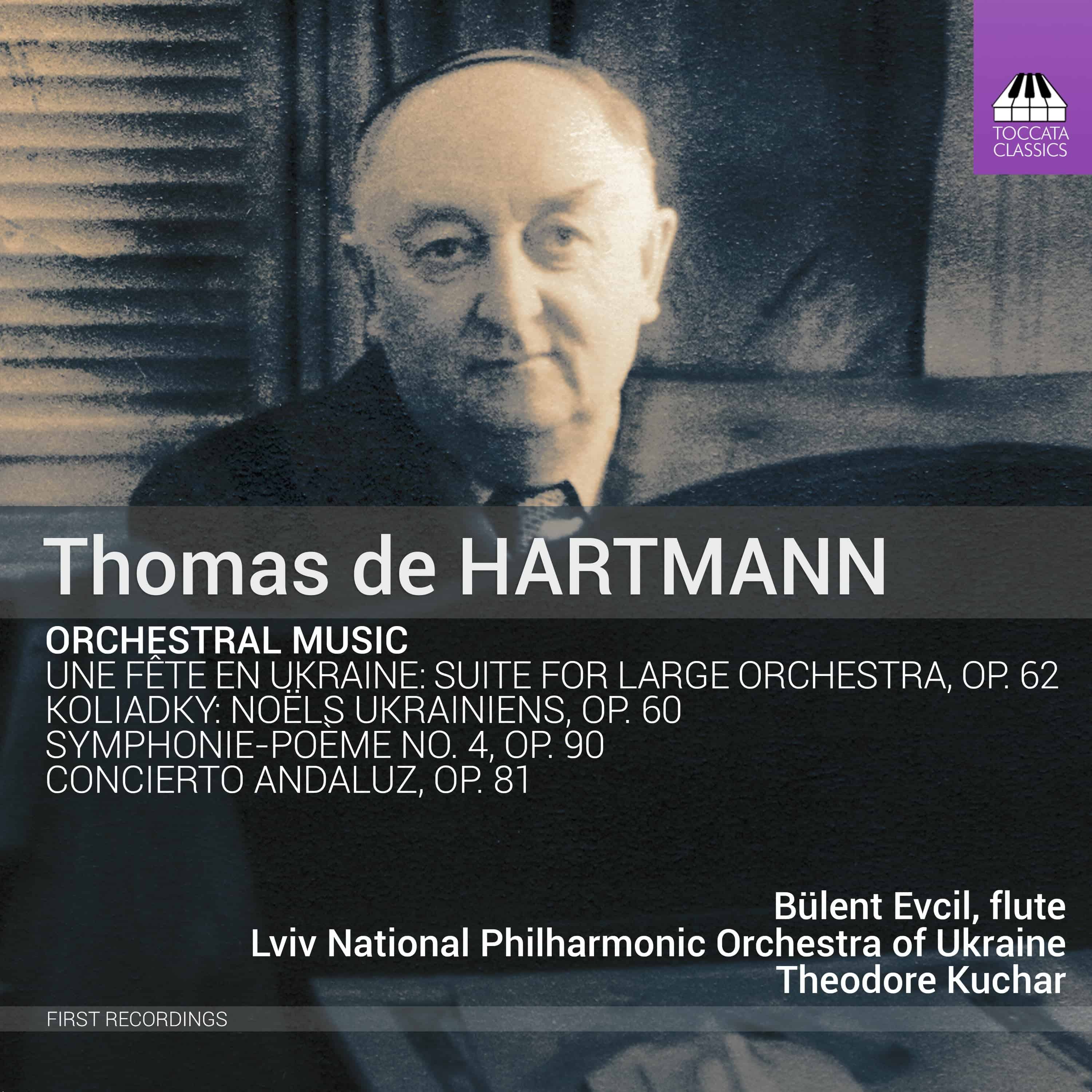
On Record – Bülent Evcil, Lviv National Philharmonic Orchestra of Ukraine / Theodore Kuchar – Thomas de Hartmann: Orchestral Music (Toccata Classics)

Thomas De Hartmann
Koliadky – Noëls Ukrainiens Op.60 (1940)
Une fête en Ukraine Op.62 (1940)
Concierto Andaluz Op.81 (1949)
Symphonie-Poème no.4 Op.90 (1955)

Bülent Evcil (flute), Lviv National Philharmonic Orchestra of Ukraine / Theodore Kuchar

Toccata Classics TOCC0633 [65’43″’]
Producer Andriy Mokrytskiy Engineer Oleksii Grytsyshyn
Recorded 11-13 September 2021 at National Philharmonic Hall, Lviv, Ukraine

Reviewed by Richard Whitehouse

What’s the story?

Toccata Classics continues its explorations with this release of orchestral music by Thomas de Hartmann (1885-1956), his posthumous reputation largely centred on his association with the Armenian philosopher George Gurdjieff but whose own music is well worthy of revival.

What’s the music like?

Although the Noëls Ukrainiens might appear as the descendent of folk-inspired sets by such as Rimsky-Korsakov or Lyadov, de Hartmann seeks rather to evoke the essence of this music than by quoting traditional melodies. The initial Chant spiritual for strings is a pertinent case in point – its textural and expressive restraint characteristic of what follows, notably the more developed final numbers: the chorale-like solemnity of La veille de l’Épiphanie, simmering fervour of Adieu, Koladá and Mussorgskian vigour of Goussak for an effervescent ending.

In his later years de Hartmann tackled the symphonic genre, albeit from a typically personal vantage in his Symphonie-Poèmes. The fourth of these remained unfinished at his death, with only its initial movement fully orchestrated. Over little more than five minutes, it provides a fair encapsulation of the composer’s later thinking – not least through an elaborate and often imaginative orchestration which accentuates formal obliqueness and expressive disjunctions. Intriguing as it is to speculate what came next, this remains a cohesive statement as it stands.

Written for Jean-Pierre Rampal then taken up by equally illustrious flautists such as Marcel Moyse, the Concierto Andaluz packs a considerable amount into its 10 minutes. Whether in the plaintive lyricism of the Entrada y Romanza, the fleet-footed and capricious Scherzino that is Juego – its winsome trio providing for necessary contrast, or the sultry evocation of Cante y Juerga, this is something of a hidden gem from the repertoire of concertante works for flute and deserving of greater exposure. Bülent Evcil leaves no doubt as to his advocacy.

Arranged from an eponymous ballet celebrating Catherine the Great, Une fête en Ukraine is de Hartmann at his most engaging. Not least the festive Ouverture, with its antecedents in the Russian ‘silver age’, or regal eloquence of Fanfare et Sarabande. The final three items are most substantial – the suitably fanciful imaginings of Incantation et danse du Chamane, the plangent modality of Nocturne, then the panache of Danilo Coupor (an English dance popular among Russian nobility in the early 19th century) which brings a scintillating close.

Does it all work?

Pretty much. That all four of these pieces are from de Hartmann’s maturity means that such influences as there were of earlier composers, primarily the melodicism of Tchaikovsky and harmonic innovations of Rimsky, have been subsumed into a more astringent while always eventful idiom. Both the shorter pieces would make attractive additions to a concert, and the larger collections each feature several items that are worth encountering in their own right – maybe as encores to round-off a programme from one of the more enterprising orchestras.

Is it recommended?

Yes, not least with the Lviv National Philharmonic giving of its best under the astute direction of Theodore Kuchar. Unexceptionally fine sound, with exceptionally detailed annotations from John R. Mangan and Evan A. MacCarthy. A follow-up volume of de Hartmann is imminent.

For more information on this release, and for purchase options, head to the Toccata Classics website. More on Thomas de Hartmann can be found here – while you can click on the artist names for more on Bülent Evcil, Theodore Kuchar and the Lviv National Philharmonic Orchestra of Ukraine