Harmony is the first album from Swedish producer Sebastian Fronda under his new Slumberville alias. Fronda has been making music for more than two decades, labelled as one of Sweden’s hip hop pioneers, and has established a strong live presence in the Nordic countries with more than 500 shows.
Slumberville is intended as a moniker under which he can make lo-fi music, dipping into his hip hop sensibilities but making room for samples and appropriations from a number of musical forms. For Harmony, he ‘Google-watched’ a number of different places around the world, such as Paraná River, assembling a set of travelcards to document his findings in musical form.
What’s the music like?
Slumberville veers towards the horizontal in his approach on this album, but there are some enjoyably quirky moments that keep the listener guessing. For The Win is quite spiky, with its staccato cello, while Chinatown plays loosely with an Oriental melody.
The most enjoyable track is Paraná River, with a couple of winsome melodies over a low slung bass and endearing hip hop beat, but a close second to this is the singalong What A Great Feeling, with its dreamy optimism. Fronda’s musical humour ensures there are plenty of wry smiles throughout.
Does it all work?
It does, largely – though some of the ideas here could be more fully developed into more tracks double the length. This is a compliment to the humour and subtle inspiration that runs through these tracks and their source material.
Is it recommended?
It is. Slumberville has made a diverting, quirky album that is a good deal of fun. It has endearing, light humour, and its beats have a spring in their step that lightens the mood.
Collisions is so-named because it is the coming together of a musical trio. Tom Hodge, Ollie Howell and Ciaran Morahan are the three musicians in question, and each brings a different skill-set. Hodge is a film composer whose connections include Max Cooper and Floex, Howell is a composer and drummer, while Morahan is described as a ‘post-rock composer’, whose output includes work with Codes In The Clouds and VLMV.
What’s the music like?
There are two elements to the collaboration album – ‘Collisions’ tracks and ‘Motions’. The former set the scene and the sonic perspectives, while the latter offer free-form musical explorations, allowing Hodge’s piano and clarinet and Howell’s drums to work their magic largely unfiltered. This works particularly well. While the Collisions have a curious order (beginning with the spacious II then moving through I, III and IV), they are ideally paced. II offers a big panorama, with concrete heavy drums and spacey synths, while I is a really good blend of subtle, brushed drums and with a thoughtfully probing piano line, before bringing in a sonorous clarinet. III has a similar profile, though this time the piano is given more space to air its thoughts.
Does it all work?
Yes – and the three artists have managed to get the ideal blend of musical events and time for reflection. Collisions is in effect two genres – an underlying ambience, but with carefully thought out ideas above them that bring positive energy and vibrant colours.
Is it recommended?
Yes – enthusiastically. Collisions will reward those who enjoy musical ambience of a wider scope, such as Erland Cooper, or those who enjoy the chattering electronics of an artist such as Max Cooper, who has close connections here. Get it and revel in the musical inspiration.
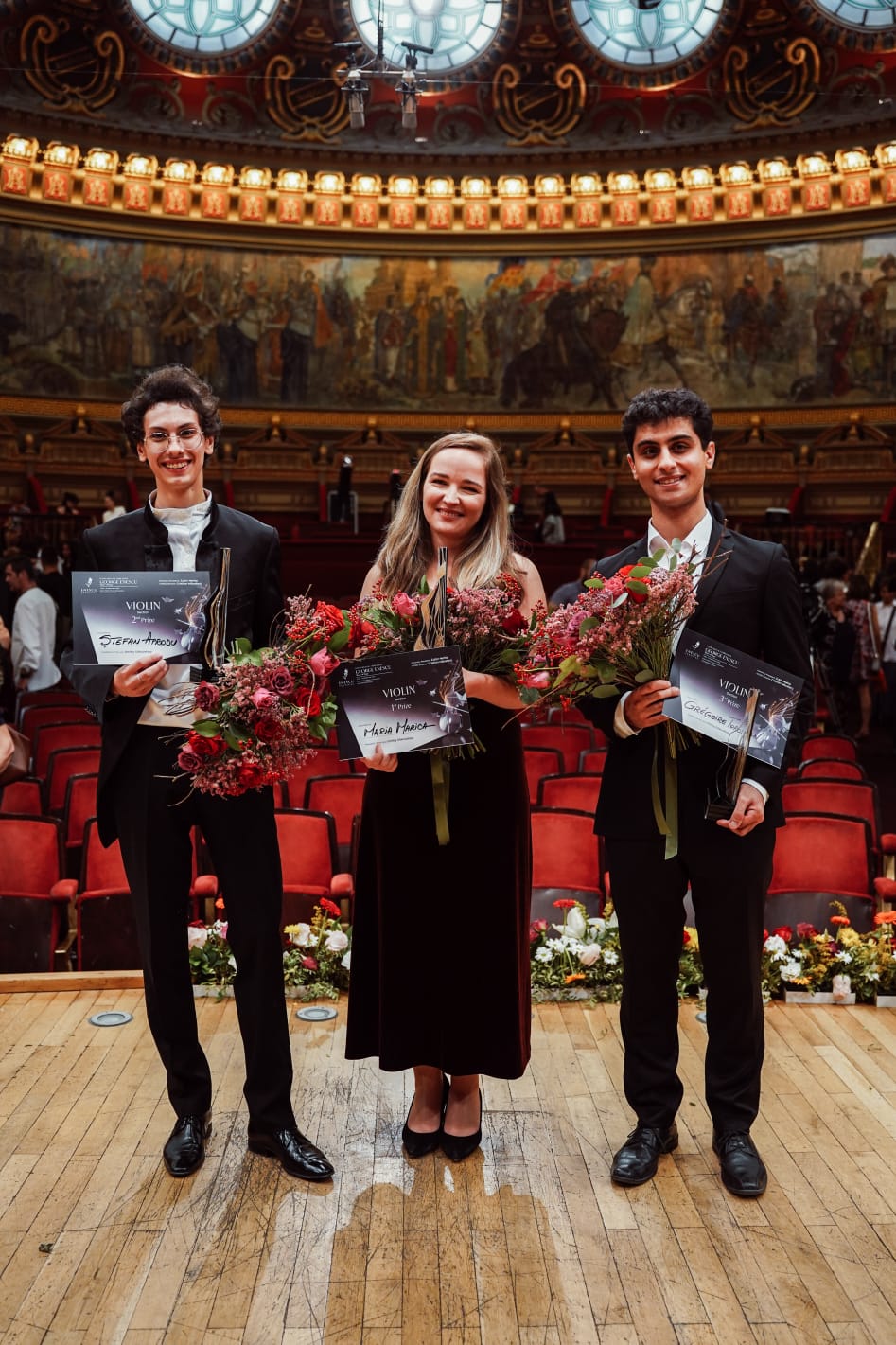
Maria Marica (above centre), won the 2022 George Enescu International Competition Violin Section after a Final in which she performed the Violin Concerto in D major Op. 77 by Brahms. The violinist also received a special award from the IMK Vienna Association, represented by jury member Igor Petrushevski: a concert as a soloist with the North Czech Philharmonic Orchestra in 2023 in Prague.
Maria Marica will perform, together with cellist Benjamin Kruithof – who won the cello section of the Enescu Competition – the Double Concerto in A minor Op.102, also by Brahms. The Violin Final of the Enescu Competition took place on Tuesday 13 September at the Romanian Athenaeum. Romanian violinist Ștefan Aprodu was second, with Frenchman Grégoire Torossian third. The audience enthusiastically embraced the three orchestral concerts in which soloists performed some beloved violin works.
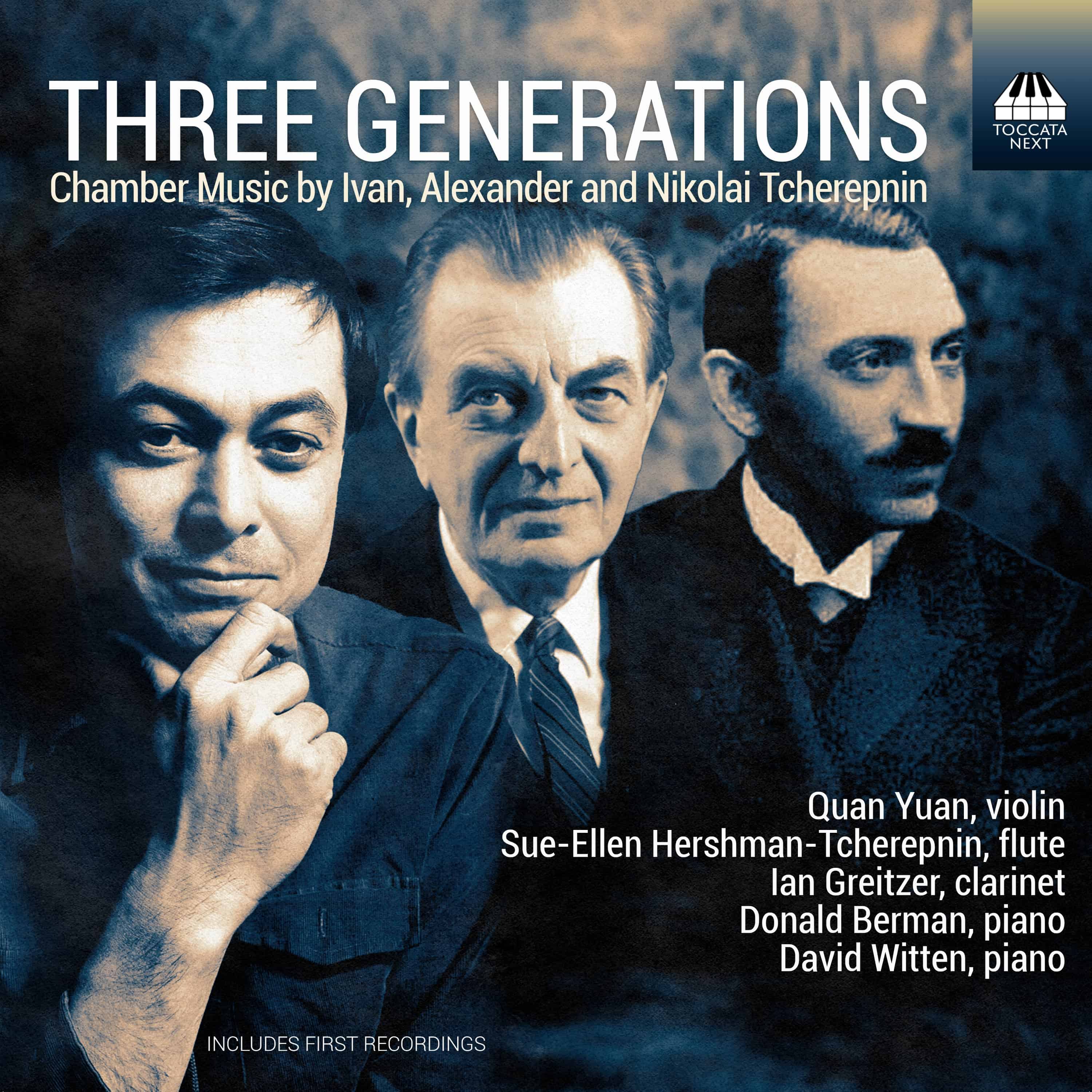
Alexander Tcherepnin Arabesque Op.11/5 (1921)a; Violin Sonata in F major Op.14 (1921)b; Romance WoO7a (1922)a; Élégie Op.43 (1927)a Ivan Tcherepnin Cadenzas in Transition (1963)c; Pensamiento (1996)d Nikolai Tcherepnin Poème lyrique Op.9 (1900)a; Andante and Finale Op. posth (1943)a
Live performances on c9 February 1997, d3 January 2002, aApril 18/19, 2019, b27 July 2021
Reviewed by Richard Whitehouse
What’s the story?
Toccata Classics’s Next imprint continues its enterprising schedule with a release of chamber music by three generations of the Tcherepnin musical dynasty, thereby illustrating the stylistic differences between them while also a degree of continuity across almost a century of music.
What’s the music like?
Nikolai Tcherepnin (1872-1945) may best be remembered as teacher (not least of Prokofiev) and conductor (including the first season of Diaghilev’s Ballets Russes), but he left a sizable output across the broad range of genres. Cannily representative of either end of his creativity, Poème Lyrique exudes a demonstrably fin-de-siècle Romanticism in its emotional flights of fancy within an already heightened expressive context, while Andante and Finale finds the aging composer looking back with affection – just a little tinged with regret – to an era four decades passed. If the former piece admits of impressionist elements, the latter looks to the full-blooded manner of Russia’s ‘silver age’ in its bracing energy and ultimate extroversion.
Alexander Tcherepnin (1899-1977) left a representative body of chamber music, not least for violin and piano – the brief Romance evincing a wistful lyrism that becomes darker and more ambiguous in the Élégie, having found its more capricious outlet in the Arabesque (fifth in a set of five). Much the most substantial of these works, the Violin Sonata comes after the First Piano Concerto and before three sets of songs to Sergei Gorodetzky (as recorded on Toccata TOCC0537). Its three concise movements proceed from an Allegro moderato whose agitation is redolent of Prokofiev, via a Larghetto whose pensive initial bars for piano build to a climax of real eloquence, to a Vivace whose capering dialogue makes its way to an affirmative close.
Ivan Tcherepnin (1943-98) may have left a less tangible legacy than his predecessors, owing largely to his activities earlier being focussed on electronic and installation media. Not that the brief Pensamiento is other than alluring with its interplay between flute and piano, which are joined by clarinet for Cadenzas in Transition. Written while the composer was still in his teens, this ranges freely across textures and moods without ever arriving at a destination – a trajectory which is most likely embodied in its title. Certainly, the contributions of Sue-Ellen Hershman-Tcherepnin and Ian Greitzer, alongside that of Donald Berman, make the strongest case for a piece that is disconcertingly formless or teasingly improvisatory according to taste.
Does it all work?
Almost always. It has been said that the Tcherepnin’s tended to be reactive in their musical idioms instead of setting the pace for others, but that would be to overlook the distinctiveness of Alexander’s output in particular – a legacy such as deserves to reclaim at least some of the standing it enjoyed in the mid-20th century. Those of Nikolai and especially Ivan can only be reassessed when more of their larger pieces are available. Neither performances nor recording leave anything to be desired, as is equally true of David Witten’s comprehensive booklet notes.
Is it recommended?
Yes, and hopefully Toccata will be issuing more from this source. Nikolai’s later ballets and symphonic poems, or Ivan’s Grawemeyer Award-winning Double Concerto would be a good place to start – while not forgetting the latter’s sons, Stefan and Sergei, are also composers.
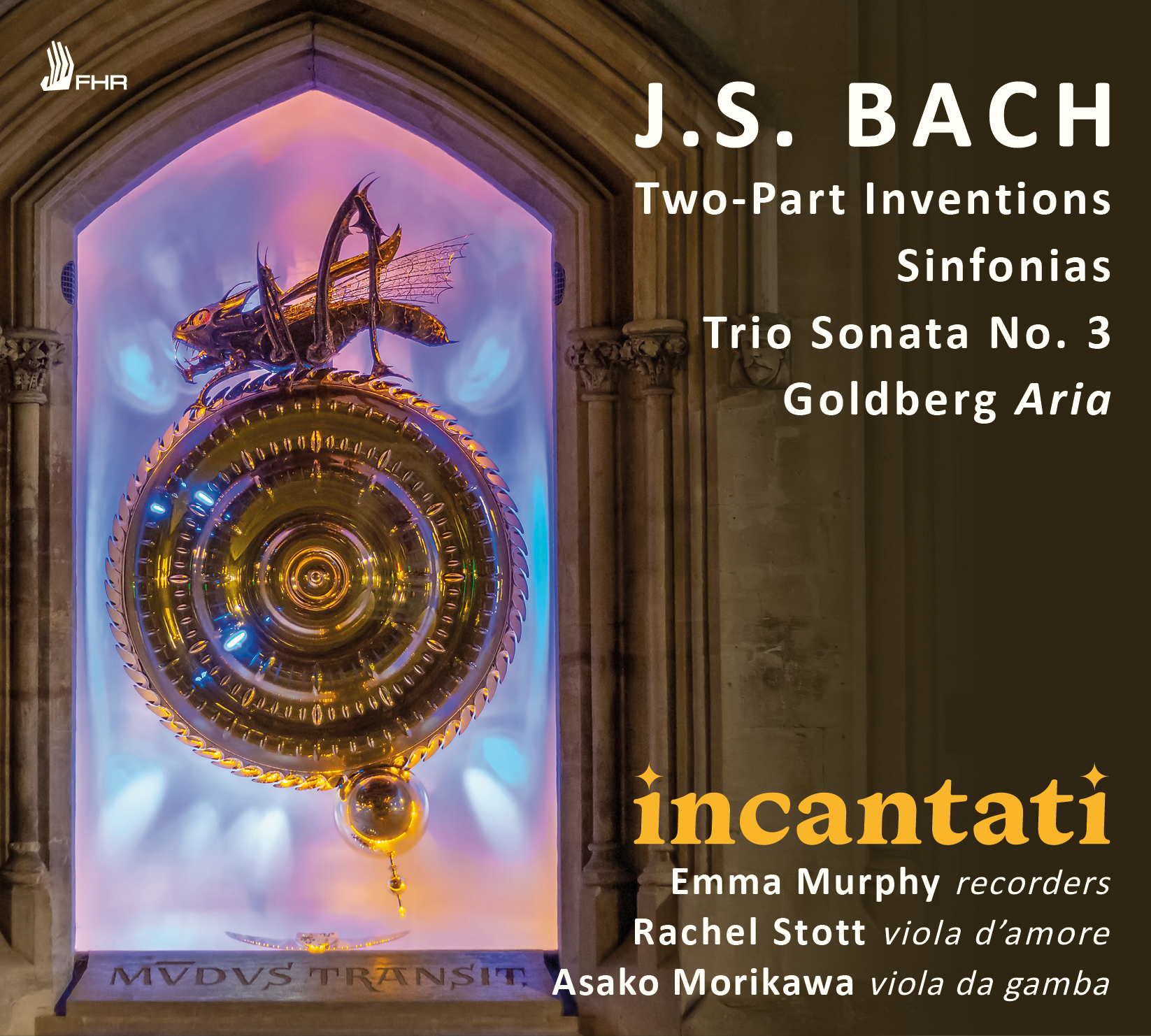
incantati [Emma Murphy (soprano/alto/tenor recorders, voice flute); Rachel Scott (viola d’amore); Asako Morikawa (viola da gamba)]
J. S. Bach Inventions, BWV772-86 (selection): no.1 in C; no.2 in C minor; No.4 in D minor; No.7 in E minor; no.8 in F; no.10 in G; No.11 in G minor; No.13 in A minor; No.15 in B minor. Sinfonias, BWV787-801 (selection): no.1 in C; no.4 in D minor; no.8 in F; no.9 in F minor; no.11 in G minor; no.13 in A minor Chorale-Preludes: Herr Jesu Christ, dich zu uns wend BWV655; Wer nur den lieben Gott lässt walten BWV691; Allein Gott in der Höh sei Her BWV716 Trio Sonata no.3 in D minor BWV527 Trio Sonata no.6 in G major BWV530/2 Aria in G major (from Goldberg Variations BWV988)
First Hand Records FHR122 [59’48”]
Producer Tom Hammond Engineer John Croft
Recorded 19-21 May 2021 at Church of the Ascension, Plumstead, London
Reviewed by Richard Whitehouse
What’s the story?
The trio incantati performs a miscellany of pieces by Bach, including selections from the two-part Inventions and the three-part Sinfonias, excerpts from the trio sonatas and several chorale preludes in what is a diverting hour-long recital by three complementary Baroque instruments.
What’s the music like?
Both the Inventions and Sinfonias stem from Bach’s period in service to Prince Leopold of Anhalt-Cöthen during 1717-23. Both sets comprise 15 pieces that ascend in chromatic order (from C major to B minor) and they explore a range of formal and contrapuntal possibilities. While the Inventions are often canonic and the Sinfonias are mainly fugal, there are various instances where Bach allows his melodic inspiration full rein. Conceived as teaching pieces they may have been – most notably for his eldest son, the talented though quixotic Wilhelm Freidemann – but there is never any feeling that these cannot be appreciated as music for its own sake. Perhaps the ideal way to enjoy them is to play them, but few of those who do will find themselves able to match the discipline and insight conveyed by the present musicians.
Also included here are three chorale-preludes which can be found in either of the Notebooks for Anna Magdalena Bach that the composer assembled from a variety of sources (including music by other composers) while at Cöthen and later at Leipzig. Although these may be less intricately textured than the two- and three-part pieces, their focus on elaborating the melodic line against a spare if pertinent harmonic accompaniment brings its own rewards. Otherwise, the trio sonatas are drawn from the set of six Bach likewise assembled in Leipzig and which also derive from pedagogic material written with Wilhelm Friedmann in mind. The third of these pieces is included here complete – its three movements being ruminative, eloquent and vivacious. The Aria on which Bach based his Goldberg Variations makes for a limpid envoi.
Does it all work?
It does. For all its economy and restraint, this music is never easy to perform and record such that the delicate interplay can be savoured in real-time – but incantati and Chiaro Audio have done just that. It helps when the pieces played have been judiciously chosen to underline the variety that Bach draws from his textures and in relatively diverse contexts. Put another way -none of this music is unfamiliar even to non-specialists, but hearing it played thus ensures it is not predictable. Ivan Moody’s succinctly informative notes are an additional enhancement.
Is it recommended?
Indeed. As recommendable as this release is in musical terms, it also and regrettably serves a commemorative function. Emma Murphy, who died in August from the effects of an auto-immune disorder just before her 50th birthday, was among the leading recorder players of her generation and respected advocate for her instrument whether as performer or teacher. Tom Hammond, who died last December from heart failure at 47, was a musician of many talents – trombonist, conductor (notably those premieres of Matthew Taylor’s Third Symphony and his Flute Concerto) of Sound Collective and Sinfonia Tamesa, teacher (masterclasses on the occupied West Bank in Israel), co-organizer of Hertfordshire Music Festival and producer for Chiaro Audio. This proved to be their final recorded project, and both will be greatly missed.



 Arcana.fm