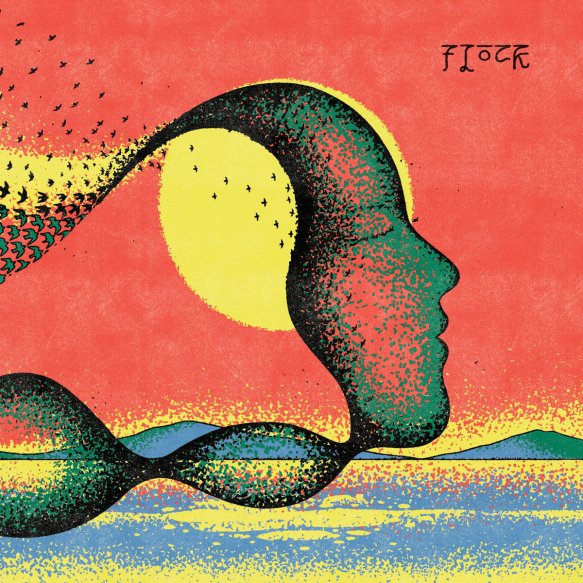
On Record – Flock: Flock (Strut Records)

flock

written by Ben Hogwood

What’s the story?

The music for Flock was recorded all on one day, 27 August 2020, at The Fish Factory in London. It was the culmination of a project overseen by multi-instrumentalist Bex Burch, band leader of Vula Viel. She assembled a group of five musicians to respond to texts she had written as scores, as a basis for improvisation – or ‘murmuration’, as she described.

Her partners in the project were Sarathy Korwar (drums and tabla), Dan ‘Danalogue’ Leavers (fender rhodes, roland juno-60, upright piano and roland SH-09 bass synth) Al MacSween (prepared piano, piano, Moog sub37) and Tamar Osborn (bass clarinet, flute, soprano saxophone and EHX deluxe memory boy). Burch assigned herself a wide variety of instruments, credited for contributions on gyil, vibraphone, bass drum, shakers, bells, gong, snake drum and electronics.

What’s the music like?

Instinctive, to put it mildly – but fascinating, atmospheric and intense. The key here is that the improvisations are focused, especially the 13 minutes and 35 seconds of It’s Complicated, and even the slightly longer, hypnotic How many are one? The musical chemistry between the players is striking, and it says a lot that with a track such as Prepare to let go, led by Korwar on foreground percussion, there is still plenty of room for each line to make itself heard. This one in particular is led equally by him on tabla and percussion but also by the insistent, jagged groove at the lower end of proceedings, with some intriguing electronics going on up top. My resonance is another track where the ensemble gel seamlessly, the melodies colourfully distributed and developed.

The keyboards are economically used, and the dynamics are carefully managed, and the percussion detailed but providing much of the backbone. Tracks like Bold dream become rituals, with energetic and almost trancey figures in the half light. There is humour in this track, too, the performers laughing at the way it peters out – nicely caught in the recording.

The icing on the cake, however, are Tamar Osborn’s contributions on woodwind. The combination of bass clarinet and keyboards is wonderfully spooky as Sounds welcome takes shape, the atmospherics like a leftfield detective series. Gradually the track blossoms into a richer, mellow mid-range, where the mournful tones of the saxophone are complemented with percussion and keys.

The bass clarinet begins It’s complicated with an Eastern flavoured soliloquy, a fascinating solo that gradually climbs in pitch and volume as the other instruments join, rising to a tumult of percussion and a rush of noise. The storm quickly abates, the intensity sinking back to a held drone and more clarinet ruminations, before a minimal exchange of ideas takes hold.

Some of the timbres the group secure are fascinating. What purpose has a mellow flute and sedentary piano complementing each other, set against more spatial electronics,

Does it all work?

Yes. The results are electric at times as the players bounce off each other, and it is fascinating listening to a one-off experience, where things go in unexpected directions at times but where the changing colours and moods are compelling.

Is it recommended?

Enthusiastically. This is an improvised gathering of white hot intensity, and the results are consistently compelling. Even if such projects prove daunting to you musically, you are encouraged to listen to Flock, for they make extremely rewarding music.

Stream

Buy

Switched On – Szun Waves to release new album Earth Patterns

by Ben Hogwood

Today brings another very welcome musical return, with Szun Waves announcing a new album, Earth Patterns, due on The Leaf Label on August 19. The band – producer Luke Abbott, saxophonist Jack Wyllie and drummer Laurence Pike – have today released a taster of what we can expect, and it is mightily impressive.

Both the title and language of New Universe suggest a return to basics, and the music – rooted in the key of C as much ‘universe’-themed music seems to be – has stark, creation-like beginnings. As it evolves the music grows in strength, reaching a full blooded apex before subsiding a little, its growth made all the more powerful when experienced with Dom Harwood’s video, with its Martian parallels.

Watch and enjoy – on this evidence the new album, with additional production from James Holden and David Pye, promises to be something special:

You can find out about the album here:

Switched On – Gold Panda – I’ve Felt Better (Than I Do Now)

by Ben Hogwood. Picture of Gold Panda by Laura Lewis

Here is some news to cheer up a Tuesday – the very welcome return of Gold Panda.

Its title is deceptive, and makes perfect sense when you get a sense of what the producer, aka Derwin Schlecker, has been through. “I made this when my daughter was two years old and I felt knackered and I’d turned 41”, he says. “The samples just came together and sounded like “I’ve felt better…” and at the same time I was looking at my anti-depressants feeling tired and just thought ‘ha, that’s right!’”

Describing the track, Derwin says, “I mess with chopping up samples until I get an interesting loop so I never set out to write a track; I’m led by the samples and then go from there. Funnily enough, my life now is actually way better than it was 10 years ago and I’m a bit healthier and I probably actually do feel better in general (apart from when I had that brain haemorrhage last year).”

With everything now in perspective, it proves easy to appreciate the summer haziness and hypnotic grooves applied to the track – which you can enjoy right here!


The Unfolding is out now on City Slang, and comes highly recommended! You can listen and purchase on the Bandcamp link below:

Switched On: Feiertag – Dive (Sonar Kollektiv)

by Ben Hogwood

What’s the story?

Dive is the second album from Dutch producer and drummer Joris Feiertag for Sonar Kollektiv. It finds him concentrating more on synth-based grooves than the upbeat, vocal-led tracks of previous album Time To Recover.

What’s the music like?

Once again Feiertag hits the sweet spot between poolside listening and a more immersive experience. His instrumentals are beautifully layered, especially the heat soaked Cala, with its urgent beats and liquid keyboard lines, and then Descend, also employing the chopped up approach with some nicely twisted percussion.

Opener Living In Slow is a clever piece of work, speeding up the vocals but squashing some of the beats to make a glitchy, sultry groove that works really well. It also has some of the urgency that courses through a track like Nocturnality, a quicker groove with flitting melodic figures that really gets going. Deep house with an edge.

Feiertag also writes fluid techno in the Detroit style with How U Do It, which is generally good save for a spoken word vocal that will be too crude for some tastes.

Does it all work?

Yes. Feiertag’s approach has a good deal of light and shade, and is really well constructed. This is music that sounds excellent on big speakers and headphones.

Is it recommended?

It is – a fine sequel and a sign that on the whole Feiertag is growing as an artist.

Listen & Buy

In concert – BBC Philharmonic Orchestra & Jac van Steen – David Matthews Symphony no.10 world premiere, Schubert & Brahms

jac-van-steen

Brahms Piano Concerto no.1 in D minor Op.13 (1854-8)
Schubert
Overture to Rosamunde D797 (1820)
David Matthews
Symphony no.10 Op.157 (2020-21) [World premiere]

Stephen Hough (piano, below), BBC Philharmonic Orchestra / Jac van Steen (above)

MediaCity UK, Salford Quays
Friday 20 May 2022, 3pm

Written by Richard Whitehouse

A substantial programme was the order of the day for this afternoon’s studio concert from the BBC Philharmonic with Jac van Steen, given at the orchestra’s regular base in MediaCityUK and that featured a first performance anywhere for the Tenth Symphony by David Matthews.

Whereas his previous symphony was written for relatively modest dimensions, the Tenth marks a return to larger forces: triple woodwind (with doublings), four horns, three each of trumpets and trombones, tuba and four percussionists alongside timpani, celesta, piano, harp, and strings. It also finds Matthews (above) retackling the one-movement format that dominated his earlier symphonies, allied to a subtle process of developing variation such as ensures unity across a varied and eventful discourse. Not least when that massive opening chord sets out a long-range tonal and harmonic trajectory for this work overall, and to which a pensive (offstage) cor anglais solo then intensifying string fugato provide both continuation and contrast by anticipating the types of expression and motion as variously come to the fore.

Distinctive in themselves yet drawn into a tensile and cohesive entity, the constituent sections take in a wistful intermezzo then an agile scherzo on the way to a central culmination whose increasingly explosive energy likely marks a point of greatest engagement with that opening chord. The music duly heads into a slower episode of sustained emotional raptness, elements heard earlier gradually being recalled through an unforced while never discursive process of reprise towards a coda whose ending seems the more conclusive for its poised equivocation. An absorbing and often gripping exploration of symphonic tenets such as Matthews has long pursued, persuasively realized by the BBCPO and van Steen – whose support of the composer – having already recorded the Second, Sixth and Eighth Symphonies – hardly needs restating.

Before the interval, Stephen Hough (above) was soloist in Brahms’s First Piano Concerto – a piece he has given many times (not least a memorable reading at London’s Royal Festival Hall in the early 1990s, Andrew Davis also giving a seismic account of the Symphony by the late Hugh Wood). There was emotional breadth aplenty in the initial Maestoso, but also latest energy as came to the fore in a combative development and tempestuous coda. Nor was the symphonic aspect underplayed in what is still the most monumental opening movement of any concerto.

If the central Adagio lacked a degree of repose in its orchestral introduction, Hough’s take on its almost confessional solo passages brought the required inwardness, with the course of this movement towards its agitated peak or enfolding serenity at its close never in doubt. Nor was that of the closing rondo, especially a central episode whose string fugato was deftly rendered then the piano’s gentle response enticingly conveyed. After the cadenza, horns and woodwind emerged as if leaving a benediction prior to the triumph that coursed through those final bars.

Throughout this performance, van Steen was an alert and responsive accompanist – then put the BBC Philharmonic through its paces with an animated account of Schubert’s Rosamunde (a.k.a. Die Zauberharfe), which made for an engaging if unlikely entrée into the Matthews.

For more information on David Matthews you can visit his website here. For more on the artists in this concert, click on the names to access the websites of Stephen Hough, Jac van Steen and the BBC Philharmonic Orchestra