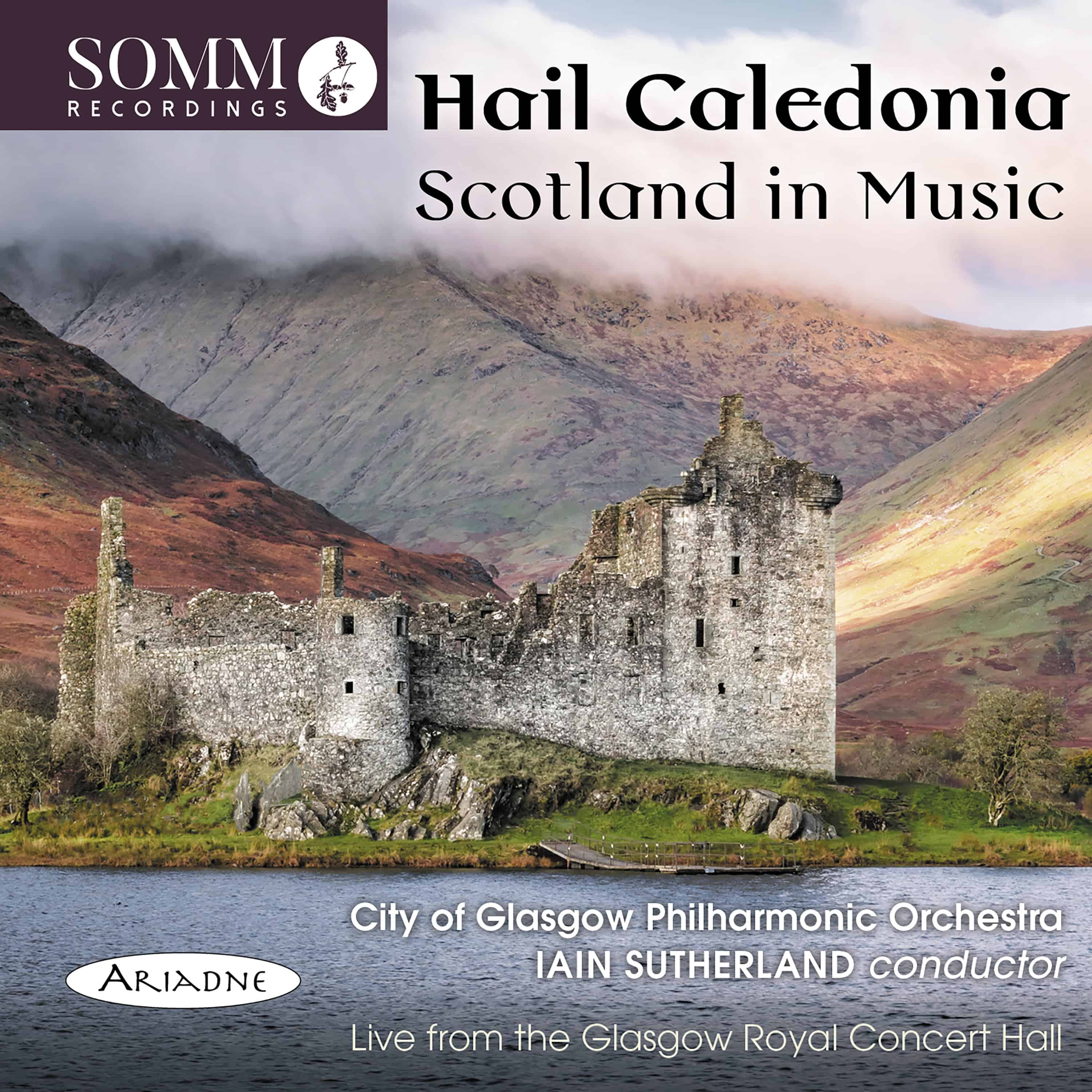
On record – Hail Caledonia: Scotland In Music (City of Glasgow Philharmonic Orchestra / Iain Sutherland) (Somm Recordings)

hail-caledonia

Trad. arr. Sutherland The Black Bear Salute
Docker Abbey Craig (1974)
Tomlinson Cumberland Square (1960)
Coates The Three Elizabeths – Elizabeth of Glamis (1944)
Mendelssohn Symphony No. 3 in A minor, Op. 56, ‘Scottish’ – Vivace non troppo (1842). Blake Take the High Road (1980)
MacCunn (arr. Sutherland) Sutherland’s Law (1886/1973)
Docker Faery Dance Reel (1958)
Sutherland Three Scottish Castles (1966)
MacKenzie (arr. composer) Benedictus, Op. 37 No. 3 (1888/1895)
Bantock Two Heroic Ballads – Kishmul’s Galley (1944)
Arnold Four Scottish Dances, Op. 59 (1957)
Williamson (arr. Sutherland) Flower of Scotland (1967)
Trad. arr. Sutherland Amazing Grace
Whyte Donald of the Burthens – Devil’s Finale/Reel o’ Tulloch (1951)

David Wotherspoon, Iain MacDonald (bagpipes), City of Glasgow Pipe Band, City of Glasgow Chorus, City of Glasgow Philharmonic Orchestra / Iain Sutherland

SOMM Ariadne 5014 [79’32”]

Digital Remastering Paul Arden-Taylor

Live performances at Royal Concert Hall, Glasgow in 1995 and 1996

Written by Richard Whitehouse

What’s the story?

SOMM releases via its Ariadne imprint this compilation of shorter pieces and arrangements which, between them, afford a wide-ranging and not at all hackneyed overview of ‘Scotland in Music’, realized with great flair by Iain Sutherland and the City of Glasgow Philharmonic Orchestra.

What’s the music like?

Whether or not the fastest regimental march in the British army, The Black Bear Salute duly launches proceedings with a gusto continued by Robert Docker’s breezy take on battle-song Scots Wha Hae in Abbey Craig. Ernest Tomlinson furthers the jollity with his amalgam of traditional Borders tunes in Cumberland Square, to which the quiet rapture of Eric Coates’s ‘Elizabeth of Glamis’ (central panel of The Three Elizabeths triptych) provides an admirable foil. The scherzo from Mendelssohn’s Scottish Symphony makes for an ideal interlude in its rhythmic vivacity and formal ingenuity, then come pieces made famous through association with television series – Arthur Blake’s atmospheric theme-tune for the soap drama Take the High Road and the corresponding sequence for crime drama Sutherland’s Law, derived from Hamish MacCunn’s overture Land of the Mountain and the Flood as has regained its place in the concert hall. Docker’s contribution to the light-music repertoire is typified by his Faery Dance Reel, a lively and infectious medley of traditional tunes that wears its heritage lightly.

Iain Sutherland displays his compositional skills (with respective nods to Arnold and Coates) in Three Scottish Castles with its evocative tribute to those of Stirling, Dunvegan (Skye) and Edinburgh. Next comes a contrasting brace of pieces – the burnished eloquence of Alexander MacKenzie’s Benedictus here followed by the unfailing extroversion of Kishmul’s Galley by Granville Bantock, whose immersion in all things Scottish was enduring. Malcolm Arnold’s Four Scottish Dances are then given a memorable reading which points up the trenchant gait of ‘Strathspey’ or the latterly inebriated progress of ‘Reel’, before ‘Hebrides’ casts a suitably rapturous spell that is summarily curtailed with the headlong energy of ‘Highland Fling’. One half of influential folk duo The Corries, Roy Williamson created his own standard in Flower of Scotland, here given an opulent arrangement comparable to that of the ubiquitous Amazing Grace – after which, the closing section from the ballet Donald of the Burthens by Ian Whyte (founder conductor of the BBC Scottish Symphony Orchestra) makes for a scintillating finale.

Does it all work?

Yes. Compilations such as this are often no more than the sum of their parts, however enticing those parts may be, but Hail Caledonia is one to sample at leisure as well as worth playing at a single sitting. It helps when the City of Glasgow Philharmonic renders all these pieces with alacrity and enthusiasm, aided by being captured on various live occasions, and owing in no small part to its founder Iain Sutherland. A familiar radio presence over several decades, he brings an authority to music whose outward flair is not without its corresponding substance.

Is it recommended?

Indeed. The remastered sound lacks nothing in realism or immediacy, while there are detailed and informative notes by composer, critic (and no doubt ecosophile) Robert Matthew-Walker. Any listeners who are looking to add such a compilation to their collections need not hesitate.

Listen & Buy

You can discover more about this release and listen to clips at the SOMM Recordings website, where you can also purchase the recording.

On record – Havergal Brian: Symphonies 3 & 17 (New Philharmonia, Royal Philharmonic Orchestra / Stanley Pope) (Heritage)

brian-heritage

Brian
Symphony No. 3 in C sharp minor (1931-2)
Symphony No. 17 (1960-61)

Ronald Stevenson, David Wilde (pianos, Symphony no.3); New Philharmonia Orchestra (Symphony no.3), Royal Philharmonic Orchestra (Symphony no.17) / Stanley Pope

Heritage Records HTGCD153 [67’26”]

Recorded 12 January 1974 and 23 June 1976 at BBC Maida Vale Studios, London

Written by Richard Whitehouse

What’s the story?

Heritage has followed its release of Charles Groves’s centenary accounts of Havergal Brian’s Gothic Symphony (Part One) and In Memoriam with this first official issue of the composer’s Third and Seventeenth Symphonies, as given in their first performances under Stanley Pope.

What’s the music like?

Although he left few commercial recordings, the London-born and Geneva-based conductor Pope (1916-95) was highly regarded in music from the 19th and 20th centuries. These studio performances are among the best premieres that Brian received, not least the Third Symphony which at almost 55 minutes is his lengthiest after the Gothic. Little is known about its genesis, but the 20-minute opening movement has a complexity and emotional breadth that suggest a suitably high-flown inspiration. Two pianos mark off crucial junctures in its formal trajectory, besides enriching the texture vis a concertante underpinning such as surges forth in the stark chordal cadenza prior to the coda. Had Brian stopped there, this would still have been among his most ambitious symphonies, and the three remaining movements afford intrigues aplenty.

The slow movement continues in similar fashion in its combining of textural audacity with a melodic immediacy (notably for flute and violin) as makes this an ideal entry-point for those new to Brian, and though its expressive ambience is by no means easy to define, a feeling of heroic fatalism comes to the fore during the climactic stages and in a coda of moving pathos. By contrast the scherzo is as direct in its appeal as anything that Brian wrote, not least a trio whose ingratiating charm provides suitable contrast with the boisterous music on either side. With its slow overall tempo, the finale builds in sonorous paragraphs – to whose Brucknerian grandeur Pope is especially attentive – toward a stormy culmination and heightened recall of earlier ideas; thence into an epilogue whose unequivocal finality is rare in Brian’s maturity.

Nearly three decades later, the Seventeenth Symphony offers a very different perspective on Brian’s creative outlook. Last in a series of five single movement such pieces, it is markedly elliptical as to formal unfolding and expressive follow-through – yet, even more than with its masterly predecessor, a continuous and metamorphic ingenuity is perceivable right from the pensive introduction then throughout the three- (or even four-) in-one sequence that follows. Confident and yet ruthless in its triumphalism, the coda is decidedly music for its ‘present’.

Does it all work?

Almost. The Third is the most inclusive of Brian’s orchestral symphonies in its intricacy of texture and (ambivalent) range of expression. Drawing four such diverse movements into a cohesive whole is no easy task, but Pope succeeds more completely than does Lionel Friend (Hyperion) and probes more fully than Adrian Leaper (Naxos) the disquieting obliquities of the Seventeenth. The playing of the New Philharmonia and Royal Philharmonic orchestras is testament to the skill of British players in tackling such complex music on limited rehearsal.

Is it recommended?

Yes. Heritage has done a fine job in opening-up the 1970s sound (the BBC’s notoriously dry Maida Vale studio) and John Pickard contributes his usual insightful notes. The 1974 account of Brian’s choral Fourth Symphony would be an ideal next candidate for such rehabilitation.

Listen

Buy

You can discover more about this release at the Heritage website, and you can read more about Havergal Brian here

75 years ago today – the first performance of Korngold’s Violin Concerto

Today marks 75 years to the day since the premiere of Korngold’s Violin Concerto. Like much of this composer’s work, the Violin Concerto took a while to gain popularity, but since we have moved into the 21st century it has taken up a much more regular position in the concert hall.

In her excellent biography of the composer, Jessica Duchen tells the story of the concerto, and how it was suggested to Korngold for close on 30 years by his friend Bronislaw Huberman, founder of the Palestine Orchestra (later the Israel Philharmonic). The regular suggestion became something of a running joke until 1945, when Korngold unexpectedly produced a completed score for the concerto. Ultimately the work had its first performance on 15 February 1947, with the incomparable Jascha Heifetz as soloist and the St. Louis Symphony Orchestra conducted by Vladimir Golschmann.

As you will hear from this live performance with violinist Hilary Hahn and the Deutsche Symphonie Orchester under Kent Nagano, the work has an intense, lyrical profile from the start, shot through with the descriptive powers Korngold used to such good effect in his film scores. There is a longing quality to the first movement especially, a nocturnal second and an energetic third which generates impressive momentum to the finish.

Watch and see what you think:

Switched On – vaghy: Minimalism (Théque Records)

vaghy

reviewed by Ben Hogwood

What’s the story?

After 20 years of playing as part of a band, Hungarian pianist Tamás Vághy is striking out on his own, with little more than a piano and some electronics. His aim was to strip music back to its bare elements, and to rediscover his own art as a performer and composer.

While vaghy plays the piano for the main melodic lines, he also provides the accompaniment through a clutch of analogue synthesizers and even a heavily manipulate zither.

What’s the music like?

Minimalism is a brave title for a new album, for although in this case it means a ‘back to basics’ approach, it also forms in the listener expectations that vaghy’s style will be close to that of Steve Reich or Philip Glass.

That proves not to be the case, but not in a bad way, for this is a thoughtful and often enlightening piece of work. It is also not a straightforward piano album, thanks to vaghy’s treatment of sounds. This is immediately apparent on the opening Rush, with dampeners applied to the tones so that the piano makes a lovely, mottled sound.

vaghy writes with a good deal of movement in his music, but with a stillness at the heart of it where the listener can position themselves. The style also bears similarities to Michael Nyman’s piano work but the tones are lighter on the ear and more evocative.

As Minimalism progresses so there is increased light and shade – the former present in the airy touches of Backwash, which has a lovely rippling effect. The latter qualities are evident in the darker Tripping, with its shuffling rhythm track.

Meanwhile the likes of Lonely and Dawn Light find a special, inward-looking intimacy, while Intention has a lovely turn of phrase and some complementary effects with the Moog, which blossom to a full-bodied and powerful conclusion.

Does it all work?

Yes – Minimalism has enough craft and descriptive colour to stand out from the crowded field in solo keyboard repertoire. Its loops become strangely hypnotic and the attention to detail invested by vaghy is repaid through music of character and subtle shades of colour.

Is it recommended?

Yes. If you like keyboard players such as Nils Frahm then vaghy’s music will definitely appeal, and its subtleties will work their hypnotic touch on many a listener. This is a quiet album – and if you make space for it, the rewards are plenty.

Stream and Buy


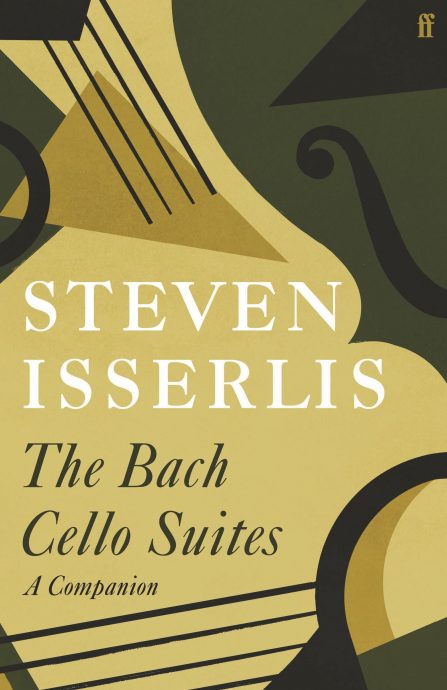
On paper – Steven Isserlis – The Bach Cello Suites: A Companion (Faber)

reviewed by Ben Hogwood

What’s the story?

Ask Steven Isserlis the music he would take to a desert island, and his answer would surely be the six Bach Cello Suites. The cellist has lived with their music all his adult life, and having released his award-winning recording of them for Hyperion in 2007, he now expresses his deep love and admiration for them in written form.

What’s the book like?

In a word, invigorating. Having lived with the suites myself for 35+ years as an amateur cellist, your reviewer is very much a convert – but reading this gave me enthusiasm anew, for Isserlis reveals new treasures about this wonderful music at every turn.

Crucially he does this in a way that will appeal to cellists and non-cellists alike, and even those who struggle with musical terms. A helpful glossary is on hand to help here, but so is an introduction that sets out this celebration of six works where mystery, expression and originality walk hand-in-hand.

The origins of the suites are shrouded in mystery, right down to their authorship. Isserlis tackles these questions head-on, in a wholly compelling way. He confronts the doubts, examines the existing performing editions, and looks at the role of Bach’s second wife Anna Magdalena in their publication, all without getting too bogged down in musicology. There is healthy but qualified assumption and speculation, made as a music lover but backed up with firm arguments from Bach scholars past and present.

Isserlis looks at the construction of each suite in great detail, marvelling at Bach’s consistent marriage of mathematical precision and emotional outpouring. He uses the scholarly texts but also leans heavily and most enjoyably on his perspective from the pure, musical instinct of a performer. This approach lifts the music from the page, frequently inspiring the reader to listen along.

This instinct leads to a central, compelling case for a subtext for the suites, describing the life of Christ in a way that can be keenly experienced by the listener but which also makes a great deal of musical sense, with the caveat that the cellist’s conclusions are largely speculative.

What is beyond doubt is the technical mastery shown by Bach in writing for the cello, and the inspiration that flowed so readily and so inevitably in writing the suites, lifting the instrument and its potential to a higher plain. The six suites are remarkable pieces both individually and collectively, as are the six movements of each – and Isserlis brings them to life as he writes. He celebrates their role in the life of any cellist while also, under his breath, lightly cursing some of the technical difficulties as the cycle progresses.

Readers can opt to take the book from start to finish, taking in each of the 36 movements, but the layout rewards repeat visits to dip in to individual parts and elements of their composition. This is ideal not just for serious, practicing cellists but also for individual listener preferences.

Does it all work?

Yes, in several ways. Isserlis is a fluent and passionate writer, putting the music first at all times, so that reading the book will almost always lead to a first hand encounter with the music. That is the surest guide to success for any book on music, surely!

Is it recommended?

Yes, on pretty much every level. For cellists – either full or part-time, like your reviewer – this book is essential and thought-provoking reading. It reveals afresh the many delights to be found in experiencing this wonderful music, and will also make you want to listen to more Bach, the choral works especially, to explore the fascinating parallels drawn between these and the suites.

Non-cellists should not hesitate to approach the book either, for there are many entertaining and thoughtful stories in the book that prove richly rewarding.

This is a fine achievement, celebrating a body of work that all cellists hold dear. The music lifts from the page and into our homes with an easy candour and compelling storytelling. It is a wonderful achievement.