On record – Ronald Stevenson: Piano Music Volume Five: Transcriptions of Purcell, Delius and Van Dieren (Christopher Guild) (Toccata Classics)

stevenson-5

Delius The Young Pianist’s Delius (1962, rev. 2005)
Purcell Toccata (1955); The Queen’s Dolour – A Farewell (1959); Hornpipe (1995); Three Grounds (1995)
Stevenson Little Jazz Variations on Purcell’s ‘New Scotch Tune’ (1964, rev ’75)
Van Dieren String Quartet No. 5 (c1925, rev. 1931; transcr. c1948-1987); Weep You No More, Sad Fountains (1925, transcr, 1951); Spring Song of the Birds (1925, transcr. 1987)

Christopher Guild (piano)

Toccata Classics TOCC0605 [80’57”]

Producer / Engineer Adaq Khan

Recorded 5 – 6 September 2020, 5 January 2021 at the Old Granary Studio, Toft Monks, Norfolk

Written by Richard Whitehouse

What’s the story?

Christopher Guild continues his survey of Ronald Stevenson’s piano music with this volume comprising transcriptions of Purcell, Delius and Van Dieren – the latter’s Fifth Quartet fairly exemplifying Stevenson’s dedication to the spirit as much as the letter of the music at hand.

What’s the music like?

The essence of Stevenson’s re-creative approach is evident in his Purcell transcriptions, not least the Toccata with its deft changes of register and tensile rhetoric where Busoni’s benign presence can be felt. A lighter and more playful manner is evident in the Hornpipe, whereas the Three Grounds point up conceptual as well as musical links with Bach and, through their forming a ‘sonatina’ of unlikely cohesion, Beethoven. Greater license is demonstrated in the Little Jazz Variations, surely among Stevenson’s most delightful pieces in its blurring of the ‘boundary’ between transcription and composition and enhanced by its discreet take on pre-bop jazz idioms. The Queen’s Dolour looks to the poignant final aria from Dido and Aeneas for what is one of the most characteristic and, moreover, affecting Stevenson transcriptions.

All these pieces have been previously recorded, but not the remainder of this programme. A pity that The Young Pianist’s Delius is not more widely known, as this cycle of 10 miniatures drawn from across the composer’s output is a gift to pianists who have little original Delius to work with, whereas listeners who are unfamiliar with or deterred from investigating this easily misunderstood figure could hardly hope for a more representative or appealing breviary of his music. It helps that Stevenson’s transcriptions are straightforward but not in the least didactic.

Two songs by Bernard van Dieren – gravely eloquent as regards Weep You No More or deftly effervescent in Spring Song of the Birds – have secured a measure of familiarity when heard as encores. Not so the Fifth Quartet, never recorded in its original guise, whose transcription occupied Stevenson over almost four decades. Premiered in its revision in 1931, this work is among the most substantial from its composer’s later years as it unfolds from a discursive (if never rhapsodic) sonata design, via circumspect and headlong intermezzi, to a lively scherzo then soulful Adagio – before a resolute finale offers closure. Tonal ambivalence and textural intricacy are borne out in this recasting in terms of piano which lasts five minutes longer than the Allegri Quartet’s 1988 broadcast; not that Guild’s reading seems to lose focus in any way.

Does it all work?

Yes, given Stevenson’s command of keyboard technique and, moreover, his placing of this at the service of the piece in question. To paraphrase his comments on Liszt – were the classical repertoire suddenly to disappear, much it could still be accessed through those transcriptions that he made over the greater part of his career. Nor is the technique required of a consistently advanced degree, with the Delius and several of the Purcell pieces accessible to most capable pianists, though the Van Diren quartet necessitates an ability not far short of the transcriber!

Is it recommended?

Indeed. Christopher Guild is a resourceful and probing guide to Stevenson’s art; his Steinway D heard to advantage and his booklet notes readably informative. One final thought – the Van Dieren Quartets positively cry out for an integral recording: how about it, Toccata Classics?

Listen

https://open.spotify.com/album/6EDUvp6G1WYgOY3yIHegtF

Buy

You can discover more about this release at the Toccata Classics website, where you can also purchase the recording. To find out more about the composer, visit the Ronald Stevenson Society, while for more on Christopher Guild, click here
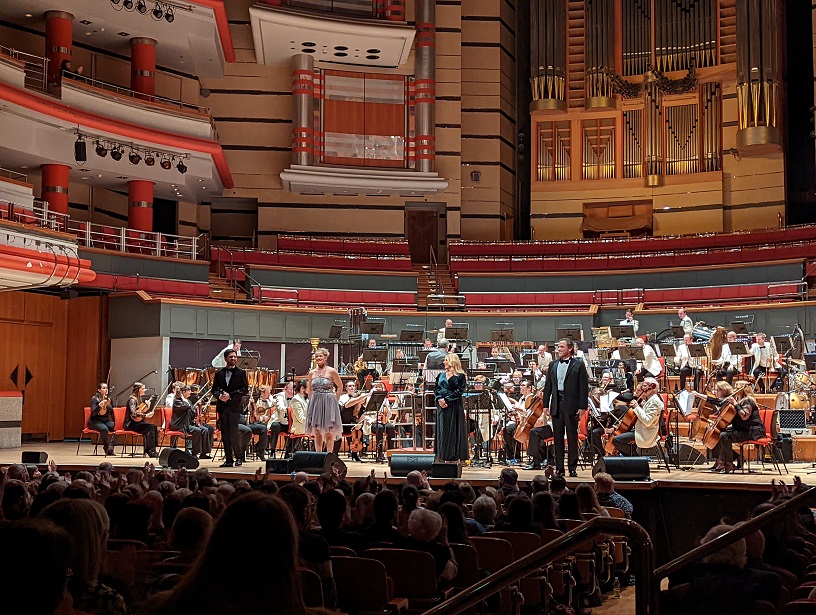

In concert – Caroline Sheen, Louise Dearman, Nadim Naaman, Jeremy Secomb, CBSO / Martin Yates – Sondheim: Broadway Baby

Follies Overture
Company Company; Being Alive
Anyone Can Whistle Anyone Can Whistle
Follies Could I Leave You; Broadway Baby
Sondheim Three Sondheim Waltzes
Sweeney Todd A Little Priest; Johanna
Gypsy Some People
Merrily We Roll Along Old Friends

A Funny Thing Happened On The Way To The Forum Overture
Company The Little Things You Do Together
West Side Story Something’s Coming; Balcony Scene; A Boy Like That
Passion Loving You
A Little Night Music Send In The Clowns
Into The Woods Giants In The Sky; Agony
Company Getting Married Today
A Funny Thing Happened On The Way To The Forum Comedy Tonight

Louise Dearman, Nadim Naaman, Jeremy Secomb and Caroline Sheen (vocalists), City of Birmingham Symphony Orchestra / Martin Yates

Symphony Hall, Birmingham
Friday 14 January 2022

Written by Richard Whitehouse photos (c) Beki Smith (above) and Florian Wende (below)

This overview of Stephen Sondheim was inevitably leant poignancy by the composer’s death in November but this, in turn, only served to emphasize the extent of his achievement across more than half a century and at least 16 stage-works; across the course of which, he brought the American musical to a new level of sophistication. The present selection further provided a reminder of that additional depth and richness made possible when the instrumental writing is allotted to full orchestra, of which the City of Birmingham Symphony Orchestra was a keen advocate.

A versatile conductor, Martin Yates launched the evening via a bustling take on the Overture to Follies, Sondheim’s double-edged homage to Broadway’s ‘golden age’, before all four of tonight’s vocalists took the stage for the title-song from Company – its edgy expectancy offset by the fervency of that musical’s ‘Being Alive’ rendered by Nadim Naaman. Jeremy Secomb brought real poise to the title-song of initially ill-fated Anyone Can Whistle; Louise Dearman was defiance itself in ‘Could I Leave You?’, while Caroline Sheen teased out the insouciance of a further Follies song ‘Broadway Baby’. The CBSO duly gave its all in the lively and not-a little sardonic waltzes as taken from Anyone Can Whistle, then Dearman and Secomb proved well complemented as scheming barber and piemaker in ‘A Little Priest’ from Sweeney Todd; Naaman’s pathos in ‘Johanna’ a reminder of this musical’s compassionate side. Sheen sassily projected Sondheim’s lyrics to Jule Styne’s music in ‘Some People’ from Gypsy, then all four singers rounded-off the first half with the barbed ‘Old Friends’ from Merrily We Roll Along.

broadway-baby

A lively traversal of the Overture to A Funny Thing Happened On The Way To The Forum set up the second half in suitably racy fashion, with Dearman and Secomb bringing real piquancy to Company’s edgy duet ‘The Little Things You Do Together’. Three numbers from West Side Story reminded one of Sondheim’s peerless lyrics to Leonard Bernstein’s music – Naaman’s inquiring take on ‘Something’s Coming’ followed by his and Sheen’s rapturous showing for the ‘Balcony Scene’ (a.k.a. ‘Tonight’), the latter joining Dearman for the searing medley ‘A Boy Like That / I Have A Love’ as forms this musical’s emotional apex. Not that Secomb’s unforced eloquence in ‘Loving You’ from Passion proved an emotional come-down; neither did Dearman in conveying the bittersweet soul of ‘Send In The Clowns’ from A Little Night Music – Sondheim’s most recognizable melody. Two numbers now from multi-layered Into The Woods – Naaman suitably astounded in ‘Giants In The Sky’; he and Secomb pointing up the fanciful imagery of ‘Agony’. Dearman and Sheen joined him for the heady triple-take of ‘Getting Married’ from Company, then the advertised programme concluded with the quartet in the uproarious ‘Comedy Tonight’ such as unerringly sets the tone for Forum as a whole.

Those who might have been bemoaning the absence of Sunday In The Park With George (its first act arguably Sondheim’s most perfect achievement) would have been reassured with the ecstatic ‘Sunday’ that brought the evening to its close; one in which the contribution from the CBSO played no small part in conveying the sheer range of Sondheim’s enduring creativity.

For more information on this concert you can visit the CBSO website. Meanwhile click on the artist names for information on Martin Yates, Louise Dearman, Nadim Naaman, Jeremy Secomb and Caroline Sheen. To read more about Stephen Sondheim himself, visit the Stephen Sondheim Society

In concert – Clara-Jumi Kang, CBSO / Ryan Bancroft – Coleridge-Taylor, Mendelssohn & Sibelius

clara-jumi-kang

Coleridge-Taylor Solemn Prelude in B minor, Op. 40 (1899)
Mendelssohn Violin Concerto in E minor, Op. 64 (1844)
Sibelius Symphony No. 2 in D, Op. 43 (1901-2)

Clara-Jumi Kang (violin), City of Birmingham Symphony Orchestra / Ryan Bancroft

Symphony Hall, Birmingham
Thursday 13 January 2022

Written by Richard Whitehouse Ryan Bancroft picture (c) Benjamin Ealovega

Having seen in the new year in customary Viennese-style, the City of Birmingham Symphony Orchestra continued its season with this programme of repertoire staples along with what was (probably) only the third performance of a relatively early orchestral work by Samuel Coleridge-Taylor.

The recent revival of interest in Coleridge-Taylor hopefully means such enticing pieces as his Violin Concerto and Clarinet Quintet will be heard more frequently at concert hall and recital rooms. If the Solemn Prelude is not quite on their level, it certainly deserved more than total neglect following its premiere at Worcester Cathedral in 1899; a further hearing last July only made possible after the manuscript was relocated at the British Library. Combining Elgarian nobility with Brucknerian grandeur, its outer sections exude a portentousness complemented by the expressive immediacy at its centre; abetted here by Ryan Bancroft’s flexible handling of tempo so a welcome melodic spontaneity came to the fore. No undiscovered masterpiece, but an appealing work that doubtless fulfilled its remit back then and could do so again today.

Mendelssohn’s Violin Concerto has never lacked for performances during the 177 years of its existence such that familiarity can breed, if not contempt, then at least a certain predictability. Credit to Clara-Jumi Kang for reminding one how (to quote David Kettle’s apt description in the programme) ‘‘quietly innovative’’ the piece is as to formal continuity and motivic fluidity. Not that this was a low-key or understated reading – Kang bringing out the combative side of the opening Allegro (‘appassionato’ it duly was), not least her impetuous take on the central cadenza whose developmental function was tellingly underlined. The Andante melded warm lyricism and plaintive regret to a bewitching effect then, after its teasing entrée, the animated repartee of the finale was deftly rendered through to a vivacious coda and decisive conclusion.

Now in his early thirties, Bancroft (above) is into his second season as principal conductor of the BBC National Orchestra of Wales and takes up a similar post with Royal Stockholm Philharmonic in 2023. This account of Sibelius’s Second Symphony left little doubt as to his interpretative credentials, not least with a finely proportioned yet impulsive reading of the initial Allegretto, then an Andante as lacked in little in that formal focus essential if its fervour is not to become histrionic. To which, an attacca from one movement to the other might have been beneficial.

The latter movements run continuously in any case – and, after a scherzo by turns tensile and tender, the transition was unerringly handled such that the finale hit the ground running. This can easily become discursive or even sprawl but, with its ‘big tune’ kept in check and starkly modal second theme keenly ominous, it built purposefully and with some inevitability to an apotheosis that, while it evinced more in the way of triumph than catharsis, none the less set the seal on an idiomatic performance with the CBSO woodwind and brass often at their best.

After an evening of Stephen Sondheim (now the more poignant following his death last November), then chief conductor designate Kazudi Yamada returns on Wednesday 19 and Thursday 20 January in a programme of Strauss, Mozart and Mahler.

For more information on the next concerts with Kazudi Yamada you can visit the orchestra’s website. Meanwhile click on the links for information on Clara Jumi-Kang and Ryan Bancroft.

Switched On – preston.outatime: Mirror Radius (Subexotic Records)

preston-outatime

reviewed by Ben Hogwood

What’s the story?

Brighton-based producer Preston Parris has been making music since the early 2000s, and this is his third long player under the preston.outatime moniker. Mirror Radius explores the theme of being lost but from a positive viewpoint, giving rise to opportunities for discovery within the natural world.

What’s the music like?

Mirror Radius is one of those albums immediately transporting the listener from their starting position to another world. Describing the album from start to finish, Permafrost begins as the track responsible for this transportation, its icy piano tendrils extending beyond the other treble lines, with a reassuring bass pulsing away underneath. All the while in between there is the constant spray of water, more balm to the listener’s ear:

Focusing Out pans even further towards the horizon, its thick ambience surrounding the headphone listener, though this is gradually cut up into a glitchy series of fragments. Postshadowing shows Parris’ ability to find original sounds and textures, with a glinting edge to the texture suggesting wintry sunshine reflected on metal. Mirror Radius forms the central point of the album, looking forward and back with a loop suggesting steel pans and recalling some of the best Plaid material.

The busy beats of this track segue into the immensely calming Antechamber, another watery experience of cool, rippling textures, before Slitscan paints a more distracted and mysterious set of images, distorting the light and pushing slow, irregular beats into the mix. Cut The Knot is a moody beauty, its probing lines underpinned by a solid, concrete rhythm track. Finally Backmask, a bonus, shimmers in the half light, the cold textures having returned.

Does it all work?

Yes. There is an abundance of ideas in this music, some of it drawn from the Replanar album of 2020, but everything here sounds very instinctive under Parris’s guidance. The combination of ambience and foreground material is finely judged.

Is it recommended?

It is – another excellent addition to preston.outatime’s increasingly substantial body of work, which finds consistently original timbres and vistas. There is much to enjoy here.

Stream

Buy


Listening to Beethoven #201 – 5 Variations on ‘Rule, Britannia’ WoO79

beethoven-arne

Beethoven and Thomas Arne (a lithography caricature after Francesco Bartolozzi)

7 Variations on ‘God save the King’ WoO78 for two pianos (1799-1803, Beethoven aged 32)

Dedication George Thomson
Duration 5’30”

Listen

What’s the theme like?

The theme is one of the best-known tunes in the British Isles today. Rule, Britannia! was written by James Thomson in 1740, and set to music by Thomas Arne the same year. It first appeared in Arne’s opera Alfred, but went on to gain its standing as one of Britain’s most patriotic songs through frequent performance at the Last Night of the Proms:

Background and Critical Reception

This is the second of two British national tunes taken up by Beethoven after an approach from George Thomson in 1803. Towards the end of the year Beethoven sent him the variations on God Save The King and this smaller set of five, taking its lead from Thomas Arne’s famous tune.

Angela Hewitt writes how the variations, ‘besides being a humorous offering from the composer, are also a great piece on which to work, and demand careful preparation’. After presenting such a rousing theme, Beethoven surprisingly gives us some rumbling in the bass (maybe a nod to the navy—it sort of sounds like being underwater), though we come out of it eventually. Variation 2 has a lovely lyrical, syncopated line, while variation 3 has typical Beethoven fingerwork. The fourth variation goes into an angry B minor and gives us the theme in recognizable form, again with those bass rumblings. Things lighten up for the last variation, onto which he tacks a very amusing coda. I hope your first reaction at the end will be to laugh!’

Thoughts

Once again Beethoven’s sense of humour comes to the fore in this variations set. It takes a little longer, however, for as the Rule, Britannia theme is presented the mood is chaste and respectful. The first variation does indeed sound mysterious, and the lilting second continues the watery association, a kind of barcarolle.

For the third variation the mood is busy and energetic, then the fourth puts on a stern countenance and heads for the lower reaches of the piano again. The slip back to D major from the darker B minor is effortlessly done – at which point the music races away to a sparkling fifth variation and impudent coda. Once again, beautifully and amusingly done!

Recordings used and Spotify playlist

Cécile Ousset (Eloquence)
Rudolf Buchbinder (Teldec)
Ronald Brautigam (BIS)
John Ogdon (EMI)
Olli Mustonen (Decca)
Angela Hewitt (Hyperion)

The variations give a rousing finish to Angela Hewitt’s superb new disc of Beethoven variations on Hyperion, with the first variation appropriately strange as it plumbs the murky depths of the piano. Ousset is typically classy with her account, while Ronald Brautigam is very much outdoors in the full spray of the waves. His third variation in particular is a treat.

You can listen to an excerpt from the recording by Angela Hewitt, released in 2021, on the Hyperion website

Also written in 1803 Krommer Oboe Concerto in F major Op.37

Next up Serenade for piano and flute in D major Op.41