Listening to Beethoven #185 – Piano Sonata no.18 in E flat major Op.31/3

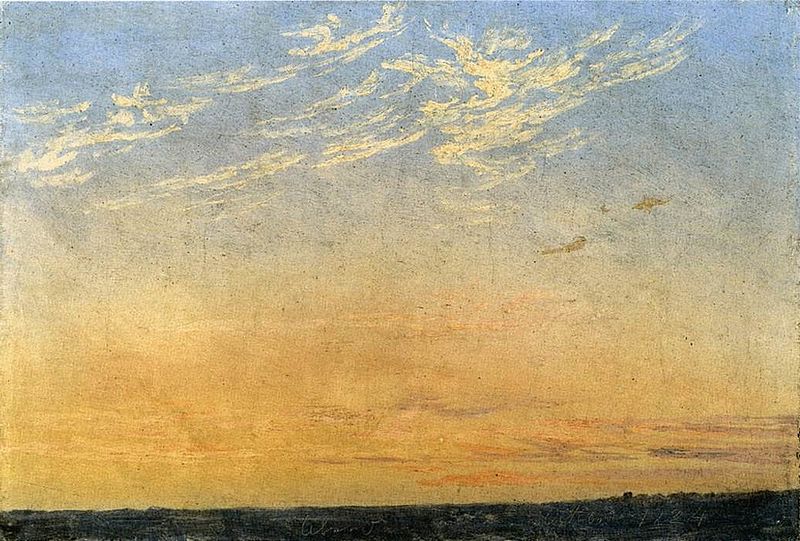
Evening by Caspar David Friedrich (1824)

Piano Sonata no.18 in E flat major Op.31/3 for piano (1802, Beethoven aged 31)

1. Allegro
2. Scherzetto: Allegretto vivace

3. Menuetto: Moderato e grazioso
4. Presto con fuoco

Dedication unknown
Duration 23′

Listen

written by Ben Hogwood

Background and Critical Reception

The third of Beethoven’s Op.31 trilogy is in four movements – the last of his piano sonatas to be structured in this way. It returns to happier climes after the darkness of The Tempest, but does so in wholly original ways.

Critics are united in their praise for this work, with Jan Swafford taking up the story. ‘Beethoven begins Op.31 no.3 in E flat with a harmony so strange that it would have earned him more cries of bizarre from critics if it did not commence a work of surpassing warmth, wit and winsomeness. The beginning is an invitation, like a hand extended in friendship or love.’ The importance of positive feeling is stressed. ‘Following the scherzo, most unexpectedly, comes a graceful and lyrical minuet – he wanted no slow movement to trouble the warm weather of this sonata. For conclusion, a tarantella marked Presto con fuoco, with the fire appropriate to that old whirling dance in which, once upon a time, you hoped to survive the bite of the tarantula by dancing to exhaustion.’

For Sir András Schiff, ‘the third sonata, in E flat major, is probably the hardest one to paraphrase in words: on the one hand it seems tender, entreating and pleading, with a lyrical basic mood strongly in evidence; and on the other hand, in the scherzo and finale it maintains a high spirited and urgent sense of motion.’

The nature of the finale earned the sonata a nickname of The Hunt in some quarters – and many admirers, including Angela Hewitt, who found that ‘Beethoven is in his element, for sure’.

Thoughts

Op.31/3 starts with a gentle question; a chord that is the musical equivalent of a bird unexpectedly landing on a small branch. It is the most unusual beginning to a sonata yet, and opens up a beautifully paced story, Beethoven’s invention bubbling up and down the keyboard. The chord itself is the sort you could easily play over and over again on the piano, creating an oasis of calm and positivity.

After this fascinating and elusive first movement, Beethoven has fun with the martial rhythms of the second. Back in A flat major, this is far removed from the stillness of the Pathétique slow movement, with the composer intent on making his audience smile and jump with the suddenly loud interjections. As a complement, a softer side in the form of a charming minuet, flowing nicely but with just a touch of shade in the form of some unusual harmonies – Beethoven’s second theme has a slight shiver running through it.

The last movement is a canter – as Angela Hewitt says, a bit fast for a hunt, but with a galloping gait. Beethoven builds up terrific momentum here, and some of the bigger chords would surely have been stretching the pianos of the day. The good feeling is irrepressible, in complete contrast to the end of the Tempest, and the sonata finishes with a winning flourish. Beethoven’s strength of feeling wins the day.

Recordings used and Spotify links

Emil Gilels (Deutsche Grammophon)
Alfred Brendel (Philips)
András Schiff (ECM)
Angela Hewitt (Hyperion)
Paul Badura-Skoda (Arcana)
Stephen Kovacevich (EMI)
Igor Levit (Sony Classical)
Claudio Arrau (Philips)
Daniel Barenboim (Deutsche Grammophon)

Some wonderful recordings to savour here – with Sir András Schiff, Stephen Kovacevich and Alfred Brendel particularly enjoyable. Yet the most enjoyable guide, and a regular late night companion for this listener, is Emil Gilels, who gets a perfect balance between the delicacy and determined optimism at the heart of this work.

You can hear clips of Hewitt’s recording at the Hyperion website

You can chart the Arcana Beethoven playlist as it grows, with one recommended version of each piece we listen to. Catch up here!

Also written in 1802 Hummel Piano Quintet in E flat major Op.87

Next up 6 Variations in F major Op.34
Listening to Beethoven #184 – Piano Sonata no.17 in D minor Op.31/2 ‘The Tempest’

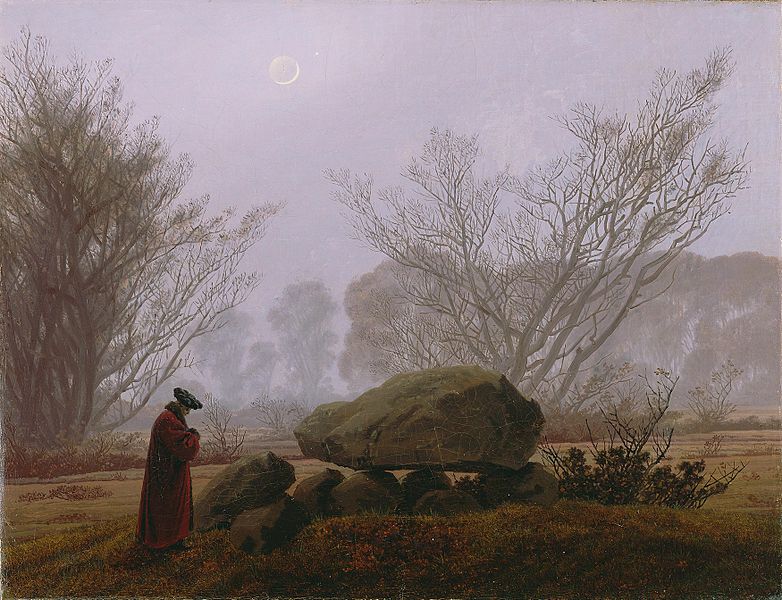
Walk at Dusk (Man Contemplating a Megalith), possibly a self-portrait by Caspar David Friedrich (1837-40)

Piano Sonata no.17 in D minor Op.31/2 ‘The Tempest’ for piano (1802, Beethoven aged 31)

1. Largo – Allegro
2. Adagio
3. Allegretto

Dedication unknown
Duration 23′

Listen

written by Ben Hogwood

Background and Critical Reception

As we have previously considered, the Op.31 sonatas were composed in the year of Beethoven’s Heiligenstadt Testament, written on 6 October 1802. In this landmark letter to his brothers, which was left unsent, he revealed the full torment of his encroaching deafness – and while nobody would guess Beethoven’s fate from the first or last in the Op.31 set of his troubles, they could be left in no doubt by the second.

Its nickname of The Tempest could well be spurious, for it was applied after Anton Schindler recounted a conversation asking the composer what the piece was about, whereupon Beethoven supposedly said, ‘Read Shakespeare’s Tempest!’

Angela Hewitt, in the booklet notes accompanying her Hyperion recordings of the sonatas, gives a heartfelt appraisal of the sonata, noting its quote in the first movement of the aria Es ist vollbracht from J.S. Bach’s St. John Passion, and also the similarity of the last few bars to the rumbling of distant thunder, a quality identified by Beethoven’s friend Carl Czerny.

Hewitt takes in ‘one of Beethoven’s most glorious slow movements’, with a dolce melody that proves ‘heartbreaking in its eloquent simplicity’. In the third movement, ‘the tragic feeling continues right to the end, with the music disappearing into the void.’

Thoughts

This sonata is both dramatic and tragic – the opposite of its predecessor in G major. From the beginning it has a heavy heart, and a tendency to lean on dissonances in a way that somehow anticipates the music of Janáček, still some 120 years away.

The first movement paints a dark picture, with a lot of the action lower down in the piano. Ominous rumblings and angular lines are the order of the day, and as the development of these ideas progresses the music almost stops, enfolded in its own mystery. Suddenly a bolt of lightning thunders down, the listener jolted back to an awful reality.

After the fire and brimstone of the first movement, the second is calmer but not necessarily consoling. The intensity is still present in Beethoven’s thoughts, now presented in a measured way. Again the composer’s use of silence is telling, as is the time given to the lower end of the piano once again.

The finale shifts up towards the higher register but stays resolutely in D minor. It retains the powerful expression of the first two movements, but stays in semiquavers the whole way through, meaning the tension never lets up. Just on the approach to the recap of the main theme the music adopts a rocking motion, before subsiding to a quiet, thoughtful end. There is no major key happiness to be had here.

This must surely be the lowest piano sonata to have been written by 1802, and would have had an enormous impact on early audiences. In the knowledge of Beethoven’s realisation of his deafness it is convenient to link the Tempest sonata to the anguish he must have felt, but it really does feel like a pure expression of pain and loss. The piano sonata as Beethoven would have known it was breaking new grounds.

Recordings used and Spotify links

Emil Gilels (Deutsche Grammophon)
Alfred Brendel (Philips)
András Schiff (ECM)
Angela Hewitt (Hyperion)
Paul Badura-Skoda (Arcana)
Stephen Kovacevich (EMI)
Igor Levit (Sony Classical)
Claudio Arrau (Philips)
Daniel Barenboim (Deutsche Grammophon)

Emil Gilels is the ideal guide for this tragic piece, and his interpretation has a great deal of gravitas. The crunch of the lower register chords comes through on Paul Badura-Skoda’s fortepiano account, while Sir András Schiff conveys plenty of drama too. Angela Hewitt’s heartfelt account is also warmly recommended.

You can hear clips of Hewitt’s recording at the Hyperion website

You can chart the Arcana Beethoven playlist as it grows, with one recommended version of each piece we listen to. Catch up here!

Also written in 1802 Haydn Harmoniemesse

Next up Piano Sonata no.18 in E flat major Op.31/3

Listening to Beethoven #183 – Piano Sonata no.16 in G major Op.31/1

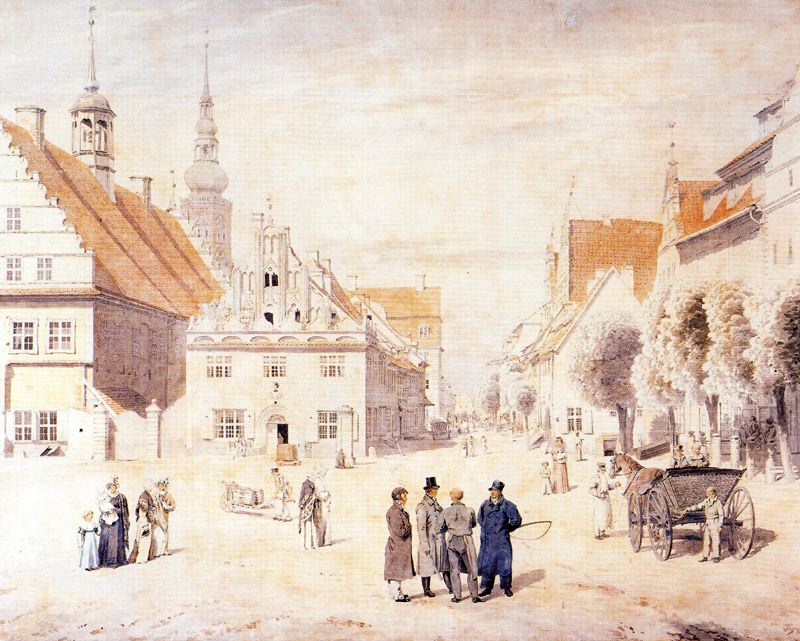
The Marketplace in Greifswald by Caspar David Friedrich (1818)

Piano Sonata no.16 in G major Op.31/1 for piano (1802, Beethoven aged 31)

1. Allegro vivace
2. Adagio grazioso
3. Allegretto

Dedication unknown
Duration 25′

Listen

written by Ben Hogwood

Background and Critical Reception

The three Op.31 piano sonatas stand right at a junction in Beethoven’s output, at the end of his more ‘classical’ approach and at the start of a period of even greater originality. Sir András Schiff notes this is the last ‘set’ of sonatas Beethoven published, and like Op.2 or Op.10, ‘we really do hear and notice an enormous diversity’. The trio is much-loved by pianists, but perhaps inevitably star billing goes to the minor key work in the middle, the ‘Tempest’.

That is to the detriment of the other two works in the group – beginning with this work in G major, something of a conundrum for Angela Hewitt. Writing booklet notes for Hyperion, the pianist confesses to a puzzled reaction on her first encounter with the piece. ‘What on earth is this?’, she thought. ‘It seemed to comprise a first movement in which the two hands can’t play together and, when they do, run around in octave unisons, and with a banal-sounding second theme that didn’t help matters; a second movement which had so many notes on the page and looked either drastically simple or too flowery, and how were you supposed to play that left hand anyway; and a last movement that had a nice theme but looked overly long and, to make matters worse, ended softly. So I didn’t go near it.’

A conversation with conductor Sir Roger Norrington gave her deep insight into the humour in Beethoven’s music, and her view was transformed. It was ‘then possible to see this very unique sonata, and indeed most of the cycle, in a totally different light. It was, and remains, very liberating.’

She points out all the instances of humour in Beethoven’s writing, especially the overly long build up to the return of the first theme, which leans on a spicy clash between E flat and D, before tripping into ‘one of those country themes that Beethoven so excelled at’, and which his pupil Czerny said should be played ‘facetiously’. The slow movement ‘is a very unusual movement. We immediately enter the world of Italian opera, and it is hard not to imagine a great bel canto singer accompanied by a mandolin. The most delicate touch is needed for this movement as well as great poise. I see it more as Beethoven setting out to prove that he could write better Italian music than the Italians!’ Finally the last movement, which ‘is perhaps less inspired, but should not be rushed. Much of this music could pass as Schubert, but the coda couldn’t be by anybody but Beethoven.’

Thoughts

A delightful piece, and an unpredictable one. This is a work where the sense of Beethoven flexing his muscles as a composer is undeniable, and the freedom of expression he has here is perhaps greater than at any point in his output so far. The first movement is allowed to run free, as though improvised at the piano, but it keeps within the boundaries of sonata form and never rambles. Instead it is witty, thoughtful, expansive, intimate and consoling by turn, always on the move and always keeping the listener guessing.

Second movement really expansive flourishes in the right hand, going further and further from the tonic in what feels like an increasingly restless desire to escape the conventional tonality. This is a really substantial, ‘staged’ movement that tells a powerful story.

Third movement feels just right after the emotional drama of the second, it is reassuring and comforting. There are some questions to this however when Beethoven starts developing the theme, and suddenly things feel less certain. The end is pure theatre, too, slowed down and drawing out the inevitable return to the home key – but even this is far from certain

That Beethoven could write a piece of such surety and humour in one of his darkest hours says much for the composer’s temperament, and it gives us an indication of how he would respond to his impending deafness with ever greater and more original music.

Recordings used and Spotify links

Emil Gilels (Deutsche Grammophon)
Alfred Brendel (Philips)
András Schiff (ECM)
Angela Hewitt (Hyperion)
Paul Badura-Skoda (Arcana)
Stephen Kovacevich (EMI)
Igor Levit (Sony Classical)
Claudio Arrau (Philips)
Daniel Barenboim (Deutsche Grammophon)

Artists really enjoy themselves in a work such as this, and providing their approach is sensitive to Beethoven’s original thoughts there is much fun to be had. I particularly enjoyed the versions from Gilels, Badura-Skoda, Hewitt, Schiff and Brendel, though in the hands of Schiff Beethoven’s inspiration felt more on the edge and likely to go over at any moment.

You can hear clips of Hewitt’s recording at the Hyperion website

You can chart the Arcana Beethoven playlist as it grows, with one recommended version of each piece we listen to. Catch up here!

Also written in 1802 Weber Peter Schmoll und seine Nachbarn

Next up Piano Sonata no.17 in D minor Op.31/2 ‘The Tempest’

Switched On – K.D.A.P.: Influences (Arts & Crafts Productions)

kdap

reviewed by Ben Hogwood

What’s the story?

Taking time out from his full-time role as frontman for Toronto band Broken Social Scene, Kevin Drew makes his first album as K.D.A.P. (Kevin Drew A Picture). It is a chance for him to revisit his early 20s, when he listened intently to the early output of the Warp label as well as a good deal of electronic and cinematic music.

While it is a bit of a throwback, Influences is ultimately a creative response to the Coronavirus pandemic, when Drew found himself in the south of England in lockdown. Embracing the chance to get out into the natural world, his walked through the woods of Slinford and along the canals in North London. The excursions yielded plenty of musical ideas, which he expressed in fully formed ideas on the Endlesss app.

These ideas were sculpted into eight instrumental works with engineer Nyles Spencer, and some of the music was re-recorded with the help of drummer Evan Tighe and Broken Social Scene bass player Charles Spearin.

What’s the music like?

Influences positively bubbles with life and promise, like the English countryside in the springtime. An abundance of melodic ideas course through each track, carefully layered into an appealing patchwork of patterns.

The Slinfold Loop, Drew’s first track. blossoms nicely and shows how the album will work, without becoming an obvious blueprint. There is busy activity in the background and attractive melodic loops up front, all with the potential to germinate.

Shadow Rescues pulses with a positive nervous energy, while single lines are intertwined like shoots, leaves and branches on You And Me And Them, each with their own distinct colours. Wilner’s Parade is underpinned by a lean piano line, while Hopefully Something has a guitar prompt that could easily be taken from an outtake by The Cure.

Does it all work?

It does. Drew’s work is full of incident, and is ambient in the sense that it radiates positive energy and melodic charm. If anything some of these compositions could be allowed to run for longer, as there are so many ideas they would stand up to more development.

Is it recommended?

Enthusiastically. Influences is a highly listenable piece of work that reveals more with each listen. Influences is ideally structured and lovingly constructed. It is in a sense a love letter from Kevin Drew to his youth, but it could lead to so much more in the future, for he is clearly at home in an environment like this, and relishes the opportunities it has to offer.

Stream

Buy


Switched On – Fake Laugh & Tarquin: Fake Laugh & Tarquin (Republic Of Music)

fake-laugh-tarquin

reviewed by Ben Hogwood

What’s the story?

“I feel a frost in the summertime”, sings Fake Laugh at the start of Ice, the second song into his collaboration with old college friend, producer Tarquin. How did he know that the album would be released in one of Britain’s worst summers in ages? The song, a single release from the pair’s debut album in partnership, is an accurate guide to what lies in store for listeners.

Their friendship was light to start with, a fleeting acquaintance while studying in Sussex, but here they hook up with far greater intent, releasing a few singles and picking up endorsements from the likes of DJ Annie Mac in the process.

What’s the music like?

Engaging and a bit quirky – but essentially some very listenable electro pop. There is a sound musical chemistry between the two, together with songwriting that comes alive in the lyrical department. Original Sin is a fine example of this, its opening lyrics set to chugging clarinets. 

In contrast, We Ride holds its poise over a crunchy backing, while Gloom On The Dancefloor is an affecting, stately torch song. The vocals from Fake Laugh are a standout feature too, floating elegantly on Slow while beautifully layered on So Good.

Does it all work?

Yes, providing the listener doesn’t take their electro pop too seriously. There is no padding to the songs, the album over relatively quickly – but there is more than enough substance for it to survive a second and a third play without running out of steam.

Is it recommended?

Yes. This album offers an original approach, with songs that are a bit different to the over polished fodder heard on mainstream radio at the moment. Fake Laugh & Tarquin are on to something here, and it is to be hoped their collaboration doesn’t stop at one album.

Stream

Buy