Listening to Beethoven #183 – Piano Sonata no.16 in G major Op.31/1

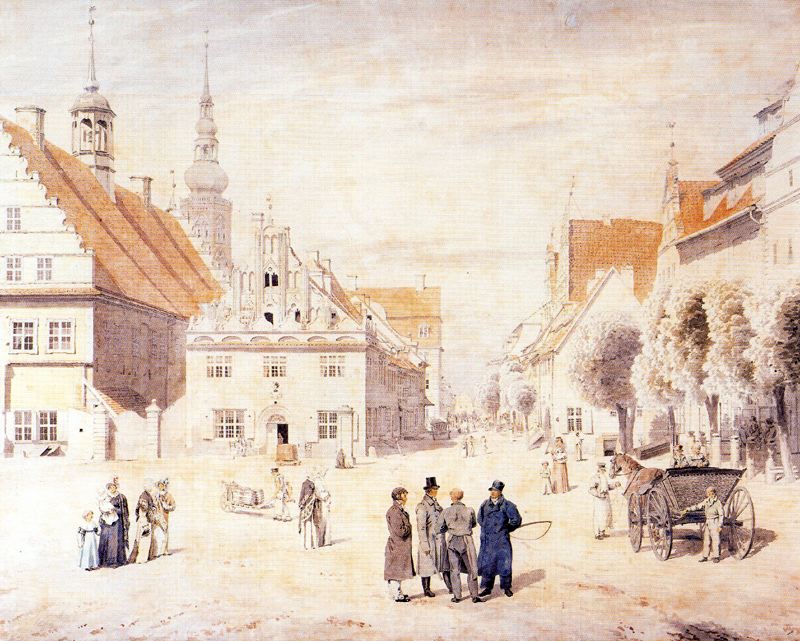
The Marketplace in Greifswald by Caspar David Friedrich (1818)

Piano Sonata no.16 in G major Op.31/1 for piano (1802, Beethoven aged 31)

1. Allegro vivace
2. Adagio grazioso
3. Allegretto

Dedication unknown
Duration 25′

Listen

written by Ben Hogwood

Background and Critical Reception

The three Op.31 piano sonatas stand right at a junction in Beethoven’s output, at the end of his more ‘classical’ approach and at the start of a period of even greater originality. Sir András Schiff notes this is the last ‘set’ of sonatas Beethoven published, and like Op.2 or Op.10, ‘we really do hear and notice an enormous diversity’. The trio is much-loved by pianists, but perhaps inevitably star billing goes to the minor key work in the middle, the ‘Tempest’.

That is to the detriment of the other two works in the group – beginning with this work in G major, something of a conundrum for Angela Hewitt. Writing booklet notes for Hyperion, the pianist confesses to a puzzled reaction on her first encounter with the piece. ‘What on earth is this?’, she thought. ‘It seemed to comprise a first movement in which the two hands can’t play together and, when they do, run around in octave unisons, and with a banal-sounding second theme that didn’t help matters; a second movement which had so many notes on the page and looked either drastically simple or too flowery, and how were you supposed to play that left hand anyway; and a last movement that had a nice theme but looked overly long and, to make matters worse, ended softly. So I didn’t go near it.’

A conversation with conductor Sir Roger Norrington gave her deep insight into the humour in Beethoven’s music, and her view was transformed. It was ‘then possible to see this very unique sonata, and indeed most of the cycle, in a totally different light. It was, and remains, very liberating.’

She points out all the instances of humour in Beethoven’s writing, especially the overly long build up to the return of the first theme, which leans on a spicy clash between E flat and D, before tripping into ‘one of those country themes that Beethoven so excelled at’, and which his pupil Czerny said should be played ‘facetiously’. The slow movement ‘is a very unusual movement. We immediately enter the world of Italian opera, and it is hard not to imagine a great bel canto singer accompanied by a mandolin. The most delicate touch is needed for this movement as well as great poise. I see it more as Beethoven setting out to prove that he could write better Italian music than the Italians!’ Finally the last movement, which ‘is perhaps less inspired, but should not be rushed. Much of this music could pass as Schubert, but the coda couldn’t be by anybody but Beethoven.’

Thoughts

A delightful piece, and an unpredictable one. This is a work where the sense of Beethoven flexing his muscles as a composer is undeniable, and the freedom of expression he has here is perhaps greater than at any point in his output so far. The first movement is allowed to run free, as though improvised at the piano, but it keeps within the boundaries of sonata form and never rambles. Instead it is witty, thoughtful, expansive, intimate and consoling by turn, always on the move and always keeping the listener guessing.

Second movement really expansive flourishes in the right hand, going further and further from the tonic in what feels like an increasingly restless desire to escape the conventional tonality. This is a really substantial, ‘staged’ movement that tells a powerful story.

Third movement feels just right after the emotional drama of the second, it is reassuring and comforting. There are some questions to this however when Beethoven starts developing the theme, and suddenly things feel less certain. The end is pure theatre, too, slowed down and drawing out the inevitable return to the home key – but even this is far from certain

That Beethoven could write a piece of such surety and humour in one of his darkest hours says much for the composer’s temperament, and it gives us an indication of how he would respond to his impending deafness with ever greater and more original music.

Recordings used and Spotify links

Emil Gilels (Deutsche Grammophon)
Alfred Brendel (Philips)
András Schiff (ECM)
Angela Hewitt (Hyperion)
Paul Badura-Skoda (Arcana)
Stephen Kovacevich (EMI)
Igor Levit (Sony Classical)
Claudio Arrau (Philips)
Daniel Barenboim (Deutsche Grammophon)

Artists really enjoy themselves in a work such as this, and providing their approach is sensitive to Beethoven’s original thoughts there is much fun to be had. I particularly enjoyed the versions from Gilels, Badura-Skoda, Hewitt, Schiff and Brendel, though in the hands of Schiff Beethoven’s inspiration felt more on the edge and likely to go over at any moment.

You can hear clips of Hewitt’s recording at the Hyperion website

You can chart the Arcana Beethoven playlist as it grows, with one recommended version of each piece we listen to. Catch up here!

Also written in 1802 Weber Peter Schmoll und seine Nachbarn

Next up Piano Sonata no.17 in D minor Op.31/2 ‘The Tempest’
Switched On – K.D.A.P.: Influences (Arts & Crafts Productions)

kdap

reviewed by Ben Hogwood

What’s the story?

Taking time out from his full-time role as frontman for Toronto band Broken Social Scene, Kevin Drew makes his first album as K.D.A.P. (Kevin Drew A Picture). It is a chance for him to revisit his early 20s, when he listened intently to the early output of the Warp label as well as a good deal of electronic and cinematic music.

While it is a bit of a throwback, Influences is ultimately a creative response to the Coronavirus pandemic, when Drew found himself in the south of England in lockdown. Embracing the chance to get out into the natural world, his walked through the woods of Slinford and along the canals in North London. The excursions yielded plenty of musical ideas, which he expressed in fully formed ideas on the Endlesss app.

These ideas were sculpted into eight instrumental works with engineer Nyles Spencer, and some of the music was re-recorded with the help of drummer Evan Tighe and Broken Social Scene bass player Charles Spearin.

What’s the music like?

Influences positively bubbles with life and promise, like the English countryside in the springtime. An abundance of melodic ideas course through each track, carefully layered into an appealing patchwork of patterns.

The Slinfold Loop, Drew’s first track. blossoms nicely and shows how the album will work, without becoming an obvious blueprint. There is busy activity in the background and attractive melodic loops up front, all with the potential to germinate.

Shadow Rescues pulses with a positive nervous energy, while single lines are intertwined like shoots, leaves and branches on You And Me And Them, each with their own distinct colours. Wilner’s Parade is underpinned by a lean piano line, while Hopefully Something has a guitar prompt that could easily be taken from an outtake by The Cure.

Does it all work?

It does. Drew’s work is full of incident, and is ambient in the sense that it radiates positive energy and melodic charm. If anything some of these compositions could be allowed to run for longer, as there are so many ideas they would stand up to more development.

Is it recommended?

Enthusiastically. Influences is a highly listenable piece of work that reveals more with each listen. Influences is ideally structured and lovingly constructed. It is in a sense a love letter from Kevin Drew to his youth, but it could lead to so much more in the future, for he is clearly at home in an environment like this, and relishes the opportunities it has to offer.

Stream

Buy


Switched On – Fake Laugh & Tarquin: Fake Laugh & Tarquin (Republic Of Music)

fake-laugh-tarquin

reviewed by Ben Hogwood

What’s the story?

“I feel a frost in the summertime”, sings Fake Laugh at the start of Ice, the second song into his collaboration with old college friend, producer Tarquin. How did he know that the album would be released in one of Britain’s worst summers in ages? The song, a single release from the pair’s debut album in partnership, is an accurate guide to what lies in store for listeners.

Their friendship was light to start with, a fleeting acquaintance while studying in Sussex, but here they hook up with far greater intent, releasing a few singles and picking up endorsements from the likes of DJ Annie Mac in the process.

What’s the music like?

Engaging and a bit quirky – but essentially some very listenable electro pop. There is a sound musical chemistry between the two, together with songwriting that comes alive in the lyrical department. Original Sin is a fine example of this, its opening lyrics set to chugging clarinets. 

In contrast, We Ride holds its poise over a crunchy backing, while Gloom On The Dancefloor is an affecting, stately torch song. The vocals from Fake Laugh are a standout feature too, floating elegantly on Slow while beautifully layered on So Good.

Does it all work?

Yes, providing the listener doesn’t take their electro pop too seriously. There is no padding to the songs, the album over relatively quickly – but there is more than enough substance for it to survive a second and a third play without running out of steam.

Is it recommended?

Yes. This album offers an original approach, with songs that are a bit different to the over polished fodder heard on mainstream radio at the moment. Fake Laugh & Tarquin are on to something here, and it is to be hoped their collaboration doesn’t stop at one album.

Stream

Buy


Switched On – Llyr: Biome (Mesh)

llyr

reviewed by Ben Hogwood

What’s the story?

‘Nature is the ultimate composer’. This is the standout quote from Berlin-based Gareth Williams, aka Llyr, as he introduces his first full-length album Biome. Natural sounds are the first things we hear, the birds and monkeys of the Borneo rainforest making themselves known and setting the scene for Williams’ thoughtful piece of work.

For Biome is an environmental album as well as a musical one, split into two distinct sections called Pre-Anthropocene and Anthropocene. The first four tracks constitute an ambient celebration of nature and its many qualities, while the second group of four are disrupted by human involvement.

What’s the music like?

Llyr allows the field recordings to flow beautifully from the start, with minimal involvement from his own electronics, but he prompts the slight changes of mood with a natural instinct for structure. The sounds are lovely on headphones, the listener allowed to revel in the unhurried natural processes of the jungle. Particularly striking is the fourth track, Courtship Signal, where the mating calls of frogs in Kubah National Park are replicated and developed.

When the humans get involved the electronics come to the fore, and so do the dance beats. Llyr manages the crossover really well, and unleashes a form of primal energy through the kinetic Intrusion #509, the bubbling of The Hawthorne Effect and a rush of percussion on Interject, featuring Private Agenda, that sweeps all before it. Llyr uses this to show the chaos of the human imprint, having a good time but sweeping away the ambience that went before. Finally Encroachment powers to the finish, and we realise all the while that we have been held under the dense canopy of the forest. The white noise of the percussion enhances this effect.

Does it all work?

Yes. Biome is an imaginative look at the so-called developing world today, and its structure works really well. Essentially it is a sequence of natural ambience, followed by 25 minutes of busy dancefloor action, like moving between two stages in a forest festival.

Is it recommended?

It is. Electronics and field recordings can work together really well in the right circumstances, and this is definitely a case in point. Llyr makes a number of powerful observations about the state of the world today without ramming them down the listener’s throat, communicating them in a very musical way. This means Biome works on several levels, a journey in the truest sense of the word.

Stream

Buy


Listening to Beethoven #182 – Romance no.1 in G major Op.40

Violin from Beethoven’s possession, one of four instruments Beethoven received as a gift from Prince Karl von Lichnowsky around 1800 (image from the Beethoven-Haus Bonn)

Romance no.1 in G major Op.40 for violin and orchestra (1800-02, Beethoven aged 31)

Dedication unknown
Duration 7′

Listen

Background and Critical Reception

Beethoven’s first published Romance for violin and orchestra was written after the second, which we have already appraised. It is seen by commentators as part of his preparation for a full-scale violin concerto, having attempted such a work ten years previously.

Once again there is a surprising lack of prose written about this piece, which is odd given its popularity on classical music radio. It is written for a ‘classically sized’ orchestra, the violin teamed with strings, flute, oboes, bassoons and horns.

Thoughts

Beethoven starts his Romance with the solo instrument alone, a striking move. It would have been relatively conventional for a piano to start such a piece on its own, but not the violin – which starts here with soft, plaintive chords, like a drone. The mood is slightly folksy.

Gradually the orchestra join the soloist, and as they do the mood becomes more warm-hearted, the theme heard several times and finished off with a decisive cadence. The violin goes on to lead quite an assertive section in the minor key, before returning to sing the main theme in a higher register.

Recordings used and Spotify links

Anne-Sophie Mutter (violin), New York Philharmonic Orchestra / Kurt Masur (Deutsche Grammophon)
Thomas Zehetmair (violin), Orchestra of the Eighteenth Century / Frans Brüggen
Itzhak Perlman (violin), Berliner Philharmoniker / Daniel Barenboim
Arthur Grumiaux (violin), Royal Concertgebouw Orchestra / Sir Colin Davis

Thomas Zehetmair gives an attractive introduction with the Orchestra of the Eighteenth Century under Frans Brüggen, with a fast tempo choice that results in a swift performance time of five and a half minutes. Perhaps not surprisingly Anne-Sophie Mutter lingers longer, hers a luxurious but tender account with Kurt Masur. Arthur Grumiaux has the ideal singing tone for this piece, while Itzhak Perlman also finds great sensitivity.

You can chart the Arcana Beethoven playlist as it grows, with one recommended version of each piece we listen to. Catch up here!

Also written in 1802 Blasius Clarinet Concerto no.1

Next up Piano Sonata no.16 in G major Op.31/3