Listening to Beethoven #114 – 12 Variations on the Russian Dance from ‘Das Waldmädchen’, WoO 71

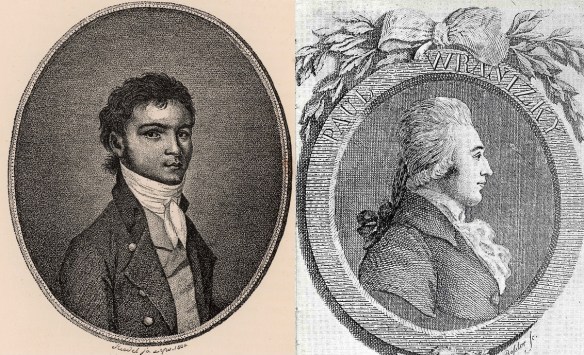
Ludwig van Beethoven and Paul Wranitzky (right, in a portrait by Johann Georg Edlinger)

12 Variations on the Russian Dance from Wranitzky’s ‘Das Waldmädchen’, WoO 71 for piano (1797, Beethoven aged 26)

Dedication Countess Anna Margarete von Browne
Duration 10′

Listen

What’s the theme like?

The theme is a Russian Dance from Paul Wranitzky‘s ballet Das Waldmädchen (The Forest Maiden), completed in 1796. Wranitzky, a Czech composer, moved to Vienna in the 1770s and was reportedly given the task of conducting the premiere of Beethoven’s First Symphony in 1800.

Background and Critical Reception

This is another set of variations from Beethoven with links to the ballet, a trait noted by Daniel Heartz. The theme is from a contemporary of the composer’s, Paul Wranitzky – resident in Vienna for a number of years having moved from Prague.

Writing about the variations in the booklet note for Cécile Ousset‘s account, Jean-Charles Hoffelé notes some unusual qualities. ‘The theme…has an irregular rhythm that Beethoven clearly cherishes, composing a set whose harmonic experiments go far enough for one to see the beginning of a new stylistic phase.’

Thoughts

Once again Beethoven serves up a dramatic set of twelve variations on a theme, with a satisfying ebb and flow, all of them wrapped up in ten minutes – even allowing for quite a substantial coda with the twelfth variation.

Initially the mood is quite restless, with the changing harmonies, but Beethoven can also be celebratory (the garland of the right hand in the fourth variation for instance.

This set of 12 is also notable for the appearance of three minor-key variations. The third is quite serious, but the seventh is a flurry of virtuosity. The penultimate variation is the most striking of the set, Beethoven leaning very heavily on one particular note – an ‘F’ natural – to create an atmosphere of uncertainty. This is dissipated in the final variation and coda. Beethoven begins with a Bach-style dialogue between the parts but develops to what sounds like the cadenza of a solo concerto, before ending gracefully.

Recordings used and Spotify links

Emil Gilels (piano) (EMI)
Vladimir Ashkenazy (piano) (Deutsche Grammophon)
Cécile Ousset (piano) (Eloquence)
Ronald Brautigam (fortepiano) (BIS)

The Spotify playlist below includes all of the versions listed above. There are some terrific accounts here. Gilels and Ousset, among the older guard, generate a terrific sense of occasion. Ronald Brautigam’s fortepiano account recreates something of the wonder Beethoven’s original audiences would have felt when presented with this music. Vladimir Ashkenazy seemingly has a soft spot for this set, pairing it with his Diabelli Variations recorded in 2007.

Also written in 1797 Dussek Piano Trio in E flat major Op.37

Next up 2 Rondos Op.51

Listening to Beethoven #113 – Duo for viola and cello in E flat major WoO 32, ‘Eyeglass Duo’


Nikolaus Zmeskall von Domanovecz, courtesy of Beethoven-Haus, Bonn

Duo for viola and cello in E flat major WoO 32, ‘Eyeglass Duo’ (1797, Beethoven aged 26)

1 Allegro
2 Minuetto

Dedication Nikolaus Zmeskall
Duration 14′

Listen

Background and Critical Reception

This is a title to raise the eyebrows – and is one of the curious corners of Beethoven’s output for sure. Perhaps fortunately the eyeglasses are not used to make any music – not directly, at any rate – rather, they refer to the wearers of the eyeglasses, Beethoven himself (viola) and Nikolaus Zmeskall (cello).

Baron Zmeskall was an accomplished cellist and a good friend of Beethoven, and the piece seems to have been written for domestic use only. It is in two lopsided movements, with a substantial first movement full of interaction between the players and a much shorter Minuetto. Richard Wigmore writes of how ‘in the minuet, with its pawky canonic trio, Beethoven suddenly pulls the rug from under the listener’s feet, by veering from E flat to a remote C flat – just the kind of comic-mysterious effect he had learnt from Haydn’.

Thoughts

Beethoven would surely have been aware that Mozart wrote two accomplished – and underrated – duos for violin and viola, and possibly of the four sonatas Michael Haydn published for the combination in the same year, 1797. Working lower down the range, Mozart also wrote a Sonata for bassoon and cello, lasting roughly the same length as this piece.

Perhaps Beethoven was aware of these when writing this highly amenable duo – which presumably appeared in large print, given the sight limitations of the players! Listening to the bright and busy Allegro, the first movement of this piece, the listener can imagine how much pleasure it brought to the bespectacled music makers. It is a lively discourse where the two instruments are treated completely as equals. The writing could easily be lifted from a string quartet, and several times I found my ear was expecting two violins to appear in harmony. The Minuetto is good fun too, including the harmonic trick noted above.

It may be intended for domestic music making only but Beethoven’s craft is all too evident, and his wit too, in this enjoyable miniature.

Recordings used

Veronika Hagen (viola), Clemens Hagen (DG)
Lawrence Power (viola), Paul Watkins (Hyperion)
Jürgen Kussmaul (viola), Anner Bylsma (cello) (Sony Classical)

Three excellent performances, bringing through the elegance of the piece, its genial nature, and also its humourous touches. Kussmaul and Bylsma, on period instruments, have a relatively grainy sound which is still appealing.

Spotify link

Veronika & Clemens Hagen

Jürgen Kussmaul, Anner Bylsma

You can listen to clips from Lawrence Power and Paul Watkins’ version on the Hyperion website

written by Ben Hogwood

You can chart the Arcana Beethoven playlist as it grows, with one recommended version of each piece we listen to. Catch up here!

Also written in 1797 Michael Haydn 4 Sonatas for Violin and Viola

Next up 12 Variations on the Russian Dance from ‘Das Waldmädchen’

Listening to Beethoven #112 – Piano Sonata no.5 in C minor Op.10/1


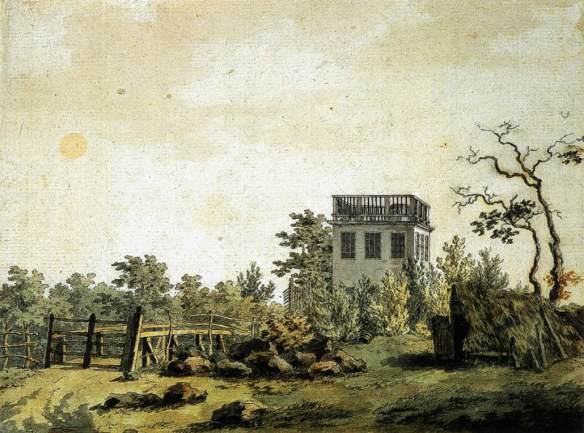
Landscape with Pavilion by Caspar David Friedrich (c1797)

Piano Sonata no.5 in C minor Op.10/1 for piano (1797, Beethoven aged 26)

1 Allegro molto e con brio
2 Adagio molto
3 Finale (Prestissimo)

Dedication Countess Anna Margarete von Browne
Duration 19′

Listen

Background and Critical Reception

Beethoven turns once more to the piano sonata, with the first of a triptych eventually published in September 1798. This work, completed almost a year earlier, sees a swift return to C minor. For the pianist András Schiff, the three works published as Op.10 ‘are more concentrated…they turn outwards, towards connoisseurs and amateurs. Perhaps for that reason they are slightly easier to play.’ From experience, the C minor is still a tough nut to crack if you haven’t reached Grade 8!

Schiff and Daniel Heartz note the pointers towards a sonata yet to be composed. ‘The Adagio molto in 2/4 time that follows is in A flat’, notes Heartz, ‘a key that, when joined with the song-like character and coming right after fretful C minor, will make an unforgettable impression in the Pathétique.

This comes after a first movement where Schiff speaks of ‘drama and turmoil. Its opening theme is a so-called ‘Mannheim rocket’, as in Op.2/1, but it is sharpened by the dotted rhythm’. Other qualities are the thick scoring, an extreme contrast between very quiet (pianissimo) and very loud (fortissimo), and increased gaps between high and low registers.

Although the ending is in C major, ‘we hear it as minor’, says Schiff, the whole movement ‘secretive and urgent’. There is a ghostly conclusion where ‘the work disappears mysteriously and rapidly’.

Thoughts

On one hand, the first movement of this sonata could feel like a ‘regulation’ piece of Beethoven – especially if you are familiar with his other works in C minor (the Fifth Symphony, Pathétique Sonata, or the First Piano Trio to pick just three examples). On the other, with closer inspection, there is still plenty going on. The beefy C minor chords show how much Beethoven’s piano writing is filling out, while the use of silence allows the composer to pop in a few witty asides for his audience, as Haydn or Clementi might have done.

Time slows to a near standstill for the second movement, the anticipation of what Beethoven would do with his Pathétique sonata. Expressive licence is given to the free right hand, which is allowed to wander in the way a C.P.E. Bach Fantasia might have done, but by the end the mood is calm and meditative. Not so the third movement, a flurry of notes with more crunchy chords in the lower end of the piano. Beethoven is off the leash again, contrasting the bold first theme with the slight lilt of the second, reflecting perhaps his work on German Dances around the time of composition. This theme moves to C major for its second statement, after which the piece hurries to the finish line – but, as Schiff notes, ends in a puff of smoke.

Recordings used and Spotify links

Emil Gilels (Deutsche Grammophon)
Alfred Brendel (Philips)
András Schiff (ECM)
Angela Hewitt (Hyperion)
Paul Badura-Skoda (Arcana)
Stephen Kovacevich (EMI)
Igor Levit (Sony Classical)

Paul Badura-Skoda gives an engaging performance on a Johann Schantz piano, dating from Vienna in 1790. The mottled tones of the left hand work nicely in the Adagio, though textures are more ragged in the faster music. Emil Gilels takes a broad view of the slow movement, complementing a commanding account of the outer two. Schiff is typically engaging, as is Hewitt, who shapes the melodic phrases beautifully.

The playlist below accommodates all the versions described above except that by Angela Hewitt:

You can hear clips of Hewitt’s recording at the Hyperion website

You can chart the Arcana Beethoven playlist as it grows, with one recommended version of each piece we listen to. Catch up here!

Also written in 1797 Viotti Violin Concerto no.22 in A minor

Next up Duo for viola and cello in E flat major WoO 32, ‘Eyeglasses Duo’

On Record: Aria Rostami & Daniel Blomquist: Still (Glacial Movements)

reviewed by Ben Hogwood

What’s the story?

The music of Still reflects the circumstances in which the album came together. Aria Rostami and Daniel Blomquist have already released a collaboration for Glacial Movements – the Wandering Eye album – where they focused on the Antarctic Plateau, and the best places to observe space. Yet during that work the building blocks for Still were already in place.

The music explores a process of change over time, describing how time can change its motion in cases of cold weather. Because of this, each track ends up at a different place from where it started.

What’s the music like?

As deep as the ocean, and as slow as a huge ship in icy water. This is music that works well as background listening but reveals its intensity when experienced up close. The structures are as big as the pair’s first album – ten minutes or more in some cases – but maintain their concentrated level throughout.

The use of fragments of speech in the background of Undercooled works well against the foreground and wide background elements, with flecks of piano appearing towards the end. The lovely wide outlook of Hoarfrost works well, with chords shifting very slowly and peacefully, while Crystal Gazer swirls and then settles on a harmonic bed before floating away.

Does it all work?

Yes. These pieces are like six massive chord progressions over a long period of time, but they link together beautifully to make one big structure. It is the coldest of ambient music – you can literally feel the ice at times! – but leaves the sort of warmth you feel when getting back indoors after a stint outside on a cold winter’s day.

Is it recommended?

Yes, along with the duo’s first album. It ticks all the boxes for a Glacial Movements release while keeping its own individual qualities. A subtly invigorating piece of work that makes its mark.

Stream & Buy

On Record: John Carpenter: Lost Themes III: Alive After Death (Sacred Bones Records)

reviewed by Ben Hogwood

What’s the story?

The further he moves into his seventies, the more John Carpenter blossoms as an artist of many creative disciplines. His work as a composer has built up an impressive momentum which nobody could have foreseen ten years ago, with two sets of Lost Themes in 2015 and 2016, along with the soundtrack to his own reboot of Halloween in 2018.

Lost Themes III: Alive After Death sees him working once again with son Cody on synthesizers and godson Daniel Davies on guitar, the three showing their musical acumen on another ten choice cuts.

What’s the music like?

Deliciously dark. Carpenter instinctively knows how to evoke a scene with instant effect, and many of the themes here have the unmistakable scent of Gothic horror. The music is hugely enjoyable, not afraid of a musical cliché or two when the trio rock out, but there is show a sensitive underbelly to Carpenter’s writing, an emotional depth underpinning each of the selections here.

That side is most evident in Dripping Blood, but the more typical Carpenter sound is the majestic, immediate presence of the title track, or the fabulously dark Cemetery, with a low piano line glinting in the moonlight. The beatless Dead Eyes is a mysterious interlude, its harmonies drifting restlessly, while in contrast The Dead Walk has a hollow beat driving it forward.

Daniel Davies’ guitar work is instrumental to the success of Weeping Ghost, a futuristic rocker with a throbbing beat, and also Vampire’s Touch, where the guitars growl as the groove gets into its stride. Yet Carpenter’s music is at its best when the keyboards dominate. Skeleton shows this best of all, a shapeshifting rock chorale that dazzles with its changing harmonies.

Does it all work?

Yes. These are brilliantly scored and wonderfully evocative instrumentals, each with a different shade of darkness. The only criticism would be that some of the themes – Dead Eyes for instance – pull up short and could be longer than they are. It’s a small point that actually emphasises how good this music is!

Is it recommended?

It is. Carpenter knows how these things work, but is never complacent in his music, which has the ideal blend of suspense, terror, humour and a sense of occasion. If you have the previous two volumes, no need to hesitate – and if you don’t, then what are you waiting for?! Prepare to be scared…

Stream

Buy