Switched On – GLOK: Dissident Remixed (Bytes)

Reviewed by Ben Hogwood

What’s the story?

This time last year Ride fans – and electronic music devotees – were both surprised and delighted at the appearance of GLOK, the self-titled instrumental album from the band’s guitarist Andy Bell. Bell had kept his electronic alias relatively under wraps until then, but he revealed himself as an accomplished producer harnessing the influence of Krautrock into some strong, beat-laden grooves.

With a talent for expanding his music to fill bigger structures, Bell also recognised the flexibility of his recordings for the remix treatment – which is what we have here. His enviable contact book has resulted in remixes from a number of sources including James Chapman (Maps), Richard Sen and the late Andrew Weatherall with one of his last studio contributions.

What’s the music like?

Remix albums can be substandard affairs and stopgaps when an artist’s inspiration is running dry, but there is no danger of any of that happening here.

Franz Kirmann impresses greatly with his two versions of Kolokol. The first has added squiggles and a dogged beat that presses all the right buttons, while the second has murkier textures and a stripped back, dubby beat. Timothy Clerkin delivers a remix of Projected Sounds with head nodding goodness, while Andrew Weatherall‘s mix of Cloud Cover is underpinned by characteristically dark bass line and fluttering atmospherics.

On the downtempo side of things there is a nice, woozy take on Weaver from C.A.R., and a lovely hazy dub version of Exit Through The Skylight from Jay Glass, with rich instrumental colours. Bell himself turns in a brilliant extended version of Pulsing. Stretched out to 15 minutes, the track turns subtly from a laid back, dub-inflected tread to a dreamy breakdown in the middle, before extra bleeps and bass are introduced.

One of the most striking inventions comes from Minotaur Shock, bringing analogue beats and warm synth colours to Weaver, twisting and turning the source material. It is immediately complemented by another excellent remix of Pulsing, this time from Maps – James Chapman reaching for the stars with a typically wide panorama.

Does it all work?

Yes. It works as a remix album should, building on the original and bringing out different elements of Bell’s music. The variety of talent on show is laid out in an appealing structure, using his acumen to craft another album that has an ideal ebb and flow.

Is it recommended?

Very much so. GLOK Remixed emerges as a companion to put alongside the original, showing off the flexibility of its source material and making some really excellent, alternative grooves from it. With Bell’s debut solo album as a vocalist coming up soon, there is much to enjoy from him this year!

Stream

Buy

Listening to Beethoven #49 – Rondo for piano and orchestra in B flat major


Portrait of Beethoven as a young man by Carl Traugott Riedel

Rondo in B flat major WoO 6 for piano and orchestra (1793, Beethoven aged 22)

Dedication not known
Duration 9′

Listen

Background and Critical Reception

This work bears all the hallmarks of the last movement of a piano concerto, so it comes as no surprise to learn that it was originally intended as the finale for Beethoven’s Piano Concerto no.2 in B flat major, Op.19. This work was particularly long in the making, for it was begun – and more or less finished – in Bonn but held back from full publishing until 1801.

The Rondo, composed in 1793, stands alone, and is used by some pianists as an attractive filler to recordings of the concertos. It was not published in the composer’s lifetime, and the solo part needed completion by Beethoven’s student Carl Czerny before it was finally issued in 1829. Beethoven replaced the Rondo with another finale for the concerto, probably in 1794,

Writing about the piece in the booklet for his recent recording on Naxos, Boris Giltburg suggests the composer ‘felt that the Rondo was too jovial and gallant in spirit, and that the deeply poetic second movement (of the concerto) required a much more energetic, irreverent and humorous finale as a counterweight.’ He opts for the original version in his performance ’only adding short transitions and a cadenza where indicated by Beethoven. In my opinion, the Rondo is a lovely standalone piece, fun and carefree, and it deserves to be played—though I fully agree with Beethoven’s decision to remove it from the Concerto proper.’

Thoughts

The piano begins this piece with a bright, rippling theme, with Beethoven in effervescent mood. The strings respond with lilting syncopations, before the orchestra offer a fuller response. This is music with its roots in the dance, leading you to wonder if Beethoven was indeed experiencing new forms of dance in Vienna.

The piano has plenty of room for display, with quickfire ascents and descents, and extended passages with the fingers playing octaves apart. Beethoven does take room for the second theme, however, piano and strings uniting in a softer, detached melody which still has a dance lilt to it.

The piano leads the orchestra the whole way through, adding flicks and tricks to the mix while the orchestra look on. It is a classic concerto finale, and while at this stage we will take Boris Giltburg’s word for its successor being more suitable for the Piano Concerto no.2, we will have to try it out when the chance arises!

Recordings used

Ronald Brautigam (piano), Norrköpping Symphony Orchestra / Andrew Parrott (BIS)
Boris Giltburg (piano), Royal Liverpool Philharmonic Orchestra / Vasily Petrenko (Naxos)
Sviatoslav Richter (piano), Wiener Symphoniker / Kurt Sanderling (Deutsche Grammophon)

Ronald Brautigam’s version is unclear, but the shorter duration of his and Sviatoslav Richter’s recordings would suggest they have taken on Czerny’s revisions. Both versions are excellent, but Richter’s rapport with the orchestra in the softer passages is lovely. The freshness of Boris Giltburg’s account and the newness of the recording tips the scales in his favour, for he clearly loves the piece.

Spotify links

Boris Giltburg, Royal Liverpool Philharmonic Orchestra / Vasily Petrenko (Naxos)

Ronald Brautigam, Norrköping Symphony Orchestra / Andrew Parrott

Sviatoslav Richter (piano), Wiener Symphoniker / Kurt Sanderling (Deutsche Grammophon)

You can chart the Arcana Beethoven playlist as it grows, with one recommended version of each piece we listen to. Catch up here!

Also written in 1793 Haydn 3 String Quartets Op.74

Next up Piano Trio no.1 in E flat major Op.1/1

Listening to Beethoven #48 – Que le temps me dure (2nd version)


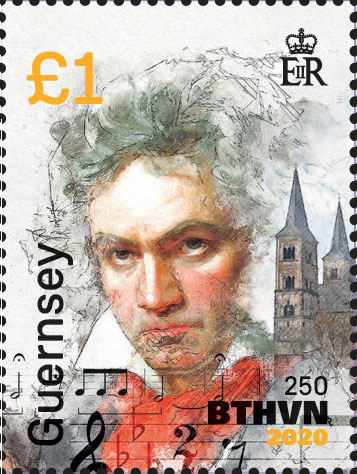
Beethoven stamp, issued by Guernsey Post – part of a series of four
Design: The Potting Shed

Que le temps me dure WoO116b for voice and piano (1793, Beethoven aged 22)

Dedication not known
Text Jean-Jacques Rousseau
Duration 3′

Listen

Background and Critical Reception

Beethoven’s second setting of this text is for soprano and piano, as though setting the same thoughts of loss from a woman’s point of view as opposed to the man in his first account.

Interestingly the key is different this time around, the composer opting for E flat major – closely related to the C minor of the first setting. A lot of Beethoven’s musical thinking around this time was in E flat, with the Piano Trio no.1 and Octet sharing this key.

Thoughts

This second setting is more expansive in style than the first, Beethoven giving the soprano a melody of long notes and phrases. The steady piano part means the song stays in what feels like a static form of contemplation, reminiscent of Gounod‘s elaboration on J.S. Bach‘s Ave Maria.

Recordings used

Ulrike Helzel (soprano), Hans Hilsdorf (piano) (Deutsche Grammophon)

Ulrike Helzel has a full and quite luxurious tone for this song, with a nicely shaped accompaniment from Hans Hilsdorf. She also has a fulsome vibrato to her sound.

Spotify links

Ulrike Helzel, Hans Hilsdorf

Also written in 1793 Kozeluch 3 Piano Sonatas, Op.38

Next up Rondo for piano and orchestra in B flat major WoO 6

Listening to Beethoven #47 – Ein Selbstgespräch


Peanuts comic strip, drawn by Charles M. Schulz (c)PNTS

Ein Selbstgespräch WoO 114 for voice and piano (1793, Beethoven aged 22)

Dedication not known
Text Johann Wilhelm Ludwig Gleim
Duration 3’45”

Listen

Background and Critical Reception

Writing in the booklet notes to a fine disc of Beethoven Lieder issued by Signum Classics, Susan Youens documents how the composer revisited some of his early songs in 1822 with a view to finally getting them published. One of them was Ein Selbstgespräch (A Soliloquy), his only setting of the poetry of Johann Wilhelm Ludwig Gleim.

The song was not published before his death, but Youens refers to it as ‘an idyll in the groves of Eros, its Anacreontic persona someone who formerly scorned love – but now, to his great surprise, finds himself in love with Doris. In fact, he is so stunned by this novel experience that he repeats his musical bemusement over and over again to deliciously comic effect.’

Thoughts

This is a restless song, thanks to the ever-moving piano part that moves around like a quickstep on high heels, portraying the ‘wayward mind’ of the singer. It seems intent on moving the text on to the next word as soon as possible, creating a good deal of nervous energy as it does so.

The singer’s mind and senses race, but ultimately he is happy – and the comic pause before he declares, ‘Ich glaubte gar, daß ich sie liebe’ (‘I do believe I love her’) offers a knowing look to the audience.

Recordings used

Dietrich Fischer-Dieskau (baritone), Hartmut Höll (piano) (Warner Classics)
John Mark Ainsley (tenor), Iain Burnside (piano) (Signum Classics)
Peter Schreier (tenor), Walter Obertz (piano) (Brilliant Classics)

Fischer-Dieskau is once again larger than life in this song, but John Mark Ainsley and Iain Burnside are superb, Ainsley’s tenor range better-suited to the character. Theirs is a partnership of equals, with Burnside leaning tastefully on the leading notes in the piano part to stress where the ever-changing harmony is going.

Spotify links

Dietrich Fischer-Dieskau, Hartmut Höll

John Mark Ainsley, Iain Burnside

Peter Schreier, Walter Obertz

Also written in 1793 Wranitzky Flute Concerto in D major Op.24

Next up Que le temps me dure (2nd version)

Listening to Beethoven #46 – Que le temps me dure (1st version)


Beethoven stamp, issued by Guernsey Post – part of a series of four
Design: The Potting Shed

Que le temps me dure WoO116a for voice and piano (1793, Beethoven aged 22)

Dedication not known
Text Jean-Jacques Rousseau
Duration 3’30”

Listen

Background and Critical Reception

“How slowly time passes, when I spend it far from you!”

So runs the English translation of the first line of Jean-Jacques Rousseau’s short poem, which Beethoven appears to have set soon after arrival in Vienna. An interesting choice of words, which might suggest a concentrated bout of homesickness. Unfortunately nothing could be found in writing about this setting, which suggests it was kept hidden and maybe only performed in private.

The text evidently meant something to Beethoven, for he made two settings. The first of these, for high voice and piano, is in the key of C minor – a key in which he was spending a good deal of time, with the third piano trio of his forthcoming Op.1 sharing this ‘home’.

Thoughts

This setting is a short one, but it is quite poignant. A sombre if elegant introduction from the piano brings in the singer, with a simple and largely stepwise melody (one note per syllable). There are two verses which are more or less identical, before the music moves into the major key (in Hermann Prey’s version but not Peter Schreier’s).

Schreier’s finishes with a piano postlude that keeps the downcast mood of the song.

Recordings used

Peter Schreier (tenor), Walter Olbertz (piano) (Brilliant Classics)
Hermann Prey (baritone), Leonard Hokanson (piano) (Capriccio)

Hermann Prey’s version is almost twice as long as Peter Schreier – and rather more sorrowful, given its much slower pace. This offers greater meaning when the music moves into the major key. By comparison the tenor Schreier feels more matter of fact in his reflections, especially without the coda that Prey uses.

Spotify links

Peter Schreier (tenor), Walter Olbertz (piano)

Hermann Prey (baritone), Leonard Hokanson (piano) (Capriccio)

Also written in 1793 Beauvarlet-Charpentier Variations on La Marseillaise

Next up Ein Selbstgespräch WoO114