
posted by Ben Hogwood, with text from the press release
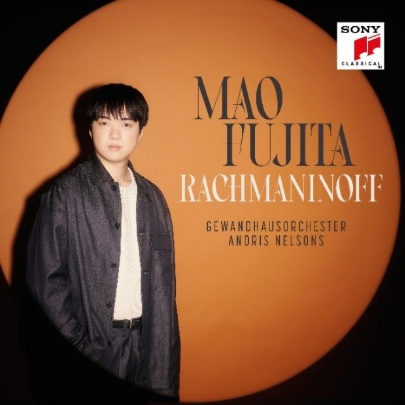
On November 27th, 2026, Sony Classical will release Rachmaninoff, the new album by acclaimed young pianist Mao Fujita. Together with the Gewandhausorchester under the baton of Andris Nelsons, Fujita presents here one of the most personal and ambitious projects of his career to date, bringing together Rachmaninoff’s monumental Piano Concerto No. 3, both Piano Sonatas and a selection of lyrical solo works and song transcriptions.
At the heart of the album stands Rachmaninoff’s legendary Piano Concerto No. 3, often regarded as the ultimate challenge in the piano repertoire. Described by the composer himself as a “concerto for elephants”, the work has become synonymous with virtuosity, endurance and technical brilliance. Yet its fascination lies not only in its difficulty but also in its extraordinary poetry, clarity and architectural sophistication. Fujita’s acclaimed performances of the concerto, including his silver medal-winning appearance at the 2019 International Tchaikovsky Competition, reveal the pianist’s deeply lyrical approach, bringing out the poetry within this highly virtuosic work. The concerto was recorded with the renowned Gewandhausorchester and Andris Nelsons.
Fujita’s interpretation reflects his close study of Rachmaninoff’s own recordings, which he regards as essential listening rather than simply a source of reference or interest. For Fujita, hearing the composer perform his own monumental works is an extraordinary privilege. Although Rachmaninoff’s unique, lyrical, and beautiful playing moves him deeply, Fujita does not seek to reproduce it. Instead, he developed the most convincing interpretation he could through his own technique, musical understanding and individuality.
Alongside the concerto, the album presents both of Rachmaninoff’s Piano Sonatas. The Second Sonata, completed in 1913 at the composer’s beloved Ivanovka estate and later revised in 1931, remains one of the most dramatic and technically demanding works in the repertoire. Less frequently performed but equally compelling is the First Sonata, inspired by Goethe’s Faust and composed during Rachmaninoff’s years in Dresden. It was composed around 1908. Together they reveal different facets of the composer’s imagination, from dark passion and demonic intensity to extraordinary structural mastery.
Offering a contrast to these large-scale works are the lyrical miniatures that complete the programme. Fujita performs his own piano transcription of Zdes’ khorosho from the Twelve Romances, alongside Alan Richardson’s celebrated transcription of the famous Vocalise. He also turns to Rachmaninoff’s beloved Morceaux de fantaisie, Op. 3, a collection that already reveals the melodic gift and emotional immediacy that would become hallmarks of the composer’s mature style. Fujita particularly values the way Richardson’s transcription preserves the simplicity and lyricism of the original Vocalise. For him, the pianist’s challenge is to make the piano sing and sustain the long melodic line as naturally as a voice, while allowing the accompaniment to remain transparent. He therefore approaches the work above all as a song rather than as a virtuoso piano transcription. The same vocal quality also characterizes his own transcription of Zdes’ khorosho.
Fujita agrees with the description of Rachmaninoff as the ‘last Romantic’, although he defines it somewhat differently. In his view, Rachmaninoff carried the musical language of previous eras to its very limits. He continued to give meaning to harmony until the very end and placed enormous importance on the relationships between notes, musical architecture, and rhythm. In this sense, he took everything inherited from previous generations and placed his faith in its final possibilities.
Rachmaninoff will be available on 2 CDs and digitally in stereo and the immersive audio format Dolby Atmos.
Published post no.3,057 – Saturday 24 October 2026

