
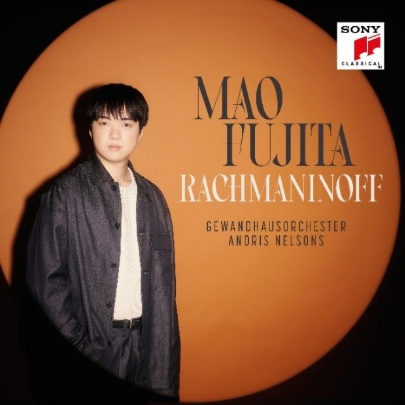
News – Mao Fujita announces new album: Rachmaninoff

posted by Ben Hogwood, with text from the press release

On November 27th, 2026, Sony Classical will release Rachmaninoff, the new album by acclaimed young pianist Mao Fujita. Together with the Gewandhausorchester under the baton of Andris Nelsons, Fujita presents here one of the most personal and ambitious projects of his career to date, bringing together Rachmaninoff’s monumental Piano Concerto No. 3, both Piano Sonatas and a selection of lyrical solo works and song transcriptions.

At the heart of the album stands Rachmaninoff’s legendary Piano Concerto No. 3, often regarded as the ultimate challenge in the piano repertoire. Described by the composer himself as a “concerto for elephants”, the work has become synonymous with virtuosity, endurance and technical brilliance. Yet its fascination lies not only in its difficulty but also in its extraordinary poetry, clarity and architectural sophistication. Fujita’s acclaimed performances of the concerto, including his silver medal-winning appearance at the 2019 International Tchaikovsky Competition, reveal the pianist’s deeply lyrical approach, bringing out the poetry within this highly virtuosic work. The concerto was recorded with the renowned Gewandhausorchester and Andris Nelsons.

Fujita’s interpretation reflects his close study of Rachmaninoff’s own recordings, which he regards as essential listening rather than simply a source of reference or interest.  For Fujita, hearing the composer perform his own monumental works is an extraordinary privilege.  Although Rachmaninoff’s unique, lyrical, and beautiful playing moves him deeply, Fujita does not seek to reproduce it.  Instead, he developed the most convincing interpretation he could through his own technique, musical understanding and individuality.

Alongside the concerto, the album presents both of Rachmaninoff’s Piano Sonatas. The Second Sonata, completed in 1913 at the composer’s beloved Ivanovka estate and later revised in 1931, remains one of the most dramatic and technically demanding works in the repertoire. Less frequently performed but equally compelling is the First Sonata, inspired by Goethe’s Faust and composed during Rachmaninoff’s years in Dresden. It was composed around 1908. Together they reveal different facets of the composer’s imagination, from dark passion and demonic intensity to extraordinary structural mastery.

Offering a contrast to these large-scale works are the lyrical miniatures that complete the programme.  Fujita performs his own piano transcription of Zdes’ khorosho from the Twelve Romances, alongside Alan Richardson’s celebrated transcription of the famous Vocalise.  He also turns to Rachmaninoff’s beloved Morceaux de fantaisie, Op. 3, a collection that already reveals the melodic gift and emotional immediacy that would become hallmarks of the composer’s mature style.  Fujita particularly values the way Richardson’s transcription preserves the simplicity and lyricism of the original Vocalise.  For him, the pianist’s challenge is to make the piano sing and sustain the long melodic line as naturally as a voice, while allowing the accompaniment to remain transparent.  He therefore approaches the work above all as a song rather than as a virtuoso piano transcription.  The same vocal quality also characterizes his own transcription of Zdes’ khorosho.

Fujita agrees with the description of Rachmaninoff as the ‘last Romantic’, although he defines it somewhat differently. In his view, Rachmaninoff carried the musical language of previous eras to its very limits.  He continued to give meaning to harmony until the very end and placed enormous importance on the relationships between notes, musical architecture, and rhythm.  In this sense, he took everything inherited from previous generations and placed his faith in its final possibilities.

Rachmaninoff will be available on 2 CDs and digitally in stereo and the immersive audio format Dolby Atmos.

Published post no.3,057 – Saturday 24 October 2026

Prom 69 – Baiba Skride, Boston SO / Andris Nelsons – Bernstein Serenade & Shostakovich Symphony no.4

Prom 69 Baiba Skride (violin, below), Boston Symphony Orchestra / Andris Nelsons (above)

Bernstein Serenade (after ‘Symposium’) (1954)
Shostakovich Symphony no.4 in C minor Op.43 (1936)

Royal Albert Hall, Monday 3 September 2018

Reviewed by Richard Whitehouse

You can listen to this Prom on the BBC Proms website here

The second of the Boston Symphony’s Proms, with its music director Andris Nelsons, offered a pertinent coupling which played to this orchestra’s strengths, while also suggesting that the interpretive insights of this much-lauded partnership are by no means to be taken for granted.

Time was when Bernstein’s Serenade was something of a rarity in live performance, but what is surely its composer’s most successful piece for the concert hall had come into its own well before the onset of his centenary celebrations. This sequence inspired by (though not indebted to) Plato’s consideration of Love in his Symposium was a gift on which Bernstein seized with alacrity, condensing its seven eulogies into five movements such as amount to a varied while cohesive totality to which he aspired without equalling in the concert music of his later years.

Baiba Skride proved a sympathetic exponent, segueing deftly from the lyricism of Phaedrus to the incisiveness of Pausanias and savouring the whimsical irony of Aristophanes. The fussiness of Erixymachus was pertly done and eloquence of Agathon not unduly emotive, for all its expansiveness; the finale almost achieving unity in the rumination of Socrates as overtaken by the ebullience of Alcibiades. Nelsons secured an engaging response from the reduced strings, while keeping some over-effusive percussion writing within sensible limits.

A pity that the sizable audience was not ideally attentive, suggesting that Bernstein as concert composer was less to its liking than when in ‘musical’ mode. It seemed rather more focussed for Shostakovich’s Symphony no.4 – an era-defining piece kept under wraps for a quarter-century after its completion, before gradually making its way into the 20th-century repertoire where it has been ever since. Subversive and despairing in equal measure, it duly received a commanding account where the BSO conveyed both visceral power and fastidious ensemble.

Were these the deciding factors of a great performance, this would assuredly have been one. Yet behind the formidable technical façade was a lack of empathy with this most emotionally charged of symphonies, not least a first movement whose stark alternations of Stravinskian energy and Mahlerian anguish Nelsons drew into a formally unified if expressively uniform whole. With its subtler pivoting between anxiety and elegance, the central intermezzo was finely rendered, even if its closing percussion ostinato was neither sardonic nor speculative.

Come the finale and Nelsons found an ideal tempo for its opening funeral march, though its overtones of heroism and plangency felt passed over on the way into a toccata section which lacked cumulative intensity for all its incisiveness. The ensuing divertimento gave several of the orchestra’s principals their moment in the spotlight that they took with panache, then the entry of duelling timpani was clumsily prepared going into a peroration as was imposing but never inexorable; the postlude which follows one of somnolence rather than numbed despair.

As so often this season, there was no encore – Nelsons purposely extending the silence at the close of the Shostakovich as its own epitaph. It set the seal on a lucidly conceived and superbly executed reading that yet missed out on what makes this piece an experience like few others.

Proms premiere – John Woolrich: Falling Down (London premiere)

john-woolrich

John Woolrich photo by Maurice Foxhall

Margaret Cookhorn (contrabassoon), City of Birmingham Symphony Orchestra / Andris Nelsons (Prom 4)

Duration: 15 minutes

BBC iPlayer link

http://www.bbc.co.uk/programmes/p02xpm1z/player

What’s the story behind the piece?

There are very few concerto pieces written for the lowest voices in the orchestra – hardly any for double bass and fewer still for the contrabassoon. This is mostly down to the trouble composers have making the instruments heard at such a low pitch.

As the publisher’s notes for the piece say, “The title explains itself: the piece begins and ends with music that tumbles from the top of the orchestra down to the depths where the contra lives”

Woolrich, who celebrated his sixtieth birthday last year, wrote Falling Down in response to a commission from the City of Birmingham Symphony Orchestra – and he dedicated it to their contrabassoon player, Margaret Cookhorn.

Did you know?

Woolrich founded the Composers Ensemble in 1991, founded the Hoxton New Music Days festival and has been an associate Artistic Director at the Aldeburgh Festival since 2005.

Initial verdict

Woolrich succeeds in his biggest challenge in this piece – making the contrabassoon heard above the orchestra!

The piece starts with a bright and brash orchestral introduction, initially up in the treble register but gradually falling from its great height until the contrabassoon comes in with an incredibly fruity note, sounding as though it is beneath the floor!

Some of the sounds are incredibly raspy and distinctive, with a full throated bellow on occasion. Woolrich uses a lot of percussion in his orchestra, with volleys of drums around the 2 and 15 minute mark that make a powerful, kinetic impact on the music. The piece ends effectively with a door slamming shut in the shape of a big bass drum.

Second hearing

tbc!

Where can I hear more?

A good place to head next is an NMC disc devoted to the composer, The Ghost in the Machine. Soundclips and biographical information present a very interesting variety of music