

In concert – Max Cooper: Yearning for the Infinite

Max Cooper: Yearning for the Infinite

Part of the Barbican’s 2019 season, Life Rewired, which explores what it means to be human when technology is changing everything.

Barbican Hall, London, Saturday 28 September 2019

Written by Ben Hogwood
Images courtesy of the Barbican: Alex Kozobolis

How do you capture the infinite in music? Composers through the ages have come close – Bruckner, Mahler, Wagner and Messiaen come to mind, as does Morton Feldman and, more recently, the Indian classical music greats.

That may be a relatively casual list of ‘big dimension’ composers, but it gives an idea of the task facing Max Cooper, responding to the Barbican’s commission to ‘capture the overwhelming vastness of infinity within the spaces of the Barbican Hall’.
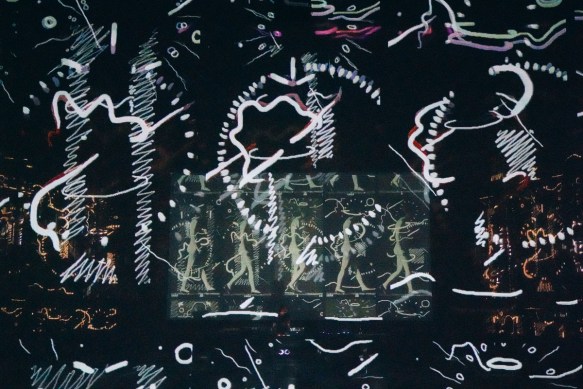
Incredibly, Cooper succeeded. His means were clever, too, exploring the infinite possibilities of data and science through tiny building blocks that combined to make cavernous structures to which we could easily have listened all night. For this he drew on his experience and knowledge of computational biology, for which he has a PhD, and made this potentially tricky area of science wholly approachable to the more casual Saturday night concert goer. To do this he added genuine emotion to the more calculated cells, drawing on historical religious traits which added even greater weight to the concept.
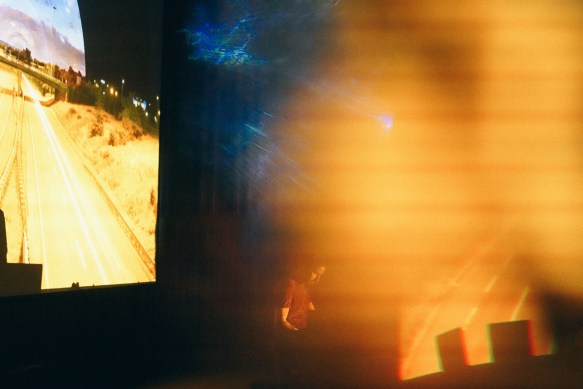
The music would not have made such an impact without the visual counterpoint, whose impact could not be overestimated. Jessica In (channeling Roger Penrose), Andy Lomas and Memo Atken all achieved the admirable balance of covering their brief, complementing the music and taking the breath away with the originality of their projections, which used two-thirds of the Barbican Hall walls and ceiling, creating a true 3D experience. Nor was the music lacking in emotional substance, Cooper having created a score of vast possibilities but also, in its quieter moments, of great intimacy.

This was borne partly of thick, semi-ambient chords with consonant harmonies but also melodic cells that grew outwards in tandem with the images, sweeping towards a conclusion where it felt as though all the positive energy in the hall was heading towards the feet. When the music did cut loose with powerful four to the floor rhythms it was all we could do not to get up and dance – a few did – though the complexity of the following breakbeat section would soon have placed us out of our collective depth!

It was that sort of evening, awe-inspiring, intimate, emotive and powerfully primal by turn. The modesty of Cooper’s bow at the end spoke volumes, showing that he sees himself as a channel through which this breathtaking art can flow. Yearning for the Infinite is due for an album release in November, and if it replicates this night then it will be essential listening. For now this evening was another feather in Cooper’s increasingly colourful cap.
Switched On – Telefon Tel Aviv: Dreams Are Not Enough (Ghostly International)

reviewed by Ben Hogwood

What’s the story?

In the 2000s, Chicago-based duo Telefon Tel Aviv were highly regarded for their moody electronic music, notable for its wispy vocals and expansive panoramic views. Three high quality albums were released in that time, peaking with Immolate Yourself in 2009. Almost immediately following the album release however tragedy struck, with band member Charles Cooper unexpectedly passing away.

The surviving member Josh Eustis continued in a solo capacity under different aliases, exploring new ground with Puscifer, The Black Queen and striking solo project Second Woman, while briefly appearing as part of Nine Inch Nails’ touring line-up. Then he announced work on new Telefon Tel Aviv material, to the delight of the band’s still devoted fan base – and with Dreams Are Not Enough he releases their fourth album.

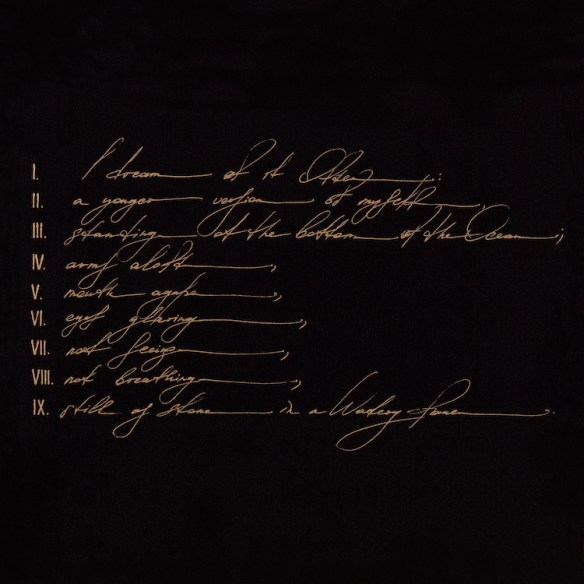
Its track titles link to describe a dream Eustis experienced at an early age. I dream of it often…a younger version of myself…standing at the bottom of the ocean…arms aloft…mouth agape…eyes glaring…not seeing…not breathing…still as stone in a watery fane.

What’s the music like?

The nine tracks unfold as a dream sequence might, staying true to the Telefon Aviv sound but if anything branching out towards more experimental territory. I dream of it often makes a really ear-catching start to the album, arriving by stealth as a reverie might, but gradually imposing itself with rhythms that ricochet and echo, the sound waves bouncing off the walls. The sonic panorama is vast, and captivating when heard on headphones, Eustis using drones that are incredibly comfortable on the ear but then blossom into something more substantial.

He continues to shift the sonic perspective, sometimes up close and very personal and then suddenly cutting away to a vast oceanic view. When he does this for standing at the bottom of the ocean, mouth agape or especially eyes glaring the vocals sound like ancient plainchant, the setting a vast underwater cathedral, the beats now resonating around the windows and arches.

There is perhaps inevitably a sense of sadness on the album, remembering Cooper, but there is an incredibly strong resolve too. As it progresses the vision of the recurring dream continues to be remarkably descriptive. Not breathing hammers home its heavy kick drums, as though the heart is struggling to cope, but when final track still as stone in a watery fane arrives there is a lasting peace, Eustis completing his cathartic journey.

Does it all work?

Yes. Electronic music is rarely as moving or as distinctive as this, and although Dreams Are Not Enough is not always an easy listen, it is never less than captivating. Eustis has a wholly original way with beats, the corrugated surfaces on tracks like arms aloft borne of a vivid imagination. It is great to hear his vocals again too, and although they are disembodied at times they frequently strike a chord.

Is it recommended?

Without hesitation. While Immolate Yourself was dreamy and leaned more towards song-based productions, Dreams Are Not Enough feels like an important part of the recovery stage for Eustis, and it continues the story of Telefon Tel Aviv in a reverential way, never wallowing but seeking new sounds, methods and ways of communicating. Anyone who thinks electronic music is devoid of emotion should head right here.

Stream

Buy

In concert – Christian Tetzlaff, Philharmonia Orchestra / Esa-Pekka Salonen: Weimar Berlin – Angels and Demons

Christian Tetzlaff, Philharmonia Orchestra / Esa-Pekka Salonen (above)

Royal Festival Hall, Southbank Centre, London
Thursday 26 September 2019

Hindemith Rag Time (well-tempered) (1921)
J.S. Bach arr. Schoenberg Two Chorale Preludes: Schmücke dich, o liebe Seele BWV654; Komm, Gott Schöpfer, heiliger Geist BWV667 (1925)
Berg Violin Concerto (1935)
Hindemith Mathis der Maler Symphony (1934)

reviewed by Ben Hogwood

This year the Philharmonia Orchestra have been exploring the music of Weimar Berlin as it was in the 1920s and 1930s, with fascinating results. Their most recent concert, subtitled Dreams and Demons, may have been relatively short, but it gave plenty of food for thought and the musical rewards were considerable.

A rather older composer who worked in Weimar made himself known throughout the concert, for the music of Johann Sebastian Bach was quoted, refracted and alluded to in each of the four pieces on the programme. Firstly we heard the opening notes of the Prelude in C minor from The Well-Tempered Clavier, part of an affectionate and brilliantly ‘worded’ joke by Hindemith, whose Ragtime started the concert with a swagger. Esa-Pekka Salonen clearly enjoyed its gruff humour, but found the touches of elegance beneath the surface too.

The Ragtime’s surge to the close in E flat minor blossomed with a cleverly executed join into the first of two Bach chorale prelude arrangements by Schoenberg. Here we wondered at his audacious orchestration, taking on what he saw as ‘the first twelve tone music’ and sharing it around the orchestra with typically inventive pointing towards the melodies. Timothy Walden’s cello probed elegantly at the inner melodic lines of Schmücke dich, o liebe Seele, while the exuberant close of Komm, Gott Schöpfer, heiliger Geistdrew heralded the Hindemith work we were about to hear.

Berg’s Violin Concerto quotes from a Bach chorale, Es ist genug (It is enough) at the height of its remembrance of Manon Gropius, daughter of Alma Mahler. Subtitled To the Memory of An Angel, the work traverses a wide range of emotions in its thought processes, from brief oases of calm to fraught periods of activity. The clarinets of the Philharmonia, in all ranges, were superb, whether in the lighter Ländler theme of the first movement or the solemn chorale itself, their imitation of a pipe organ ghostly and – when the solo violinist’s harmonics were in play – ethereal. This was because soloist Christian Tetzlaff (above) also brought a wide range of sounds to the piece, from the fragility of the opening strings of the start to the surging faster music where he took the music by the scruff of the neck. His was a technically brilliant yet musically sensitive performance, closely joined to Salonen’s deft work with the orchestra.

All the while this wonderful piece was heading for the final bars and the ultimate rest, the sort of chord you would want to go on forever as Berg’s orchestral colours mingle with the highest note the violin reaches in the whole piece. Together Teztlaff and Salonen ensured the pacing was ideal, helped considerably by the light and shade of the Philharmonia’s contribution.

After the interval came a regrettably rare chance to hear some Hindemith in the concert hall in the shape of the Mathis der Maler Symphony, a three-movement work drawn from the opera of the same name. This oft-maligned composer exerts a good deal of influence on the tonal music of the second half of the 20th century, more than he is credited for, and his own works are instantly recognisable. Nor, as Salonen and the Philharmonia illustrated, is there a lack of colour or personality in his orchestral writing.

This was a superb performance of a piece Salonen clearly holds close to his heart, having conducted it at the Proms and recorded it for Sony in 2004. The expectant hush from the strings at the start was magical, the effect like walking into a sacred building, and this was reinforced by a solemn intonation of a chorale from the trombones, those Bach influences coming quickly to the surface. Salonen’s slower tempo here worked well.

The silvery strings enjoyed the moments of confluence in Hindemith’s writing, with the added note chords allowed to breathe, but Salonen was not above letting the grittier parts of the music off the leash, pushing forward through the faster phrases. The Philharmonia woodwind and brass were superb, the bell-like clarity of their playing bolstered by deeper shades. With all these qualities noted, Engelkonzert (Angelic Concert) unfolded beautifully, with a grand sense of ceremony at the end, while in response Grablegung (Entombment) was initially thoughtful, its ruminative woodwind then replaced by a brass-dominated climax which Salonen controlled immaculately.

Most dramatic of all was Versuchung des heiligen Antonius (The Temptation of Saint Anthony), with a ravishing tone from the Philharmonia strings at the outset. As it progressed the movement had a terrific cut and thrust, its tension released with impressive stature in the closing pages. Mathis der Maler is a wonderful score, one of Hindemith’s finest achievements – and by no means the only peak of his orchestral output. Here it put the seal on a fascinating and immensely rewarding concert, with superb musicianship throughout.

Further listening

You can hear the music played in this concert on the Spotify playlist below, including Salonen’s account of the Mathis der Maler symphony:

This playlist offers a broader view of Hindemith’s orchestral output, with the ballet suite Nobilissima Visione, the Concert Music for Strings and Brass and the vastly underrated piece for piano and orchestra The Four Temperaments:

Switched on – Jas Shaw: Exquisite Cops (Delicacies)

reviewed by Ben Hogwood

What’s the story?

On the face of it, Exquisite Cops is a rare solo outing for Jas Shaw. One half of Simian Mobile Disco and a highly respected producer in his own right, Shaw is clearly capable of holding his own in a crowded field.

That, however, is only a small part of the story. Exquisite Cops has emerged from a period where Shaw has had to deal with a rare bone marrow disorder. It was diagnosed just after Murmurations, the last SMD album featuring the Deep Throat Choir, had been completed, and it meant their planned tour had to be ditched.

However Shaw is clearly one of those creative spirits who likes to respond to such a setback on the front foot, and while receiving chemotherapy he spent hours in the studio. Not only did he complete an album with Gold Panda as Selling, he made more than 20 solo recordings, which he has been releasing as singles and releasing as part of the Exquisite Cops project. This selection – a double album’s worth – is a self-picked ‘best of’.

What’s the music like?

Typically energetic, but varied too – Shaw clearly knows his techno, and as these eight tracks unfold we get a nice line in quick, pumping beats or softer material that nods across the Atlantic in the direction of Detroit.

Non-Caring Fabulousness starts the album almost lost in thought, with minimal treble but nicely paced, slightly darker material. Merely Bathing comes right out of that shell, with acidic bleeps betraying Shaw’s membership of Simian Mobile Disco.

Having heard two sides of Shaw’s solo personality, he cunningly blends them in the lush textures of Lecturing Birds On How To Fly, with upfront beats and woozy treble sounds that work across the stereo picture like a murmuration of starlings. This approach also works well for I Dream Of Meanie, Shaw adding a nice layer of white noise at the top to capture a bright, warm sound. Half way through a quasi-orchestral sound builds from the middle, suggesting Shaw might be familiar with Holst’s The Planets, and particularly the remoteness of Saturn.

Leaner textures are in play for Freedom For The Pike, which comes out fighting, heavy on the kick drum, and also the nippy Repeat Until There Is No More Other, a quick-fire track that recalls Plastikman.

The closing duo are both brilliant. Popes of Dischord is essentially a distorted set of bells over an energetic mid-range, building steadily over nine and a half minutes. It sounds a lot better than that in the flesh, and could easily work as a Chemical Brothers track. Finally A Bird With No Feet circles the listener’s head, working up a trance with its oscillating riff in a thrilling drive to the finish.

Does it all work?

Yes. Shaw’s ability to get even the stoniest cynic on the dancefloor with his music is well noted, whether in Simian Mobile Disco or in his own production work. Exquisite Cops is no different, and feels very natural – as though he has edited very little on the route from initial inspiration to finished club track.

This is an impressive achievement given that the gestation period for some of these tracks was months rather than hours. It so happens that Shaw has a great ear for spotting the compatibility of his ideas and blending them together.

Is it recommended?

Yes, strongly. The whole Exquisite Cops project is proof positive that good things can come out of awful situations, and that music is often the way to go for cathartic energy. When you listen to this it’s worth considering Shaw’s situation, and realising for a bit – in between dance steps – just how positive things really can be.

Listen & Buy

Switched on – M83: DSVII (2019)

reviewed by Ben Hogwood

What’s the story?

Twelve years on from Digital Shades Vol.1, M83 – aka Anthony Gonzalez – revisits his instrumental project. This time, ironically, he chose to use solely analogue equipment in the creation of the sequel, which goes beyond his love of ambient music and shoegaze.

What’s the music like?

While the first Digital Shades volume took its time and created vistas from scratch, DSVII is a much busier affair, reflecting the video games soundtracks of the 1980s that inspired it. Gonzalez freely admits to his wish to recreate the analogue sound of that time, and in doing so emulate or rival the electronic pioneers making music then.

The drone with which Hell Riders begins is a throwback to the first release, but soon enough an attractive set of guitar loops blossoms into what feels like a full-blown set of end credits for a TV series melodic layers piling up on each other.

This is the true sound of DSVII, which leans in towards progressive rock and those synthesizer works from the likes of John Carpenter and Jean Michel Jarre. Gonzalez takes melodic cells and moves them around like the images on the games. It is entertaining and eventful, but sometimes too busy to class as relaxing. It is ultimately background music in this setting, and tracks like Meet The Friends, while attractive, feel like they are playing second fiddle to the images in Gonzalez’s mind. Likewise A Taste Of The Dusk, with more closing credits music, and the sweet flute that fronts Lunar Son. Oh Yes You’re There, Everyday is a good example of the meandering tunes and harmonies we have here, relaxing yet curiously restless

There are some nice diversions though. Goodbye Captain Lee has a sweet air of melancholia, and Colonies is atmospheric, while Mirage effortlessly paints a hazy vista. The piano-led Jeux d’enfants invites comparison with Ravel and Satie, partly because of its name, and is attractive if not as substantial as their writing.

Arguably the best is saved until last, and Temple Of Sorrow, a substantial track that builds through a rush of drums and wordless vocals, cutting out to a soft, bell-like piano. Here you feel is the real heart of how Gonzalez naturally writes music.

Does it all work?

Not all of it. Those who know M83’s music for its power and skyscraper-like builds (Midnight City and We Own The Sky come to mind) might be surprised at the relatively frivolous side shown here – which could of course be seen as an asset too, revealing an artist of several different musical personalities and attributes. Whether you respond to this positively will depend on whether you can take on an hour of instrumental music rooted heavily in the 1980s. If you’re in the wrong mood it might feel like music to eat a meal to rather than immerse yourself in.

Is it recommended?

Yes, ultimately. M83 fans need not hesitate – nor those lovers of 1980s’ instrumental electronica. Those wanting the power of previous albums might want to try before they buy.

Stream