Switched On – Defected presents Most Rated Ibiza 2019 (Defected)

Various ArtistsDefected presents Most Rated Ibiza 2019 (Defected)

reviewed by Ben Hogwood

What’s the story?

It has been another memorable summer for Defected. 2019 has seen their head Simon Dunmore and a collective of starry guests return for a third consecutive residency at Ibiza’s Eden club, and the label’s presence grows ever stronger on the island in their 20th year. Most Rated embodies that upward curve, with 30 excellent floor fillers.

What’s the music like?

Very, very good. There are two mixes here that make nearly two and a half hours of paradise for vocal house lovers. The choice moments arrive right from the first track of the first mix, Roberto Surace’s Joys, with its lifting of vocals from the Richard X & Kelis collaboration Finest Dreams. From there we can enjoy another superb Todd Edwards moment, Deeper presented in remix form by Gorgon City. As the momentum builds Riva Starr’s remix of G-Flame and KCC’s Heaven and Melba Moore’s My Heart Belongs To You (the Ferreck Dawn remix) double up effectively, before the piece de resistance of the first mix, Mattei & Omich & Nathan Nicholson’s superb track Doors, with its tagline ‘you close one door and another one opens’.

Finally the swirling strings of Cinthie’s Mesmerizing leave a mark…and if you’ve any sense you’ll head straight on to the second mix. Here Andreya Triana shines on vocal duties with The Vision’s Heaven, while Bless Me Toda from Alan Dixon adds a spiritual high. The music heads deeper with the Heller & Farley Project with Cevin Fisher, the Fire Island remix of We Built This House, and Dave & Sam’s Till The World Blow Up, featuring Mike Dunn. Dunn reappears with the bouncy If I Can’t Get Down, and there’s a similar spring in the step of Alaia & Gallo’s Trippin, featuring Dames Brown. It’s great to see Cassius present, remixing Oliver Dollar’s John’s Church, before the final winning double from Horse Meat Disco (Joey Negro’s remix of Falling Deep In Love) and one of The Shapeshifters’ very best tracks, Kimberly Davis powering the vocals for Life Is A Dancefloor.

Does it all work?

Emphatically so. Hands in the air, smiling faces and dancing feet are all symptoms of the Defected approach, and it transfers effortlessly to these two hot weather winners.

Is it recommended?

Yes, without question. Defected are riding the crest of a wave at the moment and this compilation sums up all the label’s qualities at the moment.

Stream and Buy

Arcana at the Proms – Prom 72: Aurora Orchestra & Nicholas Collon – Berlioz: Symphonie fantastique

Prom 72: Aurora Orchestra / Nicholas Collon

Mathew Baynton (actor), Jane Mitchell (stage director / scriptwriter), James Bonas (stage director), Kate Wicks (production designer), Will Reynolds (consultant designer), Cydney Uffindell-Phillips (movement consultant)

Berlioz Symphonie fantastique Op.14 (1830)

Orchestral theatre staging; script by Jane Mitchell;
excerpts from Berlioz’s Mémoires translated by David Cairns

Royal Albert Hall, Thursday 12 September 2019 (first of two evening performances)

Reviewed by Ben Hogwood
Photography credits Mark Allan

You can listen to this Prom on BBC Sounds here

One of the aims of the Proms must surely be to attract new audiences to classical music, while enhancing the experience of the existing crowd. Both those aims were met with room to spare by this educational and often dramatic ‘orchestral theatre staging’ of Hector Berlioz’s Symphonie Fantastique, given by Mathew Baynton, the Aurora Orchestra and conductor Nicholas Collon.

As in previous seasons the Aurora were playing from memory, a great achievement when you consider at least 70 performers had to memorize not just the notes but the directions on how to shape them. Given the composer’s scrupulous markings in this area it is up for debate as to how many of these the performers would have been able to commit to memory, but judging by their performance – and Collon’s conducting – the answer would seem to have been a great deal.

It is worth remembering that Berlioz – commemorated this year in the 150th anniversary of his death – wrote the Symphonie Fantastique in 1830. Coming just three years after the death of Beethoven and Schubert, that is a staggering achievement and shifting of musical parameters, even though Collon’s assertion that it was the first ‘programmatic’ symphony could be called into question alongside Beethoven’s sixth, the Pastoral.

That is a quibble for another day, however, for this was a brilliantly weighted blend of drama, history and music. Mathew Baynton played Hector Berlioz himself, communicating the story of the composer’s first encounter with Harriet Smithson, the woman who initially spurned his advances and was the muse for the Symphonie fantastique, but who eventually became his first wife. The story was told with an attractive arrangement by Iain Farrington of the composer’s La belle voyageuse from his Neuf Mélodies Op.2, played by soloists from the orchestra.

It helped that Baynton even resembled the composer slightly, and his dialogue with Collon examined the moods and innovations of Berlioz along with the trials and tribulations of his spurned love. With this background established they examined some of the main themes of the piece and its innovations with orchestration, the audience effectively eavesdropping on a conversation that revolved around Berlioz’s ‘Idée fixe’. This was the main theme of the symphony, its music helpfully projected onto behind the players, so while we heard it in example form from the violins we were able to witness the close attention the composer paid to its phrasing and shaping.

The performance itself was helpfully pointed and often dramatically lit. The innovative orchestration was also spotlit, the four harps placed front of stage for the second movement, Un Bal, in the way Berlioz suggested. This movement ended with a wonderful effect from three glitterballs, held by the percussionists, bringing a starry night to the Royal Albert Hall. The woodwind were also brought forward at opportune moments, with the bassoons a threatening presence at the start of the March to the Scaffold.

In a very striking third movement, Scène aux champs, Patrick Flanaghan projected the shepherd’s theme out over the arena from his cor anglais, the answering call from fellow oboist John Roberts coming back to him from the stalls. This proved incredibly effective; even more so when the theme recurred at the end of the movement. With no answer forthcoming from the oboe, there sounded ominous distant thunder from the timpani.

This led us into the March to the Scaffold, where the brass – with more than a nod to historically informed performances – were superb. Yet the keenest drama was saved for last of all, each player donning a mask for the Witches’ Sabbath.

This final denouement showed the composer at his darkest and most vulnerable, the bells delivering the telling Dies irae from the gallery in another masterstroke of placement. With everyone in masks and the lights a dull red the Tolkien parallels were irresistible, especially when the percussionists were striking their instruments like orcs going to war. It would have been scary for any kids in the audience, for sure!

The planning for this occasion was extremely effective, the experience breathing new life into the Symphonie Fantastique for those who have seen it on several occasions, but also enticing new concertgoers through a much more audience-friendly approach, as you will see in our own Ask The Audience feature to come on Arcana.

It was a fitting way to complete the Proms commemorations of the Berlioz anniversary, with one of his most revolutionary scores made to sound like the ink was still drying on his page.

Arcana at the Proms – Prom 71: Bach Night – Dunedin Consort & John Butt perform the four Orchestral Suites and commissioned ‘responses’

Prom 71: Dunedin Consort / John Butt (harpsichord)

J.S. Bach Orchestral Suite no.4 in D major BWV1069 (c1730) (from dfgd on the broadcast)
Nico Muhly Tambourin (2019) (22:14 – 25:28)
J.S. Bach Orchestral Suite no.1 in C major BWV1066 (c1725) (28:12)
Stevie Wishart The Last Dance? A Baroque Tango (2019) (49:28 – 52:37)
Ailie Robertson Chaconne (2019) (1:19:50)
J.S. Bach Orchestral Suite no.2 in B minor BWV1067 (c 1738-9) (1:23:38
Stuart MacRae Courante (2019)
J.S. Bach Orchestral Suite no.3 in D major BWV1068 (c1730)

Royal Albert Hall, Wednesday 11 September 2019

Reviewed by Ben Hogwood

You can listen to this Prom on BBC Sounds here

A joyous Prom.

One of Sir Henry Wood’s many inventions at the Proms was to instigate ‘composer nights’, where the programme revolved around the output of a composer such as Wagner, Beethoven, the Strauss family, or Johann Sebastian Bach.

This particular Bach night came with a neat twist – the four orchestral suites, grouped together, but each complemented with a new commission receiving its world premiere. The idea of composers writing new music for a group that plays on the instruments of Bach’s time is not necessarily new but it is an intriguing one, and led to four very varied responses. What these short asides ultimately did, however, was make the audience even more in thrall to the music of Johann Sebastian.

The four Orchestral Suites do not get as much air or auditorium time as the six Brandenburg Concertos, but there is nothing to mark them out as inferior works. They make a very satisfying whole, especially when programmed as here by John Butt and the Dunedin Consort – the fourth suite placed first, so that we went through a satisfying key cycle and heard the most affirmative music at the end.
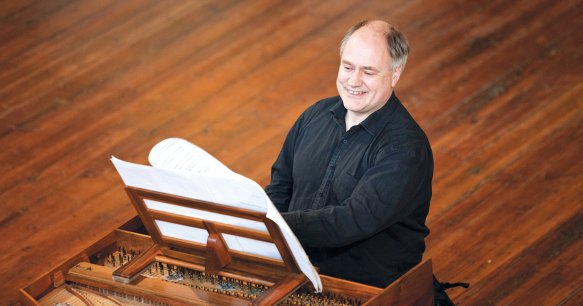
Butt (above) is a Bach specialist, living and breathing the composer’s music. He has scholarly intellect on his side but balances that with enthusiasm in spades. For this concert his energy rubbed off on the audience, and in several faster numbers he literally could not wait to get his hands busy on the harpsichord. Like all bar the cellists and basses he stood to perform, the Dunedin Consort’s freedom of movement translating nicely into their interpretations of Bach’s dance movements, which had a spring in their step.

The last two numbered suites use brass and timpani, so we began with something approaching a fanfare. It took a couple of bars for the Dunedin Consort, numbering nearly 40, to hit their stride, but from then on their playing filled the Royal Albert Hall with the expanse of the fourth suite’s Ouverture, which had a ceremonial air before breaking into a bustling faster tempo. The four dances that followed were fleet of foot, Butt enjoying the humour of the perky Bourrée (10:40), then a stately Gavotte (13:25), Menuet (15:23) and Réjouissance (19:33), at which point brass and drums returned with a flourish.

Nico Muhly’s Tambourin followed without a break, utilising the same grand forces but expanding the harmonic world considerably. As a dance it was syncopated beyond danceable rhythms, starting powerfully but dissolving into D major at the end, dressed by flecks of Stephen Farr’s harpsichord.

The Orchestral Suite no.1 is a rich tapestry of dance movements prefaced by an expansive overture. The most expansive work of the four, its French ‘ouverture’ was elegantly played and dressed with expansive bass notes before moving to a lively fugue, oboes really coming into their own. The dances, again all of French derivation, were light on their feet, propelled by nifty harpsichord accompaniment from Farr and Butt centre stage. They were topped by a bustling Bourrée, its figures flying around the violin section before the complement, a darker, minor key central section for woodwind. With harpsichords silent, this was poignant and beautifully played.

Stevie Wishart complemented the first suite with a striking tribute to the endangered Argentine Hooded Grebe, whose call matched her music and could be heard over the Royal Albert Hall speakers during a witty and rather macabre tango. Once heard the call became ever more poignant, the instruments thrown off course and off pitch. It was effective, haunting and thought provoking.

Ailie Robertson’s Chaconne opened the second half, a reflection on Scottish dance music. A slow and atmospheric piece, it began with eerie held notes in the upper violins which really came into its own when the flutes joined, like Wishart evoking a bird in imagery, though this time a slower, bigger one like an albatross.

For the Orchestral Suite no.2 Butt used reduced string forces and three flutes, headed by the excellent Katy Bircher. The colours of this work are appreciably darker, and the leaner string sound complemented the consoling flutes. After a solemn start to the Ouverture came a lively fast section, then the flutes led us in a sprightly Rondeau, with a quicksilver account of the famous Badinerie to finish. In between there were solemn, more processional numbers – a mournful Sarabande picked up by a quick Bourrée, resolute Polonaise and gallant Menuet.

Stuart MacRae’s Courante was the final commission, an upbeat to the final suite that went off at quite a pace, Stephen Farr’s rattling harpsichord pursued by the orchestra and ultimately caught, before the violins became ‘it’ and took off again, the piece diminishing to a whisper at the end.

The Courante was a cheeky upbeat to a truly joyous performance of Bach’s Orchestral Suite no.3. Trumpets were bright and timpani on point, Stephen Burke tapering his strokes to use angle rather than force to create the sound. The celebrated Air ‘on the G String’ was light on its feet and affectionate without overindulging, while the Gavotte, Bourrée and Gigue had the biggest smile on their faces, Bach’s counterpoint as inevitable and toe tapping as ever. The Gigue was especially upbeat, with rolling timpani and celebratory trumpets.

It is incredible to think that only last year Creative Scotland were proposing to cease funding the Dunedin Consort, a decision that was thankfully overturned. This night at the Royal Albert Hall illustrated beyond doubt the collective, creative bloom the group are experiencing, and it was a privilege to be a part of their Bach night.

Further Listening

John Butt and the Dunedin Consort have not yet recorded the Bach suites, but they did recently release an account of the wonderful violin concertos which you can sample below:

Bach Violin concertos with Cecilia Bernardini from Dunedin Consort on Vimeo.

For a choice recording of the suites, a new disc from the Freiburger Barockorchester is recommended here:


Arcana at the Proms – Prom 70: Daniel Pioro gives the world premiere of Jonny Greenwood’s Horror vacui

Jonny Greenwood (bass guitar/tanpura), Daniel Pioro (violin), Nicolas Mangriel (tanpura), Katherine Tinker (piano), BBC Proms Youth Ensemble, BBC National Orchestra of Wales / Hugh Brunt

Biber Mystery (Rosary) Sonatas No. 16 – Passacaglia in G minor
Penderecki Sinfonietta for strings, second movement Vivace
Greenwood Three Miniatures from Water – No. 3; 88 (No. 1)
Reich Pulse
Greenwood Horror vacui

Royal Albert Hall, Tuesday 10 September 2019 (late night Prom)

Reviewed by Ben Hogwood
Photo credits Mark Allan

You can listen to this Prom on BBC Sounds here

Alongside his role as lead guitarist with Radiohead, Jonny Greenwood has a close relationship with the string orchestra. Detailing his love for the medium in the programme for this late night Prom, he explained his preference for live music over electronic or recorded alternatives, citing the living and breathing aspects of the instruments as his prime reason for using them.

Breathing into the stringed instruments became an aspect of his new piece, Horror vacui, written for violinist Daniel Pioro and an ensemble comprising string players from the BBC Proms Youth Ensemble and the BBC National Orchestra of Wales.
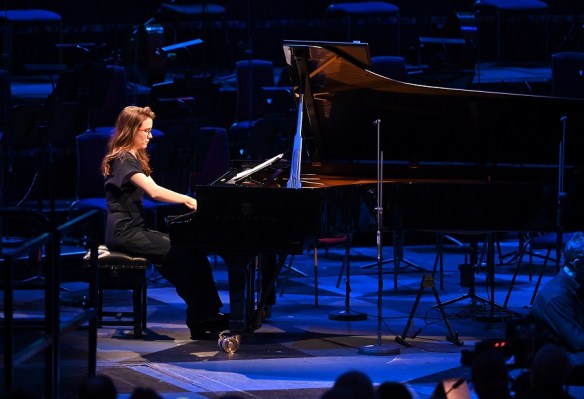
Arranged in a fan shape across the stage, the orchestra had the lowest sounds at the back in the form of eight double basses and twelve cellos, with ten violas just in front of those. That left just the 38 violins in front, each of the 68 instrumentalists having their own specific part.

Greenwood’s directions for conductor Hugh Brunt were unconventional, his arm often sweeping across the ensemble from left to right and back again so that each instrument knew when to come in and fade away. This created a powerful visual and aural effect, the string players’ bows rising and falling like a sound wave.

Greenwood explained how Horror vacui is the fear of empty space, usually in paintings. This was vividly captured not just from the dense orchestration but from Daniel Pioro’s superbly played solo violin part. With incredibly secure intonation he excelled in the pure upper register passages, the notes soaring effortlessly towards the ceiling of the Royal Albert Hall. Beneath him the textures were always changing, sometimes secured by players blowing into their instruments, literally breathing life into them, or from deep-piled chords, some of which were huge blocks of consonant sound. Around 20 minutes in the biggest of these chords drew applause from the audience, most of whom thought the piece had finished there – and indeed it would have been a natural stopping point. There was still a substantial coda to follow, which ended in a pure C major with Pioro back up in the heights. The conventional end felt like a more obvious statement after Greenwood’s innovations earlier in the piece, and though beautiful felt tacked on to the end.

That said, Horror vacui is a very impressive and engaging piece of work – and here, with the orchestra under the leadership of the energetic Lesley Hatfield, it received the best possible performance.

We heard two other Greenwood pieces. The third of Three Miniatures from Water was perfect late night fayre, especially with the drones of two Indian tanpuras to enjoy, but ultimately was not long enough for pure indulgence. The shapes made by the smaller orchestra were pleasing to the ear – while the liquid torrents from solo pianist Katherine Tinker in the premiere of 88 (No.1) were harsher. The title reflects the number of keys on a modern grand piano, and Tinker surely used them all in the course of a virtuoso performance that built on watery influences from Debussy and Ravel.

Steve Reich’s Pulse transported us to the American plains. Written in thrall to Copland’s Appalachian Spring, this very approachable piece has all the Reich qualities of small, oft-repeated melodic cells and development, but also a warmth not lost on the ensemble here. Greenwood himself played bass guitar but it was the higher riff from the violins at the start of the piece that made a lasting impression.

The inclusion of Biber and Penderecki at the start was helpful. The former ensured we could adjust to the sound of a solo violin in the big space of the Royal Albert Hall, as well as the idea of a minimalist approach in the composer’s development of a relatively small chord sequence. That it comes from the early Baroque period, late 17th century, is startling. Penderecki, a friend and close musical ally of Greenwood’s, was present in the second movement of his Sinfonietta. Energetically played here, it is however wholly under the influence of Bartók in its musical language and scoring.

This was a stimulating concert with an attentive audience. A brief note should be made about timekeeping, however, as due to the required stage changes, no matter how efficiently done, this Prom did not finish until 11:55pm. While that is unquestionably value for money, it did inevitably lead to audience members having to leave half way through or even before the main work in order not to miss their last transport options of the evening. The anxiety this can breed is contagious and can affect the whole evening, not just for the leavers but those around them. It would surely have been beneficial for an earlier item in the program to have been omitted to avoid this, or for the concert to start at 10pm as Late Night Proms used to do. I myself had to leave Greenwood’s piece before the finish, as staying on would have landed me with a £70 cab fare and an extremely late night. BBC Sounds was on hand to help with the closing minutes, naturally – but it’s something for the BBC to consider in future.

You can watch this concert in a recording on BBC4 on Friday 13 September. Rehearsal clips for Horror vacui on the BBC website

Proms at … Cadogan Hall 8: Knussen Chamber Orchestra / Ryan Wigglesworth – A Tribute to Oliver Knussen

Knussen Chamber Orchestra / Ryan Wigglesworth (above)

Knussen …upon one note – Fantasia after Purcell (1995) (from 2:15 on the broadcast link below)
Birtwistle Fantasia upon all the notes (2011) (9:29)
Freya Waley-Cohen Naiad (2019, world premiere) (20:14)
Knussen Study for ‘Metamorphosis’ (1972, rev, 2018) (30:54)
Abrahamsen Herbstlied (1992, rev. 2009) (38:58)
Alastair Putt Halazuni (2012) (47:36)
Knussen Songs without Voices (1991-2) (tbc)

Cadogan Hall, Monday 9 September 2019

Reviewed by Ben Hogwood

You can listen to this Prom on BBC Sounds here

The BBC Proms’ 800-year odyssey of music over eight weeks at the Cadogan Hall reached the present day in the company of the UK’s newest orchestra.

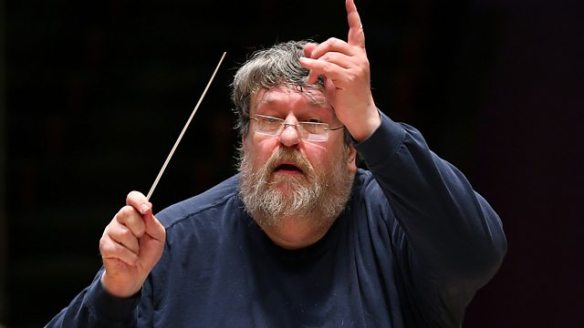
The Knussen Chamber Orchestra took its bow at the Aldeburgh Festival this year. Created specifically in memory and celebration of Oliver Knussen (above), it is an ensemble for commission and festival appearances, unrestricted in the repertoire it will perform – in that way very much reflecting the approach of its dedicatee. Comprising orchestral principals and budding young talent, it also reflects Knussen’s ability to communicate with musicians regardless of their standing.

Knussen is still greatly missed, a towering figure in British music in the latter part of the 20th century and the 21st until now. Tales have emerged not just of his mentoring of young composers and influence on the established writers, but of a sparkling personality and wit, a dinner companion par excellence. As a conductor he made several richly inventive programmes for the Proms with the BBC Symphony Orchestra and the Birmingham Contemporary Music Ensemble, and as a composer his small but perfectly formed catalogue is required listening for any budding contemporary composer of today. Like the composers he adored, particularly Stravinsky and Webern, his is a musical language that speaks directly through an economy of means.

That much was immediately evident in the three and a half minutes of …upon one note – Fantasia after Purcell, which used the colours of clarinet, violin, cello and piano to lasting effect. Knussen moved the omnipresent middle ‘C’ – the ‘one note’ – around the parts effortlessly, enjoying the harmonic diversions possible around it and alternating solemnity with mischief. The piece proved both a homage to Purcell and a brief spark of invention, and was ideally weighted by the soloists.

Birtwistle’s Fantasia upon all the notes has potential for mischief in its title but is in effect a typically serious piece. Written for an ensemble of seven players this was led with authority by harpist Céline Saout, who effectively drove the piece through its initial jagged outlines. The colours available to Birtwistle were exploited through music of stern countenance, its few tender asides to be cherished as the exception rather than the rule. Only at the end, with little points of pitch from solo instruments, did the mood lighten.

In a charming conversation with BBC Radio 3 host Petroc Trelawny, Freya Waley-Cohen revealed Knussen’s qualities as a tutor and a ‘wonderful person’. Naiad (20:14 on the broadcast) was a fitting tribute, fulfilling Cohen’s description of reflections from the scales of fish and dew on a spider’s web with music that cast a rarefied light, such as the sun does this time of year. The attractive melodic cells rippled with a slight chill, piercing moments of clarity from the woodwind contrasted by fuzzier asides from the strings. Although Cohen’s description of a slow piece and a fast piece rubbing up together was more difficult to follow, that did not mar in the slightest an enjoyable and meaningful piece, whose last few bars had a lilting four-note melody that hung on the air, leaving an enchanted atmosphere in its wake.

Bassoonist Jonathan Davies then stepped forward for Knussen’s highly virtuosic Study for Metamorphosis (30:54), based on Kafka. There were some extraordinary sounds here, the composer exploiting the cartoon-like persona the bassoon can elicit but also reminding us of the instrument’s versatility, its ability to paint pictures both happy and sad. Davies was superb and clearly enjoyed the experience.

Hans Abrahamsen’s Herbstlied followed (from 38:58), an extended arrangement and combination of a Danish song and two J.S. Bach subjects from The Art of Fugue. This instrumental version was unexpectedly moving, its picture painting of leaves ‘falling as from far…’ most apt for the time of year and given a vivid account by the five players. The cor anglais of Tom Blomfield added a unique sourness to the tone, and the downward motion of the melodies indicated sorrow, but there was still a sweeter melancholy here that stayed with the listener long afterwards.

We moved into Alastair Putt’s wind quintet Halazuni (47:36) without a break. This was a less affecting piece, more calculated in its depiction of a spiral (its title is the Persian word for spiral) The colours of the instruments – flute, oboe, clarinet, horn and bassoon – were frequently attractive, and while the music did on occasion feel predetermined, there was a clear end goal.

The best was saved until last in the form of Knussen’s Songs Without Voices (not yet linked to the broadcast on BBC Sounds). A group of four pieces for an ensemble of eight players, the Songs use vivid colour combinations which bring the composer’s imagery to life. The melodies, though short, are incredibly meaningful.

The first three Songs are wordless settings of texts by Walt Whitman, starting with Winter’s Foil, which was alive with bird calls and blustery winds. As elsewhere Wigglesworth secured playing of great poise and personality, led with characteristic authority by violinist Clio Gould. Prairie Sunset showed off the colours of the ensemble both separately and in combination, before the delicate outlines of First Dandelion were revealed. ‘simple and fresh and fair’.

Finally we heard Elegiac Arabesques, Knussen’s tribute to Polish-English composer Andrezj Panufnik. This wove an incredibly poignant thread, suitable in its own way as a memorial to the composer-conductor commemorated with such grace and feeling here.

Listen

The music in this concert can be heard on Spotify below:

A playlist featuring works both composed and conducted by Oliver Knussen can be heard below. It includes …upon one note from this concert, though not the Songs Without Voices – which are in fact available on the Erato label: