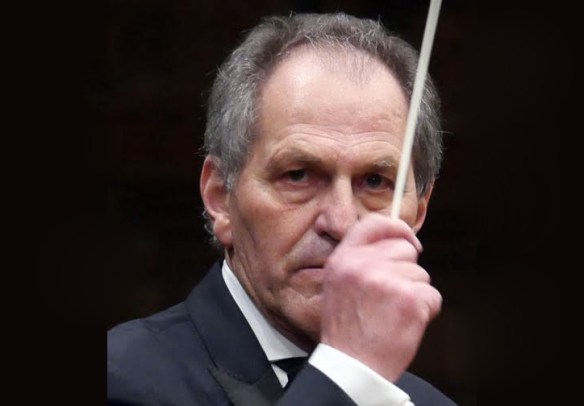
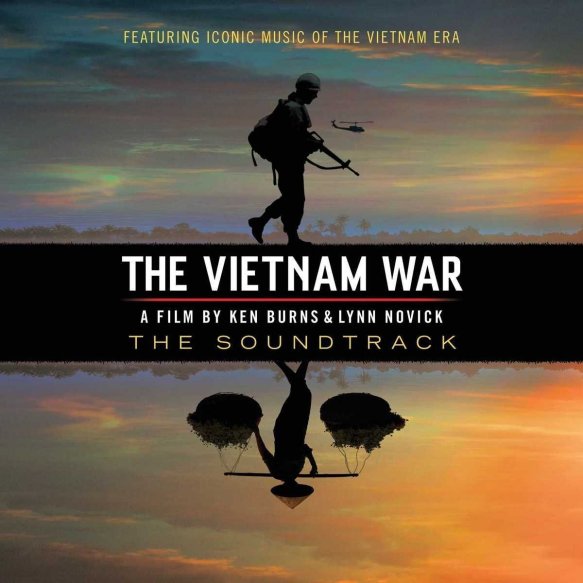
On record: Trent Reznor & Atticus Ross – The Vietnam War Soundtrack (UMC)

The Vietnam War – A Soundtrack by Trent Reznor and Atticus Ross

Reviewed by Ben Hogwood

Summary

You may have seen The Vietnam War, an ambitious 10-part series directed by Ken Burns and Lynn Novick that has aired on the BBC through Autumn and Winter. This is the first of two companion soundtracks, featuring over 90 minutes of original material composed by Trent Reznor and Atticus Ross.

Its companion is also a double album, with 38 songs including heavyweights of the era from The Beatles, Bob Dylan, Nina Simone, Simon & Garfunkel and Procol Harum.
What’s the music like?

Atmospheric and moody – but with considerable depth. Reznor and Ross write in a deceptively simple style, setting scenes through unhurried motifs and brushes of instrumental colour. Much of this colour is dark and foreboding, suggesting an underlying threat. The Forever Rain does this most vividly, suggesting the approach of an enemy vehicle.

There is an exquisite tension at play in the music, helped by the subtle use of quarter tones that can distort and pull a suggested moment of consonance in the harmony towards something more weird. Other Ways To Get To The Same Place uses these subtle variations in pitch to introduce disquiet.

There are more comforting moments – the opening Less Likely, for instance, then A World Away, where mottled piano and harp combine in an affecting loop, but by the time Justified Response arrives the tension built up throughout is released with great power. We hear cold electronic drums for the first time, then a full-on, four to the floor bluster.

Does it all work?

Yes. As background music it is extremely effective if rather disquieting, demanding more input on the part of the listener. Ross and Reznor suggest mood, emotion and peril with a surprising combination of subtlety and intensity.

Is it recommended?

Definitely. This is a cut above the average soundtrack music, and an ideal accompaniment to the visuals. The score complements the pop heavyweights elsewhere, which could hardly be bigger hitters – A Whiter Shade Of Pale, The Sound Of Silence and A Hard Rain’s A-Gonna Fall to name just three. Get both for a full picture of the climate.

Jerusalem Chamber Music Festival Ensemble – Stravinsky, Ustvolskaya & Shostakovich

Jerusalem Chamber Music Festival Ensemble: Elena Bashkirova (piano, above), Marina Prudenskaya (soprano), Pascal Moragués (clarinet), Sergej Krylov (violin), Alexander Knyazev (cello)

Stravinsky Suite from The Soldier’s Tale (for violin, clarinet and piano) (1918-19)
Ustvolskaya Piano Sonata no.5
Shostakovich Seven Poems of Alexander Blok, Op.127 (1967)
Ustvolskaya Trio for clarinet, violin and piano (1849)
Shostakovich Piano Trio no.2 in E minor Op.67 (1944)

Wigmore Hall, London; Thursday 14 December 2017

Written by Ben Hogwood

Pianist Elena Bashkirova founded the Jerusalem Chamber Music Festival in 1998, and this celebration at the Wigmore Hall was part of a desire to continually expand the festival beyond Israel’s borders. Here we had a well-conceived program of Russian music, if a little unremitting in its darkly coloured focus.

It was especially gratifying to see the prominence given to Galina Ustvolskaya’s music. A pupil of Shostakovich, she has a small but potent legacy of works, which show a style already thinking well ahead of its time. In the first half of the concert we heard the Piano Sonata no.5, a remarkably concentrated piece of music lasting only half the 20 minutes it does on record. The suspicion was that Bashkirova did not follow some of the instructed repeats, or that her performance was simply much faster than those before it. Either way it left a powerful imprint, its refusal to budge from a central Db anchoring the music becoming a really strong musical device in spite of all the activity around it.

Arguably even more accomplished was the Trio for clarinet, violin and piano with which the concert’s second half began. This too left a lasting impression, thanks largely to the sensitivity with which Pascal Moragués and Sergej Krylov played the quiet music, and to the probing and penetrating tone of Bashkirova’s right hand. As Paul Griffiths’ booklet note pointed out, this music sounds more like late Shostakovich – but its composition date of 1949 shows just how originally Ustvolskaya was thinking.

From Shostakovich we heard two works, the late Seven Poems of Alexander Blok, Op.127, and the Piano Trio no.2 in E minor, Op.67. Both are hugely effective concert pieces, but it was the Blok poems that cut to the core at the end of the first half. Soprano Marina Prudenskaya, a late stand-in for Anna Samuil, got right to the heart of Blok’s verse, nowhere more so than in the savage destruction of Burya (The Storm). From this a wispy cello line emerged, Alexander Knyazev responding with a moving plaintive tone, after which the trio joined for the first time in accompanying Prudenskaya for the final song. It capped a tightly structured performance, the string players finding just the right tone if not always the exact intonation, while Bashkirova’s piano probed the lower reaches of the bass sound.

This was also the case in the Second Trio, which was occasionally a bit unkempt technically but which unerringly found the heart and focus of Shostakovich’s music. From the ghostly harmonics at the start, Krylov and Knyazev were clearly on the same emotional page, and with Bashkirova the three players achieved an impressive variety of volume and colour. Shostakovich’s powerplay scherzo and middle of the last movement were incredibly strong and lasting statements, but as ever with his music the greater meaning could be found in the moments of intimacy where the listener can hear a pin drop. The last movement thus became the focus of attention, music of sorrow, paranoia and anger – with just a little respite at the end.

The evening began with Stravinsky’s suite from A Soldier’s Tale, distilled into short movements for clarinet, violin and piano. Melodic and spiky, this performance was enjoyable and included just the right amount of humour, before taking a darker turn for the final Triumphal March of the Devil, where Krylov took over.

An excellent and thought provoking concert, particularly in the light of the various programmes marking the centenary of the Russian Revolution this year.

You can listen to the music from this concert on the Spotify playlist below:

Ralph Lane, Oberon Symphony Orchestra & Samuel Draper – Weber, Finzi & Vaughan Williams

Ralph Lane (clarinet), Oberon Symphony Orchestra / Samuel Draper

St James’s, Sussex Gardens, London; Saturday 2 December 2017

Weber Oberon, J306 – Overture (1826)
Finzi Clarinet Concerto, Op.31 (1949)
Vaughan Williams Symphony no.4 in F minor (1934)

Reviewed by Richard Whitehouse

British music has not figured prominently on the schedule of the Oberon Symphony Orchestra thus far, so it was interesting to have two notable works from the concertante and symphonic genres juxtaposed in tonight’s concert; their contrasts in aesthetic brought unequivocally into relief.

Long the most often performed of its composer’s larger works, Finzi’s Clarinet Concerto is now firmly established in what is still a limited repertoire. Avowedly English despite (even because of?) his mixed European ancestry, Finzi cuts a somewhat ambivalent figure such as this piece pointedly confirms and which Ralph Lane duly underlined.

Whether in the starkly alternated recitative and arioso writing in the initial Allegro, the ruminative and frequently ominous poignancy of the central Adagio (its expressive eddying deftly unfolded), then the amiable but never merely blithe melodiousness of the final Rondo, this was an assured and perceptive account – enhanced by Samuel Draper’s handling of the restrained orchestration. Maybe Finzi’s shorter orchestral works will find their way onto future Oberon programmes?

As, hopefully, will other Vaughan Williams symphonies, given the success of this reading of the Fourth. Over eight decades on from its premiere, the work still divides opinion as to what its composer intended. The deteriorating political situation in Europe is often quoted as evidence, though this is not a symphony about or even anticipating war; rather the composer posits the notion whether the Beethovenian concept of adversity to triumph was sustainable in an era of cultural, specifically tonal dislocation.

The sound-world exudes an austerity and angularity not unknown in Vaughan Williams’s earlier music, though never so overt as here: worth considering in the context of Shostakovich’s (then unwritten) Fifth and Enescu’s (then unfinished) Fourth, both symphonies which have been highlights of recent Oberon concerts.

As also was this performance. Draper set a fast though never unduly headlong tempo for the opening Allegro, bringing out those contrasts between violence and eloquence on the way to a coda of rapt introspection. The ensuing Andante was similarly kept moving, its dissonant harmonies and tensile polyphony yielding an unexpected pathos confirmed in the flute-lead threnody at its close.

Rhythmically exacting, the Scherzo evinced a measure of uncertainty in ensemble, though Draper had the measure of its acerbic humour – as also the trio’s pomposity – through to an impulsive transition into the Finale. Its martial strains never descending into parody, this brought the overall conception into powerful focus; the ‘fugal epilogue’ driving onward to a fateful return of the work’s opening and an unequivocal (four-letter?) last chord.

So, an impressive take on a symphony which has lost none of its capacity to provoke, or even shock, and an admirable statement of intent from this orchestra on its fifth anniversary.

Given the occasion it was understandable when, instead of beginning with a British overture, Draper chose that which Weber wrote for his final opera Oberon. If the magical opening was a touch earthbound, the performance then hit its stride prior to an effervescent close.

On this evidence, the Oberon Symphony is set fair on the home strait towards its first decade of music-making.

Further information at on the Oberon Symphony Orchestra can be found at their website – while Samuel Draper’s website is here

Alexandra Dariescu, Royal Philharmonic Orchestra / Cristian Mandeal – Romanian Centennial Concert

Alexandra Dariescu (piano, above), Royal Philharmonic Orchestra / Cristian Mandeal (below)

Cadogan Hall, London; Tuesday 28 November 2017 (Concert supported by the Romanian Cultural Institute)

Enescu Romanian Rhapsody No. 1 in A, Op. 11 No. 1 (1901)
Grieg Piano Concerto in A minor, Op. 16 (1868)
Lipatti Concertino in Classical Style, Op. 3 (1936)
Tchaikovsky Francesca da Rimini, Op. 32 (1876)

Reviewed by Richard Whitehouse

It has often been remarked that the death of Dinu Lipatti, in 1950 at the age of 33, robbed the musical world of a rare pianist, yet his ability as a composer was by no means inconsiderable. Such was evident throughout the modest and perfectly judged proportions of his Concertino in Classical Style, its four movements discreetly and judiciously evoking formal precedents while also offering up the subtlest of allusions to several then contemporary composers who had drawn productively on a neo-classicism inspired (both more and less directly) by Bach.

The Concertino was given here with style and no little insight by Alexandra Dariescu, who had already appeared prior to the interval for an enjoyable performance of Grieg’s perennial Piano Concerto. If the first movement lacked the last degree of formal cohesion, the extent of its expressive scope was not in doubt – not least during the wide-ranging cadenza which Dariescu dispatched with aplomb. The sentiment of the Adagio never cloyed, then the finale exuded energy and eloquence on its way to a grandiloquent but not overbearing peroration.

Both these works benefitted from the stylish and attentive accompaniment as secured, from a Royal Philharmonic Orchestra on excellent form, by Cristian Mandeal – assuredly the leading Romanian conductor of his generation. He began proceedings with Enescu’s First Romanian Rhapsody – a piece that, however much its composer might have deplored the fact, continues to represent his music to the public at large. If just a shade hesitant in the initial section, this account audibly hit its stride in a coruscating take on the breathless dance-music that follows.

The programme ended with an impressive account of Francesca da Rimini – if not the most often heard of Tchaikovsky’s symphonic poems, arguably his most involving in terms of its graphic depiction of the heroine’s love and tragic fate. Not the easiest piece to hold together, it benefitted from the conviction with which Mandeal integrated its contrasting episodes; not least the infernal storm which yields even greater terror in those cataclysmic final pages. The Cadogan acoustic strained to take this all in, but orchestra and conductor emerged triumphant.

For more concert information on the Royal Philharmonic Orchestra, head to the What’s On page on their website

You can hear a recording of the Dinu Lipatti Concertino on Spotify below, part of a disc devoted to the composer’s music by Marco Vincenzi:

Distance – Mario Brunello plays Bach, Cage & Weinberg at the National Gallery in London

The Incredulity of Saint Thomas (1502-4), by Giovanni Battista Cima da Conegliano

Mario Brunello (cello, below)

J.S. Bach Solo Cello Suite no.5, BWV1011 (c1720s)
Cage 4’33” (1952)
Weinberg Sonata for Solo Cello no.1, Op.72 (1960)

Room 61, The National Gallery, London; Thursday 7 December 2017

Written by Ben Hogwood

A rare treat indeed – the chance to witness a concert in the very heart of the National Gallery. Given by cellist Mario Brunello, the hour of music was entirely inspired by the Cima work The Incredulity of Saint Thomas, a powerful and colourful depiction of the apostle’s doubting of Christ’s resurrection.

Brunello chose three pieces to bring the work to musical life, the first of which was entirely appropriate. Cellists such as Steven Isserlis have long held a belief that the six suites for solo cello by Johann Sebastian Bach carry a parallel with the story of the crucifixion and resurrection, and in choosing the Fifth Suite Brunello picked the one most closely associated with Christ’s death. The Sarabande in particular is some of Bach’s most extraordinary music, a single line portraying in vivid detail the darkest of moments, dispensing almost entirely with obvious rhythms or harmonic movement. The solemn prelude and faster dance music tends to occupy the lower registers of the instrument, and here it found a perfect match in the rich baritone of Brunello’s 1600 Maggini cello. Meanwhile the wispy lines of the second Gavotte were especially effective, tracing invisible lines around the performing space.

The second piece was a performance of John Cage’s 4’33”, a work that will divide opinions for eternity it seems. Never failing to raise a smile or a more extreme reaction, the three movements of silence – each conducted in by Brunello, as the composer instructs – were here an effective postscript to the Bach. While inevitably there was some extraneous noise from people walking around in the gallery, and a brief solo from a vibrating phone in the middle distance, the period of reflection if anything enhanced the impact of the Bach that had gone before, whilst enabling us to focus afresh on the painting behind Brunello’s left shoulder. I did not time the ‘performance’, though it felt a lot longer than the specified duration – perhaps an indication that, in a busy city, 4’33” can be a surprising length of time.

Coming out of the silence with the Suite no.1 for solo cello by Mieczysław Weinberg was a fascinating move. Only in the last five or so years has the music of this Soviet / Polish composer gained recognition, thanks in part to Brunello’s close associate Gidon Kremer and the Kremerata Baltica. Brunello grew the first movement out of nothing to a powerful apex before dropping back to the low note where it started, while the second movement was a charming yet muted dance, played as though the real drama was being held back. And so it proved, for the final movement started with such ferocity as to knock the listener back in their seat. Three powerful bow strokes of unison ‘C’s – the same tonal centre of the Bach – brought all manner of parallels with the three hours between crucifixion and death, though the violence was also portraying Thomas’s disbelieving prods at Christ’s side.

Either way this was incredibly powerful in its realisation, Brunello making up for the occasional tuning idiosyncrasy with a forceful tone which seemed to grow ever more powerful as the range went higher. Weinberg’s music carries great meaning, given the composer’s responses to the tragedies of his personal life, and its use here with Bach and Cage put it in the best possible context. Even the weather responded in kind – when we entered the gallery it was raining, but we emerged blinking into powerful sunshine. A true darkness to light experience.

Further listening and reading

You can experience the same program from the National Gallery on this Spotify playlist, including Mario Brunello’s recording of the Bach:

Meanwhile if you are interested in more Weinberg, the release below, of chamber symphonies and the Piano Quintet, is a substantial document completed by Gidon Kremer with the ECM label: