In concert – Quatuor Danel: Shostakovich & Weinberg #7 with François-Frédéric Guy @ Wigmore Hall

François-Frédéric Guy (piano), Quatuor Danel [Marc Danel & Gilles Millet (violins), Vlad Bogdanas (viola), Yovan Markovitch (cello)]

Shostakovich String Quartet no.10 in A flat major Op.118 (1964)
Weinberg String Quartet no.11 in F major Op.89 (1965-6)
Weinberg Piano Quintet in F minor Op.18 (1944)

Wigmore Hall, London
Monday 25 November 2024

by Richard Whitehouse Photo (c) Marco Borggreve

This latest instalment in Quatuor Danel’s parallel cycle of string quartets by Shostakovich and Weinberg comprised one of the former composer’s most understated pieces followed with two of the latter’s most characteristic yet, at least in terms of expression, utterly contrasted works.

Written during just 11 days, the Tenth Quartet is something of a standalone in Shostakovich’s cycle – coming as it does between the four innately personal quartets that preceded it and the four related to members of the Beethoven Quartet (who premiered all except the first and last of this cycle) that followed. Yet, as its dedication to Mieczysław Weinberg suggests, this is no less specific in intent – hence the musing ambivalence of its initial Andante and visceral force of its scherzo. The Danel savoured their respective essence, cellist Yovan Markovich coming into his own in the ensuing Adagio with its emotionally restrained variations. The link to the finale was seamlessly effected, then the movement built methodically towards a heightened restatement of the passacaglia theme before tentatively retracing its steps to a wistful close.

Written months later, Weinberg’s Eleventh Quartet is by no means lesser by design or intent. Its fugitive opening Allegro exudes a scurrying motion such as resurfaces at key moments in the overall design, akin to that of the Shostakovich in equivocation, and if the scherzo could hardly be more different in its fleeting delicacy (the original such movement it replaced was likely much more demonstrative), the solemn alternation of ensemble and solo writing in its Adagio conjures up a similarly processional aura. Contrast is again pronounced in the finale where, instead of channelling the musical loose-ends towards a formal and expressive unity, Weinberg leaves matters in abeyance; despite (or because of) the most tentative recollection of that scurrying motion which flits across the already fragmented texture at the very close.

If the Danel had long mastered Weinberg at his most refractory, it proved equally adept with the communicative power of his Piano Quintet. At almost 45 minutes this is also his largest chamber work, its five movements unfolding as a discursive if never random sequence such that the furtive questioning of its opening Moderato finds accord with the unsettled humour of its ensuing Allegretto – an intermezzo next to the scherzo-like energy of its central Presto, in which the interplay between François-Frédéric Guy and the Danel was at its most incisive.

Much the longest movement, the Largo accumulates intensity through juxtaposing passages in rhythmic unison with those during which piano and strings predominate. Its impassioned culmination is exceeded by that of a final Allegro whose impetuous main ideas bring about    a climactic return to the work’s opening theme. Even more remarkable is what follows: the intensity soon subsiding prior to this movement’s initial idea returning, quietly transformed, as though to suggest its composer having been reborn as a sentient being and creative artist.

Hearing this work, performances of which have fortunately become more frequent these past two decades, is an experience like few others in the chamber domain; suffice to add that Guy and the Danel were as one in their realizing the scale and impact of this modern masterpiece.

You can hear the music from the concert below, in recordings made by Quatuor Danel -including their most recent cycle of the Shostakovich quartets on Accentus:

For more information on the next concert in the series, visit the Wigmore Hall website. You can click on the names for more on composer Mieczysław Weinberg, Quatuor Danel and pianist François-Frédéric Guy

Published post no.2,378 – Saturday 30 November 2024

Switched On – Bibio: Phantom Brickworks II (Warp)

by Ben Hogwood

What’s the story?

This is the second instalment in Bibio’s Phantom Brickworks project, an ambient / drone concern begun in 2017. On it, Stephen Wilkinson (who is Bibio) has the aim of exploring “the human echoes still present in various sites around Britain. Wilkinson has visited these locations, observed their gradual decline, and responded with improvised and composed music.”

The sequel brings forward new, intriguing sites, described as ‘vast scars on the natural landscape, some surviving through memories, historic clips and photographs. A few remain submerged from ordinary sights, while some exist purely as legends and stories’.

What’s the music like?

Immediately restful, as Bibio leads us to an appealing calm place. The loop subtly powering Dinorwic moves at a very slow pace but maintains its poise, while the magical Dorothea’s Bed has wordless voices transmitting an icy beauty. A higher register piano twinkles in the fog of Phantom Brickworks IV, while Llyn Peris reflects the dappled light of a winter sky, the sun near the horizon.

Tegid’s Court rocks gently like a Berceuse, leading into the immensely calming, spoken word Brograve. Spider Bridge once again makes evocative use of the piano’s higher register, a distinctive feather in Bibio’s cap.

Does it all work?

It does. Bibio has mastered the art of making more from less, and these pieces are ideally weighted.

Is it recommended?

Phantom Brickworks II is strongly recommended, another feather in the cap of an artist whose versatility continues to be most impressive. Having charmed us with pastoral electronica, Bibio now has real durability as a long-form ambient artist.

For fans of… Harold Budd, Loscil, Luke Abbott, Jon Hopkins

Listen & Buy

Published post no.2,377 – Friday 29 November 2024

On Record – Piatti Quartet – Joseph Phibbs: Quartets (Nimbus)

Joseph Phibbs
String Quartet no.2 (2015)
String Quartet no.3 (2018, rev. 2021)
String Quartet no.4 (2024)

Piatti Quartet [Michael Trainor and Emily Holland (violins), Miguel Sobrinha (viola), Jessie Ann Richardson (cello)]

RTF Classical / Nimbus Alliance NI 6452 [55’57”]
Producer and Engineer Raphaël Mouterde

Recorded 14 December 2023 at All Saints’, East Finchley, London (String Quartet no.2), 25 April 2024 (String Quartet no.3), 20 June 2024 (String Quartet no.4), St Silas, Kentish Town, London

Reviewed by Richard Whitehouse

What’s the story?

Joseph Phibbs builds upon a growing discography with this release of his latter three string quartets, played by the Piatti Quartet that has already recorded his First Quartet, in what is a notable addition to the RTF Classical label administered by the Richard Thomas Foundation.

What’s the music like?

Having reached his half-century earlier this year, Phibbs can look back on a substantial output such as covers all the major genres. Two shorter works – Agea (2007) and Quartettino (2012) – precede his designated First Quartet (2014), a varied and assured five-movement sequence that was written for and premiered then recorded by the Piatti Quartet as part of its collection Albion Refracted (Champs Hill Records CHRCD145). The ensemble’s collaboration with this composer here continues with a volume that further consolidates his standing in the medium.

Written for and dedicated to the Navarra Quartet, the Second Quartet opens with what Phibbs designates a nocturne – albeit a Presto and with scurrying figuration that persists through to a brief passage of repose. It is countered with a scherzo both edgy and volatile, followed by an Interlude whose Chitarra designation indicates the pizzicato strumming that brings a climax of some velocity. Its subsiding into relative stasis presages a final Lento whose lyrical violin theme evolves toward a culmination which is the more conclusive through its sheer fervency.

Written for the Belcea Quartet and dedicated to the memory of composer Steven Stucky, the Third Quartet starts with a sizable movement whose inward introduction and coda frame an Allegro varied and unpredictable in its content but given focus by an eloquent theme prior to its eventual climax. Next is a fugal Presto – a coursing scherzo to complement the capricious intermezzo of a Corrente and, in between, a freely evolving Notturno whose pensiveness manner finds resolution through a finale of an introspection dispelled by its animated coda. Written for the Piatti Quartet and dedicated to the philanthropist Richard Thomas, the Fourth Quartet is again cast in five movements. Here, however, the trajectory seems overtly fluid as this heads from the impetuous Film Sequence, via an atmospheric Notturno then a gently elegiac Cantilena and an incisive Burlesque, to the final Passacaglia. Much the longest movement, this is centred on an extended soliloquy for cello which does not so much refer to earlier ideas as draw the ensemble into a cohesive texture sustained through to the rapt close.

Does it all work?

Pretty much always. Phibbs is a resourceful while often imaginative writer for string quartet, his music demonstrably in the lineage of 20th-century totems such as Bartók or Shostakovich (with a nod toward Britten), without being beholden to these or any other precedents. It helps when the Piatti Quartet, whose own discography features notable releases of Mark-Anthony Turnage (Delphian DCD34254) and Ina Boyle (Rubicon RCD1098), sounds so well attuned to his idiom and has evidently prepared each one of these works with unfailing commitment.

Is it recommended?

Very much so. Sound has the requisite clarity and definition if a little lacking in warmth, and Phibbs contributes informative notes. Readers should investigate further releases on the RTF Classical imprint, which is building into a valuable anthology of contemporary British music.

Listen & Buy

For further information and purchase information visit the Nimbus website. Click on the names for more on Joseph Phibbs himself, the Piatti Quartet and the Richard Thomas Foundation

Published post no.2,376 – Thursday 28 November 2024

On Record – George Lloyd: The Works for Violin and Piano (Lyrita)

George Lloyd
Lament, Air and Dance (1975)
Violin Sonata (1978)
Seven Extracts from ‘The Serf’ (1938, arr. 1974)

Tasmin Little (violin), Martin Roscoe (piano); Ruth Rogers (violin), Simon Callaghan (piano) (Extracts from The Serf)

Lyrita SRCD.424 [two discs, 60’33” and 28’16”]
Producers George Lloyd, Adrian Farmer (The Serf) Engineers Tony Faulkner, Adrian Farmer (The Serf)

Recorded 7-8 September 1989 at St Martin’s, East Woodhay; 10 June at Concert Hall, Wyastone Leys, Monmouth (The Serf)

Reviewed by Richard Whitehouse

What’s the story?

Lyrita’s eminently worthwhile Signature Edition devoted to the reissue of Albany recordings of George Lloyd (1913-1998) continues with this volume of his output for violin and piano, here re-released with the addition of music that has been specially recorded for the occasion.

What’s the music like?

Those who have been following this series (or who have those original issues) will know that Lloyd often devoted himself to a specific medium at certain times in his life, and so it proved with this particular duo. Despite having studied the violin with no less than Albert Sammons, he wrote nothing centred on this instrument until his First Violin Concerto of 1970. Between then and its successor (both on SRCD.2421-22) seven years later, he also essayed two major works for violin and piano that reflect the ambition of his symphonies from previous decades.

Although not designated such, Lament, Air and Dance is hardly less of a sonata than the piece which followed. Not least its Lament whose spacious if methodical unfolding on the lines of a chaconne, albeit that in G minor by Vitali rather than the more expected one in D minor by Bach, exhibits formal cohesion to balance its emotional immediacy. The relatively brief Air provides an oasis of lyrical calm, then the Dance makes for a more than viable balance with its bravura writing and a rhythmic verve that fairly dominates those impetuous closing bars.

Seemingly begun the following year but only finished in 1978 (the composer’s website and present booklet note diverge on this), the Violin Sonata is cast on almost the same scale, but its three sections unfold without pause. The notion of a one-movement conception is further reinforced by its initial Largamente’s two main themes – respectively rhythmic and melodic – that evolve through the central Moderato’s brief while delectably whimsical course, to their elaboration and eventual fusion in a Finale which builds to a decisive and impassioned close.

Before either of these works, Lloyd had effectively ‘tried out’ this medium by extracting then arranging seven pieces from his second opera The Serf – which, one senses, he considered his greatest achievement such that the aborted BBC production and recording in 1990 must have been a sore disappointment. Those familiar with the first of his two orchestral suites arranged as late as 1997 (SRCD.2417-18) will recognize some of this music, but the present sequence appeal taken as an overall entity or as individual items which almost all make ideal encores.

Does it all work?

Yes, not least for the fact that Lloyd’s music is idiomatically conceived for whatever medium with which he chose to work. Both main works benefit from the commitment of Tasmin Little and Martin Roscoe in teasing expressive nuances out of music that, not for the first time with this composer, is subtler and more ambivalent than often supposed. Nor are Ruth Rogers and Simon Callaghan found wanting in those extracts from The Serf, recorded just a few months ago and welcome enhancement of what was already a desirable release in the Albany series.

Is it recommended?

Indeed, given the excellence of playing, recording and Paul Conway’s customarily thorough annotations. This series of George Lloyd reissues awaits his operas Iernin and John Socman for completion, though if it could run to a new recording of The Serf then so much the better.

Listen & Buy

For further information visit the dedicated page for the George Lloyd Signature Series. For more on the composer himself, head to the George Lloyd website

Published post no.2,375 – Wednesday 27 November 2024

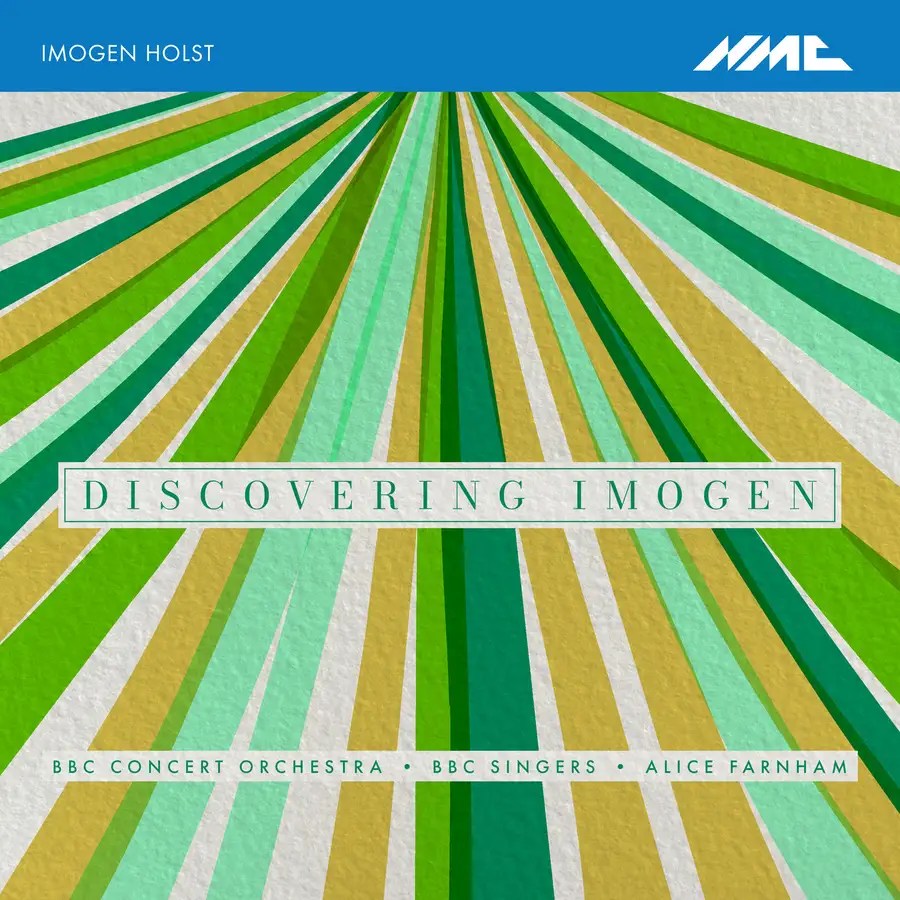
On Record – Imogen Holst: Discovering Imogen (NMC)

BBC Singers (What Man Is He?, Festival Anthem), BBC Concert Orchestra / Alice Farnham

Imogen Holst
Persephone (1929)
Variations on ‘Lorth to Depart’ (1962)
What Man is He? (c1940)
Allegro Assai (1927)
On Westhall Hill (1935)
Suite for String Orchestra (1943)
Festival Anthem (1946)

NMC Recordings NMCD280 [75’01”] English texts included
Producer Colin Matthews Engineers Marvin Ware, Robert Winter, Callum Lawrence
Recorded 27-29 January 2024 at Maida Vale Studio One, London

Reviewed by Richard Whitehouse

What’s the story?

As its executive producer Colin Matthews notes in his introduction, NMC would likely not exist had it not been for Imogen Holst (1907-84) setting up the Holst Foundation prior to her death – so making this release of her larger-scale works the more appropriate, and welcome.

What’s the music like?

The present anthology affords what seems a plausible overview of its composer’s output. The earliest piece here is Allegro Assai, evidently planned as the opening movement of a suite for strings that progressed no further, but which proves characterful and assured on its own terms. Such potential feels well on the way to being realized in Persephone, an overture (albeit more akin to a tone poem) given in rehearsal by Malcolm Sargent, with the influence of Ravel (and indirectly of Vaughan Williams) balanced by the dextrous handling of motifs across a formal evolution such as relates the myth in immediate and individual terms. That this went unheard until the present recording was likely as much a loss to the musical public as to Holst herself.

Underlining its composer’s skill in writing for amateurs, On Westhall Hill is an atmospheric piece the more appealing through its brevity and modesty of scoring. Deriving its text from the Book of Wisdom, What Man Is He? traverses a range of emotions from the sombre, via the introspective, to the affirmative in a setting as searching as it is fervent. Most impressive, however, is the Suite for String Orchestra composed for a ‘portrait’ concert at Wigmore Hall. The four movements unfold from a diaphanous Prelude, via a fluid and astringent Fugue then an Intermezzo whose ruminative warmth hints at qualities rather more fatalistic, to a Jig which convincingly rounds off the whole work with its mounting energy and resolve.

Written in the wake of the Second World War, Festival Anthem went unheard at this time but could be thought a ‘song of thanksgiving’. Adapted from Psalm 104 (‘Praise the Lord, O my soul’), it seamlessly integrates soloistic with choral passages prior to a calmly fulfilled close. The latest work here, Variations on ‘Loth to Depart’ takes a 17th-century tune as harmonized by Giles Farnaby as basis for five variations – the initial four respectively trenchant, eloquent, wistful and incisive; prior to a relatively extended chaconne as distils a pathos the more acute for its understatement. A string quartet is combined resourcefully with double string orchestra in music which can at least hold its own in the context of a distinctive genre in British music.

Does it all work?

It does indeed. It is all too easy to think of Imogen Holst as one who never fully realized her potential in the face of life-long teaching and administrative commitments, but the range of what is heard amply indicates her creative legacy to be one worth exploring in depth. The recordings, moreover, could hardly be bettered in terms of their overall conviction – Alice Farnham securing a laudable response form the BBC Concert Orchestra and, in the choral pieces, BBC Singers. Hopefully other ensembles, professional or amateur, will follow suit.

Is it recommended?

It is indeed. Sound is unexceptionally fine, with informative notes from Christopher Tinker. Alongside the NMC release of her chamber music for strings (D236), and that on Harmonia Mundi of choral music (HMU907576), this is a fine demonstration of Imogen Holst’s legacy.

Listen & Buy

You can listen to samples and explore purchase options on the NMC Recordings website. For more information on the artists, click on the names to visit the websites of the BBC Singers, BBC Concert Orchestra and conductor Alice Farnham, while a dedicated resource can be found for Imogen Holst herself

Published post no.2,374 – Tuesday 26 November 2024