
Listening to Beethoven #69 – 2 Triple Fugues


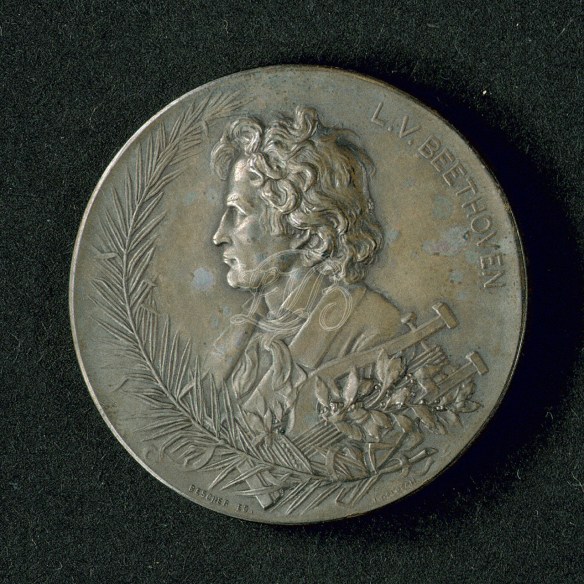
Medaille: Wyon, L. C.: Beethoven-Gedenkmünze (Philharmonic Society London, 1870) © Beethoven-Haus Bonn

2 Triple fugues, Hess 244 for four parts (1794-5, Beethoven aged 24)

no.1 in D minor
no.2 in F major

Dedication not known
Duration 5′

Listen

https://www.youtube.com/watch?v=3-bwLsthjywhttps://www.youtube.com/watch?v=wT_8-Sa3oto

Background and Critical Reception

These two triple fugues were written for four parts, though the exact instrumentation is not known. All three themes of the first piece are by Beethoven, while the second piece is collaborative between the composer and his teacher Albrechtsberger.

Thoughts

Writing a triple fugue means that a good number of musical parts are in play. Beethoven achieves his aim with music of impressive craftsmanship which will surely have satisfied Albrechtsberger.

The result for the listener is more admiration at the process than anything else, for this is clearly music that was not meant to be performed in concert. The first fugue is dutifully played out and a little downbeat as we return to D minor, while the second is more energetic and has a busier theme.

It is fascinating listening to these exercises though – and we will see much later in Beethoven’s life how they bear considerable fruit.

Recordings used

Covington String Quartet [Frank McKinster, Greg Pinney (violins), Luke Wedge (viola), William Hurd (cello)] (Deutsche Grammophon)

The versions for string quartet were arranged by the Dutch musicologist Albert Willem Holsbergen and are given sprightly performances here.

Spotify links

Covington String Quartet

You can chart the Arcana Beethoven playlist as it grows, with one recommended version of each piece we listen to. Catch up here!

Also written in 1795 Hyacinthe JadinThree String Quartets Op.1

Next up Prelude and Fugue in E minor Hess 29
Listening to Beethoven #68 – 5 Double Fugues


Commemorative medal for Ludwig van Beethoven – silver medal, based on designs by Jean-Marie Delpech and Lancelot, made by Bescher, Paris, early 20th century © Beethoven-Haus Bonn

5 Double fugues, Hess 243 for four parts (1794-5, Beethoven aged 24)

no.1 in C major
no.2 in F major
no.3 in C major
no.4 in C major
no.5 in D minor

Dedication not known
Duration 9′

Listen

Background and Critical Reception

As we rustle through Beethoven’s composition papers under the watchful eye of his teacher Albrechtsberger, we come to the tricky discipline of the double fugue.

As with previous counterpoint exercises this is a difficult one to write with feeling – but here Beethoven as a pupil was trying merely to satisfy his brief.

Thoughts

The five double fugues are lively pieces, Beethoven fulfilling his obligations with a lot more obvious energy than in previous bits of homework we have recently examined. The C major is brightly voiced, while there are signs of adventure on the second with a trill figure on the cello.

Beethoven returns to C major for the substantial third piece, which gives notice of a composer who really knows how to work his thematic material. This is busy, quite bracing music and the instruments work well in pairs before a thoroughly convincing final cadence. The fourth piece is also in C, recreating the same mood with plenty of activity.

Finally the sombre world of D minor returns – seemingly a favourite key for these lessons. This example is a full-bodied affair.

Recordings used

Covington String Quartet [Frank McKinster, Greg Pinney (violins), Luke Wedge (viola), William Hurd (cello)] (Deutsche Grammophon)

The versions for string quartet were arranged by the Dutch musicologist Albert Willem Holsbergen and are given sprightly performances here.

Spotify links

Covington String Quartet

You can chart the Arcana Beethoven playlist as it grows, with one recommended version of each piece we listen to. Catch up here!

Also written in 1795 Thomas HaighThree Keyboard Sonatas Op.10

Next up 2 Triple Fugues Hess 244