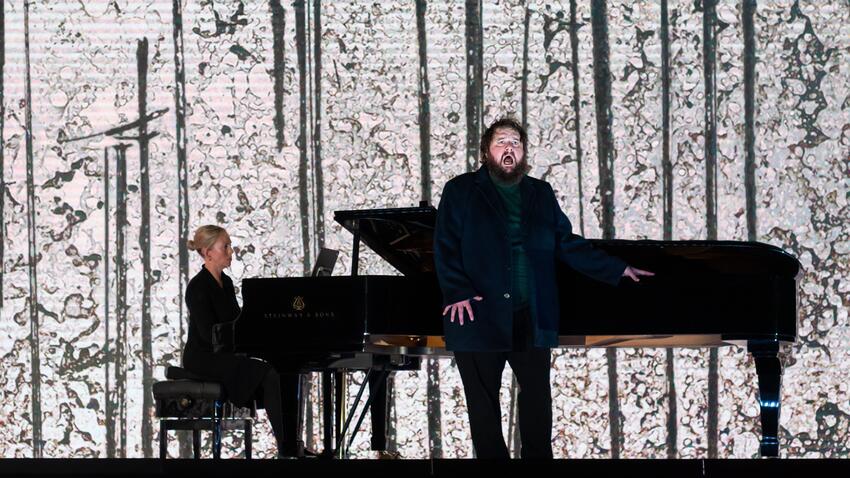
In concert – Martin Fröst, Janine Jansen, LSO / Gianandrea Noseda: Lost and Found @ Barbican Hall

Martin Fröst (clarinet), Janine Jansen (violin), London Symphony Orchestra / Gianandrea Noseda

Beethoven Leonore Overture no.3 Op.72b (1806)
Beamish Distans: Concerto for violin and clarinet (UK premiere) (2023)
Prokofiev Symphony no.7 in C# minor Op.131 (1952)

Barbican Hall, London
Thursday 20 June 2024

Reviewed by Ben Hogwood Pictures (c) Mark Allan

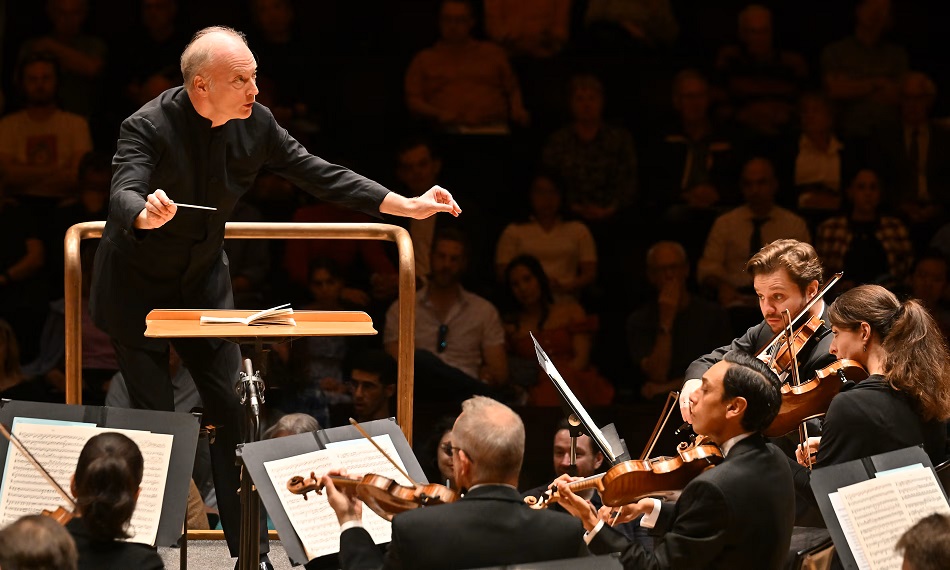
The London Symphony Orchestra and their principal guest conductor Gianandrea Noseda continued their Prokofiev symphony cycle with the elusive Seventh, prefaced by one of Beethoven’s four operatic overtures and a finally realised UK premiere.

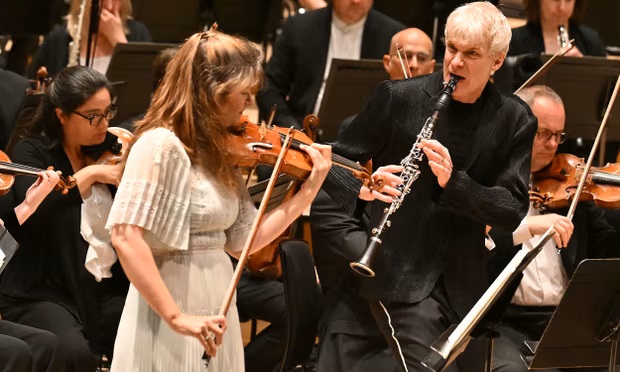
This was Distans, a co-commission between four orchestras for Sally Beamish to write a concerto for the unusual combination of clarinet and violin. Its first performance was delayed due to the pandemic, which became the inspiration for the content of the work. Themes of separation run through the three movements, drawing on the composer’s Swedish and Scottish connections. Separated from her children during lockdown, Beamish also used the forceful musical personalities of soloists Martin Fröst and Janine Jansen (both above) for inspiration.

The two began offstage, however, beckoning to each other across the Barbican Hall as Calling, the first movement, took shape. This was named in the concert notes as ‘kulning’, “the high-pitched singing of women calling the calls on remote pastures”. Beamish’s wide-angle musical lens produced an effective and touching first paragraph, the soloists eventually united on stage in music of the dance, evoking a Swedish fiddle with the full weight and energy of the orchestra in support.

Echoing, the slow second movement, explored more intense feelings of isolation through beautiful scoring, earthy cellos and metallic percussion casting a rarefied light suggesting a Swedish winter. The third movement, Journeying, was powered by an ancient march, the soloists together in spirit and melody, out in the elements with the orchestra. Although the music of beckoning reappeared, the mood was one of reunification, the soloists now at peace and content to remain on stage.

Distans made a strong impact in the hall, and Beamish’s writing for clarinet in her first major piece for the instrument made the most of Martin Fröst’s extraordinary breath control and agility. Jansen also fully inhabited the spirit of the piece, though her part often felt within that of the clarinet, and rarely used the high register. This was definitely a work to hear again, for Beamish’s sound world is a very attractive one in concert.
After the interval, Prokofiev’s Seventh Symphony was given an affectionate performance, yet one that also found the darkness lurking within. One of Prokofiev’s final works, the Seventh was written for the Soviet Children’s Radio Division, and as a result adopts a youthful stance, with commendably little room for nostalgia. Instead the composer gets up to his characteristically witty tricks, with inventive scoring enjoyed by the orchestra as woodwind doubled in octaves, and the piano and harp supplemented lower strings.

The music danced, a reminder of Prokofiev’s balletic qualities. The second movement Allegretto had poise in its first tune but a heavier swagger in the second, suggesting the unpredictable movements of older age – though an impressively powerful and assured close was reached. The following Andante enjoyed rich string colours, together with brilliant individual characterisations from oboe (Juliana Koch) and cor anglais (Clément Noël).

Yet the abiding memories came from two themes used in the outer movements. The first, a sweeping unison for orchestra, lovingly recreates the key and spirit of the composer’s first piano concerto, one of his greatest early successes – and was delivered with great charm here. The second, a cautionary motif from flute and glockenspiel resembling a ticking clock, returned like a regretful memory at the end – reminding this listener of an equivalent moment in Shostakovich’s last symphony, completed nearly 20 years later. It ended this performance on a thoughtful note, in spite of the exuberance that had gone before. The LSO were excellent throughout, presenting a convincing case for the Seventh as a bittersweet triumph, and reminding us in the process of Prokofiev’s abundance as a melodic composer.

Meanwhile Beethoven’s Leonore Overture no.3 began in a more desperate mood of resignation, the opera’s main character Florestan losing all hope in prison. Noseda – fresh from recording a symphony cycle with the National Symphony Orchestra in Washington – has very strong Beethovenian instincts, and paced this just right, with an appropriate hush falling over the hall. As the drama heightened, and an evocative offstage trumpet beckoned, the release from prison led to an outpouring of joy, sweeping us up in its forward momentum. The players were off the leash, enjoying every second.

You can find more information on further 2023/24 concerts at the London Symphony Orchestra website

Published post no.2,216 – Friday 21 June 2024
In concert – Guy Johnston, Britten Sinfonia / Thomas Gould @ Barbican Hall: The Protecting Veil

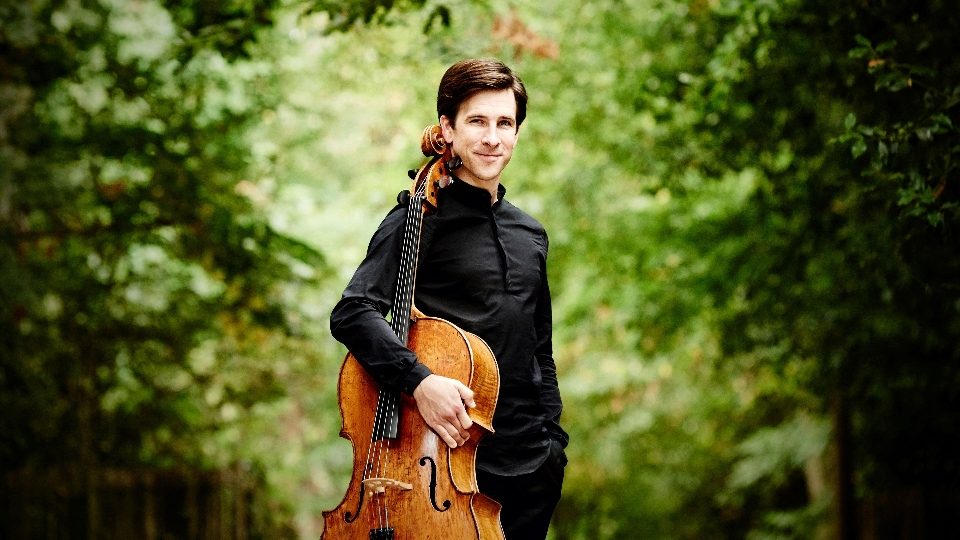
Guy Johnston (cello, above), Britten Sinfonia / Thomas Gould (violin)

Beethoven arr. Weingartner Grosse Fuge Op.133 (1826)
Bartók Divertimento for String Orchestra Sz113 (1939)
Tavener The Protecting Veil (1988)

Barbican Hall, London
Thursday 15 February 2024

Reviewed by Ben Hogwood

The Protecting Veil is a special piece. Written by John Tavener in 1988, this musical meditation for cello and orchestra is based on and inspired by the Greeks resisting Saracen invasion in the early tenth century. They are heartened by a vision of Mary, the Mother of God, surrounded by a host of saints and spreading out her Veil as a protective shelter over the Christians.

In what is effectively a single-movement concerto, the cello represents the Mother of God, leading the string orchestra in eight prayerful chapters that respond to landmark events in which she is present. It may sound elegiac and deeply ambient for much of its duration, but to achieve this elevated state the performers require poise, concentration and inner strength.

It is hard to imagine a better performance than this one experienced at the Barbican. Guy Johnston led us in contemplation, the serenity of his upper register cello line immediately establishing a mood of calm, in complete contrast to the bustling city outside. The Britten Sinfonia responded in kind, conducted where necessary by violinist Thomas Gould but largely following the cello, a congregation responding to his prompting.

In spite of its inner serenity, The Protecting Veil is troubled by the shadows of violence throughout the world. This performance was a stark reminder of how little has changed in eleven centuries, for in the ominous falling motif that recurs for the cello it was impossible not to think of bombs and missiles raining down in the many warzones we see today. The Barbican fell largely silent as those images undoubtedly projected to many listeners, aided by a sympathetic light show that cast the distinctive markings of the back of the stage as a wooden chapel. When Johnston played alone in the central section, The Lament of the Mother of God at the Cross, he could easily have been playing solo Bach, the intimacy of his and Tavener’s thoughts laid bare.

There was, ultimately, consolation and redemption, and the lights burned yellow when the music soared back to the heights with which it began. Feverish anticipation gripped the strings as they responded excitably to the higher cello, and with a surety of tone that never dimmed, Johnston led us to the end. His was a remarkable performance of stamina and poise, those long notes held for what seemed like an eternity, their pure tones never dipping.

The musical contrast with the opening piece, Beethoven’s Grosse Fuge, was notable. Here is a piece that still sounds as new and every bit as challenging as the day it was written, the Everest of fugues. In this arrangement for string orchestra by Felix Weingartner, its angular subject is a touch smoother at the edges, though here the sharp lines were just as clear as in the string quartet original, the fugue subject escaping its restrictions. The Britten Sinfonia found its core in a well-drilled performance.

Bartók’s Divertimento for String Orchestra was lighter in mood to begin with, the ensemble celebrating the great outdoors as the folksy first tune went with a swing. Yet here too there were troubled minds, the slow movement wary of its place in history. Bartók wrote the Divertimento in 1939 in Switzerland, with Europe on the brink of the Second World War. The oppressive approach of the conflict could be felt in a profound slow movement, which began with feathery violas and reached a forbidding climax, emotion wrought from its pages. Those worries were largely banished by the finale, whose powerful unisons were led by Gould as the piece swaggered and bustled to the finish.

Guy Johnston and the Britten Sinfonia continue their tour with The Protecting Veil to Dublin and Manchester – for more details visit the Britten Sinfonia website

Published post no.2,090 – Saturday 17 February 2024

In concert – Allan Clayton & Kate Golla: A Winter’s Journey

A Winter’s Journey

Schubert Winterreise D911

Allan Clayton (tenor), Kate Golla (piano), Lindy Hume (director), David Bergman (videographer)

Barbican Hall, London
Wednesday 7 December 2022

Reviewed by John Earls

Before the start of this performance it was announced that Allan Clayton had a chest infection but didn’t want to disappoint the audience who were asked to bear with him. As it turned out there was nothing to bear with and it certainly didn’t disappoint.

Many people think that Schubert’s great song-cycle Winterreise shouldn’t be tampered with beyond concentrating on the singing and piano playing in this remarkable work of 24 songs. They would prefer a ‘straight’ concert performance such as that given by Ian Bostridge and Thomas Adès in this same hall in January 2015, which was indeed unforgettable (incidentally, Bostridge has written a magnificent book on Winterreise called Schubert’s Winter Journey: Anatomy of an Obsession).

This particular ‘production’ featured video projections of abstract paintings by the late Australian artist Fred Williams on two right-angled screens behind the piano. These gave a sense of landscape although not always the landscapes one might usually associate with this work. It was deftly and beautifully done. Full credit to David Bergman (videographer).

Credit, should also be afforded to director Lindy Hume and artistic director Paul Kildea. Clayton was allowed to wander around the stage although didn’t stray too far from the piano with the exception of cutting a strikingly remote figure at the side of the stage at the beginning and end. There was no overkill, just delicate touches of theatre such as Clayton lying down to sleep under the piano using his coat as a pillow in Rast (Rest). And I wasn’t the only one who chuckled (is one allowed to chuckle during Winterreise?) when a mocking finger was pointed at the pianist sounding the posthorn in Die Post (The mail-coach).

Kate Golla provided fine piano accompaniment. But it was Clayton’s show. Despite the aforementioned ailment his singing was clear, dramatic and immensely moving, Die Nebensonnen (Phantom suns) a case in point. This, combined with his considered theatricality, gave a real sense of going on the journey with him. This will come as no surprise to anyone who saw his stunning performance as Peter Grimes at the Royal Opera House earlier this year.

There is a risk that adding visual accompaniments to this masterpiece detracts (and distracts) from the power and atmosphere of the work itself. In this case they were respectful, complementary and engaging. It was an utterly compelling experience.

John Earls is Director of Research at Unite the Union and tweets at @john_earls

In concert – London Symphony Orchestra & Sir Antonio Pappano – Respighi & Dallapiccola

Respighi Vetrate di Chiesa (1925-6)
Dallapiccola Il prigioniero (1944-8) {Sung in Italian with English surtitles]

Ángeles Blancas Gulín (soprano – Mother), Eric Greene (baritone – Prisoner), Stefano Secco (tenor – Gaoler / Grand Inquisitor), Egor Zhuravskii (tenor – First Priest), Chuma Sijeqa (bass-baritone – Second Priest), London Symphony Chorus, Guildhall School Singers, London Symphony Orchestra / Sir Antonio Pappano

Barbican Hall, London

Sunday 5 June 2022

Written by Richard Whitehouse Pictures (c) Mark Allan Photography

This second of the London Symphony Orchestra’s two concerts of Italian music with chief conductor designate Sir Antonio Pappano consisted of two pieces that brought the aesthetic and political divisions of Italy between the world wars into acute while always productive focus.

It might have originated in piano pieces written for his wife, but Respighi’s Church Windows duly emerged among the most opulent and evocative of his orchestral works. That both title and subtitles were postpriori additions does not lessen their relevance – not least as concerns The Flight into Egypt, its tense understatement a telling foil to the ensuing Saint Michael the Archangel with its warlike images rendered graphically by brass and percussion, before climaxing in one of the most theatrical of tam-tam crashes as Satan is banished from Heaven.

Not that Respighi was averse to gentler expression as appropriate, The Matins of Saint Clare featuring orchestration of unfailing finesse on its raptly expressive course. Inevitably, it is the magisterial finale of Saint Gregory the Great when this composer comes most fully into his own – its cumulative fervour drawing on all aspects of the sizable forces for what becomes a heady apotheosis. Music, indeed, that needs to be realized with discipline and focus to avoid overkill, which was certainly the case in a performance where the LSO left nothing to chance.

The London Symphony Orchestra and London Symphony Chorus conducted by Sir Antonio Pappano perform Ottorino Respighi Church Windows Luigi Dallapiccola Il prigioniero In the Barbican Hall (Ángeles Blancas Gulin Mother, Eric Greene Prisoner, Stefano Secco Gaoler / Grand Inquisitor, Egor Zhuravskii First priest, Chuma Sijeqa Second priest ) on Friday, 3 June 2022. Photo by Mark Allan

Whereas Respighi pays (indirect) tribute to Italy’s cultural greatness, Dallapiccola exposes its darker recesses in his one-act opera The Prisoner. Composed over several years that span the decline and fall of Mussolini’s Italian empire, its libretto is drawn from the novel by the late 19th century author Villiers de l’Isle-Adam whose title Torture by Hope became subtitle for this opera by intimating the culmination of a scenario set during one of the grimmest periods in the Spanish Inquisition. By this time, Dallapiccola had evolved that distinctively personal brand of serialism which served him thereafter, but his knowledge of and devotion to Italian opera meant that those more methodical or systematic aspects are harnessed to an emotional fervour as makes for a consistently powerful and often moving while harrowing experience.

The performance was a compulsive one – centred upon Eric Greene’s assumption of the title-role that built gradually to an apex of elation suddenly and cruelly denied. The opening stage is dominated by the Mother – rendered with unfailing charisma yet never wanton melodrama by Ángeles Blancas Gulín, and Stefano Secco brought hardly less conviction to the twin-role of the Gaoler whose urgings to remain steadfast assume a chilling tone when he is revealed as the Grand Inquisitor. There were telling cameos from Egor Zhuruvskii and Chuma Sijeqa as the Priests, with the London Symphony Chorus and Guildhall School Singers combining to potent effect in offstage Psalm settings – the final one a climax of sombre grandeur. Pappano directed with absolute assurance an opera he doubtless, and rightly so, ranks with the finest.

It brought this enterprising and superbly executed concert to an impressive close. One only hopes Pappano will have the opportunity to programme further such music over the coming seasons: the enthusiastic response suggested an almost full house would be there it hear it.

To read more on the London Symphony Orchestra’s current season, visit their website. For more information on the artists involved, click on the names for Antonio Pappano, Ángeles Blancas Gulín, Eric Greene, Stefano Secco, Egor Zhuravskii and Chuma Sijega

In concert – Soloists, CBSO Chorus, Czech Philharmonic Orchestra / Semyon Bychkov: Dvořák 8th symphony & Janáček Glagolitic Mass

220316_London_Barbican 2_WebRes_007_(c)_Petr Kadlec

Dvořák Symphony no.8 in G major Op.88 (1891)
Janáček Glagolitic Mass (1928 version)

Evelina Dobračeva (soprano), Lucie Hislcherová (alto), Aleš Briscein (tenor), Boris Prýgl (bass), Daniela Valtová Kosinová (organ), CBSO Chorus, Czech Philharmonic Orchestra / Semyon Bychkov

Barbican Hall, London
Wednesday 16 March 2022

Written by Ben Hogwood Photo credits Petr Kadlec

To hear the Czech Philharmonic Orchestra play Dvořák is surely one of classical music’s great pleasures. It was Dvořák who conducted them in their first ever concert, and for the second instalment of their Barbican visit Semyon Bychkov chose to programme his Symphony no.8, a work surely written with the spring season in mind.

The Eighth gets a slightly raw deal, sandwiched in Dvořák’s published output between the critically acclaimed Seventh and the ubiquitous Ninth, the New World. This is a shame because the joyous melodies and persuasive dance rhythms are a celebration of life itself, the composer glorying in the outdoor spaces of the Bohemian countryside. Melodic invention abounds throughout the four movements, and this performance gave room to the delightful swagger of the outdoor tunes, while retaining an elegant, almost Schubertian profile. Perhaps unexpectedly there were also pointers towards early Sibelius, the vivid natural scenes laden with intensity and fulsome orchestration.

The Czech Philharmonic wind section were the stars of this performance, with a sunny flute in the opening pages and some outstanding clarinet playing in the Adagio. Not to be outdone, the strings offered a cushion of sound as springy as the forest floor itself, while bright trumpets energised the fanfare at the start of the finale. The elegance of the cellos’ theme at the start of the first movement and the violins’ graceful way with the Intermezzo were two of many memorable moments from the strings. Bychkov judged the work’s profile to perfection, and there were many smiles among orchestra and audience alike as each new melody made itself known.

A very different mood prevailed for the second half, where celebration came at a cost. Janáček‘s Glagolitic Mass remains a work of extraordinary intensity, stretching its performers to the limits of their range and veering wildly between adulation and strife.

The CBSO Chorus were on heroic form throughout. Superbly marshalled and prepared by chorus director Simon Halsey, organist Julian Wilkins and conductor / pianist Lada Valesova, they sang as one, nailing the tricky ‘Old Church Slavonic’ pronunciations with apparent ease – in particular the distinctive ‘Amin, amin’ refrain of the Gloria. The Credo, the beating heart of this piece, had a white-hot intensity while leaving room for interpretation on the composer’s own religious feelings. By contrast the miraculous chord on which the Agnus Dei often hangs was truly celestial, ideally voiced and weighted. Its introduction was chilling indeed, strings and brass icy to the touch.

The Glagolitic Mass is a tough gig for its four vocal soloists, who have little room in which to make an impact, but the quartet here largely caught its operatic dimensions. If soprano Evelina Dobračeva seemed a little withdrawn initially she soon found her footing. Tenor Aleš Briscein, the highest of high priests, was commendably secure in his intonation but appropriately edgy as Janáček’s writing pushed the limits of the vocal range. Boris Prýgl offered fulsome support as bass soloist, as did alto Lucie Hislcherová in her brief appearance. Organist Daniela Valtová Kosinová, on the other hand, made the most of her instrument’s crucial role, launching into a Postludium of fearsome strength and wildly irregular rhythm. The instrument was well balanced through the Barbican speaker system, Kosinová’s feet a whirl as they kept up with Janáček’s demanding bass part, before those two damning final chords of the crucifixion. Bychkov encouraged the feverish violins through an Intrada that, while ultimately triumphant, only heightened the searing intensity of what had gone before.

Both these national statements felt so appropriate for the times, celebrating freedom of movement but also the power – and cost – of faith. As with the first night performances Bychkov eloquently dedicated the music to the people of Ukraine, before a performance of the country’s national anthem. It is hard to think of two more appropriate or contrasting accounts, and the Czech Philharmonic and their principal conductor deserve the utmost credit for two nights of unrivalled artistic brilliance.

You can listen to the repertoire in this concert by using the Spotify playlist below, which includes the Czech Philharmonic Orchestra‘s recent recordings of both works for Decca, made under their previous and sadly missed principal conductor Jiří Bělohlávek: