
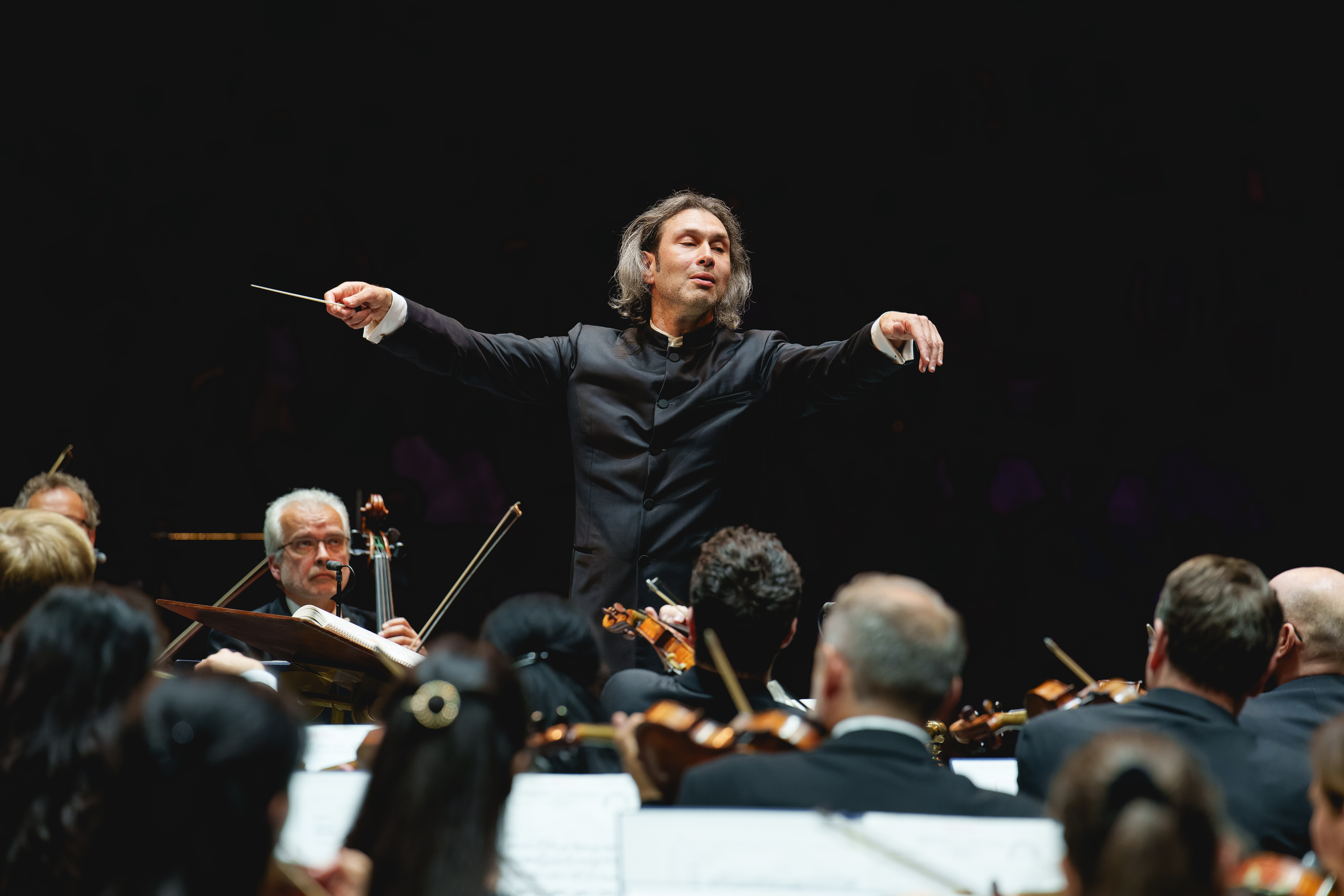
Prom 60 – Kirill Gerstein (piano), Berlin Radio Symphony Orchestra / Vladimir Jurowski
Weill Kleine Dreigroschenmusik (1928, arr. 1929)
Adès Piano Concerto (2018) [Proms premiere]
Rachmaninoff Symphony no.3 in A minor Op.44 (1935-6, rev. 1938)
Royal Albert Hall, London
Thursday 31 August 2023
by Richard Whitehouse photos by Andy Paradise / BBC
Marking its centenary this October, the Berlin Radio Symphony Orchestra may be less known abroad than other Berlin orchestras but this Proms debut under chief conductor Vladimir Jurowski confirmed an ensemble at home across the broad range of modern and contemporary music.
Not least in Little Threepenny Music, a ‘selection’ Kurt Weill arranged from his and Bertold Brecht’s reworking of The Beggar’s Opera which takes in several of that show’s best-known numbers while also affording a demonstrable overview of its satirical concerns. The BRSO responded with vigour and not a little pathos – above all, in the Threepenny Finale and its juxtaposing pensive ambivalence with a glowering decisiveness: that final chorale making plain its damning inditement of German cultural failings in the era of the Weimar Republic.
A spirited participant, Kirill Gerstein took centre-stage for the first hearing at these concerts of the Piano Concerto written for him by Thomas Adès. Now as before, Gerstein’s dexterity in negotiating this score’s pert amalgam of intricacy and bravura warranted respect: whether in what might be called the ‘Self-Portrait with Gershwin and Ligeti (though Prokofiev is also there)’ of the first movement, Stravinskian cortège of the central Andante, or the interplay of vivacity and uncertainty in the final Allegro. An attentive accompanist, Jurowski summoned playing as tensile and supple as the orchestral writing demands – though abetting the overall impression (his recent works in particular) that even as consummate a conceptualist as Adès needs to instil those ideas, often arresting in themselves, with comparable musical substance.
Gerstein’s transcription of Rachmaninoff’s In the Silence of the Secret Night (Op.4/3) duly prepared for the latter’s Third Symphony. First given at the Proms 85 years ago, it still attracts dislike from those who find it a self-conscious update of the composer’s inherently Romantic idiom as well as those who dislike such an idiom in any case. Not that Jurowski’s account brooked any compromise in marrying consistent technical precision to a powerfully shaped conception of music often appealing, frequently intriguing and not a little unsettling.
The stark rendering of its introduction – spectral ‘motto’ then surging tutti – set the course for an initial movement where contrast between expectancy and eloquence came to a head in the development with its anguished fusion between heart and brain. The Adagio unfolded with an almost Sibelian inevitability, not least in the seamlessness by which its outer sections flowed into then out of a central scherzo abounding in that sardonic humour as became a mainstay of Rachmaninoff’s later years. Nor was there anything blandly predictable about a finale whose opening exuberance was ably maintained through a consoling but never wantonly languorous secondary theme, eventually resolving into a coda whose unfolding as a crescendo of activity brought the whole work – and the present reading – animatedly and satisfyingly full circle.
Impressive music-making on all levels and Jurowski further cemented the Proms connection, specifically that between Rachmaninoff and Henry Wood, with the latter’s transcription of the former’s Prelude in C sharp minor Op.3/2) – as tempestuous as it proved exhilarating.
For more on the 2023 BBC Proms, visit the festival’s website at the BBC. Meanwhile click on the names for more information on artists Kirill Gerstein, the Berlin Radio SO and conductor Vladimir Jurowski – and finally composer Thomas Adès

 Arcana.fm