In concert – Members of Birmingham Contemporary Music Group: Soliloquies & Dialogues – Music made in Lockdown

bcmg-soliloquies

Members of Birmingham Contemporary Music Group [Oliver Janes (clarinet), Ryan Linham (trumpet), Colette Overdijk (violin), Julian Warburton (percussion), Amelie Thomas (trumpet)]

Oram Counting Steps – first version (2020)*
Murail Les Ruines circulaires (2006)
Ma Xiao-Qing Back to the Beginning (2020)*
del Avellanal Carreño speak, sing… (2020)*
Donghoon Shin Couplet (2020)*
Howard R (2021)*
Reich New York Counterpoint (1985)
Birtwistle The Message (2008)
Oram Counting Steps – second version (2020)*

[Works indicated * received their live premieres]

CBSO Centre, Birmingham
Tuesday 15 June 2021

Written by Richard Whitehouse

It may have been unable to present live events during the past 15 months, but Birmingham Contemporary Music Group has not been inactive – commissioning a series of pieces from composers around the world for performance online as part of its Soliloquies & Dialogues project. Having been performed at Bristol’s Arnolfini Gallery last Friday, a representative selection of these was this evening presented at CBSO Centre – in the process, confirming that ‘‘while we were all unified by lockdown, our reactions were still highly individual’’.

Tristan Murail’s Les Ruines circulaires was written well before the pandemic, but it vividly encapsulates the ‘dialogues’ aspect – clarinet and violin in confrontation, before opening out into a melodic discourse in a two-way process that might always be the same, only different.

It was vividly realized tonight, violinist Colette Overdijk then having two solo pieces – the first a live hearing for Ma Xiao-Quing’s evocative Back to the Beginning which, while less demonstrative than the online premiere, integrated elements of music and speech with greater subtlety and finesse. Donghoon Shin’s Couplet placed its expressive contrasts in stark relief – thus, an ‘aria and toccata’ in which long-breathed lyricism was succeeded by music whose gestural force and its rapidly accumulating energy were rendered with no mean virtuosity.

Between these works, clarinettist Oliver Janes gave the premiere of speak, sing…, where José Del Avellanal Carreño took advantage of new developments in Machine Learning technology – recorded improvisations by the soloist forming a basis for the interaction between ‘human’ responses as written by the composer with ‘artificial’ responses as generated by the prism-samplernn programme. The outcome was an eventful and unpredictable dialogue, though the subfusc quality of the electronic element rather stood in the way of more engaging synthesis.

Steve Reich’s New York Counterpoint was no less radical in its interplay between clarinet and tape four decades ago, Janes (understandably) sounding more at ease in the dialogue with his pre-recorded self in this performance of appealing deftness and not a little quizzical humour. Beforehand, percussionist Julian Warburton took the stage for the live premiere of R, where Emily Howard explores geometrical concepts as well as the possibilities of sonic growth and decay in a piece whose variety is more immediate given its concision and sense of purpose. Afterwards, Harrison Birtwistle’s The Message provided a telling foil in its halting dialogue between clarinet and trumpet – tersely curtailed by the arrival of military drum; a piece that commemorates the fortieth anniversary of the London Sinfonietta in the pithiest of terms.

Framing the whole, two versions of Celeste Oram’s Counting Steps anticipated then reflected on what was heard. Taking its cue from Fux’s treatise Gradus ad Parnassum, specifically two aphorisms with their expressing strength through courage in the face of weakness and decay, its methodically elaborating trumpet part against a graphic video projection was confidently rendered by Ryan Linham – with, in the second version, Amelie Thomas hardly less assured in support. An arresting framework in which to present this always enterprising programme.

You can find information on the next BCMG live performance here, while Colette Overdijk gives the online premiere of Back to the Beginning here
In concert – Members of Birmingham Contemporary Music Group: Huang Ruo: A Dust in Time

dust-in-time

Members of Birmingham Contemporary Music Group [Kate Suthers (violin), Colette Overdijk (violin), Adam Römer (viola), Ulrich Heinen (cello)]

Huang Ruo A Dust In Time (2020)

St Paul’s Church, Hockley, Birmingham
Tuesday 18 May

Written by Richard Whitehouse

The coronavirus pandemic and its attendant lockdowns has put paid to many events, not least a performance of A Dust in Time by Huang Ruo planned by Birmingham Contemporary Music Group for December, after a memorable online account three months earlier. Fortunately, it was possible to reschedule this to coincide with the further lifting of restrictions – enabling a socially distanced audience to hear what, when that created as the consequence of these past   18 months can be assessed more objectively, will come to be regarded as a defining artwork.

Born in southern China and now resident in the United States, Huang has emerged among the more striking composers of his generation (recordings of four Chamber Concertos and three of his ‘Drama Theatre’ pieces are well worth investigating on Naxos). Stylistically his music ranges across Eastern and Western, traditional and original sources – the resulting synthesis notable for its keen integration. An approach evident in this work, contrast between whose underlying concept and formal procedures are outweighed by its overall expressive impact.

Drawing inspiration from the circular concept of the mandala central to Hindu and Buddhist cultures (not least that of Tibet), while unfolding along the lines of a passacaglia which has long been a favoured formal model in European music, A Dust in Time patently evokes issues of transience and becoming over the course of an inevitable yet inexorable progress. Starting and ending on unaccompanied cello, it draws in viola, second then first violins as harmonic and rhythmic movement increase towards the sustained convergence of sound and emotion.

In its shortest incarnation (as previously performed by groups such as the ASKO-Schönberg Quartet) the piece ends here, but this evening it gradually effected a falling-off of tension on the way back to its beginning – deft usage of the Golden Section bringing it full circle at just under an hour’s length. In the earlier stages, listeners may have been reminded of the opening ‘Elegy’ from Shostakovich’s 15th Quartet with its oblique allusion to Russian Orthodox chant and comparable ‘otherness’, but the continuation and outcome could hardly be more different.

The performance, by a quartet from BCMG, was no less impressive than that given online by these same musicians – not least in its immaculate tonal blending and sense of venturing forth on a shared trajectory toward a common goal. Ensemble faltered passingly in the later stages, but never enough to undermine the intense focus and concentration which was brought to the music-making. Certainly, those present were held in thrall through to the transfigured closing bars – heard to advantage in the resonant while never cloying ambience of St Paul’s Church.

Huang has spoken of an extended version in which the piece can be looped round to twice its current length and played by a larger body of strings as an installation, though it is debatable whether music of this intensity would translate into a relatively passive listening experience. Hopefully, tonight’s account will be made available commercially – making possible a larger audience for a work which, together with the Donmar Warehouse’s production Blindness last year, is the surest statement of defiance and transcendence in the face of unforeseen tragedy.

Last year’s BCMG online performance of A Dust in Time can be seen here:

For further information about Huang Ruo you can visit his website here, while more information on the activities of the Birmingham Contemporary Music Group can be found at their website

City of Birmingham Symphony Orchestra – Debussy Festival: Second Weekend

Symphony Hall, Birmingham; Saturday 24 & Sunday 25 March 2018

Written by Richard Whitehouse

This second weekend of the Debussy Festival featured a similar mix of orchestral, song and instrumental events, held at various venues in Birmingham in addition to Symphony Hall and extending over the broad spectrum of Debussy’s music to include several less familiar items.

Saturday evening focussed on ‘Sacred Debussy’, and opened with his prelude La Cathédrale engloutie (1910) in an orchestration by Colin Matthews faithful to its spirit. The CBSO then vacated the platform for Messiaen’s motet O sacrum convivium (1937), fervently sung by the CBSO Chorus under Simon Halsey and preceded by Bach’s Dorian Toccata and Fugue. Its methodical progress was ideally complemented by Dieu parmi nous, concluding Messiaen’s large-scale cycle La Nativité du Seigneur (1935) with a panache to which Thomas Trotter was no less responsive. Debussy’s Danse sacrée et danse profane (1904) ended the first half with an allure and poise that Suzy Wilkinson-Kawalec conveyed in full measure; CBSO assistant conductor Jonathan Bloxham securing an elegant and fastidious response from the strings.

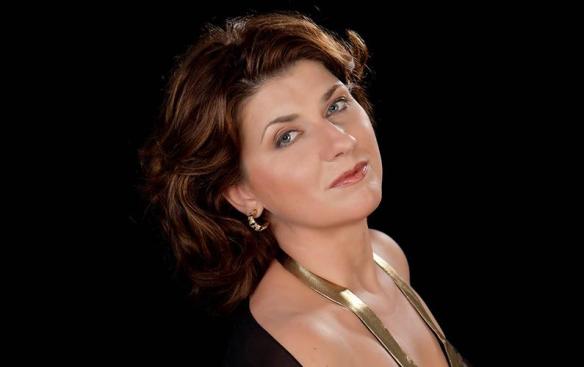
After the interval, a rare chance to hear virtually the whole of Debussy’s incidental music for Gabriele D’Annunzio’s play La Martyre de Saint Sébastien (1911). Not, then, the 20-minute ‘symphonic fragments’ arranged by André Caplet (who also undertook much of the original orchestration) or the hour-long complete score with narration, but a 35-minute hybrid where the music for the five acts was amalgamated into a four-movement ‘choral symphony’. With its hieratic modality and austere if never merely archaic polyphony, this is arguably the most emotionally affecting of Debussy’s later works and was superbly sung by the CBSO Chorus. Sopranos Ilse Eerens and Katja Stuber were effortless in their solo parts and Mirga Graźinytė-Tyla (below) drawing an eloquent response from the CBSO. Undoubtedly a highlight of this festival.

On to Sunday and an early afternoon concert of ‘Exotic Debussy’, opening with another three Preludes (1913) – the ironic wit of Minstrels, Mussorgskian heft of La puerta del vino and the bracing humour of General Lavine – Eccentric – once again heard in orchestrations by Colin Matthews responsive more to the images being evoked than the music as conceived for piano. Bloxham led the CBSO in a spirited account of the ‘Pas de six’ from Britten’s The Prince of the Pagodas (1956), then Graźinytė-Tyla presided over two sections from Ravel’s Ma Mère l’Oye (1910) – the piquant Orientalism of Laideronette and the encroaching rapture of Le jardin féerique, both enticingly rendered yet an unsatisfying close to a rather piecemeal first half. A shame the Ravel ballet was not heard in full, as this has long been a CBSO speciality.

There was nothing piecemeal about the second half, with Graźinytė-Tyla taking charge of the CBSO Youth Orchestra for a complete rendering of Debussy’s Images. His largest orchestral work when heard complete, this is difficult to bring off as a totality though this account came close. The ominous understatement of Gigues was well conveyed despite an occasional lack of subtlety, then the central triptych that is Ibéria gave this capable and enthusiastic outfit its head in the traversal from sultry street-life, through nocturnal rumination, to festal celebration – the overall sequence being projected with verve and immediacy. Yet the closing Rondes de printemps was even more successful, its oblique evocation of rural revelry given cumulative impetus such as made for a more than usually conclusive end to this wide-ranging sequence.

The mid-afternoon ‘Tombeau de Debussy’ juxtaposed pieces from the supplement published by La Revue musicale in 1920 with commissions under BCMG’s Sound Investment Scheme. Jungeun Park’s Tombeau de Claude Debussy found violinist Alexandra Wood, cellist Ulrich Heinen and pianist Richard Uttley (above) evoking the composer’s death in darkly ironic terms, then the oblique tonality of Dukas’s La plainte, au loin, du faune … seemed as much a memorial to the creative impasse as to its passing. Highly sensitive here, Uttley was no less probing in the moody ‘Sostenuto rubato’ that Bartók incorporated into his Eight Improvisations; soprano Ruby Hughes joining him for the whimsical profundity of Satie’s setting of Lamartine in En souvenir. Sinta Wallur’s Tagore Fireflies sets three brief verses by the Indian poet in music whose ornamented vocal was complemented by the piano’s gamelan-like patterning. Wood and Heinen found requisite plangency in the first movement of Ravel’s Duo; then cellist and soprano took on engaging theatricality for Frédéric Pattar’s setting of Maeterlinck in (… de qui parlez-vous?). Uttley captured the bluesy elegance of Goossens’s Pièce, before Julian Anderson’s Tombeau united the musicians in a setting of Mallarmé’s tribute to Edgar Allen Poe whose chiselled vocal writing and guitar-like sonorities made for a provocative ending.
The early-evening programme of ‘Natural Debussy’ commenced with the arresting cameo of flautist Marie-Christine Zupancic playing Debussy’s plaintive Syrinx (1913) at the rear of the auditorium; overhead lights gradually raised on the platform from where Bloxham directed the CBSO in an engaging account of Printemps (1887). Whatever its formal inelegance and stylistic derivativeness, this two-movement piece has an insouciance and extroversion which Debussy only occasionally re-captured – enhanced by the knowing sophistication of Caplet’s orchestration a quarter-century later. Graźinytė-Tyla returned for George Benjamin’s Ringed by the Flat Horizon (1980), its evocation of desert storms rendered with a graphic immediacy and sure sense of purpose to make one regret that an unfortunate accident onstage meant the performance had to be curtailed before the close. The orchestra reassembled after a break for La Mer (1905) – emotional contrasts stressed a little too readily in ‘Jeux de vagues’, but with the outer movements bracingly projected to round off this final concert in impressive fashion.

Even on the basis of these Symphony Hall concerts, this Debussy Festival did its composer proud by conveying the sheer variety of his output and also its relevance to Western music during the century since his death. Omissions were few – of which the most significant, his full-length opera Pelléas et Mélisande, will be redressed with a concert performance on the 23rd June. For now, Graźinytė-Tyla deserves full credit for having initiated this ambitious festival: its orchestral events leaving no doubt as to the rapport between her and the CBSO.

For more information on the CBSO Debussy Festival, you can visit the event’s website

City of Birmingham Symphony Orchestra – Debussy Festival: First Weekend

Symphony Hall, Birmingham; Saturday 17 & Sunday 18 March 2018

Written by Richard Whitehouse

There are numerous commemorations this month of the centenary of Debussy’s death, but the Debussy Festival taking place in Birmingham over the weekends of 17/18 and 24/25 March is likely the most extensive mounted in the UK.

Together with chamber and song recitals, films and talks, there is a series of concerts by the City of Birmingham Symphony Orchestra, as well as its related orchestras and ensembles, which between them offer an overview not only of Debussy’s major works but also those who influenced him and those who have been influenced by him in their turn.

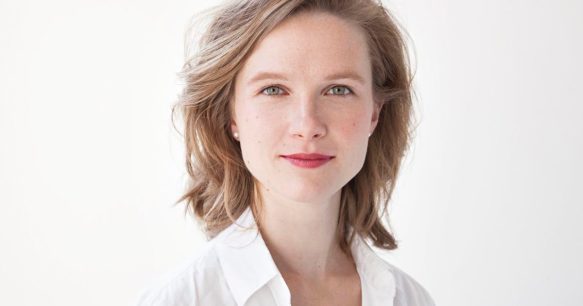
Saturday evening focussed on Sensual Debussy, opening with the piece in which the composer effectively became himself. Prélude à L’après-midi d’un faune (1894) began proceedings, its pervasive sensation of lazy eroticism palpably conveyed. This segued into Trois Chansons de Charles d’Orléans (1898/1908) – a rare instance of Debussy’s acappella writing, its lithe alternation of solo and ensemble voices enticingly conveyed by the Birmingham University Singers. Mirga Graźinytė-Tyla (above) then directed a perceptive account of La Damoiselle élue (1888), its Rossetti text inspiring a cantata whose luminous modality and ecstatic lyricism fairly define musical pre-Raphaelitism. Soprano Ilse Eerens was eloquent in the ‘title-role’ and mezzo Aga Mikolaj (below) searching in her narrative, with the CBSO Youth Chorus’s singing ethereal but never cloying.

Mikolaj returned for three of Szymanowski’s Love Songs of Hafiz (1914) and captured their capricious flights of fancy as made one wish the whole cycle of eight could have been given. This might have been preferable to the Prelude and Liebestod from Wagner’s Tristan und Isolde (1859) that rounded-off the concert – finely played and convincingly directed, save for a rather jarring accelerando toward the climax of the Prelude, but whose emotional intensity was rationalized by Debussy into something more oblique and understated. As had just been heard in the latter’s Nocturnes (1899), first of his orchestral triptychs and a marvel of shifting textures in Nuages, then ominous evocation in Fêtes. The diaphanous yearning of Sirènes was hardly less evident; less than perfect integration with its female voices the only real flaw.

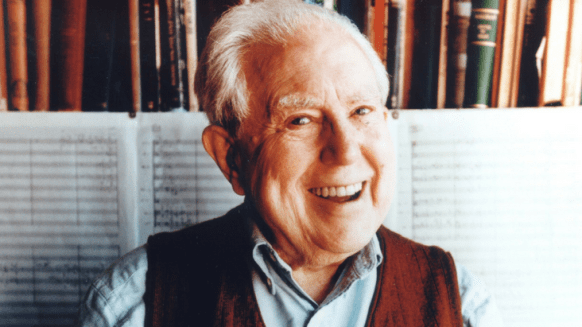
Sunday afternoon brought Birmingham Contemporary Music Group in a programme devoted to Debussy’s Legacy. Boulez’s Dérive 1 (1984) set the scene with its wave-like eddying of pithy motifs, then the music of Tristan Murail (above) took centre-stage with pieces from across three decades of his career. Treize Couleurs du soleil couchant (1978) is a reminder of how radical yet understated (à la Debussy) his music must have sounded in a French scene dominated by Boulezian serialism, harmonic overtones a constant around which the ensemble inhales then exhales its glistening timbres. How Murail got there was duly underlined by Couleur de mer (1969): almost his first acknowledged work, its five sections pit serial constructions against a more intuitive take on harmony and texture in music whose eruptive central span is almost as startling as its cadential sense of closure. Between these, Feuilles à travers les cloches (1998) is an evocative and eventful miniature anticipating the stark post-impressionism of Murail’s more recent music. Fastidious playing from BCMG, and perceptive direction by Julien Leroy.
The CBSO returned that Sunday evening for Modern Debussy, another hour-long sequence opening with a further account of Prélude à L’après-midi d’un faune in the arrangement that Schoenberg’s pupil Benno Sachs made in 1921. With flute, oboe and antique cymbals left in place, and harmonium ingeniously filling-out the ensemble, this proved an appealing novelty and ideal complement to the Première Rapsodie (1910) in which Debussy transformed a test-piece into a minor masterpiece – CBSO principal clarinettist Oliver Janes as responsive to its melodic elegance as to its deft virtuosity.

Responsive in support, Graźinytė-Tyla then directed a bracing account of Stravinsky’s Symphonies of Wind Instruments (1921) where some refined playing toned down the 1947 revision’s asperities. A pity Takemitsu’s exquisite Green had to be dropped (were the parts not received in time?), but Michael Seal presently took charge for a characterful reading of Jeux (1913) – confirming Debussy’s developing variation as no less crucial than Stravinsky’s mosaic-like construction to the evolution of music this past century.

Food for thought, indeed, over the course of this first weekend – not least for reminding one of just how central to modern Western music Debussy’s presence has been. Hopefully, too, the overall quality of interpretation will be maintained throughout next weekend’s concerts.

For more information on the CBSO Debussy Festival, you can visit the event’s website


BCMG – Celebrating Carter

Pierre-Laurent Aimard (piano), Birmingham Contemporary Music Group / Mirga Gražinytė-Tyla

Elliott Carter (above)
Mosaic (2004)
Bariolage (1992)
Two Controversies and a Conversation (2010/11)
Two Thoughts about the Piano (2007)
Double Trio (2011)
Epigrams (2012)

Town Hall, Birmingham; Sunday 28 January 2018

Written by Richard Whitehouse

Little of Elliott Carter’s music was heard in Birmingham during his lifetime, but an account of the then recent song-cycle In Sleep, In Thunder remains vivid in the memory 35 years on. That was directed by Oliver Knussen, who was latterly assiduous in the scheduling and even commissioning of the composer with Birmingham Contemporary Music Group, which this afternoon devoted a whole programme to Carter and was conducted for the first time by the City of Birmingham Symphony Orchestra’s current music director Mirga Gražinytė-Tyla.

A composer who not only lived to a great age but continued writing up until his death meant that BCMG had a sizable number of pieces from which to choose. It was an astute move to open with Mosaic, as this eventful piece is a paradigm for that ‘late late style’ Carter evolved in his 90s. Harp is the first among equals here, Carter having spoken of his desire to explore techniques developed by inter-war virtuoso Carlos Salzedo. Not that these are deployed for effect; indeed, this piece evinces an almost continuous ‘through line’ from which emerges a discourse as inventive as it is diverting – with an incitement to disciplined virtuosity that the musicians, not least Céline Saout, seized on with assurance. The harpist took centre stage for Bariolage, taking its cue from Rilke in what is a scintillating exploration of those techniques.

Nor is humour at a premium in this music. Two Controversies and a Conversation finds the piano at first mediating precariously between ensemble and percussion (first marimba, then woodblocks), before more balanced and equable discourse is made possible.

Carter’s earliest musical mentor, Charles Ives, would have been impressed by this refracted recollection of a concept he himself pursued in his Second String Quartet and while he might have been less convinced by the abstraction of Carter’s writing for piano, there can be little doubting the effectiveness of the latter’s Two Thoughts about the Piano. Complementary pieces too – the preoccupied and silence-riven progress of Intermittences countered by the linear velocity of Caténaires; Pierre-Laurent Aimard tackling both these pieces with his customary poise and precision.

Back in the early 1980s, Triple Duo was one of Carter’s most effervescent and entertaining works – its stealthy ingenuity posited in far more gnomic ways by Double Trio with its often impulsive if ultimately resigned interplay between violin, trombone and percussion as heard against trumpet, cello and piano.

Gražinytė-Tyla’s direction was at its most perceptive here, though it was left for Aimard, Alexandra Wood and Ulrich Heinen to take the platform for what was Carter’s final work. Epigrams consists of 12 refractory miniatures for piano trio (designed by the composer so that their cohesion would be assured however many were completed) – their salient gestures constantly though unpredictably recurring such that their diversity is never achieved at the expense of their unity, however hard-won this may seem.

If there was anything predictable here, it was the conviction and technical finesse of tonight’s performance, rounding off a programme as compact and absorbing as the music itself. Those yet to do so should investigate BCMG’s disc of Carter’s ‘late music’ as a matter of urgency.

For more information about Birmingham Contemporary Music Group, visit the ensemble’s website

Further listening

You can listen to the BCMG’s disc of Carter that Richard refers to on Spotify below: