
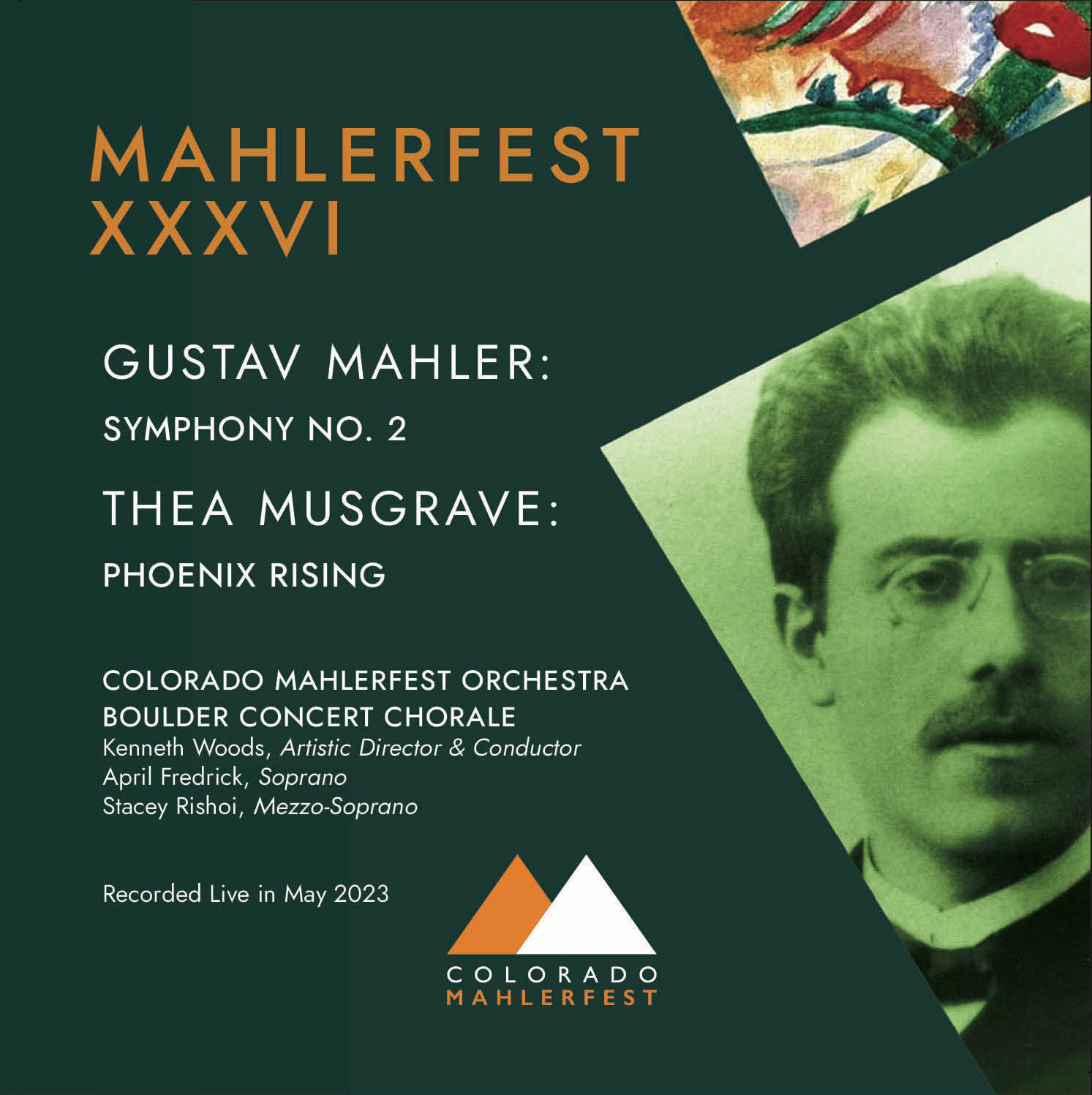
On Record – MahlerFest XXXVI: Kenneth Woods conducts ‘Resurrection’ Symphony & Musgrave’s Phoenix Rising

April Fredrick (soprano), Stacey Rishoi (mezzo-soprano), Boulder Concert Chorale, Colorado MahlerFest Orchestra / Kenneth Woods

Musgrave Phoenix Rising (1997)
Mahler Symphony no.2 in C minor ‘Resurrection’ (1888-94)

Colorado MahlerFest 195269301194 [two discs, 104’02”]
Live performances on 21 May 2023, Macky Auditorium, Boulder, Colorado

Reviewed by Richard Whitehouse

What’s the story?

Last year’s edition of MahlerFest continued its latest, not-quite-chronological traversal of the symphonies with the Second – appropriately coupled on this release (as in the concert) with a work such as considers ‘resurrection’ from a very different while no less relevant perspective.

What’s the music like?

Six years in the writing, Mahler’s Second Symphony fairly laid the basis for his reputation as a composer at its Berlin premiere in 1895. It is a measure of this performance that it captures something of the shock or excitement no doubt in evidence back then, not least in an opening movement with Kenneth Woods notably more interventionist tempo-wise as compared to that of the Third Symphony a year before. What emerges is imposing but never diffuse, at its most gripping in that baleful lead-in to a development whose terseness duly accentuates its impact, with the pathos of the second subject on its reprise making the coda’s sardonic recessional the more acute. After which, the second movement feels the more enticing through its alternation of warm sentiment with capering animation while heading to a conclusion of beatific repose.

There is no lack of incident in a scherzo whose glancing irony is leavened yet not lessened by its trios, the first as soulful with its lilting trumpets as the second is ominous in its import; but not before Stacey Rishoi has characterized the Urlicht setting with rapt inwardness. What to say about the finale other than, while this may not be the most overwhelming take on its vast fresco, it is matched by relatively few as regards an organic unfolding that sees the movement whole. Its contrasting elements here fuse with unforced cohesion to a fervent rendering of the chorale episode then on to a surging Toten-marsch – the kinetic momentum carried through to a methodical reprise of earlier ideas, then a rendering of Klopstock’s text (much altered by the composer) as only grows in intensity before the majestic affirmation of its closing pages.

As the ‘first half’, Thea Musgrave’s Phoenix Rising provides an ideal complement. The much esteemed (latterly more in the US than the UK) nonagenarian has written often for orchestra, but seldom with such immediacy than in a piece whose formal and expressive trajectory feels nothing if not symphonic in its progress. Comparison with the 2016 studio recording by BBC National Orchestra of Wales and William Boughton (Lyrita SRCD372) confirms that, passing tentativeness in ensemble excepted, Woods’s reading demonstrably makes more of this aspect.

Does it all work?

Yes, pretty much always. As on previous releases in this ongoing Mahler cycle, the Colorado MahlerFest Orchestra punches appreciably above its weight in music which should never fall prey to wanton virtuosity. The unyielding acoustic of Macky Auditorium is less an issue than before, with the finale’s offstage brass adeptly managed. April Fredrick brings her customary eloquence to bear on this movement, and the Boulder Concert Chorale – as prepared by Vicki Burrichter – rises to the occasion with notable fervency as this work reaches an ecstatic close.

Is it recommended?

It is. There have been too many superfluous Mahler cycles, but this traversal is shaping up as one of the most worthwhile and more than the memento of a memorable occasion. Hopefully such standards will be maintained by the Sixth Symphony as part of next year’s 37th edition.

Buy

For further purchase options, visit the MahlerFest website – and for more information on the festival itself, click here. Click on the names for further information on conductor Kenneth Woods, soloists April Fredrick, Stacey Rishoi and composer Thea Musgrave

Published post no.2,244 – Friday 19 July 2024

On Record – MahlerFest XXXV: Kenneth Woods conducts Symphony no.3 & Gunning Symphony no.10

Stacey Rishoi (mezzo-soprano), Boulder Children’s Chorale, Women of Boulder Concert Chorale, Colorado MahlerFest Orchestra / Kenneth Woods

Gunning Symphony no.10 (2016-17) [First public performance]
Mahler Symphony no.3 in D minor (1893-6)

Colorado MahlerFest 195269164287 [two discs, 114’21”]
Live performances on 22 May 2022, Macky Auditorium, Boulder, Colorado

Reviewed by Richard Whitehouse

What’s the story?

The 35th Colorado MahlerFest, the eighth under the direction of Kenneth Woods, reached its culmination with the performance of Mahler’s Third Symphony and preceded in this concert with a first public hearing for the 10th Symphony by the late-lamented Christopher Gunning.

What’s the music like?

In its setting out the creation of the world, from an inanimate state to the dawn of humanity, Mahler’s Third Symphony is his most ambitious conceptually and certainly his lengthiest. It is to Woods’s credit that, though his account at 92 minutes is among the swiftest, there is no sense of haste – not least his handling of the first movement’s vastly extended sonata design, which amply conveys the burgeoning of natural forces with unbridled impetus but equally a fantasy or even playfulness manifest through the irresistible abandon of those closing pages.

Those having watched the online broadcast will recall Woods observing the customary break before the remaining five movements which constitute the second part. Here, though, there is barely a pause going into the second movement, its minuet-like lilt and evocation of all things vernal rarely having sounded so delicate or ingratiating. The ensuing scherzo is almost as fine, the often boisterous irony of its outer sections finding contrast in trios whose post-horn solos are ethereally rendered by Richard Adams, with a frisson of danger emerging in the final bars.

Nor is Stacey Rishoi found wanting in a Nietzsche setting that alternates earnest speculation with heartfelt yearning. She is no less inside its successor’s setting of a Knaben Wunderhorn text, its ambivalence offset by a whimsical response from the women’s and children’s choirs. Others may have found even more profundity from the finale, but Woods ensures it emerges as a seamless totality – the anguish at its centre drawn into a rapt eloquence which is carried through to a coda bringing this disciplined and persuasive performance to its ecstatic close.

Unlike other of his peers, their concert output little more than a rehash of their work for film and television, Christopher Gunning’s symphonies and concertos seem abstract music with a vengeance. The single-movement 10th Symphony is both cohesive in its structure and methodical in its evolution. Woods has recorded it with BBC National Orchestral of Wales (Signum Classics), and while that studio recording has greater formal focus, the Colorado musicians unfold this quixotic score to its serene ending with demonstrably greater spontaneity and impulsiveness.

Does it all work?

Almost always. Those who prefer a more expansive or interventionist approach in the Mahler may be disappointed, but the no-nonsense nature of Woods’s traversal conveys any amount of insight or expressive nuance. Presentation is equally straightforward, but Mahler’s expression markings for each movement should have been included alongside those descriptive headings he later deleted, while the Gunning might have been best placed at the start (as in the concert) with the first part of the Mahler – allowing its second part to unfold as an unbroken continuity.

Is it recommended?

Very much. Boulder’s Macky Auditorium might not have the most spacious perspective, but its clarity and definition audibly benefit a performance that is much more than the memento of an occasion. Indeed, this MahlerFest series is shaping up to be a memorable Mahler cycle.

Buy

For further purchase options, visit the MahlerFest website – and for more information on the festival itself, click here. Click on the names for further information on conductor Kenneth Woods and composer Christopher Gunning