Listening to Beethoven #62 – Adelaide Op.46


Friedrich von Matthisson (1794) Portrait by Ferdinand Hartmann

Adelaide Op.46 for voice and piano (1794-5, Beethoven aged 24)

Dedication Friedrich von Matthisson
Text Friedrich von Matthisson
Duration 5’30”

Listen

Background and Critical Reception

This substantial setting of a text by Friedrich von Matthisson proved Beethoven’s most adventurous song to date. Commentators see Adelaide (pronounced A-del-eeder) as something of a watershed in his output, both in the prominence of the piano and its unusual, ‘through-composed’ structure.

By ‘through composed’ we mean a song that does not repeat itself in a recognisable way, though the four verses do each end with the beloved’s name. In this way the structure operates in the way a Baroque cantata might. Perhaps Beethoven was mindful of Handel’s vocal works when using this form.

Jan Swafford writes, ‘Beethoven obviously loved the sentimental verses of poet Friedrich von Matthisson. He labored on the setting of Adelaide for more than two years. Matthisson received the dedication and, in 1800, a copy of the song with an admiring and pleading letter from Beethoven: My most ardent wish will be fulfilled if my musical setting of your heavenly Adelaide does not altogether displease you and if, as a result, you should be prompted to write another similar poem…I will then strive to compose a setting of your beautiful poetry’.

Unfortunately the song confused some of his audience, including the poet himself, who found the song insensitive. Julian Haylock, writing in the Hyperion booklet for Stephan Ganz and Roger Vignoles’ recording, says ‘the solo-sonata style Beethoven adopts for the third verse in particular was perceived as overbalancing the text’, and that ‘the dramatic outpourings of the same verse, with its sudden changes of dynamic…were considered more suited to the opera house than the drawing room.’

Swafford speculates that ‘Adelaide might, in fact, have been written as part of Beethoven’s courting of Magdalena Willmann, a beautiful and talented contralto whom he had known in the Bonn Kapelle and who had come to Vienna to sing.’

The exact dates for the completion of the song are unknown, but it was published in 1797.

Thoughts

Something feels different and new about this song, right from the expansive piano introduction, which gives notice of a much bigger structure.

The song itself is a beauty, the most immediate we have yet heard from Beethoven as a songwriter. The dappled piano part flows in thrall to the vocal line, which is by turns lovelorn and optimistic.

For the third verse Beethoven shifts to a new key and outlook, reflecting the evening breezes through the piano and a slight shiver to the vocal line, which takes on a yearning quality as Adelaide’s name reappears.

The last of the four verses makes a decisive shift to the major key, a positive future on the cards as the singer declares Einst, o Wunder! entblüht auf meinem Grabe Eine Blume der Asche meines Herzens (One day, O miracle! there shall bloom on my grave A flower from the ashes of my heart).

Recordings used

Christian Gerhaher (baritone), Gerold Huber (piano) (Sony Classical)
Dietrich Fischer-Dieskau (baritone), Jörg Demus (piano) (Deutsche Grammophon)
Stephan Ganz (baritone), Roger Vignoles (piano) (Hyperion)
Matthias Goerne (baritone), Jan Lisiecki (piano) (Deutsche Grammophon)
Fritz Wunderlich (tenor), Hubert Giesen (piano) (Deutsche Grammophon)
Anne Sofie von Otter (mezzo-soprano), Melvyn Tan (fortepiano) (Archiv)

Gerold Huber’s introduction for Christian Gerhaher is of the sort that makes the listener stop and pay attention; it sets the scene of the ‘magical sweet light that shimmers through the swaying boughs’ perfectly. Gerhaher himself is ideal. Similar praise can be directed to Stephan Ganz and Roger Vignoles, beautifully balanced and poised.

There is a recording from tenor Martyn Hill and Christopher Hogwood on the fortepiano that is unfortunately only available as part of a massive L’Oiseau-Lyre box set; happily the fortepiano of Melvyn Tan can be heard prompting Anne Sofie von Otter’s relatively urgent account.

Dietrich Fischer-Dieskau is an ardent singer of this particular song, as is Fritz Wunderlich, moving up a few tones to sing in the tenor range.

Spotify links

The following playlist brings together six different versions of Adelaide, from Fritz Wunderlich to Matthias Goerne:

Meanwhile you can listen to a clip from the Stephan Genz & Roger Vignoles version at the Hyperion website

You can chart the Arcana Beethoven playlist as it grows, with one recommended version of each piece we listen to. Catch up here!

Also written in 1795 Reicha –  Concerto Concertant Op.3

Next up O care selve (first version)

Listening to Beethoven #61 – Piano Sonata no.3 in C major Op.2/3


Landscape in the Riesengebirge by Caspar David Friedrich (1798)

Piano Sonata no.3 in C major Op.2/3 for piano (1793-95, Beethoven aged 24)

1 Allegro con brio
2 Adagio
3 Scherzo: Allegro
4 Allegro assai

Dedication Franz Joseph Haydn
Duration 23′

Listen

Background and Critical Reception

The third of Beethoven’s Op.2 sonatas is also the most ambitious. Thinking far beyond the recital room, he wrote what is effectively a concerto for solo piano, a vehicle to show off his prowess not just as a conductor but as a performer.

The scale of the piece is impressive, with four big-boned movements that take small melodic cells and amplify them to far greater designs. In this respect he was following Haydn’s talent for expanding on small musical nuggets, while writing clearly for the instrument at hand, a bigger piano with greater volume and depth.

Jan Swafford, in the Virtuoso chapter of his superb biography Beethoven: Anguish and Triumph, waxes lyrical on this sonata. ‘In this brilliant and thematically tight-knit piece’, he writes, ‘he alternates quiet, inward music with explosions of virtuosity, the whole seeming to be a two-handed version of a piano concerto, complete with cadenzas at the end of the first and last movements’.

András Schiff agrees. ‘I see it very much as a performance piece, aimed at an audience. You could call it a ‘sonata-concertante’. The E major slow movement is also very wide-ranging’. He goes on to note anticipations of Brahms in the finale, where he describes how ‘the figures in thirds…display a new and extremely difficult kind of keyboard technique’.

For Angela Hewitt, the sonata is an early peak in the cycle of 32. She clearly loves the last movement, which is ‘not for the faint-hearted or weak-fingered’. Beethoven’s ‘perfect combination of heart, mind and humour makes this sonata, in my opinion, one of his most fulfilling pieces to perform’.

Thoughts

Beethoven’s music is definitely getting louder! This piece is one for the extravert, for a pianist capable of playing a flashy solo part – but then it is also for the introvert, capable of realising the poetic writing in the timeless writing in the slow movement.

The first movement, as András Schiff suggests, has two voices – an ‘orchestra’ (the opening theme) and the piano soloist. Soon the roles intertwine, and the pianist has a technical challenge on their hands! Some of the chords used in this movement have an awesome power we have not yet witnessed in Beethoven, packed out with notes that require the use of all ten fingers.

The slow movement, marked Adagio, is a notably early example of Beethoven’s ability to make time stand still in his slow music. That happens most noticeably when the main theme comes back, just over halfway through the movement, in a series of slow chords. It is followed by a suddenly loud statement, jerking the listener back into a harsh reality, the sudden mood change creating a strong dramatic impact.

The third movement scherzo is more, while the finale is an extension of a scherzo with its trotting theme. Gradually the music becomes more technically demanding and congested, the performer having to show athleticism and guile in equal measure. Then just before the end Beethoven suddenly disappears into a far-removed key and the music opens out into a mysterious question. The answer is emphatic – it was a false move, Beethoven toying with the performer (and listener) before bringing them ‘home’.

Recordings used and Spotify links

Emil Gilels (Deutsche Grammophon)
Alfred Brendel (Philips)
András Schiff (ECM)
Angela Hewitt (Hyperion)
Paul Badura-Skoda (Arcana)
Stephen Kovacevich (EMI)
Igor Levit (Sony Classical)

Schiff is terrific here, enjoying the contrasts of Beethoven’s writing. Some of the big fortissimo chords have alarming power, played in a way of which the composer would surely have approved! Gilels goes for power, too, in a magisterial but slightly overpowering first movement. Angela Hewitt finds a lovely balance between bravado and delicacy, as does Igor Levit.

The playlist below accommodates all the versions described above except that by Angela Hewitt:

You can hear clips of Hewitt’s recording at the Hyperion website

You can chart the Arcana Beethoven playlist as it grows, with one recommended version of each piece we listen to. Catch up here!

Also written in 1795 Haydn Piano Trio in E-flat minor Hob.XV:31 .

Next up Piano Sonata no.3 in C major Op.2/3

Listening to Beethoven #60 – Piano Sonata no.2 in A major Op.2/2


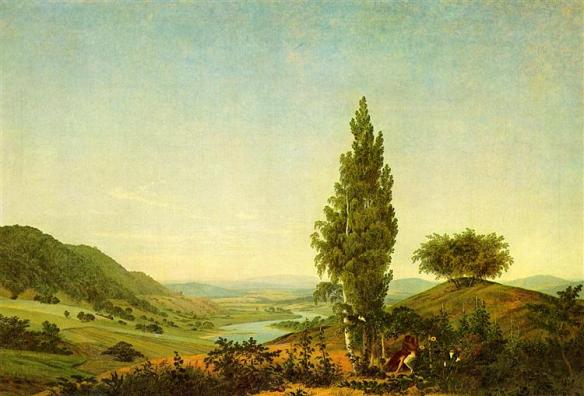
The Summer by Caspar David Friedrich (1807)

Piano Sonata no.2 in A major Op.2/2 for piano (1795, Beethoven aged 24)

Dedication Franz Joseph Haydn
Duration 23′

Listen

Background and Critical Reception

Beethoven wrote his second piano sonata in 1795, while he was studying counterpoint with Albrechtsberger, though like the other two pieces in the Op.2 set it is dedicated to another teacher, Haydn.

As with the three Op.1 piano trios, Beethoven’s three Op.2 piano sonatas inhabit very different personalities. The F minor piece described yesterday has plenty of brio, but this A major work is relatively light on its feet in comparison.

That does not make it insubstantial, however. Harry Halbreich, writing in his extensive booklet notes for Paul Badura-Skoda’s recording on Arcana, notes how Beethoven ‘seems to take possession of the piano, from which he draws entirely new contrasts of range, of dynamics and of rhythm.

Daniel Heartz writes of how the sonata ‘offers very different fare. It counters no.1’s somber mien with lighter textures overall and a sunnier disposition; it also makes more demands on the performer’. He enjoys the third movement scherzo, which ‘recaptures the bright, filigree character of the opening movement’, and the finale, an ‘easily flowing gavotte, with a captivating melody’.

Thoughts

The second instalment of Beethoven’s first group of piano sonatas is much less performed than the first. Angela Hewitt cites the quiet and gentle ending as one possible reason for this – but as she says, there is no reason to treat it as inferior to the first work in F minor.

If anything, the appeal of the second sonata is more immediate than the first. Beethoven’s mood is playful right from the start, with a glint in the eye as the clipped phrases of the first tune are announced. This is one of many instances where the silence around the tune is every bit as important as the notes themselves – and we are drawn into the charm and impish nature of the writing. Beethoven’s development of his ideas is bold, but the wit still shines through.

The second movement is a soft reverie, graceful and hymn like, but with a walking bass that could easily have come from a Haydn symphony, showing how Beethoven is now treating the piano like an orchestra. This lovely, calm water is interrupted briefly by a minor-key middle section, but becomes the prevailing mood by the end.

The third movement is classed as a Scherzo and exhibits the qualities you would expect with that label, returning to the playful mood of the first movement. For the trio section in the middle Beethoven moves from the key of A major to A minor and a more strident passage of music – but then switches on the charm again before the end.

As with Op.2/1 the last movement is substantial, bringing together the different moods of the previous three. It flows rather nicely, with a bright disposition but with the odd moment of shade. The calm finish is rather touching, as though Beethoven has said all he needs to say and is setting down his pen with a sigh of satisfaction.

Recordings used and Spotify links

Emil Gilels (Deutsche Grammophon)
Alfred Brendel (Philips)
András Schiff (ECM)
Angela Hewitt (Hyperion)
Paul Badura-Skoda (Arcana)
Stephen Kovacevich (EMI)
Igor Levit (Sony Classical)

There are some excellent recordings of this piece, which as Paul Badura-Skoda illustrates sounds really good on the fortepiano. Angela Hewitt is characteristically detailed, and almost a little shy in the first and third movements, which really suits Beethoven’s writing. András Schiff is very relaxed in his choice of tempi for the first and third movements especially, but justifies this with pure melodic phrasing.

Claudio Arrau gets the balance perfectly aligned. Emil Gilels spends almost as much time in the slow movement, where he gets lost (in a wholly good way) in the music until a stern middle section. Igor Levit, the most recently released version, throws off the third movement with some style, and signs off with a flowing finale.

The playlist below accommodates all the versions described above except that by Angela Hewitt:

You can hear clips of Hewitt’s recording at the Hyperion website

You can chart the Arcana Beethoven playlist as it grows, with one recommended version of each piece we listen to. Catch up here!

Also written in 1795 Haydn Piano Trio in E-flat minor Hob.XV:31 .

Next up Piano Sonata no.3 in C major Op.2/3

Listening to Beethoven #59 – Piano Sonata no.1 in F minor Op.2/1


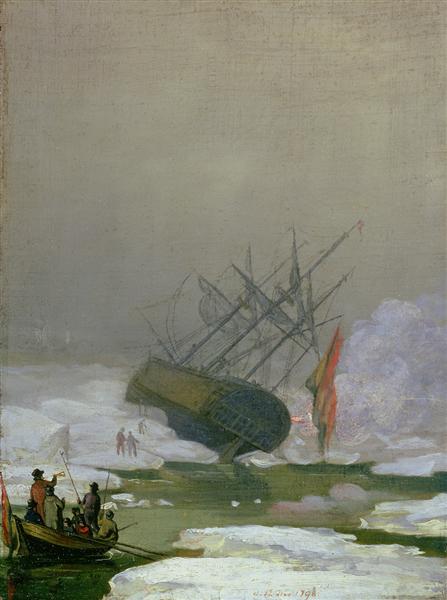
Ship in the Arctic Ocean by Caspar David Friedrich (1798)

Piano Sonata no.1 in F minor Op.2/1 for piano (1793-95, Beethoven aged 24)

Dedication Franz Joseph Haydn
Duration 21’00

Listen

Background and Critical Reception

Opus 1 for Beethoven was the piano trio; Opus 2 the piano sonata. Both publications contain three works, and both serve notice of a composer planning innovations in his chosen form. Compared to the piano trio the piano sonata was very well established, with Haydn and Mozart writing works in the form for many years previously. Signs of change were afoot however, the instruments themselves shifting away from the harpsichord to the fortepiano. Beethoven was also looking towards the symphony for inspiration, writing each of these sonatas in four movements (most had been in three) and within those movements constructing more expansive designs.

Opus 2 is dedicated to Haydn, Beethoven’s teacher at the time – around the time of his second trip to London. Commentators look to link the two composers musically, too, while acknowledging the influence of the Mannheim school in the main theme of the first movement, which is described as a ‘Mannheim rocket’ because of its quickly ascending melody. There are also parallels with C.P.E. Bach.

Pianist Angela Hewitt, in the booklet of her own recording on Hyperion, describes how Beethoven ‘is very precise with his markings for dynamics and articulation’. She makes the point that while this sonata was being written Haydn was just completing his last piano sonata. About Beethoven’s final movement, she says ‘the modern pianist would do well to try out this movement on a fortepiano to hear how terrifying it can sound’.

Thoughts

The first of Beethoven’s 32 published piano sonatas, the beginning of what Hans von Bülow called ‘The New Testament of Music’, makes a keen impression right from the off. The bold melody we hear in the right hand stays rooted in the mind, especially as Beethoven comes back to it time and again, putting a new spin on its profile. The links made to Haydn are understandable – there is a bit of the ‘Sturm und Drang’ about it (see the Mannheim link above), but already Beethoven has made it clear he is looking forward.

That much is clear in the slow movement, placed second. Here the music, while relaxed, often arrives at a suspended chord that Beethoven takes a while to resolve – and this creates a fair bit of tension, even within a passage of music that is softer on the ear than the first movement.

These tensions remain in the third movement, which is quite stern for a minuet – again in the vein of one of Haydn’s minor-key sonatas. The clouds part for the trio section, however, with some lovely bell-like figuration for the pianist’s right hand, until we turn inwards again when the minuet returns.

The last movement is stern, and fleet of foot, with more challenging writing for both hands as the music surges forward. The writing for octaves in the right hand shows how Beethoven is expanding the sound of the piano, and the music ends resolutely in the minor key – a technique of which Haydn would surely have approved.

Recordings used and Spotify links

Alfred Brendel (Philips)
András Schiff (ECM)
Angela Hewitt (Hyperion)
Paul Badura-Skoda (Arcana)
Stephen Kovacevich (EMI)
Igor Levit (Sony Classical)

András Schiff gives a very fine account of the piece that brings out its connections to Haydn, and especially the Symphony no.49 which is one of his only works in the same key. The slow movement is expertly judged, while the finale is even better, dramatic and never letting up, even as he slows to the finish. Claudio Arrau draws the listener in, especially in the slow movement. Paul Badura-Skoda, playing an instrument from Vienna in 1790, gives a crisp performance and the fortepiano has an appealing timbre.

Stephen Kovacevich is extremely brisk and does not use repeats – so his version is dispatched in a mere 15 minutes. Igor Levit, the most recent addition to this discography, also gives a quickfire performance and chooses not to use the repeat markings, but he still has time for the Minuet to dance gracefully and for the slow movement to have poetic pause for thought.

The playlist below accommodates all the versions described above except that by Angela Hewitt:

You can hear clips of Hewitt’s recording at the Hyperion website

You can chart the Arcana Beethoven playlist as it grows, with one recommended version of each piece we listen to. Catch up here!

Also written in 1795 Clementi 2 Piano Sonatas and 2 Capriccios Op.34 .

Next up Piano Sonata no.2 in A major Op.2/2

Listening to Beethoven #58 – Trio for 2 oboes and cor anglais Op.87

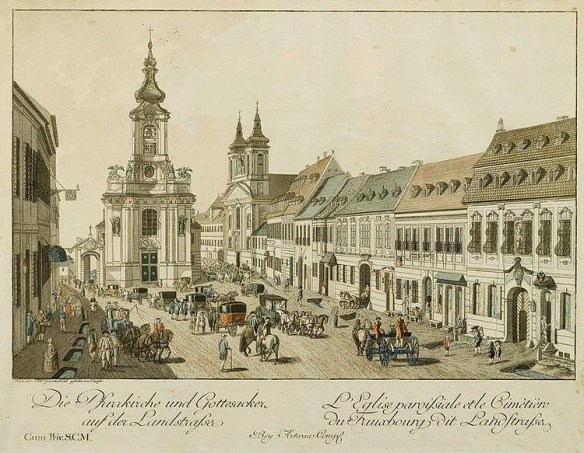
Vienna by Johann Ziegler (c1749-1812)

Trio for two oboes and cor anglais Op.87 (c1795, Beethoven aged 24)

Dedication Not known
Duration 22′

Listen

Background and Critical Reception

Beethoven’s decision to write for the unusual trio of two oboes and cor anglais appears to have been inspired by oboist and composer Johann Wenth. It is thought Beethoven attended a concert in December 1793 where Wenth’s oboe trio was performed. Given the oboists with which Beethoven was already in contact in Vienna at the time, he set about writing a piece for them.

The exact dates of composition for the trio are not known – which is the case with his other work for this instrumental combination, a set of variations on an aria from Mozart’s Don Giovanni. Indeed the variations may have been intended as a final movement for the Trio, being in the same key of C major.

The only clue for a year of composition lies in the manuscript the composer used, which going by the paper is thought to be 1795, with the trio itself published by Artaria 11 years later. There is also a version for strings, apparently sanctioned by Beethoven.

Thoughts

The combination of two oboes and cor anglais is rare in classical music nowadays, and as a result Beethoven’s trio is not often heard. This is a shame for it is an attractive and brightly coloured piece, tuneful and with appealing dialogue between the players. It may have been written for domestic music making, but to these string-playing ears it sounds like quite a taxing affair for wind players at 22 minutes.

It is as light on the ear as its instrumentation implies, and the easygoing nature of the first movement includes a fair bit of subtle wit. The 11-minute first movement does mean the piece is top heavy – effectively in two parts.

The second part has a nice, softly voiced slow movement in F major where the oboes’ lyrical qualities come through readily. This is complemented by a brisk minuet with its own lilting trio section, then a lively finale with a chattering tune.

The trio is an undemanding but thoroughly pleasant listen.

Recordings used and Spotify links

Heinz Holliger, Hans Elhorst (oboes), Maurice Bourgue (oboe) (Deutsche Grammophon)

Consortium Classicum (Christian Hartmann and Gernot Schmalfuß (oboes), Matthias Grünewald (cor anglais)

Les Vents FrançaisFrançois Leleux (oboe), Paul Meyer (clarinet), Gilbert Audin (bassoon) (Warner Classics) – tracks 1 to 4

Les Vents Français substitute the second oboe and cor anglais parts for a clarinet and bassoon, adding more depth to the sound. The Consortium Classicum version is very nicely played, as is the version from DG’s starry cast of Holliger, Elhorst and Bourgue . This one does however show its age, recorded in 1979.

You can chart the Arcana Beethoven playlist as it grows, with one recommended version of each piece we listen to. Catch up here!

Also written in 1795 Albrechtsberger 6 String Trios Op.9

Next up Piano Sonata no.1 in F minor Op.2/1