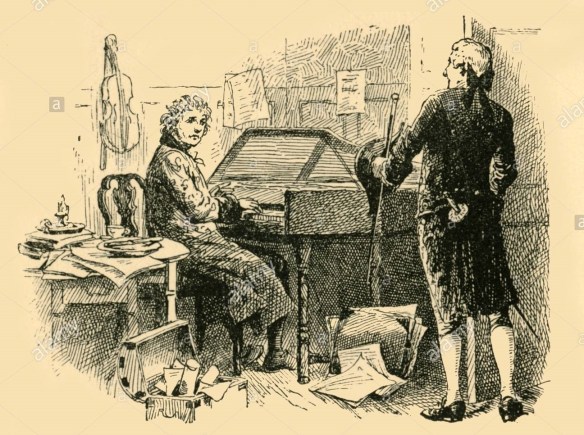
Beethoven and Count von Waldstein. Artist unknown, Alamy stock photo
Dedication Count Waldstein
Duration 13′
1. March
2. Deutscher Gedsang: Allegro moderato
3. Jagdlied: Allegretto
4. Romanze: Andantino
5. Kriegslied: Allegro assai con brio
6. Trinklied: Allegro con brio – Trio
7. Deutscher Tanz: Walzer
8. Coda: Allegro vivace
Listen
Background and Critical Reception
We have already examined (and enjoyed) Beethoven’s Ritterballet in its orchestral form. It is the piece he was prepared to ‘hand over’ to Count Waldstein… but it is clear that the composer thought highly enough of the piece to transcribe it himself for solo piano. Beethoven retains the same format and order as the orchestral version, and the arrangement appears to be a completely faithful one.
Thoughts
Perhaps inevitably the piano version of Ritterballet loses a little of its colour, though the March does benefit from firmer rhythmic impetus. The German Song retains its charm and memorability, but does lose a little of its dance-like poise when transferred to the keyboard.
Recordings used
Cyprien Katsaris (Piano 21)
Cyprien Katsaris clearly enjoys the Ritterballet, and its abundance of good tunes. He can’t resist the chance to make the opening March flourish, with a lively left hand part, and his ‘war’ scene is suitably dramatic too.
Vincenzo Righini (left) and the young Beethoven (unattributed picture) Dedication Countess of Hatzfeld Duration 23′
Listen
Background and Critical Reception
Beethoven’s second set of variations for the keyboard is very different from the first. The Dressler Variations, his first published work, were effectively testing the water to see what the young composer could come up with. This set of 24 variations is a different animal entirely. Alexander Thayer‘s biography of Beethoven tells the story of its genesis:
‘Kapellmeister Vincenzo Righini, a colleague of Sterkel in the service of the Elector of Mainz, had published Dodeci Ariette, one of which, Vieni (venni) Amore was a melody with five vocal variations, to the same accompaniment. Beethoven, taking this melody as his theme, had composed, dedicated to the Countess of Hatzfeld and published 24 variations for the pianoforte upon it. Some of these were very difficult, and Sterkel now expressed his doubts if the author himself could play them.’
He could indeed – and ‘went on with a number of others no less difficult, all to the great surprise of the listeners’. Harold Truscott is impressed. Writing in The Beethoven Companion, he declares the work ‘has a strong claim to be considered Beethoven’s earliest masterpiece’. He goes further, noting anticipations of Brahms’s variation technique, and a fade out of ‘imaginative power which would not be out of place in mature Beethoven and which also anticipates one of Schumann’s favourite coda devices’.
Thoughts
Truscott is right. This piece takes Beethoven’s writing for piano up several levels, both technically and emotionally. Righini’s them has basic outlines, which are perfect for the variation treatment – and Beethoven wastes no time in getting to work with his interpretations on the theme, picking up momentum quickly.
The sheer variety of his variations are dazzling – the trills of the fourth variation, the triplet figures of the fifth and the free, almost improvised nature of the eighth. There is plenty of humour here too, Beethoven enjoying the chromatic ninth variation, but darkening the mood considerably with two minor key variations. The first (no.12 is mysterious and uncertain; the second powers through the octaves.
The fascinating drama continues, with every variation raising the question in the listener’s mind as to what might be next! In no.14 Beethoven plays around with the tempo and mood, almost as though the composer is scratching his head as he considers his next move. In no.15, an emphatic volley of notes, we find out. Towards the end the drama heightens again, with the impish no.20, the big octaves of no.21 and the flowing no.22. The profound thoughts of the 23rd are blown out of the water by an almost violent final variation, but despite the virtuosity and drama, Beethoven opts for a quiet and thoughtful coda which is all the more meaningful and leaves the listener lost in thought.
This set of variations is a fascinating and totally absorbing journey, with thrills, spills and unexpected turns on its route. Beethoven’s unpredictable streak has truly arrived.
Recordings used
Ronald Brautigam (BIS), Cécile Ousset (Eloquence), Mikhail Pletnev (DG)
Three excellent recordings – though Mikhail Pletnev’s is a little more mannered with a clipped delivery of the main theme and some interesting ideas of playing around with the tempo of the music. Most are in line with Beethoven’s thoughts – but even he is not quite as impressive as Cécile Ousset, who delivers a compelling performance of virtuosity and thoughtful insight. The quiet passages of her playing will have you leaning in towards the speaker.
Meanwhile Ronald Brautigam is typically incisive with his fortepiano version, and the flicks he achieves on the second variation are really well done, but he is a bit breathless at times, finishing almost two minutes clear of the others.
Spotify links
Ronald Brautigam
Cécile Ousset
Mikhail Pletnev
Also written in 1791 Mozart Clarinet Concerto in A major K622
1. March
2. Deutscher Gedsang: Allegro moderato
3. Jagdlied: Allegretto
4. Romanze: Andantino
5. Kriegslied: Allegro assai con brio
6. Trinklied: Allegro con brio – Trio
7. Deutscher Tanz: Walzer
8. Coda: Allegro vivace
Listen
Background and Critical Reception
In which we meet the important character Count Ferdinand Ernst Gabriel von Waldstein for the first time. Waldstein arrived in Bonn in 1788 and was a companion of the Elector. He became part of the Teutonic Order, an organisation of German noblemen, and wrote this Knight’s Ballet for a 1791 meeting of the Order of Bonn. Lewis Lockwood writes that he ‘let it appear that the author of the music was Waldstein’.
Daniel Heartz writes how Gotha’s Theater-Kalender for 1792 called it ‘a characteristic ballet in old German costume…with plot and music invented by Count Waldstein. It honoured the main pastimes of our ancestors – war, hunting, courtship, carousing.’ Despite its brevity there is one particular tune that appears at regular intervals, the ‘returning German song’ as Heartz calls it.
Thoughts
Inevitably it is the melody of the German song that lives long in the memory…and our first fully fledged Beethoven earworm is a real charmer. The whole score is light on the ear, full of good humour and melody.
The Marsch, Jagdlied (Hunting Song), Trinklied (Drinking song) and Deutscher Tanz would not be out of place in a Mozart Serenade or a Haydn Divertimento, while the Kriegslied (War song) is full of bluster. Meanwhile the Romanze is short but perfectly formed, led by pizzicato strings.
Where Beethoven scores particularly highly is in following each of these contrasting sections with the ubiquitous German song, which will have softened even the most hardened features by the end.
Recordings used
Swedish Chamber Orchestra / Thomas Dausgaard (Simax Classics) Berliner Philharmoniker / Herbert von Karajan (Deutsche Grammophon) Nicolaus Esterházy Sinfonia / Béla Drahos (Naxos)
Comparisons between the Dausgaard and Karajan versions are fascinating. Karajan is bold, striding forward with weight and purpose in the Marsch and Kriegslied – but entertaining too. Dausgaard is sprightly with a leaner gait but also enjoys the subtle humour of the returning German Song – and the harmonic tricks Beethoven plays near the end. When compared to those two the Nicolaus Esterházy Sinfonia and Béla Drahos feel a little more polite, though still elegant.
Spotify links
Swedish Chamber Orchestra / Thomas Dausgaard (Philips)
Berliner Philharmoniker / Herbert von Karajan (Deutsche Grammophon)
Nicolaus Esterházy Sinfonia / Béla Drahos
Also written in 1791 Haydn Symphony no.96 in D major ‘The Miracle’
Piano trio – an image used by the Viennese music publisher Artaria on the title page of several of its publications of the mid-1780s
Piano Trio in E flat major WoO 38 for piano, violin and cello (1790-91, Beethoven aged 19)
Dedication not known
Duration 17′
Listen
Background and Critical Reception
The piano trio was a growing form in the latter part of the 18th century, thanks principally to the work of Haydn and Mozart. Haydn tended towards works which gave the piano most prominence, with violin and particularly cello in a more accompanying role. Mozart was a little more lenient with the stringed instruments, but as we will see it was Beethoven who fully freed up the form.
This early work, however, stays true to the example of its predecessors, a mark in the sand if you will. Richard Wigmore, writing for Hyperion’s fine cycle of the piano trios from the Florestan Trio, sums it up. He describes the E flat work as a work that was ‘doubtless played with members of the Elector’s orchestra. This slender, amiable three-movement work seems almost tentative beside the ambitious Opus 1 trios. But it contains much charming, unassuming music, together with occasional prophetic touches’.
Wigmore delights in the subtle inventions of the third movement in particular, including a ‘quiet sideslip to a surprise key in the coda’…an ‘early example of a Haydnesque gambit which Beethoven would fruitfully exploit in the years to come’.
Thoughts
The piano leads off, setting the scene for a work where the violin and cello play largely second fiddle, so to speak, to the keyboard. It is an attractive theme, and Beethoven develops it in a relatively safe way.
However the second movement, subtitled as a ‘Scherzo’, is also in E flat major – and does not really exhibit the qualities of a scherzo as we might expect, with not a great deal of wit or daring, which Beethoven would later introduce to the form. The trio feels like a much safer composition as a result.
With no slow movement, the third movement is also based in E flat major, by which time we have pretty much had enough of this key, despite the attractive, open writing. There are some more adventurous moments in this movement, a couple of moves towards the minor key and some lower and quite intriguing murmuring in the inner parts that Wigmore highlights – but these are all relative.
Beethoven has got the form of the piano trio under his pen with relative comfort, but the feeling persists there will be many more radical statements to come in this form.
Recordings used
Florestan Trio (Hyperion)
Beaux Arts Trio (Philips)
Wilhelm Kempff (piano), Henryk Szeryng (violin), Pierre Fournier (cello) (Deutsche Grammophon)
ALl three recordings are excellent, though perhaps inevitably the superstar trio of Kempff, Szeryng and Fournier bring impressive gravitas to even the slightest of music in this piece. They also employ a couple of daring held passages, pulling back the reins on the tempo before moving off again. Either of the three performances has much to recommend it – the Beaux Arts are charming and light footed, while the Florestan Trio are affectionate.
Spotify links
Beaux Arts Trio (Philips)
Wilhelm Kempff (piano), Henryk Szeryng (violin), Pierre Fournier (cello) (Deutsche Grammophon)
Also written in 1791 Mozart Piano Concerto no.27 in B flat major K595
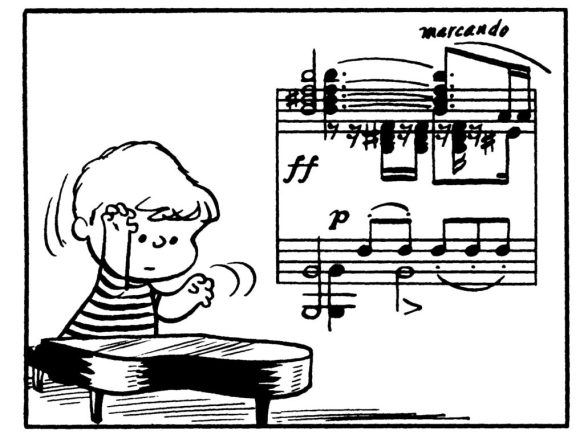
Schroder and his toy piano, drawn by Charles M. Schulz (c)PNTS
Klage WoO 113 (Lament) for voice and piano (1790, Beethoven aged 19)
Dedication not known
Text Ludwig Hölty
Duration 2’40”
Listen
Background and Critical Reception
This setting of poetry by Ludwig Hölty continues Beethoven’s current preoccupation with downcast songs, having recently set the Elegy for a dead poodle. Klage (translated as Lament) starts in a more positive light, describing the silver light of the moon, but soon talks of how ‘no peace smiles on me’, and ‘soon your silver light will shine on the tombstone that hides my ashes’.
Writing his programme notes for a collection of Beethoven songs on the Hyperion label, Julian Haylock describes this song as ‘an early setting that, despite its deceptively simple outlines and such delightfully naive effects as the doubling of right hand and voice in the first verse, touches an emotional nerve in the young composer’s psyche that was to be amongst his most enduring expressive traits – an exemplary handling of the minor mode.’
He also notes the stark closing postlude for piano, and its anticipation of similar instances in songs by Schumann.
Thoughts
If you listened to this song without a clue who the composer was, it would be hard to place. Although Beethoven does indeed use some of the ‘naive’ tactics described by Julian Haylock, his musical language is definitely looking forward to the likes of Mendelssohn and Schumann rather than backwards.
Again the topic is a relatively sorrowful one, suggesting that Beethoven’s downcast mood has lingered for a while since the death of his mother. The telling moment comes at the end of the first verse, when the silver light of the moon fades and the song turns to the minor key. Darkness falls, and tragedy with it, with little hope at the end. The bare chords from the piano offer little consolation as a closing statement.
Recordings used
Stephan Genz (baritone) & Roger Vignoles (piano) (Hyperion)
Hermann Prey (baritone), Leonard Hokanson (piano) (Capriccio)
Matthias Goerne (baritone), Jan Lisiecki (piano) (DG)
Peter Schreier (tenor) & Walter Obertz (piano) (Brilliant Classics)
The version for tenor and piano, beautifully sung by Peter Schreier with Walter Obertz, is set in E major / minor, while the version with baritone and piano is a third lower, beginning in C. For his version with Jan Lisiecki, Matthias Goerne has an ideally measured tone, with Lisiecki’s final chords completely bare. Stephan Genz and Roger Vignoles are the ideal match, while Hermann Prey operates at a much slower tempo with Leonard Hokanson, giving an even darker impression.
Spotify links
Hermann Prey (baritone) & Leonard Hokanson (piano)
Matthias Goerne (baritone), Jan Lisiecki (piano) (DG)
Peter Schreier (tenor) & Walter Obertz (piano)
Also written in 1790 Hummel Piano Quartet in D major



 Arcana.fm