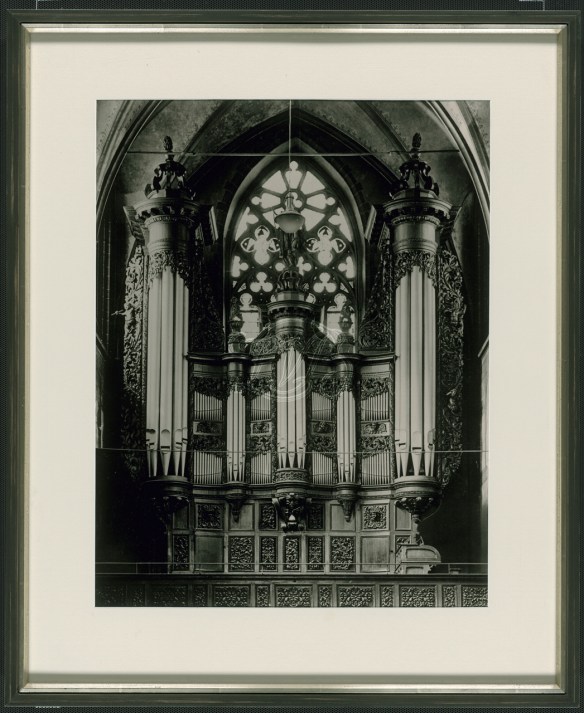
The organ of the Minorite Church in Bonn, which Beethoven played at the age of 12. Photograph from 1905, in the collection of the Beethoven-Haus Bonn
Fugue in D major WoO 31 for organ (1783, Beethoven aged 12)
Dedication not known
Duration 2’15
Listen
Background and Critical Reception
Although Beethoven regularly played the organ in his years at the Bonn court, he wrote virtually no organ music – and what survives is certainly not well known. The DG notes for their complete Beethoven edition describe it as a ‘rather modest two-voice fugue in D, written at the age of 11 or 12’ – and that’s it.
Thoughts
Yes it may be modest – and in the end it is relatively unmemorable – but there is something very impressive about the sure-footed way this fugue goes about its business. The thematic entries are textbook, Beethoven following the rules when it comes to writing a fugue, but the arrival at the big held note on the pedals towards the end feels inevitable – as does the conclusion.
Recordings used
Simon Preston (DG), Janette Fishell (Naxos)
Whereas Simon Preston’s version keeps moving it has quite a remote tone, recorded at more of a distance. Janette Fishell (Naxos) gives the fugue a warmer registration on the organ and brings it to life more. The final cadence feels more impressive in her hands.
Spotify links
Simon Preston
Janette Fishell
You can chart the Arcana Beethoven playlist as it grows, with one recommended version of each piece we listen to. Catch up here!
Also written in 1782 AlbrechtsbergerMass in D major Albrechtsberger was Beethoven’s teacher for a while, and you can read about him here
This Peanuts strip was first published on December 16, 1977, drawn by Charles M. Schulz (c)PNTS
Schilderung eines Mädchens WoO 107 (“Schildern, willst du Freund, soll ich dir Elisen?”) for voice and piano (1783, Beethoven aged 12)
Dedication not known
Text Unattributed
Duration 0’35
Listen
Background and Critical Reception
In his landmark biography of Beethoven, Alexander Thayer tells of how, by the age of 12, he was the ‘cembalist in the orchestra’. This was an important position within the Bonn Court orchestra for keyboard – presumably harpsichord rather than fortepiano – from which Beethoven would conduct the orchestra in rehearsals, filling a gap while the Electoral Kapellmeister was absent on a journey ‘of several months’.
The suggestion is that in this position lies the root of Beethoven’s powerful music, where he had to play up in volume to make himself heard. It gave him little time for composition, however, until the Kapellmeister returned – whereupon this short song was written and printed.
Thoughts
The first of many brief forays into song for Beethoven, Schilderung eines Mädchens (loosely translated as Portrayal of a Maiden) is almost over before it begins. It has a relatively high line, and a bold and bright melody. The young composer may be just getting a feel for how the voice behaves, but his instincts already appear to be sound.
Recordings used
Dietrich Fischer-Dieskau (baritone) and Jörg Demus (piano) Peter Schreier (tenor) and Walter Olbertz (piano) Hermann Prey (baritone) and Leonard Hokanson (piano)
All three recordings are in a different key. Dietrich Fischer-Dieskau is full-bodied in E major, but tenor Peter Schreier raises the tonality up to G with a brightly voiced account. Hermann Prey‘s account is very much slower (almost twice as long!). Luxurious in tone, it is beautifully sung but really stretches the words out. Leonard Hokanson shadows his every move.
Spotify links
Dietrich Fischer-Dieskau and Jörg Demus:
Peter Schreier and Walter Olbertz:
Hermann Prey and Leonard Hokanson:
Also written in 1783 Mozart Duos for violin and viola, K423 & K424
Ernst Dressler (left) and the young Ludwig van Beethoven
9 Variations on a March by Dressler WoO 63 for piano (1782, Beethoven aged 12)
Dedication not known
Duration 7′ (13’30 with repeats included)
Listen
What’s the theme like?
Dressler’s theme is serious in tone, and foursquare. The march is a slow one but it gives plenty of room for the young composer to work with his source material.
Background and Critical Reception
Beethoven’s first published work was released into the public domain when the composer was barely 12 years old. Its release was accompanied with a glowing reference from his teacher at the time, Christian Neefe. Jan Swafford takes up the story in his recent Beethoven biographer. ‘He plays the clavier very skillfully and with power, reads at sight very well, and…plays chiefly The Well Tempered Clavier of Sebastian Bach…He (Beethoven) has had nine variations for the pianoforte engraved in Mannheim. This youthful genius…would surely become a second Wolfgang Amadeus Mozart were he to continue as he has begun.’
The variation form was a good way of exercising students; seeing how inventive they could be when given a theme as a starting point. Talking with Arcana about the Dressler variations, pianist Cyprien Katsaris notes how “this piece is variations by a kid, and it could be considered in the beginning a little bit boring. His teacher probably told him to keep the same tempo, but I think there is a probability that if Beethoven played that piece as an adult he would play it in a different way to when he was under the guidance of that teacher. What a pity we didn’t have recordings earlier!”
Barry Cooper‘s booklet note for DG’s New Complete Edition of Beethoven notes how variations of the time were usually in a major key, and the adoption of C minor ‘feels like something of a statement’. It is a key we will traverse many more times as Beethoven’s portfolio unfolds. Swafford interprets the choice of C minor and its serious material ‘might form a memorial for the boy’s recently passed, still-lamented teacher and friend Franz Georg Rovantini‘, and that the final variation is a ‘triumph over sorrow’.
Thoughts
The young Beethoven takes the relatively basic Dressler theme and works nine variations from it, beginning in serious mood but gradually loosening his approach to explore different techniques.
For eight of the nine variations we keep the darker colour of the minor key, staying true to the mood of the theme but gradually adding more to it, with a few grace notes (variation 1), relatively polite sequential figures (2), then extra arpeggios in the middle parts (3), and chromatic inflections in the right hand (4). The fifth variation is more playful.
The sense of a composer running with greater freedom is clear, as the fifth variation is really let off the leash, the right hand roaming as it wishes. Variation six exchanges trills and more playful melodies between the two hands, while the seventh is in lilting triple time. The eighth feels like music we have heard already, with flowing arpeggios. Until now all variations have remained in the minor key, but this heightens the moment Beethoven switches to the major for the last variation, a terrific flurry of notes for the right hand which show off his technical prowess. Not many 12-year-olds could play music like this!
Cécile Ousset includes all of Beethoven’s repeat markings, so each half of each variation is repeated, the piece extended to 13 minutes. Hers is a gracious account, brilliantly executed at the end.
Pletnev is very straight-faced initially, and plays around with the tempo a good deal, but goes for broke at the end to make the final variation sound like a piece of C.P.E. Bach.
Katsaris, including revised material by Beethoven, is in a room with a good deal of reverberation, heightening the serious theme and quite deliberate initially – but with terrific excitement generated in the fifth and final variations.
Spotify links
Mikhail Pletnev
Cécile Ousset
Cyprien Katsaris
Also written in 1782 Haydn Symphony no.73 in D major ‘La Chasse’
Next upSchilderung eines Mädchens
You can read Cyprien Katsaris’ full interview about Beethoven with Arcana soon.



 Arcana.fm