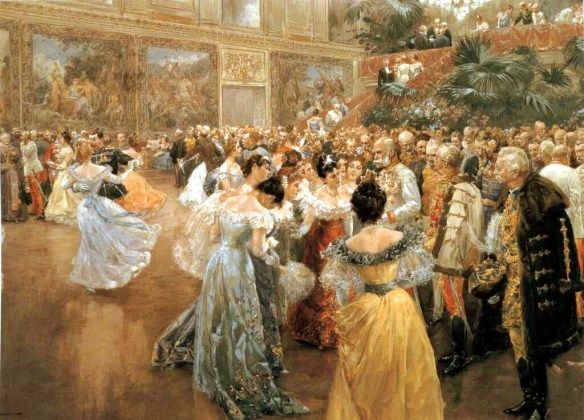
Two ladies are presented to Emperor Franz Joseph at a ball in the Hofburg Imperial Palace, painting by Wilhelm Gause (1900)
6 Ländler WoO 15 for two violins and bass (1802, Beethoven aged 31)
Dedication unknown
Duration 6′
written by Ben Hogwood
Listen
Background and Critical Reception
As we know from earlier examples, Beethoven often turned to the Ländler, a folk dance in 3/4 time, as a way of helping entertain his Viennese clientele. He was able to score them for different instrumental combinations, presumably in response to the circumstances of the entertainers. This set is originally for two violins and a bass instrument – but as with many of these dances was also reworked into a piano version.
Thoughts
D major was Beethoven’s ‘go-to’ key for Ländler – and five of the six examples in this small set are in that key. The only exception is no.4 in D minor, which works well as a ‘trio’ section if all six are played back to back. It is a frown in comparison to the other five, which are carefree examples of Beethoven fulfilling a function with ease.
The first is bright, and light on its feet, the fifth has an attractive flourish but feels half-finished. Typically the sixth and final dance, a simple arpeggiated affair, signs off with a coda.
Bagatelle in C major WoO 54, ‘Lustig-Traurig’ for piano (1802, Beethoven aged 31)
Dedication not known Duration 2′
Listen
written by Ben Hogwood
Background and Critical Reception
Around his major compositions we will continue to find Beethoven’s miniatures. This piece, whose nickname translates as ‘happy-sad’, is thought by some to have originated in 1798 – and appears to have just missed out on inclusion in the Op.33 set published earlier in the year.
Perhaps because of its size, this piece is glossed over by Beethoven commentators in favour of its more substantial companions. It appears to have been written for pianists of moderate ability, as with many of the bagatelles.
Thoughts
The happy-sad elements of this bagatelle are all told through harmony. This short character piece follows the profile of its title – switching mood between happy (C major) and sad (C minor). It’s a little doubtful if the C minor is actually sad, as it sounds more agitated, and the C major sounds happy in a slightly wary way we might associate more with Schubert.
Yet here is an aspect of Beethoven’s genius, the ability to write for all levels – be it the advanced player or the occasional one – and leave each a memorable work, a catchy tune, an enjoyable piece to return to.
Recordings used and Spotify playlist
Jenő Jandó (Naxos) Olli Mustonen (Sony BMG) Ronald Brautigam (BIS)
Three very different recordings. Olli Mustonen always has an individual take and this longer, stretched version is no exception. Brautigam is brisk, and Jandó nicely measured.
You can chart the Arcana Beethoven playlist as it grows, with one recommended version of each piece we listen to. Catch up here!
Portrait of Pietro Metastasio, c1770, by Meytens or Batoni
“Ne’ giorni tuoi felici”, WoO 93, duet for soprano, tenor and orchestra (1802, Beethoven aged 31)
Dedication Not known Text Pietro Metastasio Duration 7′
Listen
Background and Critical Reception
Ne’ giorni tuoi felici (‘In your days of happiness’) uses text from Metastasio’s L’Olimpiade, with Beethoven becoming the third recorded composer to set these words behind Leonardo Leo and Florian Gassmann. Writing briefly about the duet in booklet notes for Hyperion, Nicholas Marston notes that two of the soloists at the premiere, which appears not to have taken place until 1814, were Anna Milder-Hauptmann and Carl Weinmüller. They helped create the roles of Leonore and Rocco respectively in the premiere of Fidelio later that year.
Very little is written about this piece, other than to note its position in Beethoven’s output as one of the last vocal works written under the tuition of Salieri.
Thoughts
We hear the tenor first, pleading, ‘in the days of your happiness remember me’ – and his lover, the soprano, answers in kind. Initially the mood is relatively calm, but as the duet progresses things become more agitated. The singers’ lines are deeply expressive, and initially slower that has perhaps been the norm in Beethoven’s vocal music with orchestra so far. The composer gives the voices plenty of room, the orchestra at a polite distance, but the violins have important counter melodies to contribute.
A quicker section arrives just over half way through, the singers ‘dying of jealousy’ as they experience considerable distress, not to mention ‘savage pain’. This sours the mood and tugs at the heartstrings, ending the duet on a fractious note. At this point it feels unfinished, with more of the story to play out – as though Beethoven could have continued to write a more expansive piece using Metastasio’s text.
The soprano writing often hits the heights, but in a way less concerned with overt display and more with lyrical passion. She leads the duet, which makes a powerful impression – and gives notice that Beethoven’s dramatic gifts will be more than capable of shifting to the operatic stage before too long.
Recordings used
Dan Karlström (tenor), Reetta Haavisto (soprano), Turku Philharmonic Orchestra / Leif Segerstam (Naxos)
Christopher Maltman (tenor), Janice Watson (soprano), English Chamber Orchestra / Matthew Best (Hyperion) (an excerpt can be heard here)
Arthur Apelt (tenor), Hannelore Kuhse (soprano), Staatskapelle Berlin / Eberhard Büchner (Eterna)
You can chart the Arcana Beethoven playlist as it grows, with one recommended version of each piece we listen to. Catch up here!
Also written in 1802Charles-Simon Catel Sémiramis
Next upBagatelle in C major / minor ‘Lustig-traurig’
“No, non turbarti”, WoO 92a, scene and aria for soprano and strings (1802, Beethoven aged 31)
1. Scena: No, non turbarti’… 2. Aria: Ma tu tremi, o mio tesoro
Dedication Not known Text Pietro Metastasio Duration 6′
Listen
Background and Critical Reception
This scena and aria, setting text from Metastasio’s La tempesta, is for soprano and strings, and marks one of the final pieces of work completed by Beethoven when still under the tuition of Salieri.
The autograph manuscript has corrections from his teacher, from whom Beethoven had been learning vocal composition, pointing his efforts towards the stage. Andrew Stewart, notes that Beethoven did not completely finish the orchestration, and that the premiere of this relatively short piece did not take place until 1814 – by which time he had completed his opera Fidelio.
Soprano Chen Reiss, writing about the piece for her recent album Immortal Beloved, observes that the aria seems ‘to predict the misfortunes in love he was to experience later in life’. Using the manuscript, she restored the music to predate Salieri’s ‘corrections’, offering a more authentic account of the composer’s intentions.
Thoughts
A sad stillness inhabits the start of the recitative, but soon the music becomes agitated. When the text observes, “See how the entire sky now blackens; the wind stirs up the dust and the fallen leaves”, Beethoven takes his cue with a rush of strings, their tremolo figuration portraying the restless storm.
The aria itself feels higher in register, with a greater distance between the singer and the strings as a form of solace in pure C major. The poet, however, is after a little more, and as Ian Page says, ‘pursues more amorous intentions’. “When there’s thunder and lightning I shall be with you”, consoles the text – and this music, appearing to indulge Beethoven’s love of Handel, does likewise.
Spotify playlist and Recordings used
Sophie Bevan, The Mozartists / Ian Page (Signum Classics) Chen Reiss, Academy of Ancient Music / Richard Egarr (Onyx) Reetta Haavisto, Turku Philharmonic Orchestra / Leif Segerstam (Naxos)
Three excellent performances here, but those from Sophie Bevan and in particular Chen Reiss are to be heard again. The latter has a slightly fuller voice, especially lower in the register. Both are accompanied by instruments of the period and conductors using harpsichord – which perhaps brings out the Handelian connections. Reetta Haavisto gives a powerful interpretation, and together with Leif Segerstam takes a more expansive view of the pair, clocking in at nearly seven minutes in comparison to Bevan’s five.
The below playlist collects all three recordings referred to above:
You can chart the Arcana Beethoven playlist as it grows, with one recommended version of each piece we listen to. Catch up here!
Also written in 1802Charles-Simon Catel: Sémiramis
The Longing for Happiness. Left wall, detail from the Beethoven-Frieze (1902) by Gustav Klimt
Symphony no.2 in D major Op.36 for orchestra (1800-1802, Beethoven aged 31)
Dedication Karl Alois, Prince Lichnowsky Duration 30′
1. Adagio molto – Allegro con brio 2. Larghetto 3. Scherzo: Allegro 4. Allegro molto
Listen
Background and Critical Reception
Beethoven’s time in Heiligenstadt may have been difficult, but it yielded music of remarkable positivity in such testing situations. George Hall, writing booklet notes for Simax, sums up the situation neatly: ”What has proved remarkable to Beethoven’s biographers is that the (second) symphony, whose sketches date back to 1800 and whose finishing touches were probably added in 1803, was composed largely in the year that he wrote the famous Heiligenstadt testament. The fact that this document – in which Beethoven in his post-suicidal mood railed against his deafness and isolation in a letter – was conceived in the year of this predominantly happy and straightforward piece is considered paradoxical.’
‘Symphony no.2 is the main fruit of Beethoven’s labors in 1801-2 and is considered to be the culminating success of his early period’, writes Daniel Heartz. He gives an account of the premiere on 5 April 1803, which took place at the new Theater an der Wien, and included the hastily composed short oratorio Christus am Ölberge and also a new piano concerto, the third.
In a fascinating and detailed analysis, Heartz goes on to draw close links with Mozart‘s Symphony no.38, the Prague, which Beethoven greatly admired. Written in the same key, the two works share a broad Adagio introduction to the first movement, and a nearly identical instrumentation. The crucial difference here is that Beethoven adds clarinets in A, a distinctive part of the woodwind sound which makes such a difference to this symphony.
The second symphony would probably have been, to date, the longest symphony yet published – a quality acknowledged by Allegmeine Musikalische Zeitung of Leipzig, in their 1804 appraisal. ‘It is’, their critic wrote, ‘a noteworthy, colossal work (the biggest so far), whose profundity, strength and artistic understanding are very rare, and presents difficulties from the point of view of execution…that certainly no previous symphony has offered.’
Heartz identifies it as ‘a watershed for its composer, the last of his big works in which he looked to Haydn and Mozart for inspiration.’ Later, he notes that when ‘the London Philharmonic Society invited Beethoven to compose a symphony in the style of the first and second symphonies’, it was ‘an offer that deeply offended the composer, who indignantly refused. There can scarcely be more striking confirmation than this that a corner was turned after 1802.’
Thoughts
If you approached this piece cold, there is no way you would know it was written by a man whose grip on life itself was tenuous. In the midst of all the strife he was experiencing, Beethoven pulled out this sunny piece of beautifully joined-up thinking, giving the best possible response to his illnesses and impending deafness. If he was to be hindered, the music would see him through.
There is much to love about the Second Symphony. Its dimensions look front-loaded, with a substantial first and second movement and a shorter Scherzo and Finale placed third and fourth. These two, however, act as a combined pair – and so the feeling is of a trio of movements, as perfected by Mozart in the Prague symphony discussd above. The spirit of Mozart is present for sure, but so is the drive and energy of the younger composer, along with his ability to develop incredibly small melodic cells into material for whole movements.
His expertise in this is evident in those third and fourth movements. The scherzo’s seemingly throwaway phrase at the start is the block on which the whole movement rests, played by the orchestra but with the strings keeping busy in between. The finale follows on naturally, moving closer to ‘home’ with another clipped phrase from the full orchestra.
Before these two symphonic gems we have had the pleasure of an energy-filled first movement and a balletic second, a ‘slow’ movement with a good deal of poise. Here the clarinets make themselves known the most, and Beethoven’s writing for wind is a joy in which to indulge. The movement flows with a happy stream of invention, anticipating perhaps the outdoor vistas of the later Pastoral symphony.
Working backwards, the first movement has a good deal of drama in its introduction and a tautly argued Allegro section which frequently breaks into an unfiltered smile. Perhaps Mozart and a little of Haydn are most obvious in the music here, but again the material could not be from anyone else.
Many commentators declare the Second Symphony as the culmination of Beethoven’s first period. With music of such rich invention, such clever but instinctive development and such bright textures, it is to be savoured – and bodes extremely well for what is to come.
Spotify playlist and Recordings used
NBC Symphony Orchestra / Arturo Toscanini (RCA) Cleveland Orchestra / George Szell (Sony Classical) Orchestra of the Eighteenth Century / Frans Brüggen (Philips) Berliner Philharmoniker / Herbert von Karajan (Deutsche Grammophon) Vienna Philharmonic Orchestra / Claudio Abbado (Deutsche Grammophon) Danish Chamber Orchestra / Ádám Fischer (Naxos) Minnesota Orchestra / Osmo Vänskä (BIS) Royal Concertgebouw Orchestra / Rafael Kubelik (Deutsche Grammophon) Anime Eterna Brugge / Jos Van Immerseel(ZigZag Territories)
Performances on ‘period’ instruments or modern interpretations are both to be lauded in this piece. The former camp contains really fine versions from Anime Eterna Brugge and Jos van Immerseel, or the Orchestra of the Eighteenth Century and Frans Brüggen, to name just two thoroughly enjoyable accounts. The latter gives great enjoyment thanks to the batons of Harnoncourt, Kubelik and Szell, not to mention many, many others!
To listen to clips from the recording from the Scottih Chamber Orchestra conducted by Sir Charles Mackerras on Hyperion, head to their website
You can chart the Arcana Beethoven playlist as it grows, with one recommended version of each piece we listen to. Catch up here!
Also written in 1802 HaydnMass in B flat major Hob. XXII:14 ‘Harmoniemesse’

 Two ladies are presented to Emperor Franz Joseph at a ball in the Hofburg Imperial Palace, painting by Wilhelm Gause (1900)


 Arcana.fm