
Danish String Quartet – Haydn and Shostakovich

The Danish String Quartet play works by Haydn and Shostakovich at Wigmore Hall
danish-string-quartet
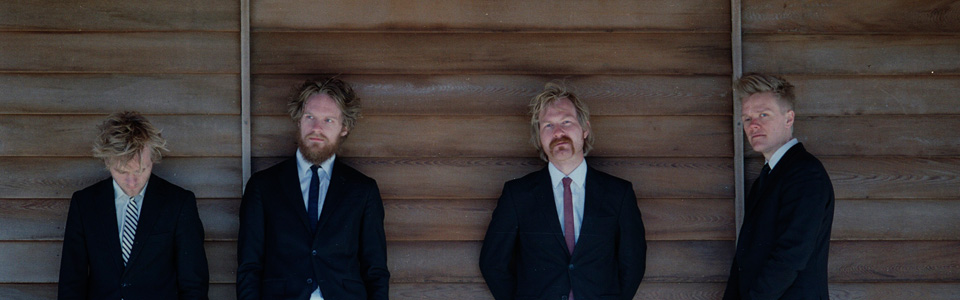
Danish String Quartet (Frederik Øland, Rune Tonsgaard Sørensen (violins), Asbjørn Nørgaard (viola), Fredrik Sjølin (cello)) – Wigmore Hall, live on BBC Radio 3, 23 March 2015.

Listening link (opens in a new window):

http://www.bbc.co.uk/programmes/b05mqmkv

on the iPlayer until 22 April

Spotify

The Danish Quartet are yet to record either of these pieces, so for listeners unable to hear the BBC audio here is a Spotify playlist of the same works from the Lindsay Quartet (Haydn) and the Aviv Quartet (Shostakovich) – two fine versions:

What’s the music?

HaydnString Quartet in C major Op.54/2 (1788) (20 minutes)

Shostakovich String Quartet no.9 (1964) (25 minutes)

What about the music?

[PIC]

As my concert-going companion remarked, Haydn string quartets are always used as curtain openers, which can be something of a shame, as they are always performed when the quartet is at its ‘coldest’. This particular work, seemingly written for the violinist Johann Tost in 1788, can not be allowed to fall into that category, for the first violinist has a lot of demands made on him right from the start.

As with many Haydn works this quartet is deceptive, for it has the routine layout – yet tinkers with the overall design of a conventional string quartet. The first movement is a lot faster than it would be normally, while the second movement (the slow movement here) runs straight into the third (a minuet), a tactic very seldom witnessed. Not only that, the last of the four movements is predominantly slow.

Shostakovich’s most private thoughts went into his string quartets, which often convey the intense fear and claustrophobia he felt with the authorities seemingly poised to knock on his door in the middle of the night, ready to remove him forever for his supposedly rebellious musical tendencies. Ultimately he found ways of expressing himself in a private musical code, and the string quartets were especially vivid at using that.

Yet his ninth published string quartet is much more positive in mood than most, seemingly gathering itself to renounce the fear and stand confidently on two feet. As the Wigmore Hall program note states, this may have been due to the composer’s recent marriage – his third – and the slight ‘thaw’ in relations that was allowing him to revive the previously out-of-bounds opera Lady Macbet of the Mtsensk District.

Performance verdict

How refreshing to hear Haydn played with the energy the Danish String Quartet gave it in this performance. All too often these quartets sound too polite, but this account was a good reminder of Haydn’s innovations in the form, and in the way he makes this piece sound a bit like a miniature violin concerto. First violinist Frederik Øland was up to the job.

The Shostakovich was even better, given a depth of feeling and range of colour that suited the piece perfectly. Whereas some of the composer’s quartets are very closed in this felt like a positive, outgoing experience, standing tall in the face of the horrors of the time. Particularly effective was the Rossini-like polka that danced manically, while the slower sections – and in particular the quotes from Musorgsky’s Boris Godunov – were beautifully handled.

The quartet’s ensemble playing was superb, and their togetherness and positivity were two standout features of a superb concert.

What should I listen out for?

Haydn

1:49 – the first movement, unusual in the composer’s output for being marked Vivace (lively). The Danish Quartet enjoy its contours – particularly first violinist Frederik Øland, who has a challenging part!

8:14 – the mood turns sombre (and the key changes from C major to C minor) for the slow movement. Again the first violin starts to take the lead but sounds a bit absentminded against the long, slow chords from the other three instruments. This moves straight into…

11:27 – the Menuetto, an injection of pace and poise, with a typically upbeat theme from the composer. This is in direct contrast to the Trio section, from 13:03, with its discords. The texture is surprisingly full here for four instruments. The Menuetto reappears to put things right at 14:01, as though nothing had happened!

15:06 – a solemn introductory theme, which turns into a thoughtful and deeply felt Adagio. Very unusual for a slow movement to appear last in a typical four-movement quartet structure in the eighteenth century…and yet there is fast music to come, from 19:54 as the music scampers away…only to return to its previous slow tempo, on which it ends at 22:12.

Shostakovich

This quartet runs continuously but is in five distinct sections / movements:

24:48 – an airy beginning, with hints of unease from the inner and lower parts. The second violin is playing a theme associated with Pimen in Musorgsky’s opera Boris Godunov. A light dance is played out and an air of tranquillity takes over. Yet even here, as the upper parts circle, nervy thoughts lurk in the shadows. Then we move to the second ‘movement’…

…at 29:05. A romance in all but name with happier thoughts, possibly inspired by the composer’s recent marriage (his third). The harmonies are lush here, and after some thought the tempo begins to increase…

..to 33:24, where a polka starts up, and the rat-a-tat rat-a-tat rhythm – a quotation from Rossini’s William Tell Overture­ – begins to obsessively take hold.  A furious energy is unleashed, brilliantly captured by the Danish Quartet, who keep an appealing roughness around the edges when the music is most fractious. The instruments converse with some of these melodic figures.

37:13 – the music takes on a mood of deep thought, but is wrenched from its reverie by violent pizzicato (38:09), a tactic used several times to unsettle the listener, before a piercing and unnerving violin cadenza briefly takes centre stage.

40:38 – the substantial final movement starts with a jolt, the music thrown forwards like a car starting suddenly. Having started this mad push forwards Shostakovich has to keep it going, and does to with some emphatic and blustery unison passages for two or more instruments of the quartet. Powerful lines on the cello are compromised by what can only be described as ‘scrubbing’ from the persistent second violin. Shostakovich’s sardonic humour makes itself known through ‘glissandi’ (where a note slides in pitch, mostly upwards in this case!), before an emphatic finish.

Encore – NielsenMit hjerte altid vanker arranged by the Danish String Quartet second violinist Rune Tonsgaard Sørensen

52:40 – Chosen to celebrate 150 years since the Danish composer’s birth, this is a short but sweetly voiced chorale lasting just under two minutes.

Want to hear more?

As the Danish Quartet mentioned, their compatriot Carl Nielsen is in an anniversary year, born 150 years ago – and the foursome have recorded his complete string quartets, not often heard but here on this album on Spotify:

For more concerts click here

The Inextinguishable Fire

The Inextinguishable Fire – The BBC Symphony Orchestra and Sakari Oramo reach the Fourth Symphony in their Nielsen cycle, adding Sibelius, Ravel and Zemlinsky for good measure

sakari-oramo
Anne Sofie von Otter (mezzo-soprano), BBC Symphony Orchestra / Sakari Oramo (pictured) – Barbican Hall, 19 February 2015

Listening link (opens in a new window):

http://www.bbc.co.uk/programmes/b052lpjh

on the iPlayer until 19 March

Spotify

Those unable to get the BBC concert can follow the same pieces here in appropriate recordings:

What’s the music?

Sibelius – The Oceanides (1914) (9 minutes)

Zemlinsky – 6 Maeterlinck Lieder, Op.13 (1913, orchestrated 1921) (19 minutes)

Ravel – Le Tombeau de Couperin (1914-17, orchestrated 1919) (18 minutes)

Nielsen – Symphony no.4, ‘Inextinguishable’ (1914-16) (34 minutes)

What about the music?

nielsenThe composer Carl Nielsen

This is a carefully picked program of intriguing opposites, part of the BBC Symphony Orchestra’s celebration of 150 years since the birth of Danish composer Carl Nielsen. All four pieces date from the same decade, and inevitably the First World War is an immovable presence, but these are four very different works that look to harness strength in adversity.

Sibelius, in his tone poem The Oceanides, looks abroad for its stimulus. He was on his only trip to America when he wrote the work at Yale University, taking an Ancient Greek legend as his inspiration. The ‘Oceanides’ are daughters of the water that circles the earth – water in all of its forms – and in this piece Sibelius describes the water as ‘a single breaker growing in force’. The version played here is the Yale version, rather than the later (and longer) revision.

Zemlinsky wrote his Six Maeterlinck Lieder while digesting the news that Alma Schindler, a long time obsession, had decided to marry the composer Gustav Mahler. This news upset and angered him, for he was preoccupied with Alma for many years – yet in these elusive and often unresolved songs he found the ideal vehicle for his response. As Anne-Sofie von Otter said in an interview broadcast on BBC Radio 3, the cycle of six songs is ‘not easy to get the balance right’ between voice and orchestra.

The work is ‘elusive and enigmatic. The stories aren’t straightforward!’

Le Tombeau de Couperin worked for Ravel on a couple of levels; firstly it helped him to observe the passing of several close friends in the First World War, while secondly it gave him chance to pay homage to the great composers of the French Baroque (from the 1700s) such as Couperin, held up as a national treasure and regarded as superior to the German equivalents, especially in time of war! It is an elegant piece, revelling in its role as a pastiche composition – using dance forms of the Baroque – but never resorting to imitation. Instead Ravel uses some cheeky and quite spicy harmonies to keep the hint of a smile on the face of the music.

Finally we have the Inextinguishable symphony, Nielsen’s Fourth and best known example in the form. This is a hugely affirmative piece of music, ‘that which is life’. David Fanning describes it as a ‘midlife crisis’ piece, as Nielsen’s life was undergoing a number of changes. It runs without a break, from searing melodies to small evocations of a village band – truly embracing the many forms and sizes of life itself.

Performance verdict

A fascinating and stimulating concert. Sakari Oramo has already gained a reputation for his prowess in Scandinavian music, and he brought Sibelius’ brief tone poem to life with a succession of watery colours. This was in direct contrast to the Nielsen, which was taut and thrilling, the strings producing some piercing lines while the real glory went to the drums, rolling like thunder in the background.

The Ravel, meanwhile, was notable for its glassy clarity, each melodic line clear to the ear and lovingly turned by the conductor. Oboist Richard Simpson was superb throughout, each of his leading tunes beautifully phrased and voiced. In some ways it was the Zemlinsky, the least known piece of the four, that made the greatest impact. Anne Sofie von Otter, ideally dressed in a long burgundy gown, got right to the heart of these poems – as much as you can with verse such as Maeterlinck’s, at any rate!

What should I listen out for?

Sibelius

3:47 – a murky start with very quiet strings and murmuring timpani. The two harps are prominent at this stage. As the music grows louder you can almost feel the water with every swirl of the harps!

6:09 – a trademark figure for woodwinds which falls back to the murky depths of the soft strings.

8:11 – the big wave grows and swells, powered by timpani, strings and woodwind

9:54 – the music settles on a home note and immediately takes on a happier air

12:09 – the big spray of a ‘breaker’ – and a typically concise finish to the piece, courtesy of a single clarinet – whose note resolves right at the end.

Zemlinsky

16:39 – Die drei Schwestern (The Three Sisters). The music moves with deliberate tread, as though walking carefully. The music moves through a succession of harmonies without stopping, and the singer too is tense – until a brief but meaningful climax which cuts off suddenly.

20:34 – Die Mädchen mit den verbundenen Augen (The Maidens with Bound Eyes). Silvery strings introduce the singer, who initially shadows the cor anglais. Zemlinsky uses the orchestra very deftly, with lots of light and shade, though eventually this song becomes darker and sorrowful.

23:41 Lied der Jungfrau (The Song of the Virgin) The otherworldly sound of the harmonium can be heard at the start of this song in conjunction with a solo violin. Zemlinsky reduces the string section to eight players and there is some truly odd but rather enchanting music here!

26:21 – Als ihr Geliebter schied (When her lover went away) Richly coloured but once again strangely elusive. This is one of the songs Zemlinsky wrote as Alma Mahler, the long-time object of his affections, had a ‘dalliance’ with another man, a year after her husband’s death

28:25 – Und kehrt er einst heim (And should he return one day)­ – the golden ring of the song glints in Zemlinsky’s orchestration for harp and celesta.

31:23 – Sie kam zum Schloss gegangen (She came towards the castle) – this song to me sounded more like Mahler than any of the other five. The oboe and cello paint a ghostly picture to begin with, and as the mysterious story unfolds there is a curious fascination on the part of the listener.

Ravel

1:03:11 – Prélude – a graceful and slightly furtive solo, beautifully played here by Richard Simpson. The strings offer a silvery melody as a complement

1:06:43 – Forlane – a French dance form that Ravel wanted to make like the tango. In the event he is quite restrained here, but the use of ‘wrong’ notes in the melody makes the dance more exotic. At 1:11:37 the clarinet introduces another section, then at 1:12:12 the melodies become awkward and twisted.

1:13:09 – Menuet – the emotional centre of the work, with a polite if slightly sad melody from the oboe, then a minor key section (1:15:08) where the shadows cast over the work get longer. Again this is beautifully phrased by the BBC woodwind, with harmonics on the strings in the background.

1:18:28 – Rigaudon – here is music of greater hope, a quick and high spirited dance that skips along.

Nielsen

1:25:24 – with a massive heave the symphony gets underway, unleashing a seemingly unstoppable force through the whole orchestra.

1:26:56 – the clarinets duet in what becomes the great theme of the symphony, heard softly at first but then in an affirmation from the whole orchestra at 1:29:31

1:35:15 – the affirmative second theme returns to close off the first movement in joyous spirits, at which point we lead to…

1:36:37 – a small village wind band pipe up with a thoughtful melody. The sound is small compared to the first movement and not rhythmically consistent.

1:40:01 – the village band returns, but the music still feels a little distracted

1:41:29 – the third movement, a tense exchange that begins with piercing high notes on the violins.

1:50:41 – strings hurry around at the start of the fourth movement, exerting a sheer primal force

1:52:35 – rolling timpani, one set of drums each side of the orchestra, dominate the sound

1:56:48 – rolling timpani return, driving forward to a thoroughly affirmative finish where the big theme from the first movement comes back in its crowning glory

Want to hear more?

The Spotify playlist link above also contains some extra items for each composer. These are the short but tuneful Karelia Suite of Sibelius, then the two other movements from Le Tombeau de Couperin that Ravel did not orchestrate, a Fugue and a Toccata. There is Zemlinsky’s highly regarded three movement Sinfonietta, a major work, and to finish the suite written by Nielsen for Aladdin.

For more concerts click here