
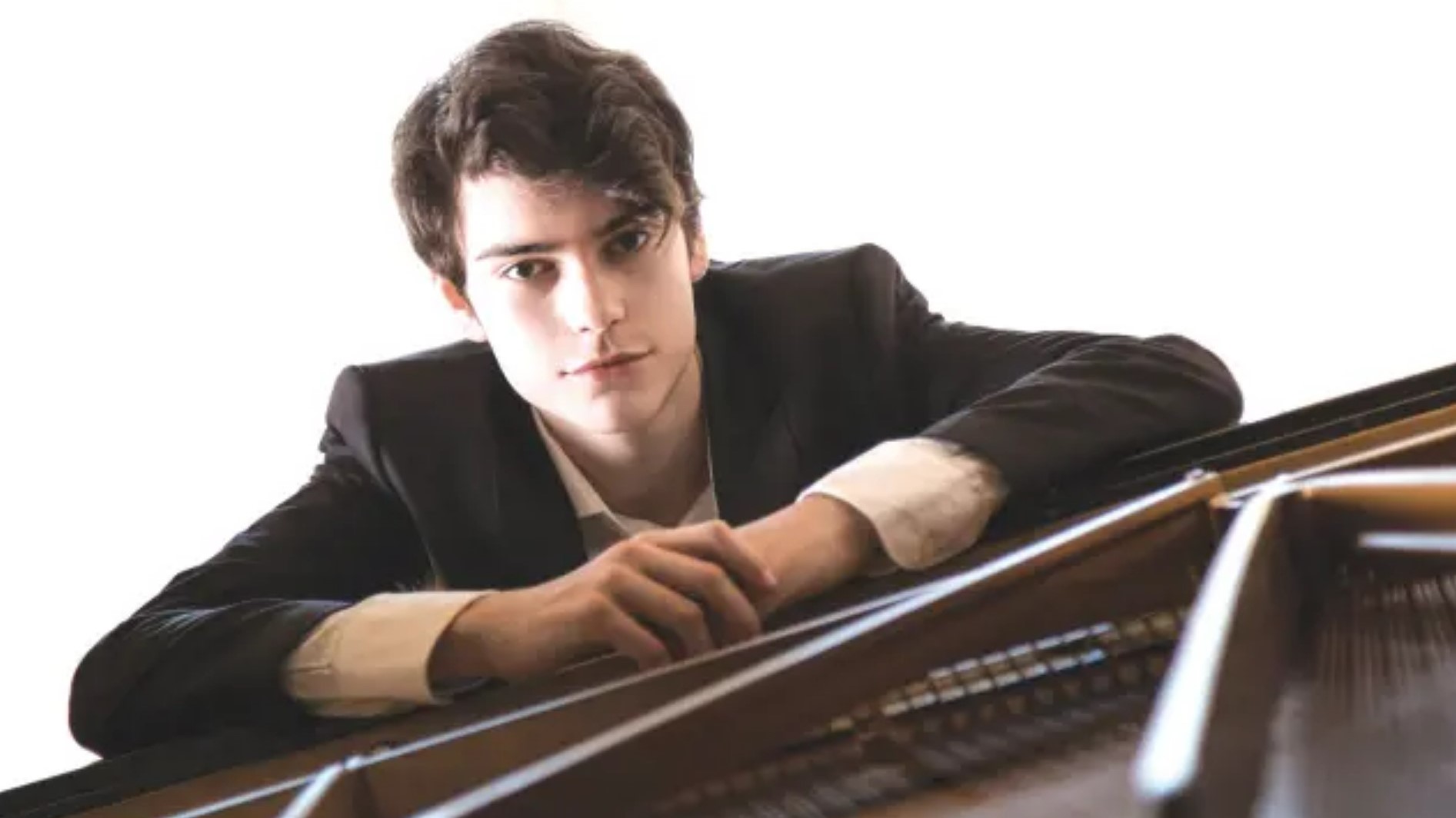
Online Concert: Tom Borrow @ Wigmore Hall – J.S. Bach, Franck & Rachmaninoff

Tom Borrow (piano)

J.S. Bach Italian Concerto in F major BWV971 (pub. 1735)
Franck Prélude, choral et fugue (1884)
Rachmaninoff Variations on a theme of Corelli Op.42 (1931)

Wigmore Hall, Monday 1 May 2023 1pm

by Ben Hogwood

This BBC Radio 3 Lunchtime Concert featured the New Generation pianist Tom Borrow, making his debut at the Wigmore Hall with a very well-judged trio of works casting their eyes back to the past. The Israeli-born performer was notably comfortable in the environment, responding to the intimate atmosphere of the hall with compelling music-making.

Bach’s Italian Concerto was first, a work that is particularly successful on the piano. Borrow’s articulation in a crisp Allegro was very pleasing to the ear, his enjoyment of the counterpoint evident. The Andante was particularly beautiful, and completely unhurried – the pianist not afraid to give the right hand plenty of room to expand Bach’s melodies, the left hand hushed but responsive too. The bustling Presto had plenty of musical activity, the energetic profile maintained throughout but again the shapely melodic phrasing winning through.

Franck’s Prélude, choral et fugue is the best known of his works for solo piano. Its form looks back to the organ works of Bach, inserting a ‘chorale’ section in between the more conventional pair of ‘prelude’ and ‘fugue’. Here the Prélude began softly, Borrow’s light touch bringing delicacy to the decorative arpeggios around the theme, while also bringing the parallels with Brahms into focus. The choral started softy but grew in stature, moving from darkness to bright light, Borrow crossing hands to play the theme with apparent ease. The flowing discourse here was notable, maybe not as loud as some pianists but finding the heart of Franck’s expression nonetheless. The fugue was stately but also mysterious to begin with, the pianist bringing forward its chromatic profile, but then taking full command of the intense exchanges and achieving a most impressive performance in the process. The closing peal of bells was brilliantly played.

Rachmaninoff’s Variations on a theme of Corelli completed the trio of retrospective works, this one another remarkably concentrated piece offering plenty of opportunity for virtuosity and interpretative skill. This was again taken up by Borrow, once again setting a reverent atmosphere with the slow exposition of the theme. The lilting second variation in triple time was persuasively delivered, while a commanding fifth variation and sweeping seventh carried all before them. This only heightened the mysterious eighth and ninth variations, lost in thought.

The dynamic contrasts of the twelfth variation were very well observed, then the anxious syncopations of the thirteenth. The following Intermezzo had the requisite elements of fantasy, followed by a yearning chorale for Variation 14. Borrow’s technical command was impressive throughout, notably in the twists and turns of Variation 16 and the jagged edges of the eighteenth variation onwards. The clarity here was notable, in spite of the volume – and the thunderous finish was complemented by a radiant coda.

Borrow’s encore choice was well-suited – a flowing account of Rachmaninoff’s Prelude in G# minor Op.32/12, with notes that twinkled in the upper right hand at the end.

For more livestreamed concerts from the Wigmore Hall, click here
Happy Christmas… with César Franck

In this year’s final post from Arcana, we would like to take the chance to wish you a very Happy Christmas and a peaceful New Year – in the company of anniversary composer César Franck. His choral favourite Panis Angelicus is ideal for the season, especially in this version from the King’s College Choir Cambridge:

So, too, is the majestic Pièce Héroïque, played here in a vintage recording by the organist-composer Marcel Dupré:

Thank you so much for being our readers this year, and we look forward to bringing you all sorts of musical goodness in 2023!

Ben Hogwood, editor

Wigmore Mondays – Daniel Müller-Schott & Annika Treutler: Dvořák, Webern & Franck

Daniel Müller-Schott (cello, above), Annika Treutler (piano, below)

Wigmore Hall, Monday 17 February 2020 (lunchtime)

You can listen to this concert on the BBC Sounds app here (opens in a new window)

Review and guide by Ben Hogwood

There is so much original music for cello and piano dating from the 19th century that there is a danger of feeling short changed in a concert when presented with music arranged from a different instrument. Yet such was the conviction with which Daniel Müller-Schott and Annike Treutler played these pieces that it was possible to forget those thoughts and enjoy the music, pure and simple.

It also showed just how flexible some of the original music is. Dvořák’s 4 Romantic Pieces began as works for string quartet but their songful nature gives them just as much expression in their better known arrangement for violin and piano, and then in Müller-Schott’s own arrangement here. The first piece, a Cavatina, is a lyrical treat (2:36), while the second has a comparatively stern expression (5:44), ending with imaginative use of harmonics from the cellist. The third and most lyrical of the four pieces (8:28) returns to the same key as the first, and is ideally suited to the cello’s range, while the fourth and longest piece (10:51) is more thoughtful and affecting.

It usually takes longer to write about Webern’s music than it does to perform – which is again the case here. Yet such is the compressed intensity of his writing that the Drei Kleine Stücke will have stuck in people’s memories, despite lasting less than 5 minutes. Webern wrote the three pieces at a particularly fraught time in 1914, and Daniel Müller-Schott’s probing tone communicates their strength of feeling. As did Annika Treutler’s timely interventions, lingering on the mysterious chords of the first (from 19:06) signing off the second piece abruptly (20:15) and then the two savouring the ghostly sonorities of the slow, stretched out notes of the third piece (20:42).

The Violin Sonata in A major is one of César Franck’s most enduring works. Brimming with good tunes, it has an air of spring about it, and its abundance of good feeling makes it a very popular concert piece – as it surely was in its first performance, at the wedding of legendary Belgian violinist and composer Ysaÿe. Although originally written for violin and piano Franck was fully aware of the potential of a version for cello, and specified it could be played as such. This was eventually realised with the help of French cellist Jules Delsart.

Because most of the melodies are an octave lower in pitch it means the sonata does not have quite such a sunny outlook in its cello arrangement – but it does bring out the red blooded Romanticism of the stormy second movement.

Before that, Müller-Schott and Treutler delight in the dreamy first movement, threading Franck’s thematic ideas together beautifully (from 24:11). The second movement, the most effective in the arrangement, powers forward with impressive momentum (30:15), the music flowing freely as Müller-Schott’s probing tone and intonation shine through. At the same time Treutler proves the ideal anchor, the two judging the tempo just right.

The third movement is a freeform recitative for cello with subtly voiced thoughts for the piano (38:22), and the pair’s instinctive feel for the music gives it just the right amount of room to breathe. The finale (46:17) is a masterful bit of writing, a canon where the cello part shadows the piano at a close distance almost constantly. There is little more to say here than simply to enjoy the music and Franck’s powers of invention in an ideal performance!

Repertoire

This concert contained the following music (with timings on the BBC Sounds broadcast in brackets):

Dvořák, arr Müller-Schott 4 Romantic Pieces Op.75 (1887) (2:36)
Webern Drei Kleine Stücke Op.11 (1914) (19:06)
Franck, arr. Desart Sonata in A major (1886) (24:11)

As an encore we had a nicely chosen Schumann treat, the first of 3 Fantasiestücke Op.73 (54:04). Like the Dvořák and Franck before it, this is a piece whose songful nature means it can be arranged for any number of instruments. The cello does just fine here though!

Further listening & viewing

The music from this concert can be heard in the playlist below, most of it recorded by Müller-Schott himself:

Beyond the Violin Sonata and Piano Quintet, very little of César Franck’s chamber music gets a regular airing. This playlist adds the String Quartet and Trio Concertant no.1, two substantial and major works that show off once again Franck’s talent for recycling and developing melodies:

On a very different tip are Webern’s works for chamber forces. Never one to overstay his welcome, he did nonetheless contribute some remarkable works in the smaller form, among them the Concerto for 9 instruments and four distilled pieces for violin and piano. They are included here as part of a disc that begins with the famous Symphony:

As well as writing large scale chamber works, Dvořák was able to put together much shorter pieces for the salon and light entertainment. The Cypresses for string quartet fall into this category, essentially working as songs without words:

Wigmore Mondays: Inon Barnatan plays Bach, Franck & Barber

Inon Barnatan (piano, above)

J.S. Bach Toccata in E minor BWV914 (c1710) (6 minutes)
Franck Prelude, Choral et Fugue (1885) (18 minutes)
Barber Piano Sonata in E flat minor Op.26 (1949) (20 minutes)

Wigmore Hall, London; Monday 15 January 2018

Written by Ben Hogwood

The broadcast can be heard on the BBC iPlayer by clicking here

This was a fascinating hour in the company of American-Israeli pianist Inon Barnatan, exploring the role of the fugue in piano music while showing off considerable artistry and technical control of his instrument.

He began with Bach, and one of the lesser heard Toccatas for keyboard. This fell into three parts (starting at 4:06 on the broadcast) and initially took on quite a serious tone before relaxing for the fugue (which begins at 5:04). Barnatan signed off expansively, in a sense preparing for what was to come.

This proved to be Franck’s three-movement Prélude, Choral et Fugue, surely written in homage to organ pieces such as Bach’s Toccata, Adagio and Fugue, but working particularly well on the piano. Barnatan gave a performance of impressive stature, really getting to the nub of the deep and almost religious expression the Belgian composer achieves.

An expansive Prélude (from 12:40) was followed by a reverent statement of the Chorale in hushed tones (at 18:18), before this grew inexorably in stature, leading to a superbly controlled peak at 21:10. The Fugue was confidently delivered, gaining intensity from its initial statement (23:50) until the final peal of bells signalled its triumphant switch from B minor to B major (30:11).

The Barber Sonata was simply superb, and a timely reminder that this is a composer worth so much more than simply the Adagio for Strings. Good though that piece is, the Sonata explores much more aggressive and twisted musical thoughts, perhaps a surprising response to a commission from Irving Berlin and Richard Rodgers, in honour of the League of Composers’ twenty-fifth anniversary. As announcer Clemency Burton-Hill says in the radio introduction it is a formidable work, perhaps not surprisingly given its dedicatee, Vladimir Horowitz.

It is difficult to imagine a better performance than Barnatan gave here, setting the tone immediately with the jagged outlines of the first movement’s main material (marked Allegro energico, from 32:40). There was considerable drama as this tumultuous piece of music unfolded, with bits of occasional lyrical repose but ultimately big outbursts in the form of the inspiration behind the piece, Beethoven’s Hammerklavier Piano Sonata.

All were given with the utmost clarity by Barnatan, who softened the mood for the second movement Scherzo (40:39), then the intimate slow movement (Adagio mesto, from 42:52) which nonetheless reached a hair raising climax some three minutes or so later. Barnatan was totally inside the music, this passage described by Barber’s biographer as ‘the most tragic’ of the composer’s slow movements. Finally a terrific final movement Fuga, brilliantly played and with some complex figurations made to look easy!

The encore (from 54:00) was wholly appropriate, Busoni’s transcription for piano of the J.S. Bach choral prelude Nun Komm der Heiden Heiland, in which a sense of stillness returned.

Further listening

The music from this concert can be heard on the Spotify playlist below. Inon Barnatan has not recorded any of this repertoire to date, so the versions chosen here are by established pianists Glenn Gould, Jorge Bolet and Joanna MacGregor:

You can also see for yourself what the fuss is about by watching Inon Barnatan playing the first movement of Schubert’s C minor Piano Sonata below:

Meanwhile if you want an introduction to the music of Samuel Barber, starting with the Adagio for Strings, look no further!

Jean-Efflam Bavouzet, BBC SO / Sakari Oramo – Schmitt, Franck, Ravel & Sibelius Symphony no.3

Jean-Efflam Bavouzet (piano), BBC Symphony Orchestra / Sakari Oramo (above)

Barbican Hall, London; Friday 27 October 2017

Schmitt Symphony No.2 in E flat major, Op.137 (1957)

Franck Variations symphoniques (1885)

Ravel Piano Concerto in D ‘for the Left Hand’ (1930)

Sibelius Symphony No. 3 in C major, Op.52 (1907)

You can listen to the broadcast on BBC Radio 3 by clicking here (available until 26 November)

Reviewed by Richard Whitehouse

Sakari Oramo‘s Sibelius cycle continued as part of a judiciously balanced programme which opened with a rare revival of the Second Symphony by Florent Schmitt. This continues the French symphonism of Roussel and Honegger; albeit with a quirkiness of melodic thought and virtuoso handling of sizable forces to confirm Schmitt as no mere epigone. Indeed, the angular wit of the first movement suggests his willingness to confront post-war modernism head on, and if the central Lent admits warmer and even tender emotion, the finale resumes the assaultive mood with an unremitting intent through to its scabrous close. Oramo and the BBC Symphony Orchestra had the measure of this unsettling piece throughout; their responsiveness underlining that Schmitt was not one to accept the passing of his own era with even a hint of good grace.

Jean-Efflam Bavouzet (below) then joined the orchestra for two staples from the French concertante repertoire, separated in time by almost half a century. Good to see that Franck‘s Variations symphoniques has now re-established itself in UK concert programmes, as this unlikely yet successful hybrid of elements from symphony and concerto, as drawn into the pithiest of its composer’s cyclical designs, has a substance more than equal to its entertainment. Bavouzet and Oramo were especially fine in the expressive contrasts of its opening minutes, and if the rhapsodic musing at its centre seemed a little inflexible, then the effervescence of its final section too forcefully projected, there was no doubting the coherence and the ingeniousness of its composer’s response to a piano-virtuoso tradition he spent much of his life despising.

That the Franck outlines a ‘three movements in one’ formal design makes it a more than likely precursor to Ravel‘s Piano Concerto in D major, the most enduring of those left-hand works written for the redoubtable (if frequently wrong-headed) Paul Wittgenstein. Not the least attraction of tonight’s performance was its emphasizing the canniness of the balance between soloist and orchestra, such that the former was never less than audible in the context of what is the most overtly rhetorical and combative of all Ravel’s works. Add to this Bavouzet’s limpidity in the eloquent theme which returns intensified in the cadenza, not to mention Oramo’s control of momentum in the jazz-inflected animation of the scherzo, and what resulted was a reading attentive to every aspect of this masterpiece: one that justifiably brought the house down.

Sibelius’s Third Symphony is easy to underestimate as a transitional work poised between overt romanticism and renewed classicism. It was to Oramo’s credit that elements of both aesthetics were not only evident but also reconciled – not least in an opening Allegro which moved between fervency and incisiveness with no mean purpose. The highlight came with a central Andantino whose quasi allegretto marking may have been minimal, but whose opening-up of emotional space made for a riveting listen. The final movement was hardly less impressive in its purposeful equivocation between scherzo and finale, Oramo teasing resolve out of uncertainty so the hymn-like theme that eventually emerges built to a powerful apotheosis. A gripping performance, reinforced by the conviction of the BBCSO’s response.

For more concert information on the BBC Symphony Orchestra, head to their website

You can hear a recording of the Florent Schmitt made by Leif Segerstam on Spotify below: