
Listening to Beethoven #160 – Symphony no.1 in C major Op.21

Gustav Klimt, Beethovenfries (Detail): Poesie
Poesie, detail from the Beethoven-Frieze (1902) by Gustav Klimt

Symphony no.1 in C major Op.21 for orchestra (1799-1800, Beethoven aged 29)

Dedication Baron Gottfried van Swieten
Duration 30′

1. Adagio molto – Allegro con brio
2. Andante cantabile con moto
3. Menuetto: Allegro molto e vivace
4. Adagio – Allegro molto e vivace

Listen

Background and Critical Reception

Beethoven took his time before setting down his first symphonic work. Aware of the prowess already shown by Haydn and Mozart, he wanted to be on a sure footing with his first contribution to the form, and used a big concert in Vienna to make his move. The concert contained a major Mozart symphony – thought to be the Prague or the Jupiter – an aria from Haydn’s The Creation, and three major Beethoven works. The first was the Septet, fresh off the page, thought to have been followed by the First Piano Concerto and, finally, this new Symphony.

Reaction was favourable, the only slight criticism an observation that the wind section enjoyed a much higher profile than previously. Beethoven’s other formal inventions were subtle enough to ease the audience into the first part of a transition – with the most inventive tactic deployed early on. The very first chord is the key – C major, but with an added B flat – the seventh – pointing the music towards F major. It may not seem a massive switch but listen to the first chord and you will hear just how different its emphasis is, the first time a composer had tried such a trick in a symphony.

Having pointed this out Jan Swafford is keen to emphasise the traditional aspects of the symphony, the first movement proceeding with ‘a vigorous, military-toned Allegro con brio, its phrasing foursquare, its modulations modest, its development and coda not excessively long’. Similar observations are made on the cautious aspects of the other three movements, though the Minuetto is noted to be a ‘dashing’ scherzo. Overall, for Swafford, ‘as a composer of symphonies and concertos he would rest patiently in the shadow of Haydn and Mozart and experiment with voices while he waited for his muse to show him a more adventurous path.’

Daniel Heartz is more complimentary, though also notes how ‘the symphony as a whole does not reach the level of Haydn and Mozart at their best. All praise to Beethoven, nevertheless, for having the courage to essay a genre that did not come easily to him, and to persevere over four or five years until he was ready to brave public appearance as a symphonist.

A final word to Brahms. ‘I also see that Beethoven’s First Symphony seemed so colossal to its first audiences. It has indeed a new viewpoint. But the last three Mozart symphonies are much more significant. Now and then people realise that this is so’.

Thoughts

While all the critical observations note Beethoven’s caution and respect of tradition in the First Symphony, it is still a remarkable work for its time. It also has great invention, and in a sense Beethoven’s work as an original thinker was already done by the time the first chord had been intoned. Using that particular chord, the C major seventh, would have been a real eyeopener for anybody of the time, a tactic not yet tried that suggested a composer ready to take risks.

As it proceeds the first movement is full of vigorous debate and fulsome writing for wind, an enjoyable dialogue with bags of positive energy. Beethoven writes with great assurance, the dynamic is often loud and the mood upbeat throughout.

In the second movement a tender side is revealed, along with a little wit resembling Haydn – it has a similar profile to the slow movement of his teacher’s Symphony no.100, the ‘Clock’. It also slips into the distant key of D flat major, wholly typical of Beethoven to be thinking further afield with his harmonies, but from here he fashions an effortless return ‘home’.

It may be marked ‘Minuetto’ but there is no way the third movement is anything other than a scherzo. It has a very simple profile – an upwardly rising scale – but Beethoven typically works it into something meaningful. Only 25 seconds in and he’s back in D flat major, showing once again the skill with which he can move between keys. With syncopations and catchy exchanges this is a compact marvel. The trio section is also incredibly straightforward, a series of repeated chords from the woodwind, but once again very effective.

The way Beethoven introduces his main tune in the finale is also very clever, stepping up a ladder one step at a time, returning to earth, then rushing up to the top for the full tune. It generates a good deal of momentum to power this substantial movement, which as Daniel Heartz says represents a desire on the part of the composer to give his works more impetus at the end rather than the beginning. As the symphonies progress we will see this more and more.

Spotify playlist and Recordings used

NBC Symphony Orchestra / Arturo Toscanini (RCA)
Cleveland Orchestra / George Szell (Sony Classical)
Orchestra of the Eighteenth Century / Frans Brüggen (Philips)
Berliner Philharmoniker / Herbert von Karajan (Deutsche Grammophon)
Vienna Philharmonic Orchestra / Claudio Abbado (Deutsche Grammophon)
Danish Chamber Orchestra / Ádám Fischer (Naxos)
Minnesota Orchestra / Osmo Vänskä (BIS)

To listen to clips from the recording from the Scottih Chamber Orchestra conducted by Sir Charles Mackerras on Hyperion, head to their website

You can chart the Arcana Beethoven playlist as it grows, with one recommended version of each piece we listen to. Catch up here!

Also written in 1800 Weber Das stumme Waldmädchen

Next up 6 Easy Variations on an Original Theme WoO 77

Listening to Beethoven #155 – String Quartet in D major Op.18/3

op183-woman-before-rising-sunWoman before the Rising Sun, by Caspar David Friedrich (c1818)
String Quartet in D major Op.18/3 (1798-1800, Beethoven aged 29)

Dedication Count Johann Georg von Browne
Duration 25′

1. Allegro
2. Andante con moto
3. Allegro
4. Presto

Listen

written by Ben Hogwood

Background and Critical Reception

This, the third piece in Beethoven’s Op.18 set of six string quartets, was the first in order of composition – yet it fits snugly into the middle of the sequence. For Robert Winter and Robert Martin in their edition of The Beethoven Quartet Companion, this is ‘the gentlest, most consistently lyrical work in the set. Daniel Heartz notes this early on, as the quartet ‘announces its lyric nature from the start by having the violin sing a long-breathed melody’.

Ludwig Finscher is not quite so sure. ‘The D major quartet, the earliest of the six, is a curiously reticent, pensive piece, especially when compared to the G major. It has a simplicity, the final effect of which, in the light of its emphatic dismissal in the finale, is thoroughly stylized, but the stylization works in exactly the opposite direction to the G major quartet. The finale makes up generously at last for what has hitherto been missing’, he says, going on to detail its ‘instrumental brilliance in a rapid perpetuum-mobile manner, dynamic, thematic and harmonic surprises, witty motivic and contrapuntal working.’

Thoughts

It takes a while for this quartet to find its bearings, partly because the opening melody is deliberately ambiguous. As several commentators have noted, it is as though Beethoven starts writing in the middle of a sentence – but after a while we get to see his opening thought in a bigger context. The initially timid mood becomes more settled, the ideas attractive and the quartet texture kept light.

The slow movement is also relaxed and nicely poised, but there are hints of cheekier moments around the edges, Beethoven channeling his inner Haydn. The harmonic writing, too, has an impatient edge as the key often strays away from the home of B flat major.

The scherzo movements of these quartets are where the music feels most modern, and once again with Beethoven’s seemingly throwaway writing a lot happens in a short space of time. This irregular dance, with sparse textures and short lines for each instrument, is balanced by a trio section that slips into the minor key with some edgy, trill-like figures.

The finale, as Finscher notes, really trips along, barely stopping for breath as each of the instruments have their say at high speed. Beethoven enjoys moving the music off the beat, and the switches between quiet and loud keep the listener on their toes, before a surge to the finishing line. For a supposedly gentle piece, it is quite a tempestuous finish – until the very end, where Beethoven is content for the music to come to a quiet standstill.

Recordings used and Spotify links

Quatuor Mosaïques (Andrea Bischof, Erich Höbarth (violins), Anita Mitterer (viola), Christophe Coin (cello)
Melos Quartet (Wilhelm Melcher and Gerhard Voss (violins), Hermann Voss (viola), Peter Buck (cello) (Deutsche Grammophon)
Borodin String Quartet (Ruben Aharonian, Andrei Abramenkov (violins), Igor Naidin (viola), Valentin Berlinsky (cello) (Chandos)
Takács Quartet (Edward Dusinberre, Károly Schranz (violins), Roger Tapping (viola), Andras Fejér (Decca)
Jerusalem Quartet (Alexander Pavlovsky, Sergei Bresler (violins), Ori Kam (viola), Kyril Zlotnikov (cello) (Harmonia Mundi)
Tokyo String Quartet (Peter Oundjian, Kikuei Ikeda (violins), Kazuhide Isomura (viola), Sadao Harada (cello) (BMG)
Végh Quartet (Sándor Végh, Sándor Zöldy (violins), Georges Janzer (viola) & Paul Szabo (cello) (Valois)

There is a range of approaches here. The Tokyo Quartet could be seen to be quite aggressive in their first movement, which while lyrical does not often show the gentle side of Beethoven’s writing. The Jerusalem Quartet are softer, perhaps even a little suave, but the Quatuor Mosaïques get the balance just right. Again the Végh Quartet are sublime in this music.

You can chart the Arcana Beethoven playlist as it grows, with one recommended version of each piece we listen to. Catch up here!

Also written in 1800 Krommer String Quartet in E flat major Op.18/3

Next up String Quartet in C minor Op.18/4

Listening to Beethoven #154 – String Quartet in G major Op.18/2

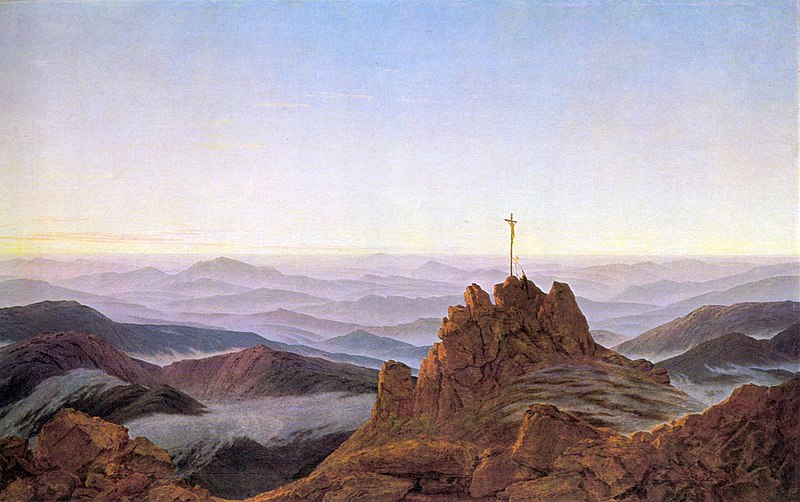
Op182-Friedrich,_Morgen_im_RiesengebirgeMorning on the Riesengebringe, by Caspar David Friedrich (1810)

String Quartet in G major Op.18/2 (1798-1800, Beethoven aged 29)

Dedication Count Johann Georg von Browne
Duration 25′

1. Allegro
2. Adagio cantabile – Allegro – Tempo I
3. Scherzo: Allegro
4. Allegro molto, quasi presto

Listen

written by Ben Hogwood

Background and Critical Reception

‘The jester of the set’, says Daniel Heartz of the second of Beethoven’s first published string quartets. Op.18/2 was actually written third, but is carefully placed by the composer to keep a satisfactory flow between the works. In Germany it acquired the occasional nickname ‘Komplientierquartett’, for what Ludwig Finscher calls the ‘graceful principal theme’. The nickname reflects on the quartet too, ‘not merely to compliment but to greet with formal respect and ceremony’.

Commentators identify more links with the past in this work than the forward looking first – yet the links do not mean the work itself is unadventurous. Finscher writes of how the first movement ‘reaches back beyond Haydn to the preclassical realm, but technically, in its almost parodic succession of two-bar groups and tiny, conventional motives, it is a dazzling tour de force, building on the achievements of the Haydn quartet style and simultaneously providing an ironic comment on them’.

Heartz draws close links with Haydn’s String Quartet Op.33/2, also in G major – and gives several examples on how the first and second movements draw on Haydnesque qualities. Finscher extends his observations, concluding that ‘in artistic skill of that order the work is also a celebration of the level of musical culture in Vienna around 1800’.

Thoughts

It is true that the second of Op.18 is very different from the first – but in a complementary way. The mood is amiable and often comedic, the first violin taking the lead in a cheery second theme, where it ascends to the heights like a bird. Some of the harmonic movements are adventurous in the development, showing that if Beethoven is influenced by Haydn he is channelling the composer’s inventive powers too. The viola and cello take the lead in a striking build to a recap of the main theme.

There are more powers of invention in the slow movement, where tender moments give way to an unexpected, capricious section in the middle. The scherzo third movement is another advance on the traditional minuet, light in mood before cutting to an elusive trio section.

At this point it suddenly feels like the work is finishing, but then Beethoven surges forward with an assertive finale, led off by the cello and featuring busy interactions between the four instruments.

Beethoven has fun with this piece, and given the right performance the listener will do too. The Haydn influences are welcome and well-managed, because the quartet never sounds derivative, and its frequent but subtle inventions keep the listener on their toes. A joy from start to finish.

Recordings used and Spotify links

Quatuor Mosaïques (Andrea Bischof, Erich Höbarth (violins), Anita Mitterer (viola), Christophe Coin (cello)
Melos Quartet (Wilhelm Melcher and Gerhard Voss (violins), Hermann Voss (viola), Peter Buck (cello) (Deutsche Grammophon)
Borodin String Quartet (Ruben Aharonian, Andrei Abramenkov (violins), Igor Naidin (viola), Valentin Berlinsky (cello) (Chandos)
Takács Quartet (Edward Dusinberre, Károly Schranz (violins), Roger Tapping (viola), Andras Fejér (Decca)
Jerusalem Quartet (Alexander Pavlovsky, Sergei Bresler (violins), Ori Kam (viola), Kyril Zlotnikov (cello) (Harmonia Mundi)
Tokyo String Quartet (Peter Oundjian, Kikuei Ikeda (violins), Kazuhide Isomura (viola), Sadao Harada (cello) (BMG)
Végh Quartet (Sándor Végh, Sándor Zöldy (violins), Georges Janzer (viola) & Paul Szabo (cello) (Valois)

The Végh Quartet give a delightful account of this piece, light on their feet and pretty quick, but still with plenty of room for their phrasing. The Tákacs Quartet are often brisk, but similarly enjoyable, while the Quatuor Mosaïques are slower and emphasise the graceful interplay between the quartet. Finally the Tokyo String Quartet are nicely poised and enjoy Beethoven’s flights.

You can chart the Arcana Beethoven playlist as it grows, with one recommended version of each piece we listen to. Catch up here!

Also written in 1800 Krommer String Quartet in A major Op.18/2

Next up String Quartet in D major Op.18/3

Listening to Beethoven #136 – Piano Sonata no.8 in C minor Op.13 ‘Pathétique’

Northern Sea in the Moonlight by Caspar David Friedrich (1823-24)

Piano Sonata no.8 in C major Op.13 ‘Pathétique’ for piano (1798, Beethoven aged 27)

1 Grave – Allegro di molto e con brio
2 Adagio cantabile
3 Rondo: Allegro

Dedication Prince Karl von Lichnowsky
Duration 20′

Listen

Background and Critical Reception

With the Pathétique sonata we arrive at the first true Beethoven heavyweight. The origin of the title – seemingly Beethoven’s own – is unclear. ‘What exactly did he mean by Pathétique?’, speculates Angela Hewitt. ‘The word comes from the Greek ‘pathos’, meaning suffering, experience, emotion. But as William Behrend says in his book on the Beethoven sonatas first published in 1923, ‘it should be understood in an aesthetic sense, as the expression of exalted passion’.

In Beethoven: Anguish and Triumph, Jan Swafford is left in no doubt about the importance of the work. ‘As a revelation of individual character and emotion, it was a kind of democratic revolution in music. And as such, the kind of expression exemplified in the Pathétique became a founding element of the Romantic voice in music.’

The Pathétique returns to C minor, scene of previous fiery triumphs such as the Piano Trio Op.1/3. Here, Beethoven writes a solemn introduction (marked as Grave), which leads to a stormy Allegro. For Daniel Heartz, ‘With its many melodic sighs and ‘speaking’ rhetoric, the Grave takes on the character of an operatic scena presaging the anguished aria to follow’.

The second movement is one of Beethoven’s most treasured slow movements, ‘simple yet profoundly moving’, and it is followed by, as Hewitt says, a ‘wistful, somewhat haunting’ finale.

Lewis Lockwood writes of how ‘the unleashed power of its first movement amazed contemporaries, even those who were becoming aware of Beethoven’s C-minor mood. The strong rhetoric of the Grave introduction dramatically prepared the way for the intense Allegro first movement, which whipped up a storm of excitement not previously heard in his – or anyone else’s – piano sonatas’.

Jan Swafford goes further. ‘From its glowering opening chords, the Pathétique paints pathos like no work before: naked and personal. Here Beethoven found a kind of music that seems not like a depiction of sorrow but sorrow itself. It is the voice that is new in this sonata, the emotional immediacy. The Pathétique did not initiate so much as confirm that Beethoven was bringing to music a new immediacy and subjectivity’. For him, ‘the Pathétique… would endure as the first fully formed avatar of the tension and dynamism Beethoven found in C minor’.

Thoughts

This work is a true landmark in Beethoven’s writing so far. While we have shared his pain in the C minor works – the Cantata on the Death of Joseph II and the Piano Trio Op.1/3 especially – nothing has approached the depth of emotion found here. The Grave is stripped to the bone, pouring its heart out in the spirit of a tragic introduction to a Baroque opera. The Allegro that follows is a whirlwind, and again the piano sounds skeletal in its execution.

The slow movement offers a calm repose, and it is Beethoven’s deepest to date, profound in the extreme and beautifully shaded. No wonder it appears on so many ‘classical contemplation’ playlists and compilations, for time really does seem to stop here. Spotify figures show just how popular it really is.

Beethoven’s return to C minor for the third movement deepens the frown again, though there is a little more light and shade now. Still, the structure is tight, the mood resolute and often stern, and the tension does not let up even through to the last chord. The Pathétique is a deeply serious work from beginning to end, giving us some of Beethoven’s most intensely beautiful music to date.

Recordings used and Spotify links

Emil Gilels (Deutsche Grammophon)
Alfred Brendel (Philips)
András Schiff (ECM)
Angela Hewitt (Hyperion)
Paul Badura-Skoda (Arcana)
Stephen Kovacevich (EMI)
Igor Levit (Sony Classical)

While revelling in the drama, Angela Hewitt highlights a problem for pianists that Beethoven ‘never indicated that the repeat of the exposition should return only to the Allegro section…perhaps he meant us to return to the very beginning and play the Grave once more?’ This is what she chooses to do in her own deeply felt recording.

Emil Gilels reaches profound depths in his reading, especially the majestic first movement, which moves from intense soul-searching to ivory-rattling drama. András Schiff is a compelling guide to the Pathétique, the sharper tone of his piano heightening the drama – as it does with the fortepiano of Paul Badura-Skoda.

You can hear clips of Hewitt’s recording at the Hyperion website

You can chart the Arcana Beethoven playlist as it grows, with one recommended version of each piece we listen to. Catch up here!

Also written in 1798 Haydn Die Schöpfung (The Creation)

Next up March for Wind Sextet in B-flat major(‘Grenadiermarsch’)

Listening to Beethoven #128 – Piano Sonata no.7 in D major Op.10/3

friedrich-coastal-landscape
Coastal Landscape by Caspar David Friedrich (c1798)

Piano Sonata no.7 in D major Op.10/3 for piano (1798, Beethoven aged 27)

1 Presto
2 Largo e mesto
3 Menuetto: Allegro
4 Rondo: Allegro

Dedication Countess Anna Margarete von Browne
Duration 25′

Listen

Background and Critical Reception

The third of the sonatas published as Op.10 in September 1798 is, for Lewis Lockwood, ‘the grandest and most powerful of the group’. The word also appears in the praise given to the piece by Beethoven’s contemporary Carl Czerny, who dubbed it ‘a grand and significant piece’.

His label is referred to by Angela Hewitt in her booklet notes for the sonata recordings on Hyperion, though she goes further to call it ‘the first masterpiece in the cycle of sonatas’.

Commentators are united in praise and an awestruck respect for the great slow movement. For Lockwood, it ‘breathes an air of desolation whose only parallel from the time is the great slow movement of the Op.18/1 quartet, a movement we know Beethoven associated with the tomb scene in Romeo and Juliet.’ Hewitt quotes Donald Tovey’s performance advice in full, which states that if you as a pianist ‘simply make sure that you are playing what is written you will go far to realize the tragic power that makes this movement a landmark in musical history.’

The second movement casts a lasting shadow over the third and fourth, though Daniel Heartz enjoys the ‘lyrical and lovely’ third, and the fourth, whose theme ‘never reaches a very firm answer in the way of a thematic-harmonic conclusion until the last moment, when the questions are finally transformed into an answer – a very Haydnesque ploy that is akin to pulling an ace from one’s sleeve to end the game’.

Thoughts

This is indeed the sonata that makes the strongest emotional impression so far – and an awful lot of that is down to the slow movement. Yet the impact of that funereal tribute is even more powerful because it follows on the heels of the first movement’s bravura, with glittering scales as both hands chase each other around the keyboard.

Because of this all energy feels spent when the second movement casts its mood of contemplation and sorrow. Time seems to stop, and though there is a little hope in the central section, where an idea seems to grow from the depths and climb slowly up the piano, a bell-like tolling still runs ominously in the background.

Consolation is sought and almost found in the Menuetto, and its bright and elegant interaction between the hands and cheery trio. The Rondo theme initially feels short changed, but Beethoven pulls out his trick of making a great deal from minimal material. The stop-start nature suggests he may have written it in a single improvisation, moving between tiny melodic cells and big, grand gestures showing off the player’s virtuosity. It is ultimately a hard-fought victory in a piece of highs and lows.

Recordings used and Spotify links

Emil Gilels (Deutsche Grammophon)
Alfred Brendel (Philips)
András Schiff (ECM)
Angela Hewitt (Hyperion)
Paul Badura-Skoda (Arcana)
Stephen Kovacevich (EMI)
Igor Levit (Sony Classical)

Again there are some special performances to treasure of this sonata. Perhaps inevitably Emil Gilels finds the deep tragedy of the slow movement, time seemingly suspended in his traversal of grief. Alfred Brendel offers the ideal mix of elegance and virtuosity, his third movement emerging with a smile after the thoughtful second. A flurry of notes on Paul Badura-Skoda’s dfgd piano threaten to take the first movement out of his reach, but this is an edge of the seat recording that proves to be very enjoyable. Its second movement is on the quick side but the left hand chords are chilling on the fortepiano. András Schiff feels too quick here in comparison to Claudio Arrau, Igor Levit and Stephen Kovacevich, all of whom find a special and profound atmosphere. Angela Hewitt is slowest of all, but balances the tension beautifully with the eventual release of the Menuetto.

You can hear clips of Hewitt’s recording at the Hyperion website

You can chart the Arcana Beethoven playlist as it grows, with one recommended version of each piece we listen to. Catch up here!

Also written in 1798 Haydn Die Schöpfung (The Creation)

Next up Clarinet Trio in B flat major Op.11