
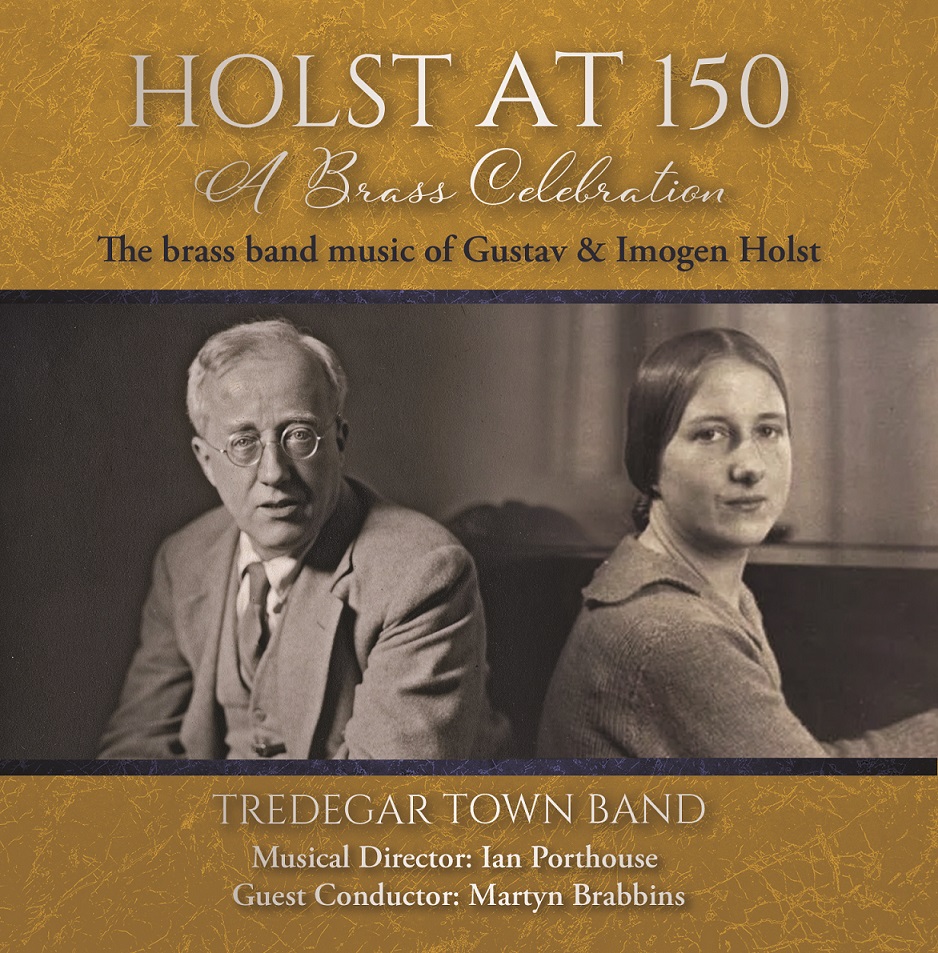
Gustav Holst
Suites for Military Band Op.28:
no.1 in E flat major (1909)
no.2 in F major (1911)
The Perfect Fool Op.39 (1918-22) – Ballet Music (all arr. Littlemore).
A Fugal Overture Op.40 no.1 (1922; arr. Wheeler)
Mr Shilkret’s Maggot (1932; arr. Hindmarsh)
A Moorside Suite (1928)
Imogen Holst
The Unfortunate Traveller (1929; ed. Hindmarsh)
Glory of the West (1969)
Tredegar Town Band / Ian Porthouse and Martyn Brabbins (A Moorside Suite)
Doyen DOYCD435 [74’37’’]
Producer Adam Goldsmith Engineer Daniel Lock
Recorded 18-19 May 2024 at Jack Williams VC Hall, The Works, Ebbw Vale
Reviewed by Richard Whitehouse
What’s the story?
The 150th anniversary of his birth, and 50th anniversary of his death, is an ideal opportunity to reassess the legacy of Holst in all its variety; not least with this anthology of his music for brass band that also finds space for her contribution to the medium by his daughter Imogen.
What’s the music like?
Typical and inimitable Holst – but, as he only wrote one work for the medium, much of this release consists of arrangements. The two Suites for Military Band were obvious candidates: the First Suite’s Chaconne emerges with renewed pathos, as too its whimsical Intermezzo or rumbustious March; no less idiomatic is the Second Suite with its recourse to traditional tunes in such as the effervescent initial March, then the final Fantasia with its memorable rendering of the Dargason. Philip Littlemore is an expert arranger here as of the Ballet Music from the opera The Perfect Fool – the sections that evoke ‘earth’ and fire’ lacking a degree of panache, but that of ‘water’ hardly less magical in this guise. Alastair Wheeler proves no less adept in capturing the impetus of A Fugal Overture, while Paul Hindmarsh gives what ought to be a new lease of life to the ‘jazz-band piece’ designated Mr Shilkret’s Maggot praised but never played by its commissioner. Imogen Holst’s 1967 orchestral arrangement as Capriccio rescued it from oblivion, but this new incarnation makes even more of its recalcitrant humour.
Mention of Imogen leads one to her pieces for brass band, both included here. Compact and characterful, her suite The Unfortunate Traveller was initially more successful as transcribed for strings, though Hindmarsh’s edition adds percussion and clarifies the brass texture as was doubtless intended. Its sure highlight is the winsome Interlude, conjuring a discreet though tangible profundity subsequently glimpsed with The Glory of the West – seven variations on said Morris Dance which confirms music written for amateurs need not involve compromise.
This just leaves A Moorside Suite, a work such as transformed the standing of test-pieces for brass band with that understated acuity surely unique to this composer. Whether in its gently satirical Scherzo, wistful Nocturne whose gradual building to a soulful culmination makes for the highlight of this collection, then a March which fuses energy and eloquence to round off the sequence with irresistible elan – this is Holst at his most engaging and communicative. Music, moreover, Martyn Brabbins clearly relished the chance to conduct for this recording.
Does it all work?
Absolutely, both in this piece and elsewhere, as long-standing music director Ian Porthouse puts the Tredegar Town Band exactingly and admirably through its collective paces. At the forefront of the modern brass-band movement, the latter is ideally placed to find this music an audience outside of its customary domain. That it succeeds is clear from the fact that one listens to this programme without thought of the medium or its context; rather, the emphasis is on those qualities of inspiration and substance as are hallmarks of any worthwhile music.
Is it recommended?
Indeed. Recorded with requisite clarity and definition, and featuring informative annotations by Hindmarsh and Littlemore, this is a significant release in Holst’s anniversary year and an evident first choice for acquiring a representative cross-section of his music in this medium.
Listen & Buy
You can listen to samples and explore purchase options on the World of Brass website Click on the names for more on conductors Ian Porthouse and Martyn Brabbins, the Tredegar Town Band, and for more on the composers Gustav Holst and daughter Imogen Holst
Published post no.2,307 – Friday 20 September 2024
 Arcana.fm