
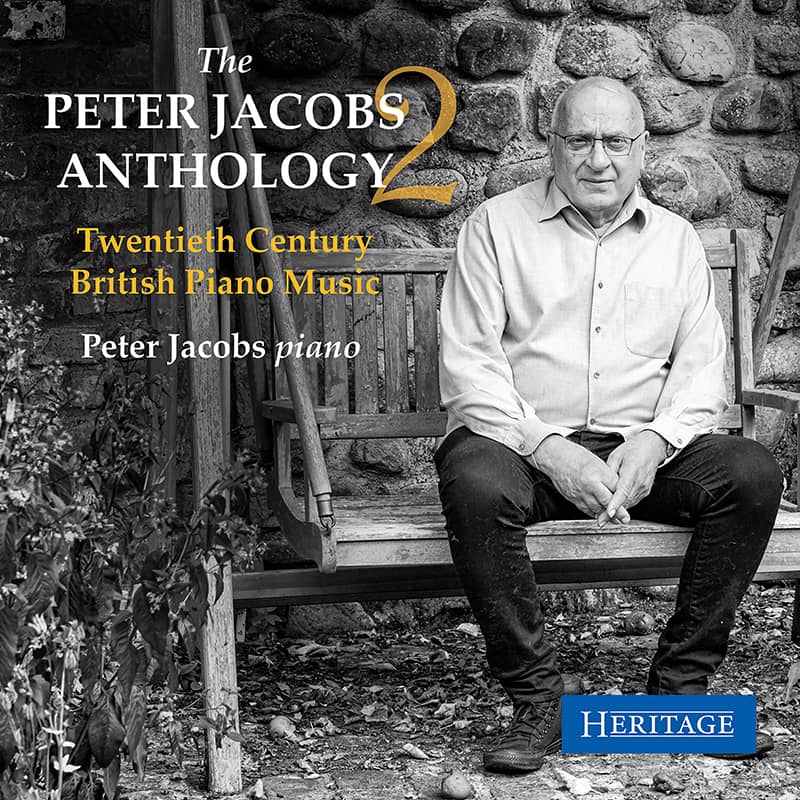
On Record – The Peter Jacobs Anthology Vol. 2 – Twentieth Century British Piano Music (Heritage)

Coleridge-Taylor Petite Suite de Concert Op.77 (1911)
Cooke High Marley Rest (1933)
Delius Mazurka and Waltz for a Little Girl RTIX/7, 1 & 2 (1922-3)
Headington Toccata (1963)
Rubbra Eight Preludes Op.131 (1967)
Scott Lotus Land Op.47/1 (1905)
Armstrong Gibbs Lakeland Pictures Op.98 (1940) – no.2, After Rain (Rydal Beck); no.8, Quiet Water (Tarn Howe)
Baumer Idyll (1935)
Mayer Calcutta-Nagar (1993)

Peter Jacobs (piano)

Heritage HTGCD131 [73’30″]
Producer & Engineer Paul Arden-Taylor

Recorded 14 & 16 September 2014 at Wyastone Concert Hall, Wyastone Leys, Monmouth

Reviewed by Richard Whitehouse

What’s the story?

Heritage extends an already extensive discography of British music with its follow-up to the Peter Jacobs Anthology, a further volume featuring collections of or standalone miniatures with a wide range of musical idioms given focus through the persuasiveness of the pianism.

What’s the music like?

Among the miscellaneous pieces included here are Greville Cooke’s ruminative ‘portrait’ of the home of pianist (and his former teacher) Tobias Matthay, Delius’s respectively pert and fey offerings, or Christopher Headington’s scintillating study for John Ogdon. Cyril Scott’s evergreen is treated to a subtly understated reading, while two out of a set of eight by Cecil Armstrong Gibbs provide enticing evocations of Rydal Beck then Tarn Howe – their innate Englishness sounding removed from the overtly Russian manner of that from Cecil Baumer.

Forming the backbone of this collection are three sets that in themselves attest to the variety of the music featured. Best known in its orchestral guise (a recording of which can be found on Heritage HTGCD249), Samuel Coleridge-Taylor’s Petite Suite de Concert is light music of a superior kind – witness its flighty initial Caprice, its ingratiating Sonnet or its lively closing Tarantelle, though its ostensible highlight is Demande et Réponse whose alluring sentiment helped with keeping the composer’s memory alive prior to his belated rediscovery.

Other than figuring among its composer’s later works, the Eight Preludes by Edmund Rubbra could hardly have been more different. As with his Eighth Symphony written soon afterward, these short while arresting pieces likewise focus on specific musical intervals rather than any overall key scheme, though their cohesiveness heard as an integral sequence could never be in doubt. Introspective without being inscrutable, this is wholly absorbing music and Jacobs accords ample justice to what is only the second complete recording this set has yet received.

As the most unlikely inclusion, John Mayer’s Calcutta-Nagar proves nothing less than a total delight. Known primarily for his syntheses of Indian and European elements, notably through the group Indo-Jazz Fusions, Mayer wrote extensively for Western media with this collection a notable instance. Only two of its 18 pieces last over a minute, yet their capturing of places recalled from the Calcutta of the composer’s youth is absolute. Jacobs notes his favourite as being the 13th (Kali Temple), but listeners will doubtless come up with their own favourites.

Does it all work?

Yes, whether as a judiciously planned collection or an anthology from which one can select individual items as preferred. The three collections are each among the most distinctive of its kind, while they and the various individual pieces provide ready-made encores in recital. Evidently this is music which Jacobs has long included in his repertoire, the performances exuding that combination of technical finesse allied to a probing insight as have long been hallmarks of his interpretations. Those who are unfamiliar with this music are in for a treat.

Is it recommended?

Indeed, not least as the sound has a combination of clarity and warmth ideal for piano music. The pianist pens informative notes, and one hopes that there will be further such anthologies. Meanwhile, Jacobs approaches his 80th birthday (this August) with his pianism undimmed.

Listen & Buy

For purchase options, you can visit the Heritage Records website

Published post no.2,448 – Monday 17 February 2025

Playlist – Sarah Beth Briggs

It gives us great pleasure to welcome pianist Sarah Beth Briggs as a guest curator for the Arcana playlist.

Sarah releases her new album Variations on Friday 24 March, a collection of works in the form by Mozart, Beethoven, Mendelssohn and Brahms. It complements a discography for AVIE that already boasts The Austrian Connection and discs of works for piano solo by Schumann and Brahms, and piano trios by Gál and Shostakovich as part of the Briggs Piano Trio.

We asked her for a blend of her current listening and one piece inspired by the Variations album – and I think you’ll agree she has come up with something rather special in the form of Edmund Rubbra’s rare but strikingly original orchestration of BrahmsVariations on a theme of Handel. Here it is in the only available current recording, conducted by Neeme Järvi:

As to her current listening, Sarah gives us a trio of very fine chamber works from the 19th century, Beethoven and Schubert to be precise, and the music of Hans Gál, finally emerging into the public consciousness – his very fine Cello Concerto:

We end with peerless jazz, the Oscar Peterson Trio and their wonderful Night Train

Our grateful thanks to Sarah – do have a listen on the Spotify link below:

BBC Symphony Orchestra & Martyn Brabbins – Havergal Brian’s ‘Sinfonia Tragica’ + Rubbra & Grøndahl

martyn-brabbins

Richard Whitehouse on the BBC Symphony Orchestra, conducted by Martyn Brabbins (above) in a concert recorded at the orchestra’s home in Maida Vale

Rubbra Symphony No.11 Op. 153 (1979)

Grøndahl Trombone Concerto (1924)

Brian Symphony No.6 Sinfonia tragica (1948)

Jörgen van Rijen (trombone), BBC Symphony Orchestra / Martyn Brabbins

Maida Vale Studios, Tuesday 11 October

The BBC Symphony continues to schedule some of its most distinctive concerts at its Maida Vale studios, and this afternoon saw Martyn Brabbins at the helm for a sequence of English and Danish music – all being pieces that are rarely, if ever, encountered in UK concert halls.

When Edmund Rubbra’s Eleventh Symphony received its premiere at the 1980 Proms, it must have felt appreciably more distant in aesthetic than it now does. Yet timelessness was central to the composer’s music; nowhere more than this 18-minute summation of both his symphonic and orchestral thinking. Its two continuous sections – a ‘moderate’ Andante, then a ‘calm and serene’ Adagio – offer only incremental expressive change, though the cumulative emotional impact as Rubbra evolves intervallic motifs via a seamless process of developing variation is undoubted; as also his fashioning of alternately diaphanous and granitic instrumentation. This latter was superbly rendered by the BBCSO, with Brabbins attentive to the music’s wealth of detail and its by no means untroubled emergence towards an eloquent plateau of tranquillity.

jorgen-van-rijenNext came a welcome revival for the Trombone Concerto by Launy Grøndahl, best known as a conductor (he premiered Robert Simpson’s First Symphony in Copenhagen) but who, on the basis of those pieces to have been recorded, evinced a modest while appealing compositional talent.

The outer movements of his concerto alternate between trenchant and lyrical ideas, the latter having a deftness to offset the hints of rhythmic stolidity elsewhere, but it is the central Andante – in its initial blues-inflected theme and resourceful deployment of piano – that most readily confirms its composer’s prowess. Here, as throughout the piece, Jörgen van Rijen (above) was unfailingly perceptive – underlining the extent to which Grøndahl, a violinist by training, had mastered the technical range of an instrument whose overall potential remains to be realized.

During the break, Van Rijn performed Slipstream by the German-born composer and metal guitarist Florian Magnus Maier (b1973) – its interplay of live playing and recorded repetition, via a loop-station operated by the musician, affording a fresh twist to Reich-style minimalism.

Brabbins has championed Havergal Brian extensively on disc; his live advocacy so far limited (!) to a revival of the Gothic symphony at the 2011 Proms. At just under 20 minutes, Sinfonia tragica comes near the opposite end (albeit conceptually) of his orchestral output. Envisaged as the prelude to an opera on J. M. Synge’s Deirdre of the Sorrows that was soon abandoned, it was not incorporated into his canon for two decades, yet its symphonic status is not hard to discern.

The BBCSO duly had the measure of its progress, as unpredictable as it is inevitable – from the fugitive gestures of its opening section, through the (surprisingly?) long-breathed melodic writing at its centre, to the eruptive activity and stoic processional of its final pages. A persuasive reading of a piece that ranks among its composer’s most immediate utterances.

Indeed, this was a persuasive concert overall – one that made light of the turgid accusations sometimes levelled at Rubbra, or the unplayability too often associated with Brian. Hopefully the BBCSO and Brabbins will continue their exploration of this rewarding music at future studio concerts.

This concert will be broadcast on BBC Radio 3 during November – further details to follow