The latest addition to the English Symphony Orchestra library of online music is the first performance of Philip Sawyers‘ major choral work, Mayflower on the Sea of Time.
With its ‘luminous and ecstatic choruses’ picked out by Richard Whitehouse in his review of the initial concert, this is an affirmative and major piece by one of the finest contemporary English composers.
Soprano April Fredrick and baritone Thomas Humphreys are joined by the ESOChorus and English Symphony Orchestra in the premiere from Worcester Cathedral, given on 17 June this year.
April Fredrick (soprano), Thomas Humphreys (baritone), ESO Chorus, English Symphony Orchestra / Kenneth Woods
Dvořák Symphony no.9 in E minor Op.95 ‘From the New World’ (1893) Sawyers Mayflower on the Sea of Time (2018) [World Premiere]
Worcester Cathedral Saturday 17 June 2023
Reviewed by Richard Whitehouse
This final concert of the season by the English Symphony Orchestra brought us the premiere of a piece delayed from three years ago. Philip Sawyers’ Mayflower on the Sea of Time was to have been launched at the Three Choirs Festival in April 2020, but the pandemic derailed this as so many other events. Happily, the tenacity of conductor Kenneth Woods has paid off such that the composer’s largest work so far was finally heard, and in the venue originally intended, making for a notable addition to the English choral tradition and one wholly on its own terms.
Commissioned to mark the 400th anniversary of the sailing of the Mayflower from Leiden to Plymouth and thereby founding the United Sates of America, this is an oratorio in concept but equally a choral symphony in its overall design and thematic cohesion. Its libretto, mainly by the artist Philip Groom, features set-pieces for various figures from the Old and New Worlds duly taken by soprano and baritone soloists (those for treble being allotted to sopranos in the chorus), but these along with ones for chorus are drawn into an inherently musical evolution.
Formally, there are four continuous parts. Persecution and Journey, a sonata design such as informs the Pilgrims’ flight from religious persecution and their decision to cross the Atlantic; Arrival in the New World, a slow movement charting their embarkation and tentative initial interaction with native peoples; Survival and Making our Community, a scherzo where the Pilgrims’ industriousness and idealism quickly becomes its own justification; and Our New World, a rondo-finale whose looking to the future is framed by choruses of growing fervour.
As befits such a work, the choral writing is both extensive and resourceful – not least when it elides between depicting Pilgrims or Natives, and that of a more abstract commentary. No less assured, the writing for soprano and baritone allows Sawyers’ lyrical impulse free reign – not least in extended sections toward the end of the second and fourth parts; the latter, especially, rendering comparable passages by Delius or Tippett from a perspective wholly of the present. On either side, luminous and ecstatic choruses accentuate an essentially affirmative message.
The contributions of April Fredrick (no stranger to Sawyers via her long association with the ESO) and Thomas Humphreys could hardly be faulted for commitment or insight, while that of the ESO Chorus exuded a power and immediacy amplified by the resonance of Worcester Cathedral’s acoustic as to belie its relatively modest numbers. The ESO gave its collective all throughout, projecting the textural intricacy and emotional heft of music whose longer-term formal integration was securely conveyed through Woods’s precise yet unobtrusive direction.
Before the interval, Woods gave a notable account of Dvořák’s Ninth Symphony. The poised anticipation of its introduction and visceral drama of its coda were highlights of the opening Allegro, proceeded by a Largo of an eloquence epitomized by rapt cor anglais playing from Louise Braithwaite. Contrast between the incisiveness of the Scherzo’s outer sections and the lilting delicacy of its trio was pointedly underlined, then the final Allegro surged onward to a coda paying tribute to 19th-century symphonism while blazing a trail for what was to come.
Noriko Ogawa (piano), English String Orchestra / Kenneth Woods
Brahms Tragic Overture, Op. 81 (1880) Grieg Piano Concerto in A minor, Op. 16 (1868) Sibelius Symphony No. 5 in E flat, Op. 82 (1915-19)
Town Hall, Cheltenham Sunday 16 April 2023
Reviewed by Richard Whitehouse
The English Symphony Orchestra’s latest concert had no English (or British) connection and no premieres or unfamiliar music. In short, a mainstream sequence of overture, concerto and symphony which worked as a programme simply because these pieces went so well together.
Although it has never lacked for performances, Brahms’s Tragic Overture remains among his more unusual conceptions: a concert overture whose deftly modified sonata design admits an element of evocation as if some intangible drama were being played out. It was to the credit of this performance when such subjection offset an otherwise unwavering formal trajectory, Kenneth Woods integrating the speculative central episode with a conviction that made the heightened reprise of the main theme the more telling for its implacably wrought fatalism.
Brahms’s writing of an overture with components as if ‘in the wrong order’ made an unlikely link to the Piano Concerto by Grieg, which still offers a wealth of surprises in a sympathetic reading. This it received from Noriko Ogawa – bringing out the unforced eloquence of what, the opening Allegro in particular, is much more than a loose sequence of enticing melodies in search of coherence. As her imaginative take on its cadenza underlined, Grieg left nothing to chance as the movement turns decisively full circle. With its easeful horn melody (courtesy of James Topp) and alluring solo response, the Adagio exuded an understated allure, and if the finale lacked for any rhythmic verve, the central section with its rapt flute melody (courtesy of Laura Jellicoe) sounded as affecting as its heightened peroration at the close was majestic.
The ESO and Woods are currently working towards a Sibelius cycle and their account of the Fifth Symphony had all the hallmarks of complete identity with, here again, a determination not to take to take anything in so familiar a work for granted. This was especially notable in the opening movement – its segueing between what began as two separate entities rendered with due seamlessness. Not least that central climax, out of which the scherzo emerged then proceeded to accrue motion imperceptibly through to a coda whose velocity was irresistibly evident. Much more than a whimsical interlude, the Andante had keen appreciation of those ambiguous shadows which inform its progress at crucial junctures, yet without undermining that guileless essence to the fore in the closing pages with their felicitous woodwind playing.
Making an attacca (and rightly so) directly into the finale, Woods brought out the productive contrast between its ideas – thus, the initial theme with its onrushing strings, then the ‘swan melody’ with its harmonic allure and intricate textural layering abetted here by the up-front acoustic of Cheltenham Town Hall. Just how so tensile and compact a movement generates an apotheosis of such grandeur cannot easily be explained, yet such an outcome was tangible as those concluding chords emerged with an inevitability as undeniable as it was heartening.
They certainly set the seal on an impressive performance which was warmly received by the sizable house. The ESO can be heard in Worcester early next month with assistant conductor Michael Karcher-Young, then with Woods in June for the latest edition of The Elgar Festival.
Filmed at Worcester Cathedral, Saturday 4 June 2022
by Richard Whitehouse
The English Symphony Orchestra’s concerts at last year’s Royal Jubilee Elgar Festival have already yielded several online performances of note, with In the South perhaps the finest yet in terms of vindicating a work that can all too easily fall victim to its seeming ‘indulgencies’.
The main issue is in setting a tempo flexible enough to accommodate this concert overture’s extended sonata design without it becoming episodic. At around 24 minutes, this unhurried take was mindful of Worcester Cathedral’s expansive acoustic and utilized it to the music’s advantage. The surging initial theme, its speculative transition and suave second theme duly emerged with a formal continuity – the underlying tension carried through to a development whose impulsiveness was maintained despite (even because of?) the intervening first episode.
Evoking the grandeur of ‘empires past’, this episode necessitates astute handling so that its implacability avoids bathos. Kenneth Woods judged it accordingly, and if his tempo for the second ‘canto populare’ episode felt just a little reticent, its expressive raptness (along with Carl Hill’s playing of its indelible viola melody) more than compensated. Nor was there any loss of continuity across the reprise of the opening themes, with Woods’ gradual building of momentum at the start of the coda ensuring an irresistible but never overbearing apotheosis.
Certainly, the response suggested anyone who may previously have harboured doubts about this piece was won over on this occasion. Further evidence of this orchestra and conductor’s empathy with this music as augers well for the First Symphony at this year’s Elgar Festival.
Esther Abrami (violin), English String Orchestra / Kenneth Woods
Saxton Scenes from the Epic of Gilgamesh (2022-3) [World Premiere] Bruch Scottish Fantasy in E flat (1880) Mendelssohn Symphony no.3 in A minor Op.56 ‘Scottish’ (1841-2)
Sheldonian Theatre, Oxford Friday 10 March 2022
Reviewed by Richard Whitehouse
There cannot be any more historic or atmospheric performance venues than the Sheldonian Theatre in Oxford, which is still going strong after over 350 years and the setting for this latest contribution to the English Symphony Orchestra’s ‘21st-Century Symphony Project’.
Speaking only recently, Robert Saxton stated a reluctance to call his Scenes from the Epic of Gilgamesh a symphony and yet the piece, a result of many years’ thinking about the musical treatment right for one of the oldest written texts, has a formal cohesion and expressive unity comparable to previous instalments in the ESO’s project. Scored for late Classical forces of pairs of woodwind, horns and trumpets with timpani and strings, its textural clarity serves to imbue any illustrative aspect with an abstract focus duly sustained across the five movements.
Charting a deft course over its narrative, the work heads from the fluid motion of a Prologue to The Journey to the Forest of Cedar, whose passacaglia-like evolution finds this composer at its most harmonically alluring, then to From dawn to dusk and a scherzo as tensile as it is evocative. Lament distils a tangible emotional force into its gradual yet inexorable build-up, moving straight into an Apotheosis which opens out the melodic content of earlier ideas and so brings a powerful culmination as the hero is forced to seek his immortality by other means.
More overtly tonal it may have become, Saxton’s music still presents considerable challenges technical and interpretive. Suffice to add these were met with finesse and no little conviction by Kenneth Woods (above) and the ESO who, having previously recorded this work for future release, were fully conversant with its elusive while always approachable idiom. Almost four decades on from the flamboyant pieces which helped establish his name, Saxton revealed an orchestral mastery that will hopefully find an outlet in further such pieces – whether or not ‘symphonic’.
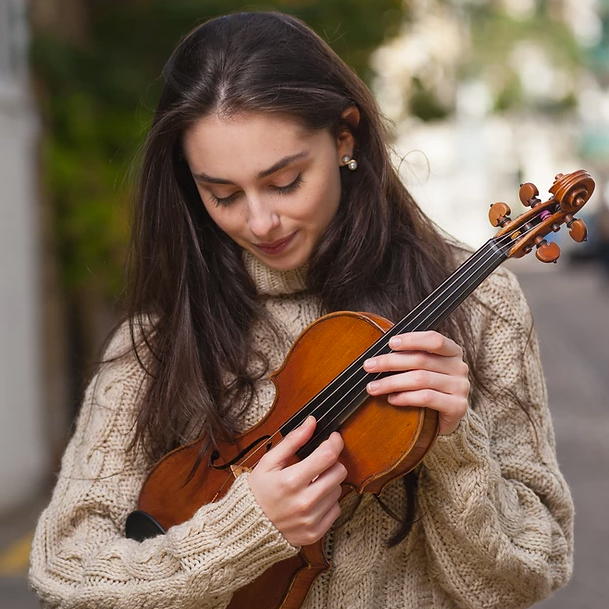
Tonight’s concert was also notable for featuring the ESO’s new Creative Partner and Artist in Residence – violinist Esther Abrami (above), her presence on social media enhanced by the release of her eponymous debut album for Sony. Stylishly attired (with an image that, for older readers, might recall Audrey Hepburn), she gave an account of Bruch’s Scottish Fantasy at its best in the transition from sombreness to eloquence of its Introduction and high-flown sentiments of an Andante in which the composer’s recourse to folk melodies is at its most felicitous. Before it, the Scherzo ideally needed more incisiveness for its engaging humour fully to register, with the final Allegro (given in abbreviated form) rather less than ‘warlike’ – though its mellifluous second theme enabled Abrami to conjure a tonal warmth which was never less than appealing.
After the interval, the ESO came fully into its own with an impressive take on Mendelssohn’s ‘Scottish’ Symphony. Whatever its genesis in his tour of that country when just 20, the work is demonstrably that of a composer who, having reached a creative mid-point, surveys his many successes but also failings. Hence the fatalistic aura such as informs the opening movement’s introduction or the tense agitation of its main Allegro – both of which were palpably brought out by Woods, who then gave the brief if scintillating scherzo its head. The highlight was an Adagio whose constant pivoting between pathos and anguish was graphically stated – aided by an orchestral discipline no less evident in the final Allegro, its martial overtones carrying through to a pause in which the decision to opt for tragedy or triumph is held in the balance.
That the work closes in triumph has often been felt its downfall but, as conveyed by Woods at a swift if not inflexible tempo, such an apotheosis is one of determination or even defiance in the face of whatever is to come. It certainly brought this concert to a memorable conclusion.





 Arcana.fm