In concert – Zoë Beyers, English Symphony Orchestra / Kenneth Woods: Celebrating the Queen’s Platinum Jubilee

Beethoven Egmont, Op. 84 – Overture (1809-10)
Elcock Violin Concerto, Op. 13 (1996-2006) [UK premiere]
Vaughan Williams The Lark Ascending (1914/20); Symphony no.5 in D major (1938-43)

Zoë Beyers (violin), English Symphony Orchestra / Kenneth Woods

Routh Hall, Bromsgrove School
Friday 27 May 2022

There will be many concerts over the next fortnight celebrating Queen Elizabeth II’s Platinum Jubilee, but few (if any) of more substance than that given tonight by the English Symphony Orchestra with its principal conductor Kenneth Woods, taking place on the attractive campus of Bromsgrove School some miles from Birmingham.

It might not have been written for this occasion, but the Violin Concerto by the ESO’s current composer-in-association Steve Elcock (above) was no less impressive for that. This marks something of a transition from those less ambitious pieces written for local musicians and the symphonic works now being recorded to great acclaim. It opens with an Allegro vivo whose rhythmic energy is maintained throughout, yet with enough expressive contrast for its second theme to assume greater expressive emphasis in the reprise. The highlight is a Molto tranquillo whose haunting main theme, initially unfolded by the soloist over undulating upper strings in a texture inspired by change-ringing techniques, is a memorable inspiration. A pavane-like idea later comes into focus and the closing stage, opening onto an eloquent plateau before evanescing into silence, lingers in the memory. The finale is a Passacaglia whose theme accelerates in five variations from Andante to Presto, culminating in a ‘cadenza’ for violin and timpani then a decisive pay-off.

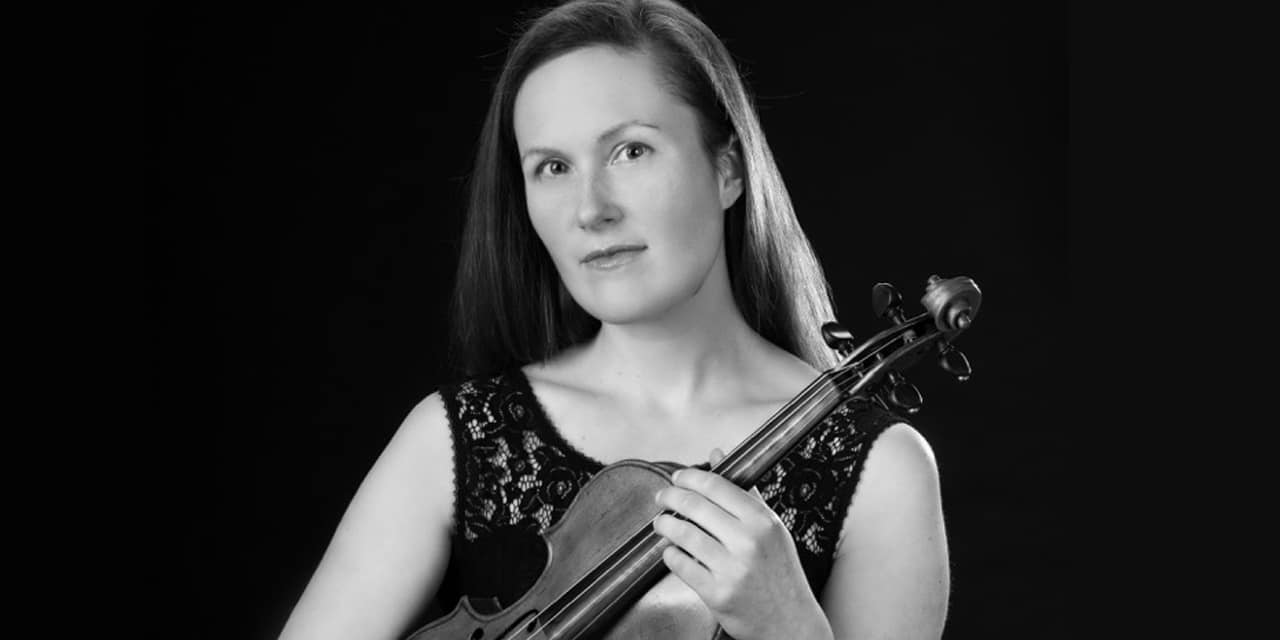
A tough challenge, indeed, for any soloist and one which Zoë Beyers met with assurance over its 30-minute course. Aside from its sheer velocity the first movement is notable for a close-knit interplay between soloist and orchestra that was brought off with admirable precision, while the modal subtleties of the slow movement were rendered as enhancements to its overall tonal trajectory. Aside from a slight falling away of tension toward its centre, the finale saw the piece to a forceful close. Good to hear these performers recorded it prior to this performance, as a coupling to the Eighth Symphony that the ESO premiered last year, and which should be released over the coming months.

Beyers returned after the interval to launch a Vaughan Williams second-half (this year being the 150th anniversary of his birth) with The Lark Ascending. Easy to take for granted now that it is so frequently performed, the piece can still work its magic in an attentive rendering such as this. The underlying tempo might have been on the slow side, but the elegance and poise invested into the solo line were not to be gainsaid, nor was the translucency of orchestral textures which Kenneth Woods shaped with due restraint through the folk-like central section then into the easeful closing pages. Suffice to add that the unaccompanied final bars held those present spellbound with their artlessness.

There was at least as much to admire in the reading of VW’s Fifth Symphony which here followed on inevitably. A steady overall tempo for the Preludio did not exclude a palpable accumulation of energy in its development, nor a build-up of real fervency with the thrilling re-entry of its second theme. Understated it may be, but the Scherzo is replete with rhythmic quirks and while these were not always ideally negotiated, the music’s sardonic humour and ultimate evaporation were tellingly rendered. Doubtless this work’s emotional heart, the Romanza was admirably realized in its gradual coalescing of hymnal and folk-inflected elements towards a nobly wrought apex, but Woods kept enough in reserve so the final Passacaglia never risked becoming an anti-climax. It earlier stages conveyed  an emotional release as is countered by the ensuing anxiety then fateful reappearance of the work’s opening theme, subsiding into a coda which feels as much a benediction now as when it was first heard almost eight decades ago.

Beethoven‘s overture to Goethe’s Egmont might have seemed anomalous in this context but, as Woods pointed out in his opening remarks, the heroes and villains of 16th-century ‘Spanish Netherlands’ were not so far removed from those of today and, as the heady closing pages reminded us, triumph over adversity can never be taken for granted.

For further information on Steve Elcock, click here to visit his dedicated site, and for more on Vaughan Williams click here. To find out more about the artists, click on the names for more on Zoë Beyers, Kenneth Woods and the English Symphony Orchestra.

Online concert – English Symphony Orchestra / Kenneth Woods: Composer Portrait – Walter Arlen

Walter Arlen
Songs of Songs (1955)
The Poet in Exile (1991)

Anna Huntley (mezzo-soprano), Gwilym Bowen (tenor), Thomas Mole (baritone), BBC National Chorus of Wales, English Symphony Orchestra / Kenneth Woods

Studio recording at BBC Hoddinott Hall, Cardiff, 17-20 February 2022

by Richard Whitehouse

Although he is likely best known by his trenchant music criticism for the Los Angeles Times, Vienna-born Walter Arlen has made a distinguished contribution to music administration and is increasingly being recognized as a composer. Several releases of his songs and piano music can be heard on the Gramola label, and this latest of the English Symphony Orchestra online concerts provides a welcome introduction to two of his works that feature orchestra – the one drawing on ancient Jewish sources with the other on poems from a leading modern author.

Whether The Song of Songs is indeed harbinger of monogamy in the Judeo-Christian moral code, it contains some of the eloquent expression in either of the Biblical testaments and has long provided a potent inspiration for musical treatment. In just under 30 minutes, Arlen’s ‘dramatic poem’ takes in the main narrative – the lively opening chorus features much sub-divided writing for female chorus underpinned by incisive orchestral textures. As the piece unfolds, it becomes evident that emotional emphasis is placed upon the solo contributions – whether those of King Solomon as sung with burnished warmth by Thomas Mole, those of the Shepherdess rendered with winsome poise and not a little insouciance by Anna Huntley, or those of the Shepherd which Gwilym Bowen here projects with no mean virility but also tenderness. Nor is the BBC National Chorus of Wales found wanting in passages with textural intricacy and intonational accuracy at a premium. If the final resolution does not bring the expected closure, the direct and unaffected appeal of this setting certainly warrants revival.

Yet the real discovery is The Poet in Exile, a song-cycle to texts by the Polish-American author and cultural eminence Czesław Miłosz. For all its undoubted depth and profundity, these texts are not easily rendered in musical terms, and it is to Arlen’s credit that he goes a considerable way towards elucidating them thus. As the latter states, these poems ‘‘dealt with situations echoing my own remembrance of things past’’; a quality which holds good from the trenchant rhetoric of ‘Incantation’, via the sombre rumination of ‘Island’ then the whimsical elegance of ‘In Music’ and controlled fervour of ‘For J.L.’ (with its distinctive obligato for harpsichord), to the confiding intimacy of ‘Recovery’. Inquiring listeners may already have heard these songs with piano on one of the Gramola releases with Christian Immler accompanied by Danny Driver (GRAM98946), but this version – as orchestrated by Kenneth Woods after an arrangement by Eskender Bekmembatov – makes for a richer and wider-ranging context for a vocal line projected with real assurance by Thomas Mole.

Throughout these works, the musicians of the ESO are heard to advantage in the spacious acoustic of Hoddinott Hall and are directed by Woods with sure sense of where to place the emotional emphasis – especially important in conveying the meaning of the songs. If not a major voice, Arlen’s output is always approachable and often thought-provoking. Anyone who has encountered it will enjoy getting to know his music on a larger scale and hearing it played so persuasively: a worthy present for the composer in advance of his 102nd birthday.

These works are available for free public viewing from 13-17 May on the English Symphony Orchestra website

For further information on Walter Arlen, click here – and for the appropriate Gramola Records link click here. Meanwhile click on the names for more on Czesław Miłosz, the English Symphony Orchestra and Kenneth Woods

Online concert – English String Orchestra / Kenneth Woods: Elgar Festival Highlights 2 – Elgar’s Strings

elgar-festival-2

Truscott Elegy for Strings (1944)
Tippett Little Music for Strings (1946)
Elgar Serenade in E minor, Op. 20 (1892)
Chambers The Tall-Eared Fox and the Wild-Eyed Man (1994)

English String Orchestra / Kenneth Woods

Live performances at Guildhall, Worcester, Friday 29 October 2021

A further highlight from last year’s Elgar Festival, in the guise of an attractive miscellany that drew on the abundant body of music for strings, and which was persuasively rendered by the English String Orchestra that has been associated with this repertoire across several decades.

Interesting its principal conductor Kenneth Woods should have proposed a moratorium on the ESO’s performances of Elgar’s Serenade, as the three-year break evidently worked in favour of a piece here emerging as fresh and unjaded – whether in the capering motion of the initial Allegro as was ‘pleasurable’ indeed, the soulful intensity of a Larghetto centred on one of its composer’s most affecting melodies, or a final Allegretto which combines thematic elements with the deftest precision. 130 years on and this piece exhibits no signs of losing its appeal.

eso-woods

Sir Michael Tippett’s Little Music for Strings does seem to be gaining performances, which is only to the good of music as characteristic and accessible as this. Woods was rightly intent on imparting unity to the whole – tempering the rhetoric of the Prelude so it segued into the Fugue with its accumulation of textural weight and expressive intensity, before infusing the Air with a plaintiveness to which the vigorous Finale provided a natural foil. ESO performances in the presence of the composer need not detract from the excellence of its present-day incarnation.

The highlight, however, had come at the start with a revival of the Elegy by Harold Truscott. If the 22 piano sonatas are his greatest achievement, this is surely the piece to make his name more widely known – most likely his expression of acute regret over a failed relationship, and music that went unheard and unacknowledged in his lifetime. The ESO projected its questing tonal trajectory (redolent of later Nielsen) and plangent eloquence with unfailing conviction, so reinforcing its evident claim for a place near the heart of the repertoire for string orchestra.

A relative easing of emotional tension across this programme was made manifest by the final piece. Little known this side of the pond, Evan Chambers is widely respected as a composer and teacher – the present piece evincing his enthusiasm for Irish traditional music through its interplay of jigs which duly underpin the heady evocation that is The Tall-Eared Fox and the Wild-Eyed Man. That inspiration came from an encounter on the west coast of Wales serves to point up the playful irony of music such as strings and conductor alike attacked with relish.

An enjoyable piece, then, with which to round off a recital that was engaging and absorbing by turns. The ESO can be heard in further highlights from last year’s Elgar Festival towards the end of May – by which time, the 2022 edition will be only a few days away from starting.

This concert is available to view on the English Symphony Orchestra website from 29 April – 3 May

For further information on the 2022 Elgar Festival click here. For more on composer Harold Truscott click here, and for more on Evan Chambers click here. For more on the English String Orchestra, click here – and their conductor Kenneth Woods, click here

Online concert – English Symphony Orchestra / Kenneth Woods: Elgar Festival Highlights

eso-woods

Smyth The Wreckers – Overture (1906)
Elgar Variations on an Original Theme, Op. 36 ‘Enigma’ (1898-9)

English Symphony Orchestra / Kenneth Woods

Live performances at Worcester Cathedral, Saturday 30 October 2021

One of 2021’s welcome returns to the musical calendar, following its cessation in ‘lockdown year’, was the Elgar Festival – highlights from the final concert held at Worcester Cathedral last October comprising this latest in the English Symphony Orchestra’s digital online series.

The new production at this year’s Glyndebourne Festival should provide Ethel Smyth’s opera The Wreckers with a suitable reassessment. Never having entirely fallen out of the repertoire, the overture affords a decent overview of the emotional impulses found therein and makes for a forceful curtain-raiser. If its headlong opening pages and plangent ensuing melody – shared between cor anglais and oboe – set up a promise not entirely fulfilled, the hymnic fervour of its climax and the impetuous final surge were keenly projected in this forthright performance.

Elgar’s Enigma Variations has been a staple of British music since its premiere 123 years ago and, by definition, a regular feature of this festival. Neither time nor familiarity has (or should have) detracted from the originality of both its underlying conception and its musical content – attributes to the fore with this engrossing account. Kenneth Woods pointed up those formal divisions into which the 14 variations fall, prefaced by the hushed rendering of a theme whose mingled wistfulness and pathos set the tone not just of this work but also for Elgar’s maturity.

On to the first stage with the searching emotion of ‘C.A.E’ – followed by the quick succession of capriciousness in ‘H.D.S-P.’, insouciance in ‘R.B.T.’, then impetus in ‘W.M.B.’. The next three variations opened-out the expressive range accordingly – hence the alternation between the earnest and playful in ‘R.P.A.’, gentle whimsy of ‘Ysobel’ with its teasing viola part, and headlong energy of ‘Troyte’. The next two variations contrast genial elegance in ‘W.N.’ with rapt eloquence in ‘Nimrod’, here rightly conveying ardent passion instead of nostalgic regret.

The following two variations yield studies of a more complementary nature – thus the halting piquancy of ‘Dorabella’ during what becomes a relatively extended intermezzo, to which the swift animation of ‘G.R.S.’ (more probably his bull-dog Dan) functions as a decidedly terse scherzo. Especially persuasive was the next brace of variations – the thoughtful undulations of ‘B.G.N.’ as framed by its haunting cello solos, then the imaginative ‘***’ which romanza takes in easy affability and aching rumination over its unpredictable and speculative course.

Its considerable expanse (though how right Elgar was to extend those concluding stages from the perfunctory end he first envisaged) makes equating the final ‘E.D.U.’ variation with what went before a test of interpretive skill. Suffice to add this performance met its challenge head on – Woods gauging that initial crescendo as a basis from which the ensuing festivities could take off, allowing necessary breathing-space for the inward central interlude to leave its mark prior to resuming the earlier extroversion, then upping momentum for the opulent peroration.

Needless to add, the organ of Worcester Cathedral made its presence felt with those weighty pedals in the work’s closing bars – setting the seal on a memorable reading which benefitted from as spacious and well-balanced sound as has been achieved with this venerable acoustic.

You can watch this concert on the English Symphony Orchestra website, with free public viewing from 8-12 April 2022. The concert is available thereafter only to ESO Digital supporters.

For further information on the 2022 Elgar Festival click here, and for more on composer Dame Ethel Smyth click here Meanwhile for more on Kenneth Woods, click here

Online concert – English Symphony Orchestra / Kenneth Woods: Adrian Williams: Symphony no.1

English Symphony Orchestra / Kenneth Woods

Adrian Williams Symphony no.1 (2018-19, rev. 2021)

Wyastone Concert Hall, Monmouth
Studio recording 1-2 December 2021

Written by Richard Whitehouse

The 21st Symphony Project, launched five years ago by the English Symphony Orchestra and Kenneth Woods, has seen several impressive premieres – with this First Symphony by Adrian Williams its most ambitious yet, whether in terms of underlying conception or overall impact.

Now in his mid-60s, Williams has been a notable presence – albeit on the periphery – of music in the UK for several decades (more information can be found via the web references below); his advocates including Raphael Wallfisch and the Amsterdam Sinfonietta. Regular listeners to the ESO’s digital concerts will have encountered his striking Chamber Concerto ‘Portraits of Ned Kelly’ and intricately wrought eloquence of Migrations for strings; aspects from both resurfacing here, if on a considerably larger scale and exuding correspondingly greater force.

Playing almost 50 minutes and scored for a sizable orchestra including triple woodwind, five horns, four trumpets and four percussionists with harp, piano and celesta, the present work is evidently a summation of where its composer has reached over the course of his musical (and likely extra-musical) odyssey. Not that there is anything gratuitous or self-indulgent about the outcome; indeed, for all its formal complexity and emotional reach, this is music created out of inherently basic motifs – its initial three notes and their rearrangement generating the first movement’s main themes as well as outlining a long-term tonal trajectory which, though not pursued as systematically as in the earlier symphonies of Robert Simpson, remains as a focus throughout the intervening activity and the focal-point toward which such activity is directed.

From its imposing Maestoso epigraph, the opening Stridente unfolds against the background of, without thereby adhering to, sonata-form principles – its motivic components drawn into a continuous and frequently combative evolution necessarily left unresolved at the close. There follows a Scherzando that eschews ternary design for a through-composed format proceeding by tension and release to its decisive ending. To say the ensuing Lento is the expressive crux of this work might detract from the plangent, desolate tone of music whose frequently sparse textures and elliptical harmonies re-affirm that ‘less is more’. Despite its Energico marking, the finale unfolds with slow-burning momentum made cumulative by channelling its motivic evolution towards a Dolente apotheosis whose outcome is as inevitable as it is transcendent.

An impressive piece in terms not only of ambition but also realization. There are considerable technical challenges on route, but these are met with conviction and no little resourcefulness by an expanded ESO often tested while never fazed during its eventful course. Woods directs with his customary discretion and an attention to detail that goes a long way toward clarifying music which feels ‘complex and luminous’ as much in spirit as by design. Whether or not the outer movements might yield greater panache could only be determined under live conditions.

It might also be noted the designation is no idle boast, Williams having been commissioned to write a successor the ESO will schedule at a future date. Even were it to pursue a wholly different course, the achievement of this First Symphony is one not likely to be diminished.

You can view this concert from 25-29 March at the ESO website, and thereafter for ESO digital supporters here. For more information on Adrian Williams, head to his website or an extensive biography on the MusicWeb International site