
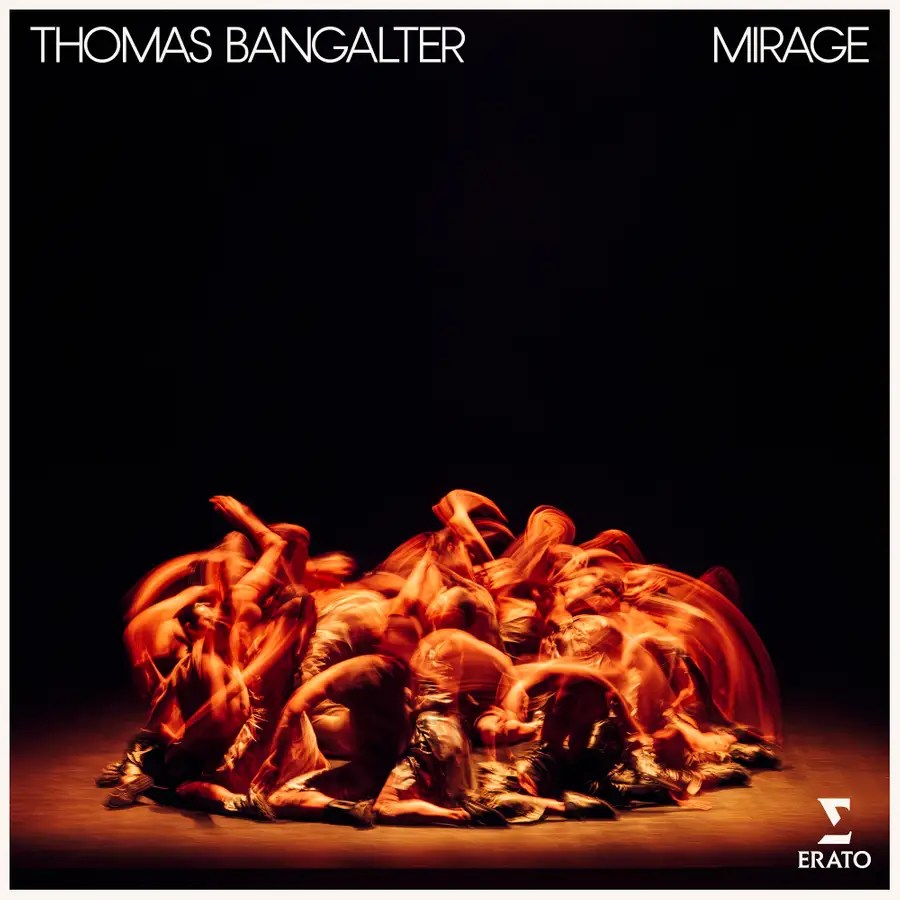
On Record – Thomas Bangalter: Mirage (Erato)

Reviewed by Ben Hogwood

What’s the story?

Mirage is the latest work by Thomas Bangalter, formerly of Daft Punk, to show his credentials for a more through-composed style of composition. Bangalter had an education in classical music, which can be felt through the cleverly constructed songs Daft Punk made, and perhaps most vividly in their score for Tron: Legacy.

More recently we have heard an orchestral album, Mythologies, a sizeable ballet characterising a series of wonderful and awful creatures – following in a line of French composers who have done this with such wonderfully pictorial writing. Mirage, however, is an electronic score, conceived by choreographer Damien Jalet and contemporary artist Kōhei Nawa, with the ballet premiered at the Grand Théâtre de Genève in 2025. It continues to tour Europe throughout 2026.

What’s the music like?

Very different to Mythologies, and arguably less colourful – but more compelling.

Mirage is a very slow build, a brave tactic from Bangalter but one well worth sticking with, especially on headphones. Starting with the pulse of a sonorous bass note, like a subterranean signal from another planet, the wave form starts to go wavy, as though the electromagnetic winds were picking up, and that slight shift is critical to the momentum of the ensuring piece. On Part II the drums get bigger and momentum builds through fidgety hi hats, the sense of forward movement increasing like an accelerating train.

Part III cuts to a bass drone before what feels like the mirage itself on Part IV, shapes dancing in the middle ground before an ominous wavering of the drone pulls the rug from under the listener’s feet. Part VI opens out into wide space before mirage images appear again, rich in colour. The tension relaxes audibly into Part VII, dappled figures and light interference suggesting the space beyond. Then, as a conclusion, Part VIII drops again towards inaudible bassy figures, the distant knock confirming the signal is still out there.

Does it all work?

Yes, though is clearly most effective if you experience the whole piece in one sitting, on equipment that can do justice to the range of frequencies employed.

Is it recommended?

It is. Bangalter’s musical trajectory will be very interesting to watch, for here he is aligning himself more with experimental composers such as Xenakis rather than the French ballet masters. The suspicion is that his sweet spot will be somewhere between the two, and will include both electronic and acoustic instruments, and hopefully on the Erato label, whose livery appropriately dresses this release. An auspicious second album, and highly recommended.

For fans of… Daft Punk, A Winged Victory For The Sullen, John Murphy, Vangelis

Listen / Buy

You can explore purchase options for Mirage on the Presto Music website

Published post no.2,919 – Tuesday 16 June 2026

On record: Renaud Capuçon plays the Bruch Violin Concerto no.1 and Lalo’s Symphonie espagnole

Featured recording: Lalo: Symphonie espagnole; Bruch: Violin Concerto no.1; Sarasate – Renaud Capuçon, Paavo Jarvi and the Orchestre de Paris (Erato)
lalo-capuconRenaud Capuçon, Paavo Jarvi and the Orchestre de Paris play arguably the best-loved work for violin and orchestra, Bruch‘s Violin Concerto no.1, and pair it with the sultry Symphonie Espagnole of Lalo. A virtuoso work by Pablo Sarasate makes up the trio.

What’s the music like?

These are two perennials of the repertoire for violin and orchestra, bursting with tunes. Bruch’s Violin Concerto no.1, the first of three he wrote, was dedicated to the Hungarian violinist Joseph Joachim, as was Brahms’ Violin Concerto. This is the work by which Bruch is best known.

It is small wonder really, for it is highly romantic, setting the ideal balance between violin and orchestra, who share some wonderful tunes. The soft hearted Adagio brings a tear to the eye, while the outer movements have an invigorating energy.

Meanwhile the Lalo Symphonie Espagnole, a five-movement piece that is essentially an extended concerto, brings some much-needed warmth. Lalo is a composer who has fallen out of fashion in the last few years, so it is good to have a new recording of this piece, as it has a few spiky and very catchy themes. If you like Bizet’s Carmen you will recognise his use of the Habanera, while the final Rondo has one of those tunes you won’t be able to stop whistling for the rest of the day!

Complementing the two bigger pieces is Sarasate’s Zigeunerweisen (Gypsy Airs). Lalo dedicated the Symphonie espagnole to Sarasate, who was a virtuoso violinist himself – and who also incorporates some memorable tunes in this shorter piece.

Does it all work?

Yes. Renaud Capuçon shares a birthday with Lalo (January 27) and will in fact be 40 this year. He is in great musical health, choosing a program that is definitely youthful in its tuneful profile.

His tone is especially beautiful in the Bruch, initially brooding but with an underlying sunny picture that comes through. The sun is hotter in the Symphonie espagnole, the more successful of the two bigger pieces here, and the one where Capuçon expresses himself with more fire.

The orchestral accompaniment from Paavo Jarvi and the Orchestre de Paris is ideal – clean and fresh, as you would want in a new recording of the often-heard Bruch. The Lalo is the best rendition here though, like a fresh sunny day.

Is it recommended?

Yes. A classical antidote to the January grind!

Listen on Spotify

You can judge for yourself by hearing the album on Spotify here:

Under the surface – Shostakovich Cantatas

shostakovich-cantatas

Composer: Dmitri Shostakovich (1906-1975)

Nationality: Russian

What did he write? Shostakovich is best known for his output of symphonies (15) and string quartets (also 15) as well as popular concertos, two each, for piano, violin and cello. Yet a relatively large amount of his output remains unexplored, especially his vocal work.

What are the works on this new recording? There are three cantatas for chorus, published relatively late in Shostakovich’s career. The Execution of Stepan Razin is the best known of the three, and certainly the most accomplished, being also the closest we get to the real composer on this recording, as it was written ten years after the death of Stalin and was free of his decrees on musical direction. The Sun Shines on the Motherland and Song of the Forests are different, being works in praise of his authority and the forests of Russia, so they are by nature more celebratory. All three works are performed in this new recording from Warner Classics by the Estonian Concert Choir and National Symphony Orchestra, conducted by Paavo Järvi, with soloists Alexei Tanovitski (bass) and Konstantin Andreyev (tenor).

Why aren’t these works more popular? That’s an easy one – in the case of The Sun Shines on the Motherland and Song of the Forests the texts are pro-Stalin and completely of their time. Even when recording, Järvi had to contend with demonstrations outside the Estonia Concert Hall in Tallinn, with people aghast at his idea of recording the original texts. Yet this recording is an extremely valuable illustration of music Shostakovich had to write against his will – and, if you look closely, how he managed to keep in a number of sardonic and witty references.

What is the music like? Despite the bombast of the two obviously pro-Stalin works, there is a curious emptiness to their celebrations, the sense of duty paid. Far more substantial and lasting in its impact, The Execution of Stepan Razin leaves a very strong impression of a hero in extreme adversity, cutting frequently to the bone emotionally – and is described by Paavo Järvi as ‘a critical work of the Soviet regime’.

After a bombastic opening the music remains powerfully driven, reaching a tremendous climax around 21’30”, which may be after the moment of execution itself – though unfortunately we do not have texts here.

The Sun Shines on the Motherland is immediately brighter in tone with the Narva Boys Choir, and leads to a positive but musically telegraphed high point. It is very well written and brilliantly performed, but has little substance emotionally other than empty celebration.

The Song of the Forests  begins in soft reverence but then there is a resonant solo from bass Konstantin Andreyev. The harmonies Shostakovich uses often lead to the same, deliberately hackneyed progression – effective but ultimately strangely wearing. The first part ends with a pure and peaceful low ‘C’ from the basses in the choir – peace at the end of the war, though not for the composer.

What’s the verdict? This is a fascinating and extremely valuable disc that adds another dimension to your collection if you know Shostakovich just through the orchestral works and string quartets. The ferocity of the singing is striking, especially from the choir, and the standard of performance is consistently high.

One serious drawback here is a lack of texts in the booklet, especially given the use of the original pro-Stalin material. Fortunately Shostakovich’s means of expression is direct enough to bring them straight off the page.

Spotify

You can hear the Shostakovich cantatas here:

If this appeals, a very strong recommendation goes to this double album, as reissued by EMI, of Rachmaninov and Prokofiev masterpieces with André Previn (The Bells by the former and Alexander Nevsky by the latter), together with the sharply toned Ivan the Terrible in a pioneering version conducted by Riccardo Muti.