I thought I would offer a quick, spoiler-free blog on the use of classical music in Netflix’s most-successful drama ever, Squid Game. The Korean morality tale has been a huge hit through the originality of its storylines, the quality of its acting, and the jaw-dropping directness of its violent game and fight scenes.
What has probably passed under the radar is its frequent use of classical music. To start with it is piped to the game players by as they try to rest / avoid death between the games, and as they prepare for another tension-laden stint in the games room. Soon it becomes front and centre of the action itself. There are three main pieces used:
HaydnTrumpet Concerto in E flat major, 3rd movement
This is heard in the first episode, when the players gain consciousness of the new setting they find themselves in:
TchaikovskyWaltz from Serenade for Strings in C major
This is doubtless meant to be a calming presence in the background while the players begin their formative friendships / relationships / grudges. It proves to be a deceptively graceful backdrop:
Johann Strauss IIOn The Beautiful Blue Danube
The clincher. This has been used in many a film of course, and even in The Simpsons (when Homer eats potato chips in space!) but here it takes on an unexpectedly sinister air. Occasionally it can be triumphant – towards the end of a game for instance – but its first appearance is the lasting one, from the terrifying first game, where the players realise just how high the stakes are going to be:
It is intriguing how the producers of Squid Game keep classical music in reserve for these moments, and use specially commissioned music from Jung Jae-il to describe scenes and events elsewhere in the drama. In doing this they create very different and effective backdrops that only add to the tension in a thoroughly gripping series!
Various works (see DG link below for full repertoire details)
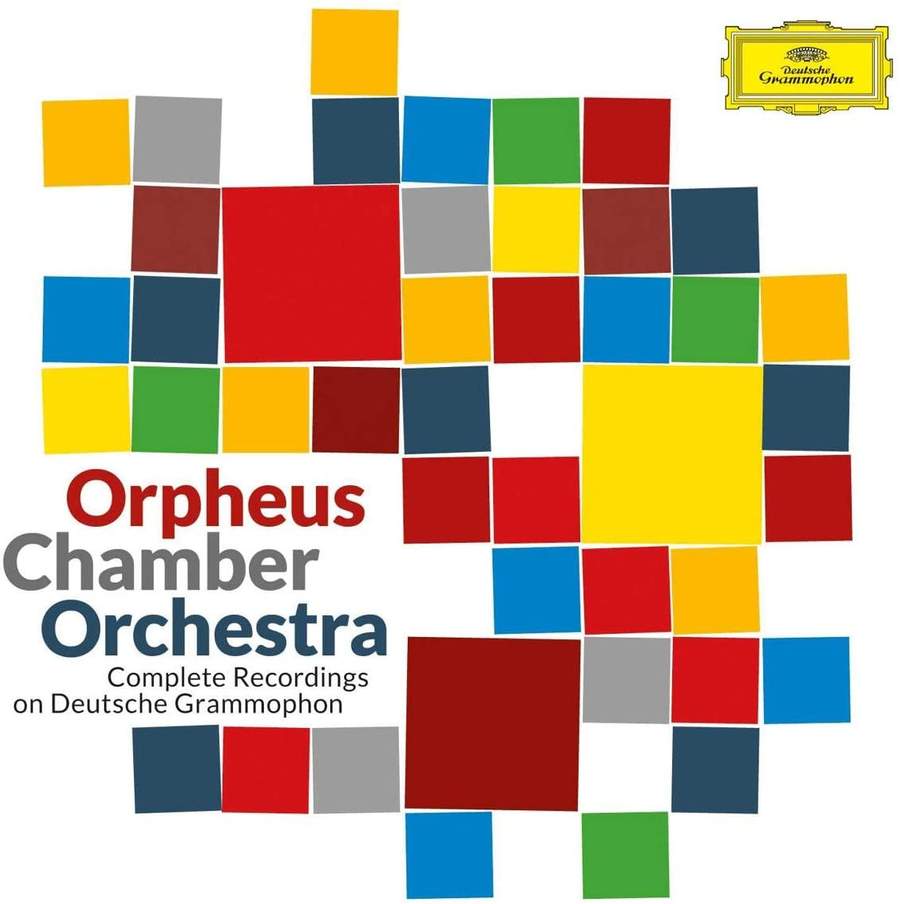
Deutsche Grammophon 4839948 (55 CDs)
Written by Ben Hogwood
What’s the story?
This box set tells the story of the Orpheus Chamber Orchestra – soon to celebrate their 50th anniversary – and the recordings they have made to date for Deutsche Grammophon. Formed in 1972, the conductor-less ensemble from New York have amassed an impressive body of work, spanning repertoire from Handel and Vivaldi to Schoenberg and William Bolcom, examined here across 55 CDs.
The group have enjoyed a fruitful relationship with DG, undertaking several projects. Among these are the Mozart wind concertos, with principals from the orchestra employed as soloists, and a clutch of hand-picked Haydn symphonies. Jed Distler’s booklet introduction, meanwhile, reveals a remarkable agreement which saw them commit the SchoenbergChamber Symphonies and Verklarte Nacht to disc in 1989, in return for a version of Vivaldi’s Four Seasons four years later.
Also included in this set is a previously unavailable account of Mendelssohn’s Italian Symphony, a live recording from Warsaw in 2018.
What’s the music like?
Orpheus Chamber Orchestra records are known for their crisp ensemble and energetic, engaging performances, but also for their poise. While their approach to Baroque music might not appeal to historical purists, nobody can deny the enthusiasm they bring to the Handel Concerti Grossi Op.6, nor their vibrant collection of Vivaldi Cello Concertos with regular collaborator Mischa Maisky, or the Flute Concertos with Patrick Gallois.
Their Mozart is particularly enjoyable, the wind concertos blossoming under the ‘home’ soloists, who have the advantage of an immediate musical rapport with their accompanists. The Sinfonia Concertante, with soloists Todd Phillips (violin) and Maureen Gallagher (viola), is especially good, while horn players William Purvis and David Jolley, clarinettist Charles Neidich, flautist Susan Palma-Nidel, oboist Randall Wolfgang and bassoonist Frank Morelli also excel. The Flute and Harp Concerto, with harpist Nancy Allen, is sublime, while a generous selection of the wind Serenades and string Divertimenti are delightful.
The Haydn symphonies fare particularly well, too, and often have an irresistible zest. The account of the Symphony no.80 in D minor is notable in this respect, but there is restraint and darker feeling in the Symphony no.49 in F minor, ‘La Passione’, its introduction taken at a daringly slow tempo. Meanwhile the disc of Rossini overtures still defies gravity in the absence of a conductor, a remarkable achievement!
The inclusion of Mendelssohn’s Italian symphony boosts an already excellent account of the two piano concertos, with Jan Lisiecki. It is fresh faced and buoyant in the outer movements, with a balletic poise for the inner two. Meanwhile their account of Beethoven’s The Creatures of Prometheus has plenty of spring in its step, as does a wonderful disc devoted to music for strings by Grieg and Tchaikovksy. The DvořákSerenades, too, fare particularly well, and there are two thoroughly engaging discs devoted to the music of Copland and Ives.
Best of all are the orchestra’s Stravinsky and Schoenberg recordings. The Stravinsky selection has excellent accounts of the ballets Pulcinella (the suite) and Orpheus, but equally valuable are the shorter pieces, where the composer’s gruff humour is caught to rhythmic perfection. The performance of Dumbarton Oaks could hardly be bettered. The Schoenberg has some eye-watering virtuosity in the Chamber Symphony no.1, an ideal way in for doubters of the composer – as is a translucent Chamber Symphony no.2 and a velvet-textured Verklarte Nacht.
Finally a mention for the orchestra’s Respighi, a colourful and moving trio of pieces comprising The Birds, a selection of the Ancient Airs and Dances and a particularly vivid account of the Trittico Botticelliano, showing off the composer’s colourful orchestration but also his deeply felt treatment of long-treasured melodies.
Does it all work?
Largely. One could argue that the disc of French orchestral music is a touch too glossy, or that the recordings of Bartók, Kodály and Suk do not quite have the authority a central European ensemble might bring to them. Even with those reservations, however, they are so well played that there is so much to enjoy, the slow movement of the Bartók Divertimento a particularly chilly example.
Is it recommended?
Unreservedly. This is a superb collection from an orchestra who are essentially a single instrument themselves, so together are their interpretations and their virtuosity. Their recording legacy for DG is unlike any other, and it is to be hoped it will blossom still further over – who knows? – maybe the next 50 years. This is a remarkably solid platform on which to build.
Listen and Buy
You can listen to clips and purchase this disc from the Presto website.
Reading
You can read Arcana’s interview with Orpheus Chamber Orchestra violist Dov Scheindlinhere, and listen to a playlist picking out Ben Hogwood’s personal favourites here.
Last week Arcana published an interview with Orpheus Chamber Orchestra violist Dov Scheindlin, in recognition of his time with the orchestra and their significant birthday. 50 years is a long time for a chamber orchestra, let alone a conductor-less one! Joining the celebrations, Deutsche Grammophon have released a 55-CD box set of all the orchestra’s recordings for the label.
Arcana have drawn on personal experience to select a playlist of recordings from the orchestra too, mostly from the DG archive. They range from a perky Haydn symphony to sparky Stravinsky pieces, from the wonderful open-air freshness of Grieg‘s Holberg Suite to the instinctive genius of Brad Mehldau‘s recently-released variations.
If I had to pick a favourite it would be a quite wonderful disc of Respighi orchestral works, crowned by an account of Trittico Botticelliano, a set of three orchestral responses to Botticelli pictures that is both colourful and intensely moving. Listen to the third picture, The Birth of Venus, and you will see what I mean:
This is the first in an occasional series of posts where I would like to draw attention to writers on music, classical or pop, whose work I love and respect.
Yesterday Arcana’s Listening to Beethoven series reached the Second Symphony– the last work discussed by Daniel Heartz in the third volume of an epic series looking at music of the 18th century.
I wanted to draw attention to Daniel’s writing because this series of books is quite simply invaluable. When I first considered purchasing it I baulked at the price per instalment (roughly £45, even at second hand) but I can honestly say it has provided me with incredible value for money.
Heartz’s strengths are many, but his ability to talk through technical aspects of music without losing the reader in jargon is unusually strong. However even that quality is second to his knack of placing the music in historical context, which he does so throughout the books. I warmed to this quality in the third volume (Haydn, Mozart and early Beethoven 1781-1802) just as much in the second (Haydn, Mozart and the Viennese School: 1740-1780). Going back further, the equally sizable volume of Music In European Capitals: The Galant Style, 1720-1780 ensures lesser-known and appreciated composers such as Boccherini, J.C. Bach and Stamitz get the detail and respect they fully deserve.
Heartz is great at telling a story, applying the same detailed and pictorial approach to each composer or historical figure, and at every turn it is clear that a remarkable depth of research has been applied to his work. There is very little speculation needed, but where it is made he is never fanciful or exaggerated.
Very sadly Professor Heartz died in 2019. I must admit, rather selfishly, that I was hoping his exploration of Beethoven would continue beyond the year 1802, but on learning the sad news I can only say I am very grateful to him for illuminating the classical period of music history with such high quality, informed writing. His books will give pleasure and more information, no doubt, for many years to come.
A tribute to Daniel can be found here on the University of California website. The three books referred to above are published by W.W. Norton.
Haydn String Quartet in D major Op.64/5 ‘Lark’ (1790) Simpson String Quartet no.1 (1951-2)
Cadogan Hall, London Monday 16 August 2021 (1pm)
Written by Richard Whitehouse
In his centenary, it was timely to include music by Robert Simpson (who spent three eventful decades at the BBC) at the Proms, and while one might have hoped for one of his symphonies in the evening concerts, his First Quartet at a Cadogan Hall recital was hardly less welcome.
Finished when Simpson was in his early thirties and dedicated to Enescu (who read through and commended the score during his last visit to the UK), the First Quartet fairly typifies the composer’s music at this time in its stealthy take on progressive tonality and methodical yet never pre-ordained design. Thus, the opening Allegro evolves seamlessly from wistful then animated main ideas through an inwardly probing development to a trenchant reprise then a headlong coda; the ensuing Andante unfolding a series of variations on a ruminative theme – structured as a palindrome – that grows in intensity towards a fervent culmination before it touches on the work’s opening theme on route to a limpid final repose. Simpson was to use a two-movement format on subsequent occasions, but never so elegantly or lucidly as here.
In his introductory remarks, Johannes Marmén stated that the Marmen Quartet had not been familiar with Simpson’s music until asked to learn the First Quartet for this recital. Evidently played-in beforehand, this afternoon’s performance was impressive in its formal command and audible feel for a distinctive idiom of far-reaching consequences. Hopefully this group will tackle further Simpson – the Second and Third Quartets, which explore the potential of their predecessor in what effectively becomes a ‘meta-quartet’, are a good place to continue.
A passing allusion to Haydn’s Lark Quartet at the start of the Simpson made the former a natural pairing, of which the Marmen made a virtue with its attentive and insightful account. After an animated reading of the initial Allegro (second half repeat included to make it weightier), the Adagio was notable for its eloquent ensemble and a tentative wit made manifest in the lively Menuetto. Sparkling yet never skittish, the final Vivace rounded off this performance in appealing fashion – leaving little doubt of the Marmen Quartet as an outfit with a future.
You can find more information on the BBC Proms at the festival’s homepage




 Arcana.fm