Christoph Prégardien – The Darker Side of Love

The Darker Side of Love – Christoph Prégardien and Daniel Heide at the Wigmore Hall

christoph-pregardien

Christoph Prégardien (tenor), Daniel Heide (piano) – Wigmore Hall, London, live on BBC Radio 3, 18 May 2015

Listening link (opens in a new window):

http://www.bbc.co.uk/programmes/b05tpryp

on the iPlayer until 17 June

Spotify

In case you cannot hear the broadcast, I have put together a Spotify playlist of most of the music in this concert, including recordings the artists have made where possible. The playlist can be found here

What’s the music?

Schubert: An den Mond, D259; Schäfers Klagelied, D121

Schubert: Erster Verlust, D226

Schubert: Rastlose Liebe, D138

Schubert: Wandrers Nachtlied II, D768

Schubert: Willkommen und Abschied, D767 (17 minutes)

Schumann: Dichterliebe, Op.48 (30 minutes)

What about the music?

The relationship between Schubert and the poetry of Goethe was long-standing, beginning in October 1814 and yielding tens of songs. Many of them are darker utterances, and the collection here enjoys the composer’s ability to cast a nocturnal scene for voice and piano seemingly at will. It also celebrates his faster, galloping songs, the singer in the saddle for an action-packed horse ride, while the sheer simplicity of shorter songs such as Erster Verlust is pure and touching.

Schumann’s famous year of song reached its creative peak in May 1840, when he wrote the Liederkreis, published as Op.39, and Dichterliebe, where he sought inspiration once again from the poetry of Heinrich Heine. The quote in the Wigmore Hall program sums it up perfectly, Schumann describing the verses as ‘short, maliciously sentimental, and written in the folk style’. They evoke outdoor scenes but also inward and often crippling emotions, the singer – and possibly the listener! – an emotional liability by the end. Schumann rescues Dichterliebe, however, through the piano postludes he provides to Am leuchtenden Sommermorgen (One bright summer morning) and the closing song Die altern, bösen Lieder (The bad old songs), attempting and largely succeeding to restore stability.

Performance verdict

Christoph Prégardien has been singing these songs (or ‘Lieder’, as we should really call them!) for a long time – he recorded most of them a while back – but he still brings keen emotion to the stage.

The silence of Wigmore Hall during a song as tense as Schumann’s Ich hab’ im Traum geweinet (I wept in my dream), the ninth of Dichterliebe’s dozen, said it all. Here was a performer creating vivid pictures from Heine’s barbed text and Schumann’s equally frosty responses to the dark side.

In Schubert, too, the steely edge of even the most youthful Goethe setting could be glimpsed, brought out in an early song like An den Mond (To the Moon) by pianist Daniel Heide, stressing the notes Schubert brings in to challenge the happier times of the song.

Schubert’s horse-riding songs, Rastlose Liebe and Wilkommen und Abschied, were adrenalin-fuelled dashes into the country, while Schäfers Klaglied brilliantly evoked both the tempest and its subsequent rainbow.

Prégardien is an unfussy singer who communicates with his audience through subtle but meaningful expression, both visually and with the use of his hands. This somehow carries over to the listener too, either in the hall or at home, part of a masterclass in how to sing these songs.

What should I listen out for?

Schubert

1:50 – An den Mond (To the Moon) A calm and seemingly contented song to begin the selection – though there are some warning signs, chiefly in the piano part, to suggest all is not well.

5:27 – Schäfers Klagelied (Shepherd’s lament) A downcast and solemn song, with a vivid depiction of a storm in its central section from the piano (from 6:55), which also somehow describes the resultant rainbow (7:13) before a return to sadness.

8:58 – Erster Verlust (First loss) A song of striking simplicity and sadness, with an aching melody where the purity of Prégardien’s tone really comes through

11:22 – Rastlose Liebe (Restless love) A song that gallops out of the blocks with its rapid movement on the piano, and the breathless voice almost struggles to keep up. Meine signs off beautifully at 12:30.

12:47 – Wandrers Nachtlied II (Wanderer’s Nightsong II) Here we can feel the stillness of a summer evening, the conditions in which Goethe scribbled the verses for this poem as he stood outside in a garden. Prégardien’s higher notes are beautifully tailored.

15:18 – Willkommen und Abschied (Greeting and farewell) Another of Schubert’s quick dashes through the text, though at the end of each verse we have a pregnant pause. Prégardien cries out ‘ihr Götter’ (‘O gods!’) at 17:17. The text at the end translates as ‘what a joy to be loved’

Schumann

The words for Dichterliebe can be found here

21:12 – Im wunderschönen Monat Mai (In the wondrous month of May) A graceful song to begin the cycle, with some beautiful top notes (the translated words ‘blossom’ and ‘desire’) that Prégardien very subtly stresses through a pause.

22:54 – Aus meinen Tränen sprießen (From my tears will spring) The spring-like openness continues, in the same key.

23:51 – Die Rose, die Lilie, die Taube, die Sonne (Rose, lily, dove) A playful song, over in a flash!

24:23 – Wenn ich in deine Augen seh (When I look into your eyes) A tender love song, that tellingly moves to the purity C major to tell of how ‘when I kiss your lips, then I am wholly healed’. There is a yearning postlude on the piano.

26:12 – Ich will meine Seele tauchen (Let me bathe my soul) Another short love song, this time with a flowing, watery piano accompaniment.

27:08 – Im Rhein, im heiligen Strome (In the Rhine, the holy river) The singer adopts a much more imposing tone to evoke the grandeur of the Rhine and the great cathedral of Cologne, where hangs an image of ‘Our beloved Lady’ – which the singer equates to that of his own love. The piano postlude is reminiscent of a Baroque aria.

29:16 – Ich grolle nicht (I bear no grudge) The text turns darker, though the musical language is still generally positive. The tenor has a heavier tone here, the voice more of a baritone in its richness.

30:49 – Und wüßten’s die Blumen, die kleinen (If the little flowers only knew) The piano matches the tenor in this flowing, limpid song – spring like in its subject matter but ultimately sad and regretful at a broken heart. This leads straight into…

32:05 – Das ist ein Flöten und Geigen (What a fluting and fiddling) A proud song but once again with a darker centre.

33:29 – Hör’ ich das Liedchen klingen (When I hear the little song) This is Heine’s poetry at its coldest, and in this brief song it gets a suitably bare response from Schumann, who then attempts some consolation in the extended piano postlude, which in reality says just as much as the song does.

35:47 – Ein Jüngling liebt ein Mädchen (A boy loves a girl) A more positive mood now – but soon the poetry turns dark as well. Schumann keeps his tongue firmly in his cheek, allowing the tenor a bit of sardonic humour and the piano a grand finish

36:47 – Am leuchtenden Sommermorgen (One bright summer morning) A beautifully simple song – though now the mood of sadness is taking hold with greater certainty. Again we have a longer piano postlude, the pianist reflecting the text through music and trying to console.

39:38 – Ich hab’ im Traum geweinet (I wept in my dream) Schumann’s use of silence here is striking and altogether ominous. Prégardien gathers the power of the final verse, the texture sparse as can be, until the music stops abruptly.

42:25 – Allnächtlich im Traume (Nightly in my dreams) An elusive song – another dream but one the poet cannot really remember – which possibly explains why Schumann leaves the music sounding half-finished at the end.

43:54 – Aus alten Märchen winkt es (A white hand beckons) There is greater optimism in this song, using the upper register of the piano for the first time in a while, but once again Heine insists on an ending that takes away the potential for happiness. Schumann’s music rescues this in the postlude however!

46:39 – Die alten, bösen Lieder (The bad old songs) A bit of nostalgia to finish – though this is a purge, the poet casting all his ‘bad and bitter dreams’ away in a heavy coffin. Schumann responds with gallows humour, a song that is bold and defiant in its execution but which fades away to reflection. Once again we have a piano postlude, this one even more meaningful as it tries to draw the cycle to a soft conclusion. In the right performance however, like this one, a level of bitterness remains.

Encore

53:05 – Schumann – Mit Myrthen und Rosen (With myrtle and roses) (the last song from Liederkreis, Op.24) This has an effortless, upward curve to the melody. Prégardien’s gestures to the audience here were beautifully observed.

Further listening

With Christoph Prégardien demonstrating his almost unparalleled abilities in Schubert, here is a Spotify link to a recent recording of him singing the great Schubert song cycle Winterreise. Again this is music on the dark side, but is greatly inspired at that. Texts can be found http://www.recmusic.org/lieder/assemble_texts.html?SongCycleId=47″>here and the playlist is here

For more concerts click here
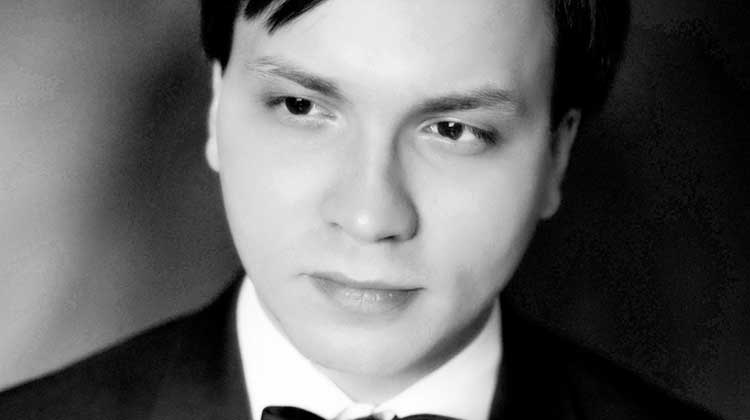
Alexei Grynyuk at the Wigmore Hall – Schubert’s last breath

alexei-grynyuk

Alexei Grynyuk, Wigmore Hall, 16 April 2015.

The last of Schubert’s 21 published piano sonatas is a remarkable piece of music, as in it we encounter one of those truly rare instances where time really does seem to stand still.
Alexei Grynyuk, completing a fine season of lunchtime recitals at the Wigmore Hall under the sponsorship of Lisa Peacock, gave the piece an eloquent and moving account, maintaining remarkable feats of concentration over the near-50 minutes in which Schubert’s last inspiration unfurled.

The opening movement seemed to go on for ever – but not in a bad way! From the off it was clear Grynyuk was going to let this music breathe, refusing to hurry in much the same way the great Sviatoslav Richter used to work with the sonata. Because of that the first movement alone clocked in at 28 minutes, but the disquiet it brought whenever the left hand was rumbling low in the piano register was palpable.

Eventually there was a form of resolution, but the questioning nature of the music returned in the slow movement and its less than comfortable modulations. As the sonata progressed so did Schubert’s willingness to cast his demons aside, and because of this Grynyuk ensured the third movement scherzo became ever sunnier as it progressed. Meanwhile the finale, despite some strife in its minor key exertions, ultimately strove for positivity.

This was a magnificent and clearly thought through performance, one where Alexei Grynyuk was ready to stand back, remove any showiness from his interpretation, and let Schubert’s music do the talking. Similar praise could be levelled at his performance of the Three Movements from Petrushka, arranged by Stravinsky from the ballet. A lot of pianists show off here but Grynyuk was careful to characterise, to bring forward the abundant selection of tunes and – crucially – not to play too loudly. His approach worked wonderfully well.

A Spotify playlist containing the works in concert can be accessed below. As Alexei Grynyuk has not yet recorded these works – though I understand this performance of the Schubert was recorded for future release – I have chosen versions by Maurizio Pollini:

Zhang Zuo – Schumann and Schubert at Wigmore Hall

Zhang Zuo plays contrasting piano works by Schumann and Schubert at the Wigmore Hall

zhang-zuo
Zhang Zuo (piano) – Wigmore Hall, live on BBC Radio 3, 30 March 2015.

Listening link (opens in a new window):

http://www.bbc.co.uk/programmes/b05nsbm7

on the iPlayer until 29 April

Spotify

Zhang Zuo has not recorded either of these works, so this Spotify playlist – for those unable to hear the radio broadcast – includes the Schumann played by Daniel Barenboim and the Schubert by Romanian pianist Radu Lupu.

What’s the music?

Schumann – Faschingsschwank aus Wien, Op.26 (Carnival pranks in Vienna) (1839) (19 minutes)

Schubert – Piano Sonata in C minor D958 (1828) (28 minutes)

What about the music?

Both Schumann and Schubert could proclaim the piano to be their first discipline, and both wrote masterfully for the instrument. These two pieces form a nice contrast in concert, for we hear Schumann at his most exuberant, in the throes of a love affair that was soon to culminate in marriage and the so-called ‘Year of Song’. Written in a brief stay in Vienna, the mischievous ‘carnival pranks’ include a quotation of the ‘Marseillaise’ in the first of the five pieces. This was especially daring as the French national anthem was banned in the Austrian capital at that time.

Schubert, on the other hand, was in the last year of his life and in the knowledge that death was increasingly to hand. His late trio of piano sonatas are remarkable works, reaching an intensity of emotion and accomplishment you can barely comprehend for a composer only just in his thirties. The C minor, the first sonata of the three, is perhaps the most tortured, and is complemented by two even bigger works in the form of the A major and B flat major sonatas, each weighing in around the 40 minute mark.

Yet all three are compelling works in the right performances, for Schubert finds ways of making the music reflect the depths of his thoughts, vividly so in the sudden lightning bolts of anxiety that strike at unexpected points. Time stands still in the slow music, while in faster passages there are almost not enough notes for Schubert to describe his thinking.

Performance verdict

Zhang Zuo – Zee Zee – is a brilliant pianist, of that there is no doubt. Technically assured and very clear in her communication of the notes, she made the music fairly rush out of the Steinway like an endless stream. Yet there were times in this recital where I longed for the music to have a bit more breathing space, because she showed in the slower moments that she has a tender side to her playing.

In some of the Schubert the sonata came across as rather brash. It must be difficult for a pianist in her early twenties to fully probe music written by a composer who knew he was dying. And although at times Zuo communicated some of the anguish Schubert must have been experiencing, the fast music was brittle and at times simply too fast. The finale was certainly thrilling but it raced away, pausing only occasionally for breath.

The Schumann was fun – especially the first of the six pieces – and there were some nice, intimate asides such as the second piece, which felt like a confidential letter between loved ones. But here too the music cut to the bone a little too quickly, especially in the closing piece. It isn’t entirely fair to compare Zuo, a pianist at the start of her career, with the old masters Lupu and Barenboim, who you can hear on the Spotify playlist above, but it is instructive to learn that Lupu spends nearly two minutes longer on the Schubert than Zuo.

I don’t want to be unduly critical – there was an awful lot to admire here after all – but I longed for a bit more light and shade from a pianist who clearly has the technical ability.

What should I listen out for?

Schumann

1:04 – We hear Schumann at his most exuberant as the carnival pranks get underway. This piece takes up half the duration of the collection, returning to its catchy main theme with great gusto each time, but also wandering off into distracted thoughts. The most enjoyable and extravert of these is the march beginning at 5:17 – which ushers in the ‘Marsellaise’ quotation. See if you can spot it!

10:07 – a short and tender romance, in complete contrast to the bluster of the opening piece. A confidential aside in the minor key.

12:36 – the third piece is quicker and flighty, and Schumann surprises his listener by moving to a distant key briefly, before coming back ‘home’.

14:36 – Zee Zee moves straight into the turbulent fourth piece, a torrent of notes that subsides at the end, before almost crashing straight into the fifth…

16:37 – the fifth piece starts with similar vigour and leads to an emphatic conclusion.

Schubert

22:16 – although the first movement is not one of unremitting darkness, the torture of Schubert’s final years is immediately clear to the untrained ear. There is edginess and anxiety here, and you can hear it in Zuo’s right hand right from the off.

There is respite, however, in the form of a second theme that melts under the fingers, especially when Zuo plays it for the second time at 27:10. The music seems set to move into calmer waters but Schubert muddies the textures by introducing a coda with low rumblings in the left hand, bringing the movement to an uncertain close.

30:09 – a soft, thoughtful slow movement with similar contours to the slow movement of Beethoven’s Pathétique sonata. Like Beethoven’s late period, Schubert’s last sonatas are known for their ability to hang suspended in time, but Zuo’s performance is just a bit too quick to capture that consistently – apart from 37:03, where the music reaches new levels of intimacy. A darker strand of music makes itself known at 31:34, and this comes to dominate the louder parts of the movement.

38:21 – an awkward attempt from Schubert to pick up the mood that ultimately ends in darkness. Although a minuet, the main theme does not feel like a piece for dancing – and especially when the stop-start episodes take over. The ‘trio’ section (from 39:31) has a more obvious lilt to its triple time, but is incredibly brief – and the opening returns at 40:40.

41:13 – the last movement, a Tarantelle, begins quickly and urgently, but disruption sets in when Schubert insists on moving to new and distant keys, trying hard it seems to assert some positive music but generally ending up with darker, stormy episodes. An exception to this can be found in a brief excursion to B major for more poetic thoughts at 44:10, while the final two chords – wrapping up at 50:16 – tell of resolution and grit but not release from the darkness.

Encore – J.S. Bach – the Minuet from his Partita for keyboard no.1 in B flat major

51:31 – an attractive, light touch to this encore, nicely detailed. There are two Minuets, the second appearing at 52:17 before the first is repeated at 53:00.

Want to hear more?

The second Schubert sonata has perhaps even more drama, and can be heard on Spotify played by Maurizio Pollini from track 5 of this album

To complement the Schumann, try his set of character pieces Carnaval, which can be heard here, played by Jorge Bolet.

For more concerts click here

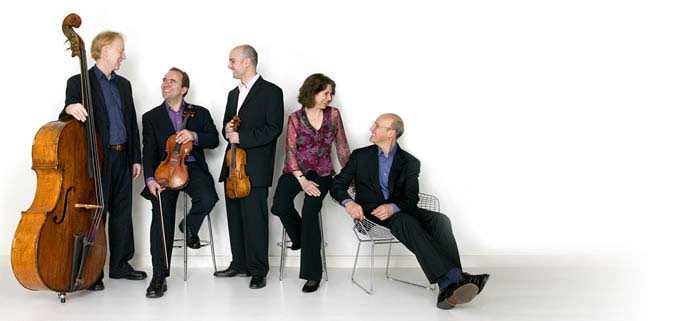
The Schubert Ensemble – French piano quartets

schubert-ensemble

The Schubert Ensemble Milton Court, 11 March 2015.

An evening chamber music concert has the potential to take the sting and stress out of a busy day – as was the case here, with the Schubert Ensemble giving their first recital at the still relatively new Milton Court venue.

As an annex to the Barbican Centre in the City of London the hall is a desirable alternative to its larger cousin – which remains difficult to navigate even after two decades! Milton Court feels fresh and exciting, though it can get a bit claustrophobic around the bar area when the main hall is turning out.
Thankfully the Schubert Ensemble’s music making was airy enough to completely dispel any discomfort, though they had a few problems of their own to contend with in the shape of violinist Simon Blendis, who had fractured his arm.

Blendis, allocated the role of compère, praised his more than able stand-in, Krysia Osostowicz, one of the finest chamber musicians around – and she fitted seamlessly into the group’s music making here. Though unfortunately not credited in the program, William Howard (piano), Osostowicz, Douglas Paterson (viola) and Jane Salmon (cello) were all at the top of their game.

Unfortunately because of the injury we lost the Saint-Saëns Piano Quartet from the program, which was a shame as this not often performed, and the Schubert Ensemble doubtless have the energy and grace from which this work would benefit. Instead of that, however, we had the First Piano Quartet of Fauré – which was not exactly a hardship, for this is a lovely, tuneful work where emotion simmers just below the surface, breaking through in a passionate finale. Led by their superb pianist Howard, the group played with poise and control but clearly felt the music, and the resultant half-hour passed quickly!

After the interval a close musical relation of Fauré, Ernest Chausson, took his chance to shine in the form of a substantial Piano Quartet, a work he completed in 1897. There is an unexpected Eastern flavour to the opening of this piece – of Chinese origin, arguably – and Howard held back a bit on the tempo to give this plenty of air. Douglas Paterson found real depths of emotion in his viola solo from the slow movement, while the third movement waltz swung dolefully.

To begin with we had heard music from the composer after which the Schubert Ensemble are named – a movement for String Trio (violin, viola and cello) from 1816. This musical palette cleanser proved a suitable introduction to the two meatier works on the program.

A Spotify playlist containing the works heard can be accessed below. The Fauré is as recorded by the Schubert Ensemble themselves: