On Record: Richard Deering – Parry: Piano Music (Heritage Records)

Parry
Piano Sonata no.1 in F major (1876)
Piano Sonata no.2 in A minor (1878)
Sieben Charakterbilder (1872)
Five Miniatures (pub. 1926)

Richard Deering (piano)

Heritage Records HTGCD140-141 [two discs, 87’15’’]
Producer/Engineer: Paul Arden-Taylor
Recorded 15 July 2023 at Wyastone Concert Hall, Wyastone Leys, Monmouth

written by Richard Whitehouse

What’s the story?

Heritage continues its coverage of unfamiliar British music with this set featuring much of the music for solo piano by Hubert Parry, representative of those earlier years when his immersion in the Austro-German tradition was being leavened with a more personal vein of expression.

What’s the music like?

Although he had essayed two sets of shorter pieces in the late 1860s, Parry’s large-scale piano works come from the following decade. The First Piano Sonata owes a debt to Beethoven but also Mendelssohn and Weber, the eddying restraint of its first movement finding contrast with the capricious charm of its scherzo or wistful poise of its Andante. The finale duly heads from a pensive introduction to an elegant Allegretto that, in turn, finds greater animation in its coda. Modest in scope, the whole piece has a limpidity and understatement which is most appealing.

The Second Piano Sonata, if not that much longer, none the less leaves a greater impression – not least as the influences of Schumann and Brahms are more evident. The opening Allegro features a Maestoso introduction that recurs after the development and in the coda to deepen this music’s ingratiating manner, then the Adagio touches on deeper or even darker emotions. The ensuing Scherzo is more rhythmically incisive than its predecessor and while the finale is marked Allegretto, it builds to a decisive close – the introductory music again in evidence.

Before either of these sonatas, Parry composed a set of studies entitled Charakterbilder but with the intriguing subtitle Seven Ages of Mind, which suggests an evolving concept akin to several of Schumann’s collections. The Dreaming of a whimsical Prelude is followed by the impetuosity of Learning then the histrionics of Passion. The trenchancy of Striving precedes the eloquence of Longing then the elation of Triumphing, and though the final Adagio is untitled, its mood of inward rapture might well be thought of as being Fulfilling.

Parry soon went on to write a notable Piano Concerto and engaging Theme and Variations, but little further for the solo instrument until late in life. Published posthumously, the Five Miniatures likely emerged over a quarter-century – the initial Sleepy having an affecting charm complemented by the winsomeness of A Little Christmas Piece then wry humour of Capriccio. Greater profundity is hinted at in the ensuing Pause before this sequence reaches its close with the bittersweet resignation of Envoi – most delicate of miniatures.

Does it all work?

It does. Parry was still in the process of finding his own voice (which, as can be heard from his later choral and orchestral works, was a distinctive one) when writing this music, which should not detract from the technical finish and emotional warmth in much of what is heard here. It helps that Richard Deering brings out its salient qualities through playing responsive to the composer’s idiomatic if stylistically undemanding pianism, as rendered on a Steinway D which clarifies a preponderance of ‘middle range’ keyboard sonorities and passagework.

Is it recommended?

It is. The sound has all the clarity and perspective expected, and there are useful background notes by Lisa Hardy. A follow-up release featuring the Theme and Variations, along with the three sets of Sonnets and Songs without Words and the Schulbrede Tunes, would be welcome.

Listen

Buy

You can explore purchase options for this album at the Heritage Records website. For more information, click on the links for performer Richard Deering and for the Hubert Parry life history

Published post no.1,981 – Tuesday 17 October 2023

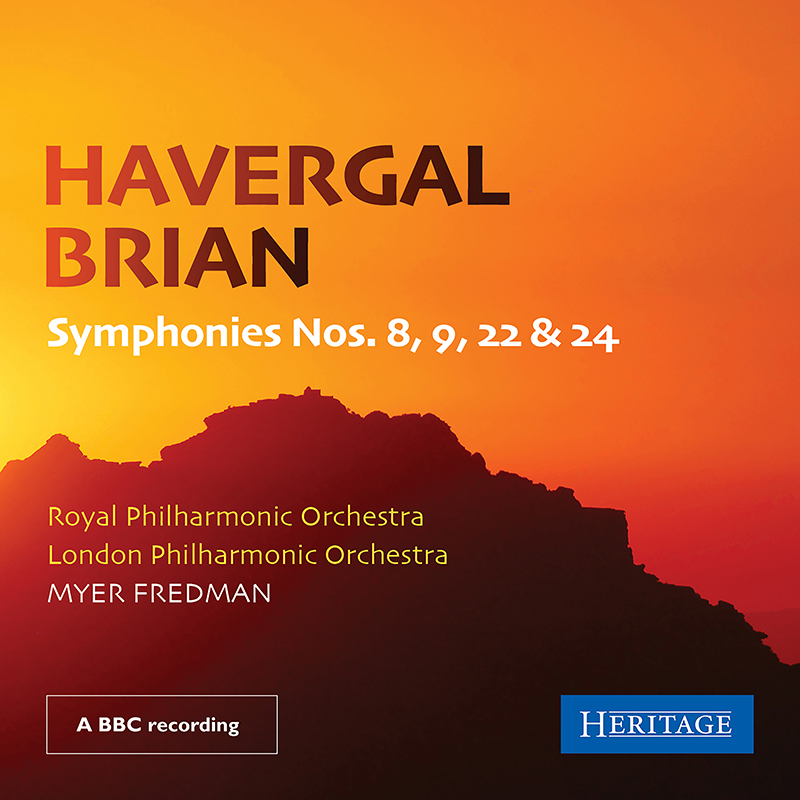
On Record: RPO, LPO / Myer Fredman – Havergal Brian: Symphonies nos. 8,9,22 & 24 (Heritage)

Brian
Symphonies – no.8 in B flat minor (1949); no.9 in A minor (1951); no.22 in F minor, ‘Sinfonia Brevis’ (1964-5); no. 24 in D major (1965)

Royal Philharmonic Orchestra (nos.8,9 & 22), London Philharmonic Orchestra (no.24) / Myer Fredman

Heritage HTGCD146 [77’46’’]

Broadcast performances from St John’s, Smith Square, London on 28 March 1971 (nos. 9 & 22) Maida Vale Studios, London on 27 June 1971 (no.8) and 1 April 1973 (no.24)

Reviewed by Richard Whitehouse

What’s the story?

Heritage continues its releases of pioneering symphonic broadcasts by Havergal Brian with this issue of performances from the 1970s conducted by Myer Fredman, two of these being world premieres in what was a productive decade for furthering the music of this composer.

Born in Plymouth and later resident in Australia, Fredman (below) (1932-2014) set down Bax’s first two symphonies, together with Brian’s Sixth and Sixteenth Symphonies (Lyrita) that remain among the finest such recordings. He also made studio broadcasts of the present symphonies which, as John Pickard indicates in his detailed booklet notes, are among the most revealing of Brian performances from the period either side of the composer’s death – making them a natural inclusion for a series such as that now undertaken by the enterprising Heritage label.

What’s the music like?

This was the fourth hearing of the Eighth Symphony, coming after two live broadcasts with Adrian Boult in 1954 and one by Rudolf Schwarz in 1958. In many ways a template for what came after, its single span elides sonata-form and multi-movement design with a cohesion the greater for its overt unpredictability. The initial rhythmic figure (one of Brian’s most striking such openings) is not quite together, but thereafter Fredman exerts firm while never inflexible control over the interplay of martial dynamism and contemplative stasis, building its central climax superbly if losing momentum into the contrasted passacaglias – the second of which brings only a fugitive calm in its wake. Commercially recorded by Charles Groves in 1977 (EMI/Warner) and Alexander Walker (Naxos) in 2016, this work awaits public performance.

Preceded by live broadcasts with Norman del Mar in 1958 and ’59 (the latter now on Dutton), the Ninth Symphony features three continuous movements that outline a Classical framework. Fredman launches the initial Allegro with due impetus and charts a secure course through its quixotic changes of mood – the hushed transition into the reprise especially striking. He is no less focussed in a central Adagio whose musing reverie is constantly undercut by militaristic aggression, a reminder Vaughan Williams’s Sixth had appeared three years before, while the final Allegro tempers its festive cheer with a plaintive interlude which even the jubilant coda only just outfaces. Surprising that since Groves’ public performances in Liverpool and at the Proms in 1976, then his commercial recording a year later, this work has remained unheard.

The remaining performances are both world premieres of works which form outer parts of a symphonic triptych. Lastly barely 10 minutes, the Twenty-Second is (as its subtitle implies) the shortest of Brian’s cycle if hardly the least eventful. More impulsive than Lázsló Heltay with his 1974 recording (CBS/Heritage), let alone Groves in his spacious 1983 performance, Fredman teases out the eloquence of the initial Maestoso through to its fervent culmination, then brings a deft nonchalance to the ensuing Tempo di marcia such as makes contrast with its baleful climax the more telling. Brooding and fatalistic, the coda ranks among the finest passages in post-war symphonic literature and Fredman captures its essence. Walker comes close with his 2012 recording (Naxos), but this account effortlessly transcends its 52 years.

A pity Fredman never tackled No. 23, who three Illinois hearings by Bernard Goodman in October 1973 make it only the Brian symphony premiered outside the UK, but he did give the Twenty-Fourth. After its intense then impetuous predecessors, this one-movement piece feels more expansive for all its methodical ingenuity. The martial opening section is adroitly handled so its breezy extroversion reveals unexpected inwardness towards its centre then at its close; a whimsical and lightly scored interlude making way for the (relatively) extended adagio which, in its searching if often equivocal repose, brings both this work and those two before it to an affirmative end. Walker’s 2012 account (Naxos) enables all three symphonies to be heard in consecutive order, but the insights of this first performance remain undimmed.

Does it all work?

Almost always. Fredman has an audible grasp of Brian’s often elusive thinking, so that these performances unfold with a formal inevitability and expressive focus often lacking elsewhere. The Royal Philharmonic Orchestra betrays passing uncertainty with Brian’s more idiosyncratic touches, whereas the London Philharmonic Orchestra copes ably with what is among his most approachable later symphonies. Heritage has done its customary fine job opening out the sound, and anyone who knows these performances through the pirated Aries LPs will be delighted at the improvement.

Is it recommended?

Indeed. Those familiar with these symphonies from the studio recordings will find Fredman’s interpretations an essential supplement. Hopefully this series will continue apace, ideally with John Poole’s 1974 performance of the Fourth or Harry Newstone’s 1966 take on the Seventh.

For purchase information on this album, and to hear sound clips, visit the Heritage website. For more on the composer, visit the Havergal Brian Society – and for more on Myer Fredman, visit a dedicated page on the Naxos website

On Record – David Quigley – The Fair Hills of Éire: Irish Airs and Dances (Heritage Records)

david-quigley

David Quigley (piano)

Beach The Fair Hills of Éire Op.91 (1922)
Esposito Two Irish Melodies Op.39 (1883)
Field Go to the Devil and Shake Yourself (1798)
Hammond Miniatures and Modulations (2011) – No. 5, Old Truagh; No. 21, The Beardless Boy
Hennessy Variations sur un air Irlandais ancien Op.28 (1908)
Hough Londonderry Air (2014)
Martin Sionna – Spirit of the Shannon (2018)
Moeran Irish Love Song (1926); The White Mountain (1929)
Smith Paraphrase on ‘The Last Rose of Summer’ Op.173 (1883)
Stanford arr. Grainger Four Irish Dances Op.89 (1916) – no.1: Maguire’s Kick; no.4: A Reel

Heritage Records HTGCD152 [62’39”]
Producer / Engineer David Marshalsea

Recorded 9 & 11 April 2022 at Elgar Concert Hall, The Bramall, University of Birmingham

Reviewed by Richard Whitehouse

What’s the story?

The enterprising Heritage label continues its association with David Quigley in this recital   of Irish piano works as cover over two centuries, reminding listeners of the wealth of folk or traditional music from that island and its influence on successive generations of composers.

What’s the music like?

Published as Favorite (sic) Irish Dance Arranged as a Rondo for the Piano Forte, the first item is not unreasonably attributed to the teenage John Field and make for a breezy recital-opener – following which, pianist Stephen Hough demonstrated his prowess as an arranger with what is surely the most famous of all Irish melodies. Two pieces by the Italian émigré Michele Esposito – the trenchant Avenging and Bright, followed by the pensive Though the Last Glimpse of Erin – complement each other ideally, whereas the first from a set of dances by Charles Villers Stanford exudes bracing humour most likely accentuated in this idiomatic arrangement by no less than Percy Grainger. By some distance the longest piece here is from Swan Hennessy, an Irish/American later resident in France – his 12 variations on an (unidentified) theme in the lineage of various such works from the 19th century but diverting in its ingenuity. Best known as an inquiring pianist, Philip Martin the composer is represented by this evocative set of ‘rhapsodic variations’ written for the present artist.

Sidney Smith’s Paraphrase de concert on another Irish staple is the most virtuosic music and would make a dashing encore even today. Philip Hammond is the other contemporary composer featured – the present brace, part of a sequence of 21 drawn from the Edward Bunting collection and likewise written for Quigley, respectively searching and animated     in their emotional profile. From among her many mood-pieces, that by Amy Beach yields       a limpid poetry that more than deserves to provide the title for this collection overall. An English composer with direct Irish ancestry, Ernest Moeran’s predilection for all-things Celtic is made plain by the two pieces heard here, their recourse to traditional melodies enhanced by an idiomatic pianism which adds greatly to the winsomeness of their appeal. Back, finally, to those Stanford/Grainger dances with the fourth from this set a reminder that the former, whatever his formidable reputation as a pedagogue, was never averse to indulging his Irish roots in the writing of music as scintillating as it remains appealing.

Does it all work?

Admirably. Quigley is as committed to the music of his homeland as have been numerous of his predecessors, not only with performing these pieces in recital but also by finding ways of integrating them into a cohesive overall programme. Only one achieves (just) the 10-minute mark and another is almost eight minutes, making them ideal for combining into a judicious sequence – one which, at little more than an hour’s length, can be enjoyed at a single hearing. Quigley will hopefully have the chance to mine the ‘Irish piano-book’ further in due course.

Is it recommended?

Indeed. Quigley is a perceptive exponent of this repertoire, his Kawai Shigeru SK-EX heard to advantage in the spacious yet detailed acoustic of the Elgar Concert Hall. With succinctly informative notes from Andrew H. King, this recital warrants the warmest recommendation.

For further information on this release, and to purchase, visit the Heritage Records website, and for more on David Quigley click here

On record – Havergal Brian: Symphonies 3 & 17 (New Philharmonia, Royal Philharmonic Orchestra / Stanley Pope) (Heritage)

brian-heritage

Brian
Symphony No. 3 in C sharp minor (1931-2)
Symphony No. 17 (1960-61)

Ronald Stevenson, David Wilde (pianos, Symphony no.3); New Philharmonia Orchestra (Symphony no.3), Royal Philharmonic Orchestra (Symphony no.17) / Stanley Pope

Heritage Records HTGCD153 [67’26”]

Recorded 12 January 1974 and 23 June 1976 at BBC Maida Vale Studios, London

Written by Richard Whitehouse

What’s the story?

Heritage has followed its release of Charles Groves’s centenary accounts of Havergal Brian’s Gothic Symphony (Part One) and In Memoriam with this first official issue of the composer’s Third and Seventeenth Symphonies, as given in their first performances under Stanley Pope.

What’s the music like?

Although he left few commercial recordings, the London-born and Geneva-based conductor Pope (1916-95) was highly regarded in music from the 19th and 20th centuries. These studio performances are among the best premieres that Brian received, not least the Third Symphony which at almost 55 minutes is his lengthiest after the Gothic. Little is known about its genesis, but the 20-minute opening movement has a complexity and emotional breadth that suggest a suitably high-flown inspiration. Two pianos mark off crucial junctures in its formal trajectory, besides enriching the texture vis a concertante underpinning such as surges forth in the stark chordal cadenza prior to the coda. Had Brian stopped there, this would still have been among his most ambitious symphonies, and the three remaining movements afford intrigues aplenty.

The slow movement continues in similar fashion in its combining of textural audacity with a melodic immediacy (notably for flute and violin) as makes this an ideal entry-point for those new to Brian, and though its expressive ambience is by no means easy to define, a feeling of heroic fatalism comes to the fore during the climactic stages and in a coda of moving pathos. By contrast the scherzo is as direct in its appeal as anything that Brian wrote, not least a trio whose ingratiating charm provides suitable contrast with the boisterous music on either side. With its slow overall tempo, the finale builds in sonorous paragraphs – to whose Brucknerian grandeur Pope is especially attentive – toward a stormy culmination and heightened recall of earlier ideas; thence into an epilogue whose unequivocal finality is rare in Brian’s maturity.

Nearly three decades later, the Seventeenth Symphony offers a very different perspective on Brian’s creative outlook. Last in a series of five single movement such pieces, it is markedly elliptical as to formal unfolding and expressive follow-through – yet, even more than with its masterly predecessor, a continuous and metamorphic ingenuity is perceivable right from the pensive introduction then throughout the three- (or even four-) in-one sequence that follows. Confident and yet ruthless in its triumphalism, the coda is decidedly music for its ‘present’.

Does it all work?

Almost. The Third is the most inclusive of Brian’s orchestral symphonies in its intricacy of texture and (ambivalent) range of expression. Drawing four such diverse movements into a cohesive whole is no easy task, but Pope succeeds more completely than does Lionel Friend (Hyperion) and probes more fully than Adrian Leaper (Naxos) the disquieting obliquities of the Seventeenth. The playing of the New Philharmonia and Royal Philharmonic orchestras is testament to the skill of British players in tackling such complex music on limited rehearsal.

Is it recommended?

Yes. Heritage has done a fine job in opening-up the 1970s sound (the BBC’s notoriously dry Maida Vale studio) and John Pickard contributes his usual insightful notes. The 1974 account of Brian’s choral Fourth Symphony would be an ideal next candidate for such rehabilitation.

Listen

Buy

You can discover more about this release at the Heritage website, and you can read more about Havergal Brian here

On record: Meriel & Peter Dickinson: An Erik Satie Entertainment (Heritage Records)

satie-dickinson

Meriel Dickinson (mezzo-soprano / reader), Peter Dickinson (piano / reader)

Heritage Records HTGCD171 [68’09”] French texts included
Producer Antony Hodgson
Engineer Tony Faulkner

Recorded 6 October 1975 at All Saints’ Church, Petersham (Unicorn LP only) Remastered by Peter Newble

Reviewed by Richard Whitehouse

What’s the story?

The Heritage label continues its worthwhile excavation of overlooked ‘deep catalogue’ with this selection of Erik Satie’s piano pieces, songs and prose as performed by Meriel and Peter Dickinson, whose recitals were a notable fixture of the UK music-scene over several decades.

What’s the music like?

After the lively and rumbustious march Le Piccadilly (1904), Trois melodies (1887) show the composer’s poignant take on domestic song-writing from the period. The haunting Deuxième Gnossienne (1893) is followed by the hieratic plangency of Hymne: ‘Salut Drapeau!’ (1891), while the Deuxième Pièce froide (1897) anticipates the quirky humour to come. Tendrement (1902) ranks among Satie’s most disarming songs, as does the amiable Proudre d’or (1900/1) within his piano music. Two winsome songs from incidental music for the play Geneviève de Brabant (1899/1900) precede two piano pieces – the mystically aloof Première Gymnopédie (1888) and the demurely anarchic Vexations (1893) – which, between them, outline the extent of Satie’s creative thinking. Similarly, the gently facetious humour of Trois melodies (1916) affords pointed contrast with the introspective mystery of the early Chanson (1887) then the considered evocation which is Chanson medieval (1906); further reminders that demarcation between this composer’s seemingly serious and humorous sides cannot be taken as absolute.

An undoubted bonus of the added live material is the Dickinsons’ readings from Satie’s own writings. Thus, there is Peter’s deadpan rendering of Satie’s Self-Portrait as provided for his publisher, its barbed whimsy duly complemented by brief piano interludes from his comedy Le Piège de Méduse (1913), while those gnomic expressions that are Quatres petites melodies (1920) inhabit similarly elliptical domain. Peter reads from the composer’s fanciful outline of his ‘routine for living’ in A Musician’s Diary, while Meriel tells of his ironic attitude towards Beethoven in Satie’s Fakes; between them, she sings the compact confessionals that are Trois Poèmes d’amour (1914). The gnomic song-cycle Ludions (1923), among Satie’s final works, makes a suitably telling foil to Peter’s reading of the archetypal Satie text In Praise of Critics. The selection concludes with a brace of songs – the blithely sardonic La Diva de l’Empire (1904) then the quintessentially Satie confection Je te veux (1897), its deftest interplay of charm and guile with a knowing sentimentality evidently to the pleasure of those listening.

Does it all work?

Very much so, given that Meriel and Peter are so attuned to the facets of Satie’s inimitable genius. At the time of this LP and its attendant recitals, its sheer extent had still to be fully assessed, which does not lessen the significance of the Dickinsons’ efforts (as with Satie’s younger contemporary and English counterpart Lord Berners) in championing this music at the highest artistic level. Both the transfer of the original Unicorn disc and the live extracts (mono) have been capably done – revealing few, if any, limitations in the source-material.

Is it recommended?

It is, not least as an informed and appealing introduction to this music by artists for whom its advocacy was clearly a labour of love. A pity that English translations of the song-texts were not included, though these are mostly accessible online, and their omission is a minor caveat.

For further information on this release, and to purchase, visit the Heritage Records website, and for more on Meriel and Peter Dickinson click here