With it being Guy Fawkes Night tonight, Arcana has decided to put on a quick fireworks display – in the form of two pieces from two of the 20th century’s standout composers.
The first is from Claude Debussy’s second book of Préludes for the piano, published in 1913. His firework display is set for the evening of 14 July, Bastille Day, but the depiction of the mini explosives is brilliantly done – as is the interpolation of snippets of the Marseillaise:
The second depiction of fireworks is through the orchestra, by Igor Stravinsky. His work predates Debussy’s by five years, and is for orchestra – described as ‘a short orchestral fantasy’. It was apparently a wedding present to his teacher, Rimsky-Korsakov:
Mahan Esfahani (harpsichord), City of Birmingham Symphony Orchestra / Ludovic Morlot
Ravel Le Tombeau de Couperin (1914-17, orch. 1919) Sørensen Sei Anime (2020) [CBSO Centenary Commission: UK premiere] C.P.E. Bach Harpsichord Concerto in D major, H421 (c1745) Stravinsky Pulcinella – Suite (1922)
Symphony Hall, Birmingham Thursday 28 April 2022
Written by Richard Whitehouse
A concert with a difference this evening from the City of Birmingham Symphony Orchestra, featuring harpsichord concertos ‘ancient and modern’ alongside two staples of the chamber-orchestra repertoire from the early 20th century in a programme as balanced as it was equable.
His final major work for solo piano, Ravel’s Le Tombeau de Couperin (or at least four of its six movements) is more often heard in the orchestral transcription that accentuates its mood of searching pathos. Not least the Prélude, its liquid motion unerringly conveyed, or in the astringent humour of the Forlane. The Menuet featured a melting oboe contribution from Oliver Nordahl, then in the final RigaudonLudovic Morlot avoided an unduly rapid tempo – vividly characterizing the outer sections while drawing confessional intimacy from its trio.
Harpsichordists are infrequent visitors to orchestral concerts, so credit to Mahan Esfahani (above) for tackling two very different yet strikingly complementary works – including the first hearing in this country of another CBSO Centenary Commission. Inspired by matters mundane and metaphysical, the six short movements of Sei Anime have been likened by Bent Sørensen to a French Suite in its expressive contrasts. Unforced alternation of (relatively) slow and fast dances drew an always inquisitive response from the soloist, heard in the context of reduced yet diverse forces that included a range of percussion adeptly handled by Adrian Spillett and the ethereal tones of an accordion played by violinist Kirsty Lovie. By turns enchanting and disquieting, the piece raised many more questions than could be answered at a first hearing.
Esfahani was on familiar ground after the interval with a Harpsichord Concerto in D major by C.P.E. Bach (which this reviewer recalls last hearing at a 70th birthday concert by George Malcolm). If not among his more exploratory works in the medium, this certainly ranks among his most appealing – its three movements perfectly balanced as to form and content such that the lively interplay between soloist and strings in the initial Allegro is complemented with the urbanity and poise of its central Andante, the final Allegro maintaining a scintillating onward motion though to its close. Music such as this most engaging of present-day harpsichordists rendered with unceasing clarity and verve, not least in those cadenzas where the figured-bass writing brought an extemporization whose immediacy never drew attention from the music at hand.
Having proved the deftest of accompanists, Morlot presided over a sparkling account of the suite Stravinsky took from his ballet Pulcinella. Again, it was the lucidity of the woodwind that really came through – not least in the plaintive Serenata or the elegant Gavotta with its two graceful variations. Nor was there any lack of robustness in the opening Sinfonia or, thanks to trombonist Richard Watkin, deadpan humour in the Duetto. An eloquent take on the ensuing Menuetto prepared ideally for the Finale to bring about the uproarious close. A rewarding concert which deserved a bigger attendance than it received. Those deterred by this ‘journey through time’ will no doubt feel on safer ground next Wednesday, when future chief conductor Kazuki Yamada directs a programme of Prokofiev, Bruch and Mendelssohn.
For more information on the CBSO’s 2021-22 season, click here
Meanwhile for more information on composer Bent Sørensen, click here– and for the artists, click on the names to access the websites of Mahan Esfahani and Ludovic Morlot
Tchaikovsky Romeo and Juliet (1869, rev. 1880) Stravinsky Violin Concerto in D (1931) Tchaikovsky Symphony No. 4 in F minor Op. 36 (1877-8)
Patricia Kopatchinskaja (violin), City of Birmingham Symphony Orchestra / Mirga Gražinytė-Tyla
Symphony Hall, Birmingham Wednesday 2 March 2022
Written by Richard Whitehouse
Coming toward the end of her tenure as music director of the City of Birmingham Symphony Orchestra, Mirga Gražinytė-Tyla presided over this orthodox programme of Tchaikovsky and Stravinsky given additional resonance by the geopolitical context against which it was heard.
At its centre was the Violin Concerto which Stravinsky wrote for his then duo partner Samuel Dushkin, whose four succinct movements nominally correspond to what is frequently thought a typical work from his neo-classical years, but with Patricia Kopatchinskaja involved this was anything but a straightforward rendering. From the start, a theatrical burlesque undercut any notions of Classical or even Baroque poise – those acerbic contrasts of its opening Toccata complemented by the speculative ambivalence of its First Aria or plangent eloquence of its Second Aria; the final Capriccio no less provocative in its constantly changing harmonic and rhythmic emphases. Regretting the absence of a cadenza, Kopatchinskaja instead gave Ligeti’s early Ballad and Dance – the latter in partnership with leader Eugene Tzikindelean.
Ambivalence in Tchaikovsky’s Romeo and Juliet is more to do with what sort of piece it is – the composer taking over a decade to get the formal balance of this ‘fantasy overture’ right. While there was no lack of evocative immediacy, MG-T was more concerned with bringing out its symphonic logic; not least in a sombre introduction and notably circumspect take on the ‘love theme’. For all the ensuing cumulative impetus, it was the woodwind chorale near the end – Tchaikovsky’s empathy with his subjects made explicit – as proved most affecting.
It was with Tchaikovsky’s Fourth Symphony that MG-T concluded her first concert in charge of the CBSO at the 2016 Proms, which memory recalls as similar in approach to that heard this afternoon. The complex formal trajectory of the first movement (tempo markings given inadvertently in the programme as being those for the whole piece) was adroitly negotiated – audibly intensifying when the pervasive ‘fate’ motto emerges at the start of the development and reprise, then a coda whose ultimate implacability never descended into mere histrionics.
Its oboe melody limpidly rendered by Steve Hudson, the Andantino unfolded audibly as ‘in modo di canzona’ – the emotional surge of its central section (rightly) held in check and the closing pages suffused with pathos. Neither was the Scherzo treated as an excuse for empty virtuosity – strings articulating its ‘pizzicato ostinato’ outer sections with delectable humour, and woodwind relishing the ‘harmonien’ writing of its Allegro trio. Following on apace, the Allegro con fuoco found viable balance between untrammelled exuberance and a methodical progress such as makes the climactic return of the ‘motto’ structurally as well as emotionally inevitable. If MG-T (purposely?) underplayed this crucial episode, then there was no lack of resolve in her handling of a peroration which brought a defiant rather than triumphal close. Ukrainian flags on and above the platform were ample evidence of just where the thoughts of musicians and audience alike were directed. As postscript to this concert, MGT’s choice of a soulful Melody in A minor by the late Myroslav Skoryk could hardly have been more apposite.
Meanwhile for more information on the artists, click on the names to access the websites of Patricia Kopatchinskaja and Mirga Gražinytė-Tyla – and for more information on Myroslav Skoryk, click here
Kodály Dances of Galánta (1933) Rachmaninoff Rhapsody on a Theme of Paganini, Op. 43 (1934) Debussy Nocturnes – Sirènes (1899) Stravinsky The Firebird – Suite (1919)
Sunwook Kim (piano, below), CBSO Youth Chorus, City of Birmingham Symphony Orchestra / Mihhail Gerts
Symphony Hall, Birmingham Thursday 17 February 2022
Written by Richard Whitehouse
As Mihhail Gerts (taking over at short notice from Lionel Bringuier) said in his initial remarks, all four pieces in this concert by the City of Birmingham Symphony Orchestra were written by composers born within 20 years of each other and made for some intriguing interconnections.
Youngest of these composers, Kodály’s piece was on one level the most traditional – Dances of Galánta looking back to the Hungarian Rhapsodies of Liszt with its bringing together folk melodies in a free flowing fantasia whose larger paragraphs were judiciously shaped by Gerts so that a cumulative overall structure was always evident. The CBSO responded with alacrity to Kodály’s vivid if sometimes workaday orchestration, Oliver Janes making the most of the clarinet solo as stealthily sets the course for all that follows through to a teasing final pay-off.
By the time of Rhapsody on a Theme of Paganini, Rachmaninoff’s music had all but shed its earlier opulence for a tensile, even sardonic quality pointing up expressive contrasts between the 24 variations which fall naturally while ingeniously into a three-movement continuity. It helped that Sunwook Kim constantly brought out those subtle changes of emphasis to which the theme is put, not least when combined with the Dies irae plainchant as if to underline the darker ambivalence at work in this music. That said, the 16th and 17th variations might have been probed even more deeply, so making the famous 18th more affecting in its catharsis, but the six variations of the ‘finale’ headed with unfailing panache to the suitably deadpan close – Kim responding to the enthusiastic applause with a limpid take on Brahms’s Intermezzo in A.
Whether or not it was the earliest piece to use wordless voices as a facet of the orchestration, Debussy’s Sirènes provided a template for numerous comparably innovative works across the next quarter-century and beyond. Gerts was scrupulous as to his enfolding of the textural strands into a cohesive and diaphanous whole; one to which the CBSO Youth Chorus made a suitably ethereal contribution. Nor was this too passive a reading as it moved with notably restive intent toward a culmination which brought a necessary measure of emotional repose.
But (and to misquote Ronald Reagan’s immortal words) ‘where was the rest of it’? Debussy’s Nocturnes being as integrated a triptych as his later La Mer or Ibéria, it seemed unfortunate to jettison Nuages and Fêtes – especially as they would have added no more than 15 minutes to a relatively short programme rounded off with Stravinsky’s The Firebird. This was heard in its 1919 suite, currently returning to favour given the over-exposure of the complete ballet over recent decades. Gerts duly encouraged the CBSO to give its all – whether in the sombre Introduction and a dextrous Dance of the Firebird, the affecting poise of The Princesses’ Khorovod or animated virtuosity of Kashchei’s Infernal Dance, then a Berceuse of real pathos as merged seamlessly into a Finale which conveyed the necessary emotional frisson.
A fine showing for Gerts who, as artistic director of the TubIN Festival, ought to be invited to schedule the Estonian’s Sixth Symphony on a future appearance. The CBSO returns next week in a concert featuring a UK premiere for R. Nathaniel Dett’s oratorio The Ordering of Moses.
For more information on the next CBSO concert, visit theirwebsite. Meanwhile click on the links for information on conductor Mihhail Gerts and Sunwook Kim.
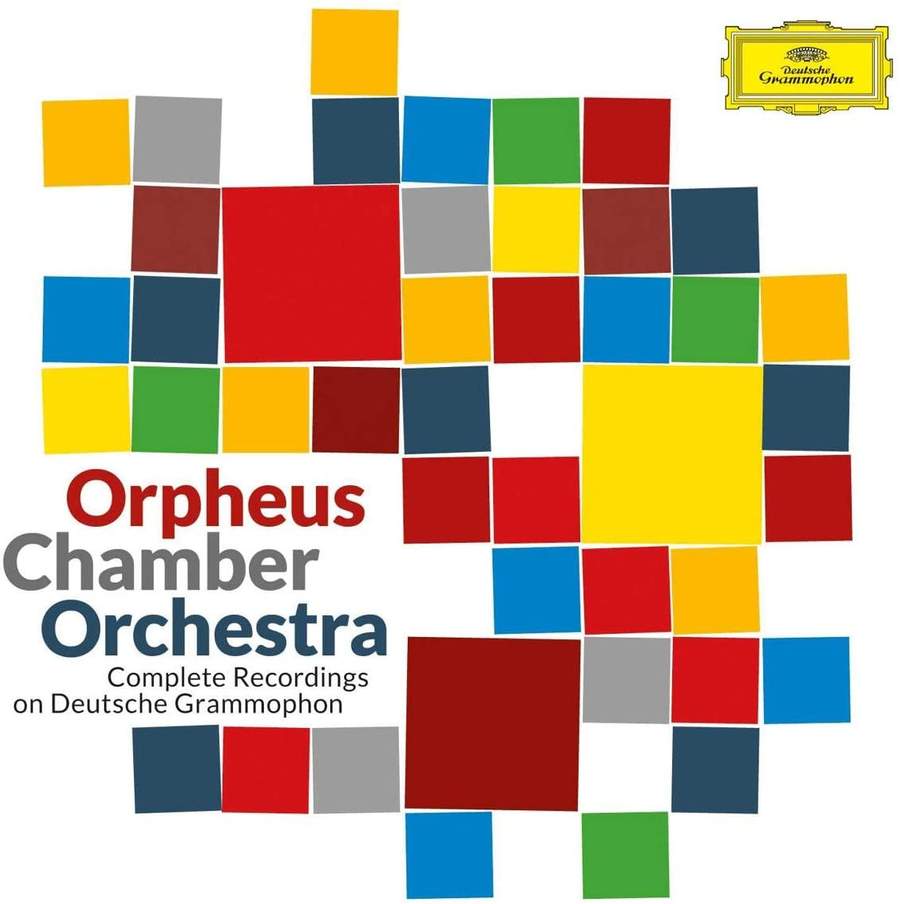
Various works (see DG link below for full repertoire details)
Deutsche Grammophon 4839948 (55 CDs)
Written by Ben Hogwood
What’s the story?
This box set tells the story of the Orpheus Chamber Orchestra – soon to celebrate their 50th anniversary – and the recordings they have made to date for Deutsche Grammophon. Formed in 1972, the conductor-less ensemble from New York have amassed an impressive body of work, spanning repertoire from Handel and Vivaldi to Schoenberg and William Bolcom, examined here across 55 CDs.
The group have enjoyed a fruitful relationship with DG, undertaking several projects. Among these are the Mozart wind concertos, with principals from the orchestra employed as soloists, and a clutch of hand-picked Haydn symphonies. Jed Distler’s booklet introduction, meanwhile, reveals a remarkable agreement which saw them commit the SchoenbergChamber Symphonies and Verklarte Nacht to disc in 1989, in return for a version of Vivaldi’s Four Seasons four years later.
Also included in this set is a previously unavailable account of Mendelssohn’s Italian Symphony, a live recording from Warsaw in 2018.
What’s the music like?
Orpheus Chamber Orchestra records are known for their crisp ensemble and energetic, engaging performances, but also for their poise. While their approach to Baroque music might not appeal to historical purists, nobody can deny the enthusiasm they bring to the Handel Concerti Grossi Op.6, nor their vibrant collection of Vivaldi Cello Concertos with regular collaborator Mischa Maisky, or the Flute Concertos with Patrick Gallois.
Their Mozart is particularly enjoyable, the wind concertos blossoming under the ‘home’ soloists, who have the advantage of an immediate musical rapport with their accompanists. The Sinfonia Concertante, with soloists Todd Phillips (violin) and Maureen Gallagher (viola), is especially good, while horn players William Purvis and David Jolley, clarinettist Charles Neidich, flautist Susan Palma-Nidel, oboist Randall Wolfgang and bassoonist Frank Morelli also excel. The Flute and Harp Concerto, with harpist Nancy Allen, is sublime, while a generous selection of the wind Serenades and string Divertimenti are delightful.
The Haydn symphonies fare particularly well, too, and often have an irresistible zest. The account of the Symphony no.80 in D minor is notable in this respect, but there is restraint and darker feeling in the Symphony no.49 in F minor, ‘La Passione’, its introduction taken at a daringly slow tempo. Meanwhile the disc of Rossini overtures still defies gravity in the absence of a conductor, a remarkable achievement!
The inclusion of Mendelssohn’s Italian symphony boosts an already excellent account of the two piano concertos, with Jan Lisiecki. It is fresh faced and buoyant in the outer movements, with a balletic poise for the inner two. Meanwhile their account of Beethoven’s The Creatures of Prometheus has plenty of spring in its step, as does a wonderful disc devoted to music for strings by Grieg and Tchaikovksy. The DvořákSerenades, too, fare particularly well, and there are two thoroughly engaging discs devoted to the music of Copland and Ives.
Best of all are the orchestra’s Stravinsky and Schoenberg recordings. The Stravinsky selection has excellent accounts of the ballets Pulcinella (the suite) and Orpheus, but equally valuable are the shorter pieces, where the composer’s gruff humour is caught to rhythmic perfection. The performance of Dumbarton Oaks could hardly be bettered. The Schoenberg has some eye-watering virtuosity in the Chamber Symphony no.1, an ideal way in for doubters of the composer – as is a translucent Chamber Symphony no.2 and a velvet-textured Verklarte Nacht.
Finally a mention for the orchestra’s Respighi, a colourful and moving trio of pieces comprising The Birds, a selection of the Ancient Airs and Dances and a particularly vivid account of the Trittico Botticelliano, showing off the composer’s colourful orchestration but also his deeply felt treatment of long-treasured melodies.
Does it all work?
Largely. One could argue that the disc of French orchestral music is a touch too glossy, or that the recordings of Bartók, Kodály and Suk do not quite have the authority a central European ensemble might bring to them. Even with those reservations, however, they are so well played that there is so much to enjoy, the slow movement of the Bartók Divertimento a particularly chilly example.
Is it recommended?
Unreservedly. This is a superb collection from an orchestra who are essentially a single instrument themselves, so together are their interpretations and their virtuosity. Their recording legacy for DG is unlike any other, and it is to be hoped it will blossom still further over – who knows? – maybe the next 50 years. This is a remarkably solid platform on which to build.
Listen and Buy
You can listen to clips and purchase this disc from the Presto website.
Reading
You can read Arcana’s interview with Orpheus Chamber Orchestra violist Dov Scheindlinhere, and listen to a playlist picking out Ben Hogwood’s personal favourites here.




 Arcana.fm