
In concert – Anne-Sophie Mutter, London Symphony Orchestra / Thomas Adès: Myth and Magic @ Barbican Hall

Anne-Sophie Mutter (violin), London Symphony Orchestra / Thomas Adès

Stravinsky Orpheus (1947)
Lutosławski Partita (for Violin and Orchestra) (1988)
Adès Air – Homage to Sibelius (Violin Concerto) (UK premiere) (2021-22)
Stravinsky Agon (1953-57)

Barbican Hall, London
Thursday 31 May 2024

Reviewed by Ben Hogwood Pictures (c) Mark Allan

This rewarding concert featured the imaginative programming of four works looking simultaneously backwards and forwards, with two great Stravinsky ballets framing shorter works for violin and orchestra.

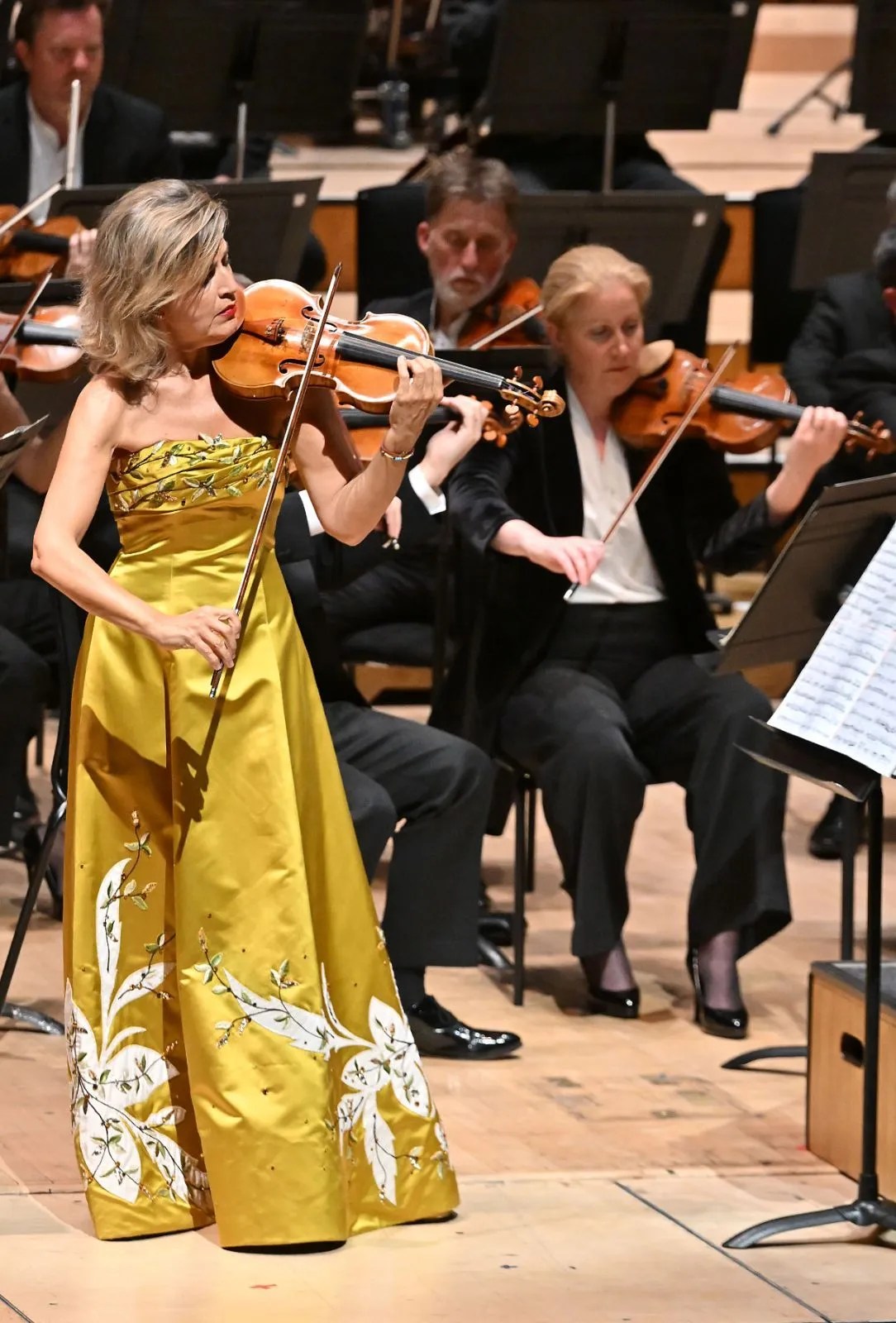
Anne-Sophie Mutter (below) has forged a pioneering path for contemporary music throughout her career, and added another dedication to an illustrious list that includes Lutosławski, Penderecki, Sir André Previn and Unsuk Chin. Air – Homage to Sibelius was written in the light of her admiration for Adès’ Concentric Paths, his Violin Concerto of 2005. It is a very different work indeed, an extended meditation based on a single melody written in the slow days of lockdown in 2021. In the execution Adès brought his music unexpectedly close to that of John Tavener or Arvo Pärt, the latter’s Cantus in memoriam Benjamin Britten recalled by the solemnly descending melody. Beginning on high with the orchestral violins, this was soon joined by Mutter’s silky-smooth tones. Now the piece developed with the soloist in charge, its serene progress tinged with longing. With no brass in the orchestra the textures were light, with tuned gongs suggesting a soft breeze, before the music gained weight on the gradual descent as though nearing the bottom of a mountain. The Sibelius homage could be determined in the line and structure of the piece, and also the rarefied light that it cast adrift.

Before the interval we heard Lutosławski’s Partita, written initially for violin and piano in 1984 but orchestrated for Mutter four years later. The word ‘partita’ is interpreted by Lutosławski in its 18th century form, and this work begins with a stern Allegro giusto that comes adrift when the soloist starts to use portamento, the melody travelling through microtones. Mutter’s control here was masterful, yet the feeling of dislocation was compounded. The central Largo was powerful indeed, the violin singing a darker song, before the closing Presto brought a terrific burst of energy, the colourful orchestration prompting and cajoling. Mutter’s voice, though, spoke the loudest.
The concert had begun with a relatively rare live account of Orpheus, the second of Stravinsky’s three Greek ballets. Thomas Adès directed a compelling performance of a work whose dynamic levels remain quiet for almost the entire half hour – yet contain music of acute description and poignancy. There is dread too, which Adès brought out in the scenes where Orpheus is surrounded by the Furies, then where he met his untimely demise at the hands of the Bacchantes. With the harp of Bryn Lewis treading a solitary, elegant line, Orpheus’ lyre remained as a ghostly presence right through to the end – in spite of the efforts of the Angel of Death, brilliantly voiced by violinist and orchestra leader Benjamin Gilmore.

The concert finished with the remarkable Agon, with which Stravinsky completed his Greek trilogy and indeed entire ballet output when premiered in New York in 1957. Even in his mid-70s the composer was pushing boundaries, this time in the direction of Schoenberg’s serial technique, without compromising his dramatic instincts. With no plot, Agon is essentially a celebration of movement, Stravinsky free to explore old dance forms through the prism of twentieth century harmony and melody, with remarkably imaginative instrumentation. This performance fully revealed its genius, the Renaissance and Baroque dances given a new lease of life with orchestration turned on its head. The colours were enhanced by mandolin (Huw Davies), harp (Bryn Lewis) and percussion (Neil Percy and Tom Edwards), not to mention the superb LSO brass, wind and string sections. Double basses got in on the act, playing high in the register, the weird and wonderful sounds given gruff harmonies and comedic punctuation as the ballet unfolded. Light and shade were exquisitely explored, the advantage of having a composer-conductor such as Thomas Adès at the helm meaning no stone was left unturned. This was a memorable interpretation, capping a wholly stimulating evening of music making.

You can find more information on further 2023/24 concerts at the London Symphony Orchestra website

Published post no.2,195 – Friday 31 May 2024

In appreciation – Sir Andrew Davis

by Ben Hogwood

Yesterday we heard the sad news of the death of the British conductor Sir Andrew Davis, at the age of 80.

The warmth of the tributes made on social media to Sir Andrew are an indication of his standing as a highly respected conductor who was for many a friend as well as a fellow musician. As a live performer he excelled at the BBC Proms, becoming the festival’s musical figurehead in the 1990s as chief conductor of the BBC Symphony Orchestra, a post he held from 1989 until 2000. Yet he also made his mark overseas, through posts held with the Toronto Symphony Orchestra (from 1975 until 1988) and the Melbourne Symphony Orchestra (from 2013).

The playlist below attempts to summarise his considerable contribution to recorded music – and in particular his many outstanding discs of British music. The reader is particularly directed towards an extensive and hugely rewarding series of Elgar for Chandos, but the list below includes early Berlioz, Delius, Elgar, a recent highlight of Stravinsky‘s Violin Concerto recorded with James Ehnes and the BBC Philharmonic Orchestra, and an outstanding version of Vaughan WilliamsSymphony no.6, capturing a side of the composer seldom heard at the time of recording.

Published post no.2,156 – Monday 22 April 2024

In appreciation – Maurizio Pollini

by Ben Hogwood. Picture (c) Matthias Bothor / DG

Yesterday we heard the sad news of the death of the great Italian pianist Maurizio Pollini, at the age of 82.

You can read a number of tributes to Pollini, by Barry Millington on the Guardian website and by HarrisonParrott, his agents.

Throughout his career Pollini recorded for Deutsche Grammophon, leaving a succession of remarkable recordings ranging from a famous early collection of the Chopin Etudes through to pioneering modern collections, with a landmark LP of works by Schoenberg and a 20th century collection of Stravinsky, Webern, Boulez and Prokofiev. The playlist below is a personal selection of favourites and a memory from seeing Pollini play Schumann‘s Fantasie in C major at the Royal Festival Hall.

Published post no.2,127 – Saturday 24 March 2024

In concert – Jess Gillam, CBSO / Eduardo Strausser: Villa-Lobos, John Williams, Rimsky-Korsakov & Stravinsky

Jess Gillam (soprano & alto saxophone, above), City of Birmingham Symphony Orchestra / Eduardo Strausser

Rossini La Cenerentola (1817) – Overture
Villa-Lobos Fantasia for Saxophone, W490 (1948)
Rimsky-Korsakov arr. Glazunov/Steinberg Le Coq d’or – Suite (1908, arr. 1909)
Williams Escapades (2002)
Stravinsky L’Oiseau de feu – Suite (1910, arr. 1919)

Symphony Hall, Birmingham
Wednesday 31 January 2024

Reviewed by Richard Whitehouse. Photo (c) Robin Clewley

Brazilian conductor Eduardo Strausser made his welcome return to the City of Birmingham Symphony with a programme where three orchestral showpieces were heard alongside two pieces that gave full rein to the charismatic playing and persona of saxophonist Jess Gillam.

Although he featured the saxophone on numerous occasions, Heitor Villa-Lobos wrote just one concertante piece. His Fantasia makes a virtue out of brevity in the lively declamation of its opening movement then the motoric impetus of its finale. No slouch in either, Gillam sounded most involved (understandably so) in the central Lent – its initial melody for viola, soulfully rendered by Adam Römer, soon giving rise to an eloquent dialogue which (hardly for the first time) inferred, that in this most productive of composers, less can often be more.

More compelling overall was Escapades, a concerto drawn from his soundtrack to the Steven Spielberg film Catch Me if You Can by John Williams. A movie as promises rather more than it delivers, this features one of the most appealing of its composer’s latter-day scores with its evoking US culture in the early 1960s that the present work encapsulates to perfection. From the ominous while humorous expectancy as conjured by Closing In, via the lightly applied pathos of Reflections to the coursing energy of Joy Ride – this is Williams at something near his best and Gillam responded accordingly. A pity the contributions of double bass and vibraphone was not as prominent aurally as it was visually (maybe they should have been given more to do?), but this hardly affected the scintillating immediacy of what was heard.

Having opened proceedings with an account of the overture to Rossini’s Cinderella as deft and as scintillating as could be wished, Strausser ended the first half with a (surprisingly?) rare outing for the whole suite from Rimsky-Korsakov’s final opera The Golden Cockerel. For all the controversy aroused by its scenario, this is otherwise an archetypal example of its composer relying on technique rather than inspiration. Most of the best music can be found   in a suite made posthumously by Glazunov and Maximilian Steinberg that provides a telling portrait of Tsar Dodon – whether mired in the superstitious inertia of his palace, hapless (and helpless) on the battlefield, serenaded by the alluring Queen of Shemakha, or exuberant at his intended wedding before meeting his ‘lamentable end’ to the crowing of that pesky cockerel.

The CBSO despatched what is effectively a ‘concerto for orchestra’ before its time with real aplomb, then sounded no less committed in the second of those suites Stravinsky drew from his highly Rimskian ballet The Firebird. Here the sombre aura of its Introduction segued effortlessly into Appearance… and Dance of the Firebird, the latter exuding an infectious lilt, before a plaintive take on the Princesses’ Khorovod. Others have found greater abandon in the Infernal Dance, but the clarity and articulation conveyed here were beyond reproach. Strausser then steered a secure course through the Lullaby, its folk-derived bassoon melody plaintively intoned by Nikolaj Henriques, into a Finale whose hymnic jubilation set the seal on an evening where the absence of any Austro-German element proved its own justification.

Click on the link to read more on the current CBSO concert season, and on the names for more on saxophonist Jess Gillam, conductor Eduard Strausser and composer John Williams

Published post no.2,075 – Friday 2 February 2024

In concert – Marcus Roberts Trio, Philadelphia Orchestra / Yannick Nézet-Séguin @ Carnegie Hall: Stravinsky, Weill & Gershwin ‘Rhapsody In Blue’

Breathtaking music-making for an attentive audience including a sparkling Petrushka.

Marcus Roberts Trio [Marcus Roberts, Martin Jaffe, and Jason Marsalis] Philadelphia Orchestra / Yannick Nézet-Séguin

Stravinsky Petrushka (1910-11 rev.1947)
Weill Symphony No. 2 (1933-34)
Gershwin Rhapsody in Blue (1924)

Carnegie Hall, United States
Tuesday 23 January 2024

Reviewed by Jon Jacob. Photo (c) Jon Jacob

For those of us from the UK more accustomed to perfunctory applause, the enthusiastic response from the audience welcomed conductor Yannick Nézet-Séguin to the stage ahead of Stravinsky‘s ballet Petrushka came as a bit of a surprise. The sound of the applause crinkled in the acoustics in a way I don’t remember hearing at the Cleveland concert. The capacity crowd was already psyched. Uplifting stuff before a single note was heard.

The Philadelphia Orchestra’s sound is incredible, generated by a powerful, carefully controlled machine that delivers both weight and delicacy. The band feels incredibly responsive, meaning the smallest of gestures can bring about a range of different colours and textures that illicit all manner of emotional responses. This receptiveness demands players at the top of their game. They are the elite.

There’s also a perceptible self-assurance in the sounds they produce. That promotes a sense of confidence in the listener, in turn elevating listening experience. Put simply if the first sounds you hear aren’t like anything you’ve heard before you’re going to listen more attentively, in the same way you’ll drive an expensive BMW differently simply because of the feel of the steering wheel and the smoothness of the ride. 

In Petrushka the principal flute had a bright sweet sound, flanked by a delicate and precise piccolo. There were beautifully burbling and babbling clarinets. Trumpets sparkled with rapid articulation that was clear but avoided fussy-ness. A virtuosic piano line highlights that the material was originally conceived as a concert piece for piano – the demands Stravinsky makes on the pianist remain high and it’s a dazzling contribution from pianist Kiyoko Takeuti.

Elsewhere, the big string section brings phenomenal weight given the heft (no great surprises perhaps – 17 first violins, 14 seconds, 12 violas, 10 cellos and 8 basses).  When the basses underpinned a sequence, it felt as though we were digging down into the foundations, great jabs slicing into the ground with a sharp-edged spade.

The Weill Second Symphony opened the second half. A smaller number of players on stage but still the same detail, responsiveness and jaw-dropping spirit that elevates this band above so many others. At three movements it is a concise work, packed full of evocative tunes, inventive treatments, and tantalising textures. It undoubtedly entertains but does it move? I’m not entirely convinced, although age has mellowed me, so my conclusions are not as severe as those reported by Weill to a friend after the 1934 premiere who said the work had been dismissed as ‘banal, ‘disjointed’, and ‘empty’.

There were plenty of entertaining thrills and spills conjuring up nail-biting peril and jeopardy in the first movement. The Mahlerian second movement funeral march had some respite from the powerful grandeur on display in the sweet flute and trombone solos. It was a much prompter reading compared to some of the recordings I’ve listened to after the concert. Weill’s trademark melodies are evident in the final raucous movement.

Running to half an hour, Weill’s second symphony isn’t a long work, but given the stage move necessary to bring the piano and drum kit on for the final Rhapsody in Blue, the evening was feeling long. But the payoff was undoubtedly worth it. Hearing the music of New York, written in New York, here in New York was special. So too hearing the Marcus Roberts Trio with Philadelphia Orchestra.

Pianist Marcus Roberts treats the work’s piano sequences with far more improvisational zeal than the more familiar ‘straight’ recordings (you can get a sense of the material from this performance filmed in Geneva’s Victoria Hall

The familiar signpost orchestral sequences remain, but the energy is upped tenfold by the seeming flights of creative fancy the trio embarked upon. Excited applause rippled around the auditorium accordingly. The effect of this ‘directors cut’ was for competition to emerge between orchestra and trio. When the improvisations concluded and the orchestra kicked in, the well-known orchestral score sounded dull in comparison to the spectacle we had been treated to before. Was the kind of ‘Experiment in Modern Music’ Gershwin had in mind when the work was first premiered at the Aoliean Hall down the road a hundred years before?

The energy in the auditorium unexpectedly seemed to come with me as I made a ‘dash’ up the steep balcony steps for the exit. After I’d run for a subway train (conveniently located outside the concert hall), I sat down and immediately yawned. Heads turned.

“It was a long evening, wasn’t it?” said the man sat next to me. “It was. But I loved every single minute of it.” “The Weill was fantastic. I do think they packed in more than they needed to. And I’m sure the ensemble was off in the Petrushka.” He looked across the aisle to a couple who were listening to our exchange. “I thought so too,” said the woman. Then a man stood in the aisle, “No. It was the Weill that was the problem. I can’t stand Weill.” 

I gently protested, jokingly telling them they were all wrong and they should take a long hard look at themselves and listen back to the broadcast when they got home. A surprisingly in-depth conversation ensued amongst the five of us. I missed my stop as a result.

“You know, you’d never have this kind of post-kind of conversation on the Tube in London”, I explained. “Oh we know,” replied the woman, “That’s what we do here.” It’s a lovely thing too.

Get a taste of the Philadelphia Orchestra sound in this recording of Stravinsky’s Petrushka from the early 1980s. For a taste of Yannick with the Philadelphia taking things at a rip-roaring pace, be sure to listen to the last movement of the Philadelphia’s 2023 recording of Rachamaninov’s Second Symphony.

Jon Jacob is a writer, digital content producer and strategist, authors the Thoroughly Good Classical Music Blog, and produces the Thoroughly Good Podcast.

Published post no.2,066 – Wednesday 24 January 2024