In concert – Ilya Gringolts, BBC Symphony Orchestra / Roderick Cox: Debussy, Wennäkoski, Lyatoshinksky & Stravinsky

Ilya Gringolts (violin), BBC Symphony Orchestra / Roderick Cox

Debussy Prélude à l’après-midi d’un faune (1891-4)
Wennäkoski Prosoidia (BBC co-commission: world premiere)
Lyatoshinsky Grazhyna
Stravinsky The Firebird – suite (1919)

Barbican Hall, London
Friday 3 November 2023

Reviewed by Ben Hogwood. Pictures courtesy of BBC/Mark Allan

If the number of concertgoers whistling the Finale of Stravinsky’s Firebird down Silk Street to the tube was anything to go by, this typically creative BBC Symphony Orchestra program had made its mark.

This was in spite of a late change of conductor, Roderick Cox replacing the indisposed Eva Ollikainen – yet the transition was seamless, Cox an alert and subtly commanding presence who clearly enjoyed making music with his new charges. All those qualities were evident in a hazy, sensuous account of Debussy’s Prélude à l’après-midi d’un faune, the temperature raised in spite of the autumnal weather outside. This is, as Paul Griffiths observed in the booklet notes, where Debussy’s ‘music begins here afresh. So does modern music generally.’ Daniel Pailthorpe’s flute solo set the tone, the BBC Symphony Orchestra revelling in alluring wind melodies and hazy, soft-focus strings. The sense of the new – even 120 years after completion – was tangible throughout.
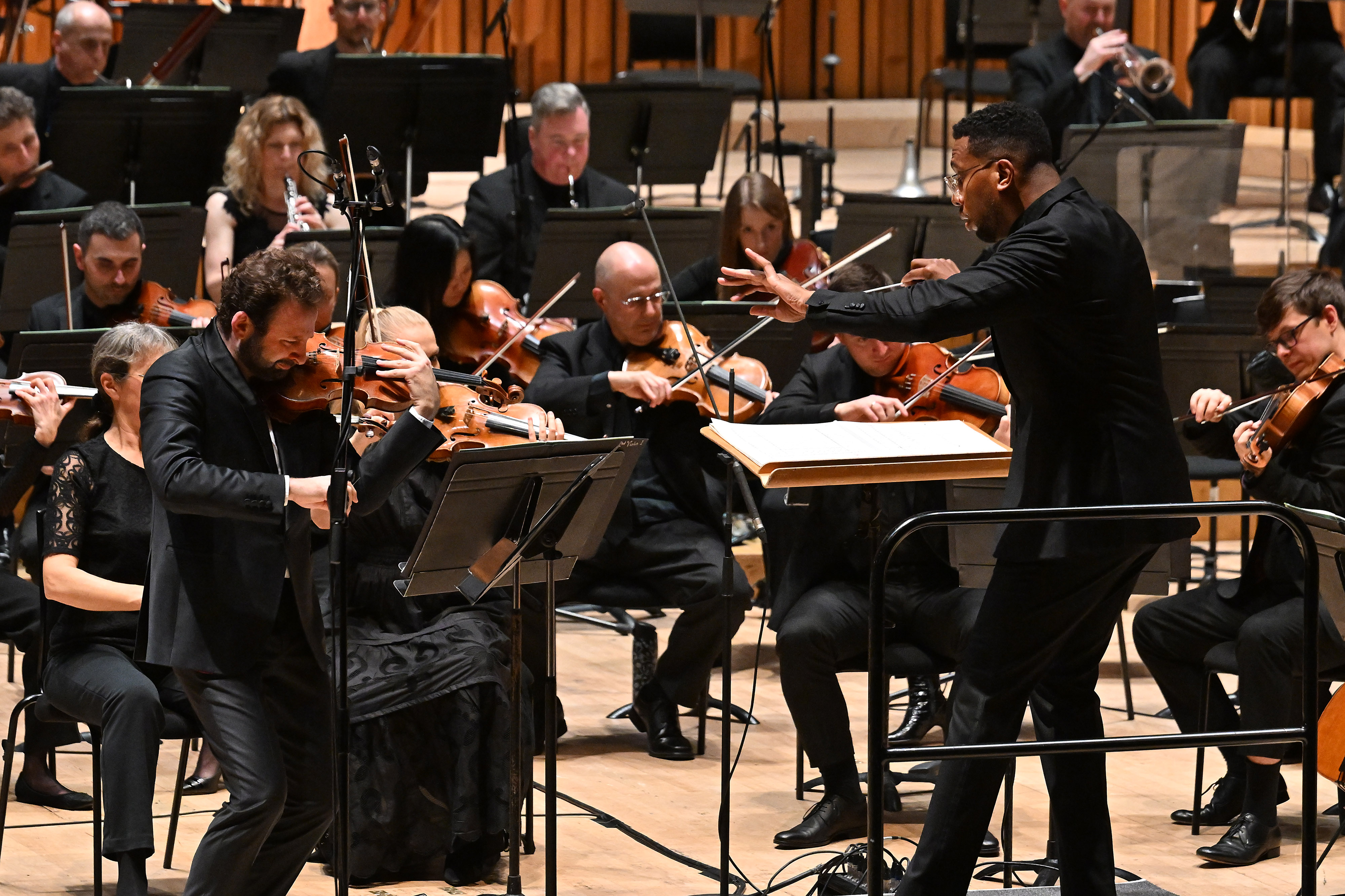
Lotta Wennäkoski’s Prosoidia was also new – still drying on the page in fact, as this was the world premiere of a co-commission from the BBC SO, Lahti SO and Norrlands Opera for violin and orchestra. Though not billed in the title as a violin concerto it assumed that function, though Ilya Gringolts (above) moved between his own solo statements and conversations as part of the orchestra. Throughout he showed impeccable technique and great expression. The orchestra’s role was headed by percussion and harp, with some exquisite shading especially in the quiet music. How refreshing to hear a composer confidently writing music that the audience strained to hear, the resultant effect all the more powerful for this restraint. Here Wennäkoski was reflecting linguistic instructions inspired by ‘prosody’ – the word referring to the musical properties of speech: rhythm, pitch, stress and pauses. Her focus gave the work a moving humanity, a concerto where wordless instrumental voices spoke with great intensity.
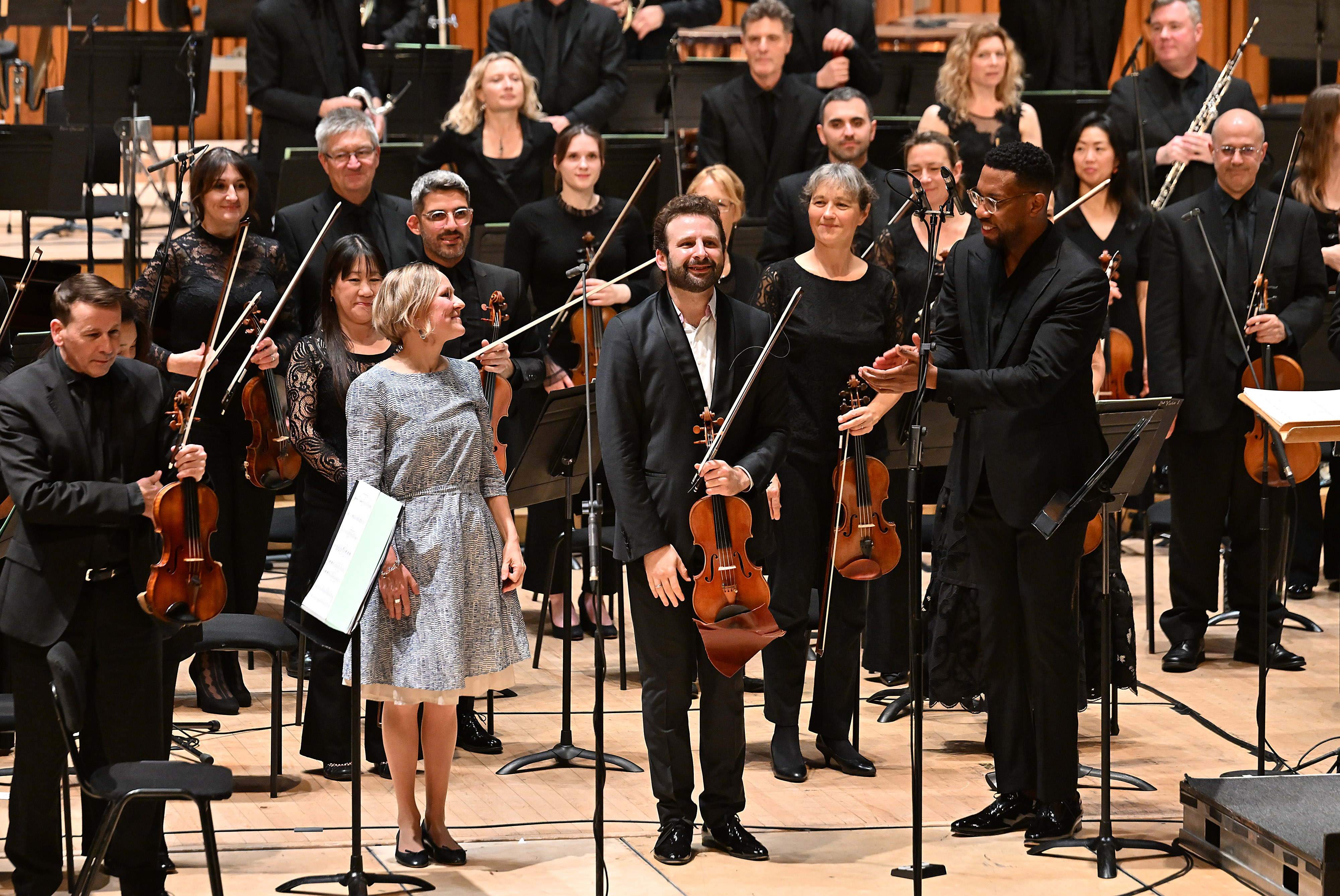
The second movement, Word Stress, had a primal savagery, the orchestral voices clamouring to be heard and on occasion drowning the violin. Here the influence of Bartók was palpable, Wennäkoski drawing perhaps on her studies in Budapest. A moving third movement followed, inspired by Ingmar Bergman’s film Cries and Whispers – and in particular a scene where the voices are replaced by the Sarabande from Bach’s Cello Suite no.5. Written in memory of the recently departed Kaija Saariaho, Wennäkoski’s teacher, it was an intimate discourse, recalling the equivalent passage in Berg’s Violin Concerto where the composer also quotes from Bach. Here the approach was less explicit but formed an engaging tableau, where the dynamic dimmed and textures became spare at the thoughtful close. A concerto with an appealing economy and frank musical language, Prosoidia deserves a regular place in the repertoire.
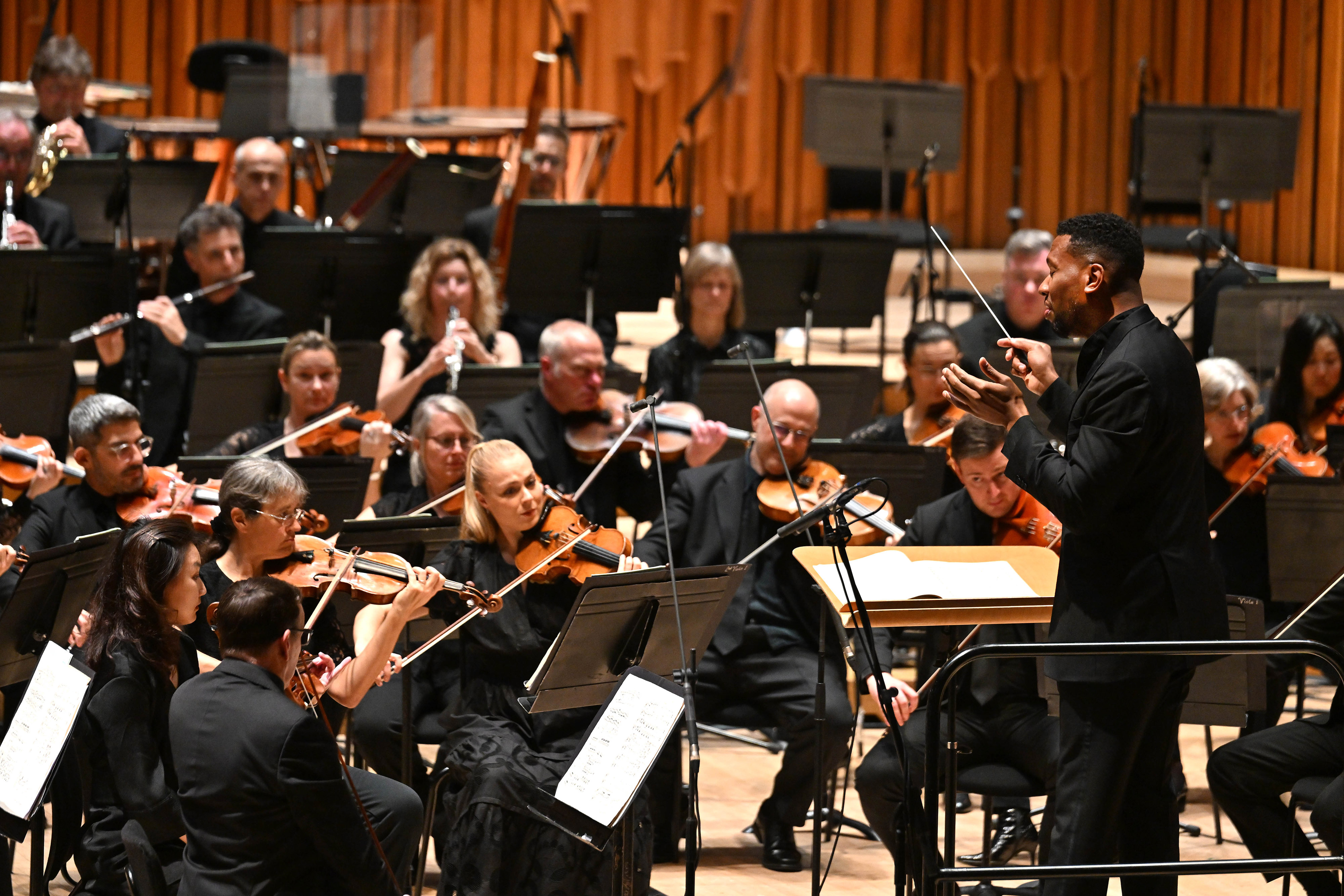
After the interval we heard music from Boris Lyatoshinsky, described in Martin Anderson’s composer profile as ‘the first explicitly Ukrainian composer of the modern age’. Grazhyna, a symphonic poem about a fictitious 15th century female Lithuanian chieftain, cast its eyes back to Liszt and Saint-Saëns in its orchestral narrative, but the modern harmonic language of 1955 spoke more of Myaskovsky and Shostakovich’s music for the stage, not to mention the lasting influence of Lyatoshinsky’s teacher Glière. Roderick Cox presided over a convincing interpretation, impressively grasping the piece in spite of what was surely limited preparation. From the brooding violas portraying the River Neman, we heard a plangent cor anglais lament from Max Spiers, then a high voltage tutti as the battle scene raged. Though short on distinctive melodies, Grazhyna was dramatic to the last as the river music returned, capping an atmospheric and compelling account.

This was also the case for Stravinsky’s 1919 suite from The Firebird, fashioned by the composer into a crowd-pleasing five movements, and creeping in stealthily on the lowest strings. This was an assured interpretation, Cox cajoling the well-drilled BBC SO through a thrilling Infernal Dance, having enjoyed the vivid colours of The Princesses’ Round Dance. The bassoon of Andrea de Flammineis excelled in the Berceuse, where Stravinsky’s ‘sweet and sour’ melodies were in evidence, before the bold as brass Finale that sent the audience home whistling. This was an impressive concert all round, showing the strength in depth the BBC Symphony Orchestra possess these days. Their ensemble, a winning combination of experience and raw talent, is enjoying a purple patch.

You can listen to this concert on BBC Sounds – and read all about the 2023/24 season and book tickets at the BBC Symphony Orchestra website. Click on the artist names for more on violinist Ilya Gringolts and conductor Roderick Cox, and for more on composer Lotta Wennäkoski

Published post no.1,999 – Saturday 4 November 2023

In concert – Simon Höfele, CBSO / Kevin John Edusei: Street Music – Stravinsky, Ellington, Zimmermann & Rota

Rota La Strada – Suite (1954, rev. 1966)
Zimmermann Trumpet Concerto ‘Nobody Knows de Trouble I See’ (1954)
Ellington (orch. Henderson) Harlem (1950-51)
Stravinsky Petrushka (1910-11, rev. 1947)

Simon Höfele (trumpet), City of Birmingham Symphony Orchestra / Kevin John Edusei

Symphony Hall, Birmingham
Thursday 1 December 2022

Reviewed by Richard Whitehouse

Tonight’s concert by the City of Birmingham Symphony Orchestra was one with a difference, Kevin John Edusei directing a programme which avoided the Austro-German mainstream with a vengeance as it surveyed music with a distinctly ‘alternative’ outlook.

Federico Fellini’s La Strada accords with the realism of post-war Italian film, yet its acutely emotional undertow makes it equally prophetic and Nino Rota’s score embodies both aspects with its heady dance-music but also a plangent inwardness in those passages for solo violin (eloquently rendered here by Philip Brett) where the tragic relationship between Gelsomina and Zampanò is made explicit. The suite Rota subsequently derived from the music’s later incarnation as a ballet remains among the most significant of his output for the concert hall.

While Rota looks to popular idioms, Bernd Alois Zimmermann utilizes jazz in his Trumpet Concerto, its (later appended) subtitle denoting the spiritual as underpins much of its content and comes to the fore at crucial junctures. The subtly varied orchestration – with saxophones, Hammond organ and ‘rhythm section’ featuring electric guitar – is complemented by that for the soloist with its range of mutes and a virtuosity new to the classical domain which Simon Höfele despatched with alacrity born of conviction. The respectively brooding and headlong initial sections created an expectancy fulfilled by a climactic episode which was taken a little too fast for its layering of jazz rhythms to come through unimpeded, though the final section lacked nothing in evocative power as it subsided edgily towards a close of muted anguish.

Duke Ellington’s Harlem may now have become relatively familiar in concert, but few such performances can have conveyed the sheer panache as was evident here. Edusei traversed the numerous brief sections of this ‘Tone Parallel’ (commissioned but never conducted by Arturo Toscanini) with innate appreciation of their musical as well as scenic potency that culminates with a rhythmic energy whose effect was undeniably visceral. A little audience participation, moreover, did not go amiss in the final pages where the orchestra duly gave its collective all.

From social, via racial and cultural to psychological alienation. Stravinsky may have intended Petrushka as a vehicle primarily for balletic or orchestral display, but the inner two of its four tableaux, defining the contrasting psyches of Petrushka and the Moor as they compete for the attentions of the Ballerina, provide acute character portraits delineated here with needle-sharp clarity (not least by pianist James Keefe – his crucial obligato contribution vividly embedded within the orchestral texture). Nor did the outer tableaux lack for atmosphere – the sights and sounds of St Petersburg’s Shrovetide Fair palpably in evidence, Edusei securing more poise and pathos than was usual from the relatively utilitarian orchestration as Stravinsky revised it. The closing stages of Petrushka’s death and apparition felt spine-tingling in their immediacy.

This resourceful reading concluded what is sure to prove a highlight of the orchestra’s current season. Other concerts might attract larger attendances, but the attentiveness of those younger listeners present confirmed this as precisely the kind of event the CBSO should be presenting.

You can read all about the 2022/23 season and book tickets at the CBSO website. Click on the artist names for more on Simon Höfele and Kevin John Edusei

Musical Fireworks for Guy Fawkes Night

With it being Guy Fawkes Night tonight, Arcana has decided to put on a quick fireworks display – in the form of two pieces from two of the 20th century’s standout composers.

The first is from Claude Debussy’s second book of Préludes for the piano, published in 1913. His firework display is set for the evening of 14 July, Bastille Day, but the depiction of the mini explosives is brilliantly done – as is the interpolation of snippets of the Marseillaise:

The second depiction of fireworks is through the orchestra, by Igor Stravinsky. His work predates Debussy’s by five years, and is for orchestra – described as ‘a short orchestral fantasy’. It was apparently a wedding present to his teacher, Rimsky-Korsakov:

In concert – Mahan Esfahani, CBSO / Ludovic Morlot: A Journey Through Time

Mahan Esfahani (harpsichord), City of Birmingham Symphony Orchestra / Ludovic Morlot

Ravel Le Tombeau de Couperin (1914-17, orch. 1919)
Sørensen Sei Anime (2020) [CBSO Centenary Commission: UK premiere]
C.P.E. Bach Harpsichord Concerto in D major, H421 (c1745)
Stravinsky Pulcinella – Suite (1922)

Symphony Hall, Birmingham
Thursday 28 April 2022

Written by Richard Whitehouse

A concert with a difference this evening from the City of Birmingham Symphony Orchestra, featuring harpsichord concertos ‘ancient and modern’ alongside two staples of the chamber-orchestra repertoire from the early 20th century in a programme as balanced as it was equable.

His final major work for solo piano, Ravel’s Le Tombeau de Couperin (or at least four of its six movements) is more often heard in the orchestral transcription that accentuates its mood of searching pathos. Not least the Prélude, its liquid motion unerringly conveyed, or in the astringent humour of the Forlane. The Menuet featured a melting oboe contribution from Oliver Nordahl, then in the final Rigaudon Ludovic Morlot avoided an unduly rapid tempo – vividly characterizing the outer sections while drawing confessional intimacy from its trio.

Harpsichordists are infrequent visitors to orchestral concerts, so credit to Mahan Esfahani (above) for tackling two very different yet strikingly complementary works – including the first hearing in this country of another CBSO Centenary Commission. Inspired by matters mundane and metaphysical, the six short movements of Sei Anime have been likened by Bent Sørensen to a French Suite in its expressive contrasts. Unforced alternation of (relatively) slow and fast dances drew an always inquisitive response from the soloist, heard in the context of reduced yet diverse forces that included a range of percussion adeptly handled by Adrian Spillett and the ethereal tones of an accordion played by violinist Kirsty Lovie. By turns enchanting and disquieting, the piece raised many more questions than could be answered at a first hearing.

Esfahani was on familiar ground after the interval with a Harpsichord Concerto in D major by C.P.E. Bach (which this reviewer recalls last hearing at a 70th birthday concert by George Malcolm). If not among his more exploratory works in the medium, this certainly ranks among his most appealing – its three movements perfectly balanced as to form and content such that the lively interplay between soloist and strings in the initial Allegro is complemented with the urbanity and poise of its central Andante, the final Allegro maintaining a scintillating onward motion though to its close. Music such as this most engaging of present-day harpsichordists rendered with unceasing clarity and verve, not least in those cadenzas where the figured-bass writing brought an extemporization whose immediacy never drew attention from the music at hand.

Having proved the deftest of accompanists, Morlot presided over a sparkling account of the suite Stravinsky took from his ballet Pulcinella. Again, it was the lucidity of the woodwind that really came through – not least in the plaintive Serenata or the elegant Gavotta with its two graceful variations. Nor was there any lack of robustness in the opening Sinfonia or, thanks to trombonist Richard Watkin, deadpan humour in the Duetto. An eloquent take on the ensuing Menuetto prepared ideally for the Finale to bring about the uproarious close.
A rewarding concert which deserved a bigger attendance than it received. Those deterred by this ‘journey through time’ will no doubt feel on safer ground next Wednesday, when future chief conductor Kazuki Yamada directs a programme of Prokofiev, Bruch and Mendelssohn.

For more information on the CBSO’s 2021-22 season, click here

Meanwhile for more information on composer Bent Sørensen, click here – and for the artists, click on the names to access the websites of Mahan Esfahani and Ludovic Morlot

In concert – Patricia Kopatchinskaja, CBSO / Mirga Gražinytė-Tyla: Tchaikovsky & Stravinsky

CBSO-mirga-patricia

Tchaikovsky Romeo and Juliet (1869, rev. 1880)
Stravinsky
Violin Concerto in D (1931)
Tchaikovsky
Symphony No. 4 in F minor Op. 36 (1877-8)

Patricia Kopatchinskaja (violin), City of Birmingham Symphony Orchestra / Mirga Gražinytė-Tyla

Symphony Hall, Birmingham
Wednesday 2 March 2022

Written by Richard Whitehouse

Coming toward the end of her tenure as music director of the City of Birmingham Symphony Orchestra, Mirga Gražinytė-Tyla presided over this orthodox programme of Tchaikovsky and Stravinsky given additional resonance by the geopolitical context against which it was heard.

At its centre was the Violin Concerto which Stravinsky wrote for his then duo partner Samuel Dushkin, whose four succinct movements nominally correspond to what is frequently thought a typical work from his neo-classical years, but with Patricia Kopatchinskaja involved this was anything but a straightforward rendering. From the start, a theatrical burlesque undercut any notions of Classical or even Baroque poise – those acerbic contrasts of its opening Toccata complemented by the speculative ambivalence of its First Aria or plangent eloquence of its Second Aria; the final Capriccio no less provocative in its constantly changing harmonic and rhythmic emphases. Regretting the absence of a cadenza, Kopatchinskaja instead gave Ligeti’s early Ballad and Dance – the latter in partnership with leader Eugene Tzikindelean.

Ambivalence in Tchaikovsky’s Romeo and Juliet is more to do with what sort of piece it is – the composer taking over a decade to get the formal balance of this ‘fantasy overture’ right. While there was no lack of evocative immediacy, MG-T was more concerned with bringing out its symphonic logic; not least in a sombre introduction and notably circumspect take on the ‘love theme’. For all the ensuing cumulative impetus, it was the woodwind chorale near the end – Tchaikovsky’s empathy with his subjects made explicit – as proved most affecting.

It was with Tchaikovsky’s Fourth Symphony that MG-T concluded her first concert in charge of the CBSO at the 2016 Proms, which memory recalls as similar in approach to that heard this afternoon. The complex formal trajectory of the first movement (tempo markings given inadvertently in the programme as being those for the whole piece) was adroitly negotiated – audibly intensifying when the pervasive ‘fate’ motto emerges at the start of the development and reprise, then a coda whose ultimate implacability never descended into mere histrionics.

Its oboe melody limpidly rendered by Steve Hudson, the Andantino unfolded audibly as ‘in modo di canzona’ – the emotional surge of its central section (rightly) held in check and the closing pages suffused with pathos. Neither was the Scherzo treated as an excuse for empty virtuosity – strings articulating its ‘pizzicato ostinato’ outer sections with delectable humour, and woodwind relishing the ‘harmonien’ writing of its Allegro trio. Following on apace, the Allegro con fuoco found viable balance between untrammelled exuberance and a methodical progress such as makes the climactic return of the ‘motto’ structurally as well as emotionally inevitable. If MG-T (purposely?) underplayed this crucial episode, then there was no lack of resolve in her handling of a peroration which brought a defiant rather than triumphal close. Ukrainian flags on and above the platform were ample evidence of just where the thoughts of musicians and audience alike were directed. As postscript to this concert, MGT’s choice of a soulful Melody in A minor by the late Myroslav Skoryk could hardly have been more apposite.

This concert is repeated on Thursday 3 March at 7.30pm. For details and tickets click here

Meanwhile for more information on the artists, click on the names to access the websites of Patricia Kopatchinskaja and Mirga Gražinytė-Tyla – and for more information on Myroslav Skoryk, click here