
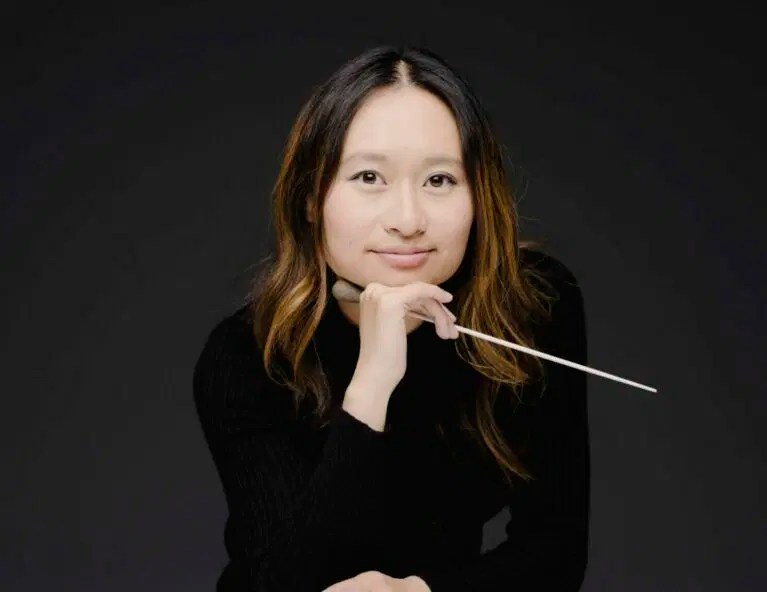
In Concert – Carolin Widmann, CBSO / Tianyi Lu: Habibi, Korngold & Prokofiev

Carolin Widmann (violin, below), City of Birmingham Symphony Orchestra / Tianyi Lu

Habibi Zhiân (2023)
Korngold Violin Concerto in D major Op.35 (1945)
Prokofiev Symphony no.5 in B flat major Op.100 (1944)

Symphony Hall, Birmingham
Wednesday 25 February 2026, 2:15pm

Reviewed by Richard Whitehouse Picture of Tianyi Lu (c) Marco Borggreve

This afternoon’s concert saw the City of Birmingham Symphony Orchestra in action with the Chinese-born New Zealand conductor Tianyi Lu, and a programme that prefaced established works from the mid-20th century with a recent piece by an Iranian-born Canadian composer.

Its title translating not only as ‘Life’ in Kurdish but as ‘indignant’ or ‘formidable’ in Persian, Iman Habibi’s Zhiân takes its cue from Iranian government repression in response to protests after the death of Mahsa Amini in police custody. Although not directly programmatic, there is a discernible trajectory from the initial explosion of violence, through a sequence of more ambivalent yet increasingly consoling episodes – during which solo instruments (notably the oboe) come into focus, towards a culmination of unalloyed fervour. Such a statement could easily have descended into overkill, but Habibi gauges its progress with audible sureness of intent; abetted here by the conviction of the CBSO’s response. Little heard as yet in the UK, Habibi is clearly a composer with something worth saying and the means by which to say it.

Those with longer memories may remember when Korngold’s Violin Concerto was far from being the concert staple it is today, its uninhibited romanticism held in check by orchestration as fastidious as it is sophisticated along with a formal concision that ensures this work never outstays its welcome. It was such a balance between effusiveness and discipline which came across most clearly in Carolin Widmann’s playing, by turns tensile and expressive so that the music retained its focus throughout. Even she could not quite prevent the finale from veering towards bathos, as Korngold’s otherwise judicious recourse to earlier film-scores rather gets the better of him, yet as its uproarious closing bars surged onwards, there was little doubting the sheer effectiveness of this work taken as a whole or of Widmann’s ease when realizing it.

The stage was set for a memorable performance of Prokofiev’s Fifth Symphony which, in the event, was no more than decent. Not that this was because of technical failings, yet the initial Andante never quite recovered from a sluggish opening such that the strenuous development was unduly hectoring then the climactic restatement of the main theme sounded turgid rather than implacable. The scherzo’s central phase had appealing insouciance, but its outer sections lacked impetus with little emphasis on the ‘marcato’ designation to ensure the necessary edge.

The ensuing Adagio was the sure highlight, Lu’s preference for leisurely tempos and gradual accumulation of tension coming into its own not least with a seismic climax which subsided towards a coda of melting pathos. The finale opened enticingly, but progress here was again undermined by a lack of momentum; without which, its ostensibly genial themes never took flight. This was most evident with a denouement, among the most hair-raising in symphonic literature, whose seeming matter-of-factness rather left the whole work hanging in abeyance.

A pity so relatively lacklustre an interpretation ended David Powell’s final concert as CBSO sub-principal cello. Your reviewer remembers his engaging presence from four decades ago, and is glad an overt dislike of Mahler did not end his 45-year tenure almost before it began.

To read more about the CBSO’s 2025/26 season, visit the CBSO website. Click on the names for more on conductor Tianyi Lu, violinist Carolin Widmann and composer Iman Habibi

Published post no.2,812 – Saturday 28 February 2026

In concert – Mark Bebbington, Czech National Symphony Orchestra / Steven Mercurio: Delius, Beethoven, Smetana & Dvořák @ Symphony Hall, Birmingham

Mark Bebbington (piano, below), Czech National Symphony Orchestra / Steven Mercurio

Delius The Walk to the Paradise Garden (1906)
Beethoven Piano Concerto no.5 in E flat Op.73 ‘Emperor’ (1809)
Smetana Má vlast – Vltava (1874)
Dvořák Symphony no.8 in G major Op.88 (1889)

Symphony Hall, Birmingham
Tuesday 21 May 2024

Reviewed by Richard Whitehouse

Although it might not see the number of visiting orchestras that it once did, Symphony Hall still hosts a number of such concerts and the season’s representation ended tonight with this welcome appearance by the Czech National Symphony Orchestra and music director Steven Mercurio.

Opening with DeliusThe Walk to the Paradise Garden (from his opera A Village Romeo and Juliet) found these players evincing real affinity with its powerful if elusive idiom, Mercurio securing a poetic response from the woodwind and no mean ardour during its climactic stages.

Despite coming from and being based in or around Birmingham for most of his career, Mark Bebbington (above) is less known locally than he might be and his account of Beethoven’s Emperor Concerto confirmed a sure grasp of its expansive formal structure, with his secure and never inflexible technique more than equal to its pianistic demands. After those commanding initial exchanges, the initial Allegro felt just a little under-characterized until hitting its stride in the development; from where this reading proceeded with tangible conviction through to an agile ‘anti-cadenza’ then combative coda. The Adagio’s winsome variations could have had greater inner rapture, yet the eloquence of Bebbington’s response was not in doubt while the hushed transition into the Rondo produced an emotional frisson as carried through this finale overall.

Throughout the movement, Bebbington’s scintillating pianism duly galvanized the CNSO into a forthright response right up to the life-affirming close – after which, he acknowledged the enthusiastic applause with his limpid take on Chopin’s Nocturne (no.20) in C sharp minor.

Following the interval, Czech music not unreasonably took centre-stage. The players might have been surprised by reference to the ‘Moldau’, but Mercurio directed a fluent Vltava with such passages as its wedding dance or traversal of St John’s Rapids nothing if not evocative.

Having been at the helm of the CNSO since March 2019 (in succession to the much-missed Libor Pešek), Mercurio has certainly put his own stamp on its repertoire and presentation. He gave an account of Dvořák’s Eighth Symphony (sometimes referred to as the ‘English’ due to being published by Novello, but actually the most Czech-sounding of his mature symphonies) that, if affording few revelations, underlined its structural innovations as surely as its melodic immediacy. The opening Allegro made a virtue out of eliding the customary formal divisions on route to a resounding peroration, then the Adagio was even finer for the way that its pathos and grandeur were melded into a seamless and methodical yet cumulative design; one where the composer’s Romantic instincts and his Classical inclinations find especially potent accord.

The lilting Allegretto sees Dvořák at its most felicitous – Mercurio aptly taking its boisterous pay-off as a lead-in to the final Allegro, with its variations on an easeful theme for the strings that ingeniously shadow the outline of a sonata design prior to a coda of headlong brilliance.

Conductor and orchestra duly responded with two encores – a rhythmically incisive piece by Iranian-Canadian composer Iman Habibi, then a bossa nova as gave first trumpet and CSNO co-founder Jan Hasenöhrl the spotlight and brought the whole evening gently down to earth.

Click on the names to read more about the Czech National Symphony Orchestra, conductor Steven Mercurio, pianist Mark Bebbington and composer / pianist Iman Habibi

Published post no.2,186 – Wednesday 22 May 2024