
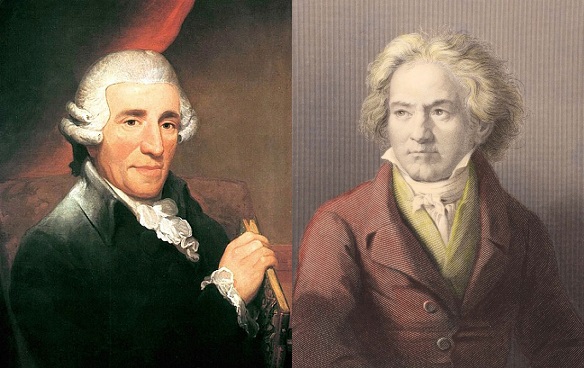
Routes to Beethoven – Joseph Haydn

by Ben Hogwood

November, 1792. The 21-year old Beethoven was planning to leave his home town of Bonn for Vienna, and he left with a ringing endorsement from Count Waldstein, his most important patron. Mozart had died the previous year at the age of thirty-five, and Waldstein sensed the stage was clear. “Dear Beethoven!”, he wrote. “You are going to Vienna in fulfillment of a wish that has long been frustrated. Mozart’s genius is still in mourning and weeps for the death of its pupil. It found a refuge with the inexhaustible Haydn but no occupation; through him it wishes to form a union with another. With the help of unceasing diligence you will receive the spirit of Mozart from the hands of Haydn.”

This was of course rather fanciful. To suggest Haydn as a channel for Mozart’s inspiration did the older composer – now sixty and in the prime of his musical life – little recognition. Haydn was aware of Beethoven, the younger composer having sent him his ambitious choral Cantata on the Death of Emperor Joseph II – and was willing to take him on. Thus Beethoven left Bonn in early November 1792 and travelled for ten days until arriving in Vienna.

All appeared to be going well for him there, but when Haydn sent a letter to Elector Maximilian dated just over a year later he included a clutch of works that Beethoven had already written in Bonn. Most were sadly lost – including an Oboe Concerto – but an Octet-Partita for wind ensemble has survived. The covering letter expressed the conviction that ‘On the basis of these pieces, expert and amateur alike must admit that Beethoven in time will attain the rank of one of the greatest musical artists in Europe, and I shall be proud to call myself his teacher. I only wish that he might remain with me for some time yet.’

The reply was curt, since Maximilian was receiving music he had already seen – and could not see any discernible progress to finance Beethoven further. As Lewis Lockwood points out in his Beethoven biography, Haydn’s priorities as a composer were stacked up. He had made a pioneering and highly successful visit to London in 1792, and a sequel was on the cards, for which he would need new string quartets and symphonies. Beethoven, too, given his ability and individuality, was not to be the perfect match. Lockwood talks of ‘the same stubborn personal resistance’…which ‘seems to have troubled his relationship to Haydn, though here it was mingled with reverence for authentic genius.’

With Haydn’s focus abroad, Beethoven looked elsewhere for his teaching and found counterpoint studies with Johann Schenk. Haydn returned to London and the brief relationship was at an end. Before he left Vienna, however, he was privy to Beethoven’s Op.1 – three trios for piano, violin and cello – and Op.2, a set of three piano sonatas dedicated to Haydn.

The trios contained a problem, in the explosive form of the third piece in C minor. Haydn advised withholding this from publication, calculating the impact on the Viennese audience might damage Beethoven’s reputation. It was, as Michael Steinberg in The Beethoven Quartet Companion points out, ‘a surprising attitude from a composer who was himself so bold. An observer went further, noting ‘a kind of apprehension, because he realised that he had struck out on a path for himself of which Haydn did not approve.

Jan Swafford holds the conviction that Beethoven took far more from Haydn than he himself declared at the time. ‘There is no record of what transpired in their lessons’, he writes. But it can be said that at least by his Op.2 Piano Sonatas, composed in 1794-5, Beethoven was showing the fruits of his studies in a startlingly mature way. After his months with Haydn, Beethoven emerged a far more sophisticated composer. To mention only one issue: Before Haydn, Beethoven had a shaky idea of proportion, might write an introduction to an aria that was a quarter of its length. After he finished the lessons with Haydn, he had one of the most refined senses of proportion of any composer – a sense of it, in other words, at the level of Haydn.’

Haydn’s influence on Beethoven can be gauged at this stage by listening to some of the works he was writing while teaching the younger composer. The three string quartets published as Op.74 are a case in point. The slow movement of no.3 in G minor finds the sort of spaciousness we became accustomed to from Beethoven in his equivalent slow movements. Meanwhile in the slow movement of no.1 in C major Haydn goes on all sorts of unusual tonal routes, seeming to travel far from home but only so he can show his dexterity as a composer, bringing the music ‘home’ with a single, deft switch. Beethoven was to acquire that quality too.

The Piano Sonatas offer some clues, too. The playful opening of the Sonata in C major has a wit Beethoven was only too keen to take forward. So too the grand gestures of the Sonata in E flat major, a key that was to assume great importance for Beethoven over the years. Haydn’s Masses were well known to Beethoven too, and the Nelson Mass – closely associated with Nelson’s victory over Napoleon – cast quite an influence on the younger composer’s Mass in C major.

The later symphonies acquire a dramatic instinct which must have appealed to Beethoven too. Like C.P.E. Bach, who we have already heard from, Haydn had a Sturm und Drang period that marked his music forever, and the last twelve symphonies, written for use in London, are even more vivid in their stories. The introduction to the relatively unsung Symphony no.98 in B flat major has a dark edge, and these works, now laden with timpani, have more emotive and dynamic contrasts, straining at the leash of the conventions of form and harmony. The final, London symphony – no.104 in D major – demonstrates best of all how far Haydn had taken the form. Its dramatic slow introduction reaching towards the 19th century and beyond, while the slightly rustic finale is brilliantly written.

There is much speculation on how Beethoven and Haydn’s relationship developed, if it did at all, beyond that of a prodigious pupil and a seasoned master of his craft in his early sixties. Certainly a healthy mutual respect existed, Haydn spotting the gifts Beethoven had in abundance, while Beethoven himself found his early works bearing clear influence of Haydn even more than Mozart. We will explore those in greater depth, as Beethoven takes on the forms of symphony, string quartet, piano trio and piano sonata and bears them into the 19th century.

You can listen to selections from Haydn’s enormous output, including the works discussed above, on the playlist below:

Routes to Beethoven – Handel

by Ben Hogwood

As we move on from the two Bachs, Johann Sebastian and Carl Philipp Emmanuel, towards Beethoven, we arrived at the person he described as ‘the greatest, most ablest composer’ – George Frideric Handel.

In his superbly written Beethoven biography, Jan Swafford makes the point of how “Handel, who died in 1759…gave the first inkling that there could be such a thing as a permanent repertoire. One of the things that made Beethoven what he became was the understanding, still relatively novel at the time, that one’s music could not only bring fame in life but also write one’s name on the wall of history.”

Swafford goes on to tell of how, when Beethoven was seeking outside ‘influences’ from the work of other composers, he repeatedly asked his publishers Breitkopf & Hartel for scores and literary works. These were by the two Bachs already mentioned, but extended specifically on the musical side to Handel’s Messiah, Mozart’s Requiem and Haydn’s Masses.

The effect of Handel on Beethoven’s late works – in particular the Missa Solemnis and Choral Symphony – is also considered. He goes as far as to suggest that “The whole of the Missa Solemnis is informed by Handel…” while noting that “Beethoven jotted down the dead march from Saul as he worked on the Ninth.”

We also learn of how, “out of the blue, in the middle of December arrived the forty-volume set of Handel’s works sent by his British admirer Johann Stumpff. Beethoven was overjoyed. ‘I received these as a gift today; they have given me great joy with this…for Handel is the greatest, the ablest composer. I can still learn from him.'”

Listening to Handel over the last few days has been a thoroughly uplifting experience. His instrumental music in this encounter has been full of positive intent, while one listen to the Messiah confirms it to be the work of a composer working in the white heat of inspiration. Some of Handel’s word painting here is exquisite, such as the excitement of the violins when they portray the arrival of the angels to the shepherds.

Beethoven clearly had some familiarity with Handel’s sacred works, for in 1796 he used an excerpt from the oratorio Judas Maccabaeus, ‘See, the conqu’ring hero comes’, as the basis for a brilliant set of variations for keyboard and cello.

Handel’s Concerti Grossi and Organ Concertos are revealed to be a strong blend of invention and convention – that is, following some of the models already established but with a composer putting his own stamp on proceedings. The Op.6 concertos have such a good nature to them, but also a few more spicy dissonances in the slower music especially.

The Keyboard Suites – which Beethoven may well have played – also have craft and harmonic originality in good measure:

It appears that the true influence of Handel on Beethoven’s music may not become clear until we reach the late works – but that throughout he was held in an incredibly high regard, an inspiration to Beethoven as he sought to become a lasting household name.

Listen

This Spotify playlist presents some of the works discussed, including two of the Keyboard Suites, the first of the Op.6 Concerti Grossi and Part 1 of Messiah. It begins with the second of the Water Music suites, illustrating how Handel could work to commission but find plenty of inspiration in doing so:

Next up

Routes to Beethoven moves on to a quick look at the music of one of his teachers, Anton Albrechtsberger.

Routes to Beethoven – C.P.E. Bach

by Ben Hogwood

Our first stop on the route to Beethoven was one of the great fathers of music, Johann Sebastian Bach. Moving on a generation, we arrive at the doorstep of his second surviving son, Carl Philipp Emmanuel.

Comparing the music of the two best known Bachs is like comparing chalk with cheese. Whereas the senior composer Johann Sebastian was notable for the order of his exemplary part writing, meticulously crafted melodies and an incredible economy of expression, Carl Philipp Emmanuel assumes the mantle of a rebellious son. As Steven Isserlis brilliantly describes it, his music is that of ‘divine disorder’.

In his best work, C.P.E. drives forward with terrific energy and unpredictability. Try this Fantasy in C major for starters, played on the fortepiano by Robert Hill:

But what was the extent of his influence on Beethoven? In his recently published biography, Jan Swafford writes how Beethoven began his studies with Christian Gottlob Neefe around 1781. “Central to Neefe’s influence on Beethoven”, he writes, “was Leipzig’s living memory of two towering composers who had lived and worked in the city: J.S. Bach…and his son C.P.E. Bach.”

He goes on to talk of how, “during his later years in Berlin and Hamburg, C.P.E. became the prime musical representative of the aesthetic called Empfindsamkeit, a cult of intimate feeling and sensitivity.” Empfindsamkeit (which can loosely translate as ‘sensitivity’) was associated with C.P.E. and a group of composers working for his employer, Frederick The Great.

Flötenkonzert Friedrichs des Großen in Sanssouci by Adolph Menzel

This approach, also known as Sturm and Drang, gained momentum through the 1760s, thanks to the output of Haydn, Mozart and an influential group of early symphonists operating in Mannheim. C.P.E. Bach was regarded as one of its pioneers, with further assertions made in his important treatise Toward the True Art of Clavier Playing. Here he declared that “moving the heart was the chief aim of music, and to do that one had to play from the heart and soul.”

In the New Oxford History of Music, Philip Radcliffe notes how “C.P.E. Bach’s richly varied range and texture in keyboard writing affected later composers such as Haydn and Beethoven. True to Empfindsamkeit, he preferred extremes, very high and very low ranges, sudden contrasts of thin and full textures or close and distant spacing. The expressiveness at the keyboard strangely did not influence his orchestration, where he showed no particular aptness in either choice or treatment of instruments.”

C.P.E.’s output includes some eye-opening moments. As well as the Fantasy above there are some fine works in the traditional style. The Cello Concerto in A minor, a substantial piece, has terrific drive to its writing in the fast movements, but also a deeply emotive lyrical side:

C P E Bach Cello Concerto A minor from Konserthuset Play on Vimeo.

The keyboard works, of which there are many, strain at conventional writing. The Sonata in D minor, included in the playlist, is the opposite of conventional ‘front loaded’ works. Where the first movement would often be the dominant one, on this occasion the third of three movements is twice as long as the first two – and is a colourful and thoroughly enjoyable set of a theme and variations.

C.P.E.’s Symphonies are striking in their unbuttoned enthusiasm and power, and are on occasion misunderstood as being reckless. The keyboard works operate with a freedom glimpsed much less commonly in the works of his father – which seems to have been Beethoven’s approach too. His choral music is striking, too – the hour long oratorio Die Auferstehung und Himmelfahrt Jesu (The Resurrection and Ascension of Jesus) is a powerful utterance, while shorter pieces such as the motet Helig ist Gott are notable for their vivid responses and word painting.

This musical freedom was shared by Beethoven, so it will be interesting to see how closely the approaches of the two composers align. The respect shown by Beethoven to C.P.E.’s documentation and keyboard works shows his deep and lasting respect for the composer, and will surely extend into a willingness to challenge the norm and push down musical boundaries.

Listen

This Spotify playlist presents just a small proportion of the massive output of C.P.E. Bach. It is intended to give an idea of his fearless approach to composition and his instinctive writing for orchestra, solo keyboard and choir. As you listen you will I’m sure recognise a fierce energy and drive, and also the sense of pushing against the boundaries of much of the music around him:

Next up

Routes to Beethoven moves on to the music of Handel, a composer Beethoven greatly admired.