Listening to Beethoven #69 – 2 Triple Fugues


Medaille: Wyon, L. C.: Beethoven-Gedenkmünze (Philharmonic Society London, 1870) © Beethoven-Haus Bonn

2 Triple fugues, Hess 244 for four parts (1794-5, Beethoven aged 24)

no.1 in D minor
no.2 in F major

Dedication not known
Duration 5′

Listen

Background and Critical Reception

These two triple fugues were written for four parts, though the exact instrumentation is not known. All three themes of the first piece are by Beethoven, while the second piece is collaborative between the composer and his teacher Albrechtsberger.

Thoughts

Writing a triple fugue means that a good number of musical parts are in play. Beethoven achieves his aim with music of impressive craftsmanship which will surely have satisfied Albrechtsberger.

The result for the listener is more admiration at the process than anything else, for this is clearly music that was not meant to be performed in concert. The first fugue is dutifully played out and a little downbeat as we return to D minor, while the second is more energetic and has a busier theme.

It is fascinating listening to these exercises though – and we will see much later in Beethoven’s life how they bear considerable fruit.

Recordings used

Covington String Quartet [Frank McKinster, Greg Pinney (violins), Luke Wedge (viola), William Hurd (cello)] (Deutsche Grammophon)

The versions for string quartet were arranged by the Dutch musicologist Albert Willem Holsbergen and are given sprightly performances here.

Spotify links

Covington String Quartet

You can chart the Arcana Beethoven playlist as it grows, with one recommended version of each piece we listen to. Catch up here!

Also written in 1795 Hyacinthe JadinThree String Quartets Op.1

Next up Prelude and Fugue in E minor Hess 29
Listening to Beethoven #68 – 5 Double Fugues


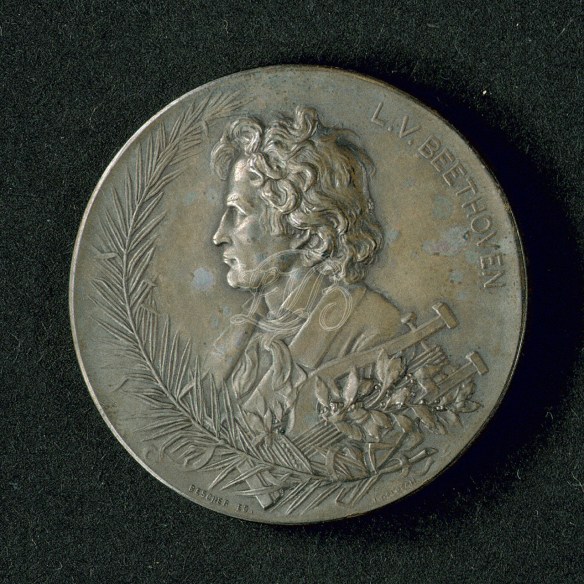
Commemorative medal for Ludwig van Beethoven – silver medal, based on designs by Jean-Marie Delpech and Lancelot, made by Bescher, Paris, early 20th century © Beethoven-Haus Bonn

5 Double fugues, Hess 243 for four parts (1794-5, Beethoven aged 24)

no.1 in C major
no.2 in F major
no.3 in C major
no.4 in C major
no.5 in D minor

Dedication not known
Duration 9′

Listen

Background and Critical Reception

As we rustle through Beethoven’s composition papers under the watchful eye of his teacher Albrechtsberger, we come to the tricky discipline of the double fugue.

As with previous counterpoint exercises this is a difficult one to write with feeling – but here Beethoven as a pupil was trying merely to satisfy his brief.

Thoughts

The five double fugues are lively pieces, Beethoven fulfilling his obligations with a lot more obvious energy than in previous bits of homework we have recently examined. The C major is brightly voiced, while there are signs of adventure on the second with a trill figure on the cello.

Beethoven returns to C major for the substantial third piece, which gives notice of a composer who really knows how to work his thematic material. This is busy, quite bracing music and the instruments work well in pairs before a thoroughly convincing final cadence. The fourth piece is also in C, recreating the same mood with plenty of activity.

Finally the sombre world of D minor returns – seemingly a favourite key for these lessons. This example is a full-bodied affair.

Recordings used

Covington String Quartet [Frank McKinster, Greg Pinney (violins), Luke Wedge (viola), William Hurd (cello)] (Deutsche Grammophon)

The versions for string quartet were arranged by the Dutch musicologist Albert Willem Holsbergen and are given sprightly performances here.

Spotify links

Covington String Quartet

You can chart the Arcana Beethoven playlist as it grows, with one recommended version of each piece we listen to. Catch up here!

Also written in 1795 Thomas HaighThree Keyboard Sonatas Op.10

Next up 2 Triple Fugues Hess 244

Listening to Beethoven #67 – 2 Chorale fugues


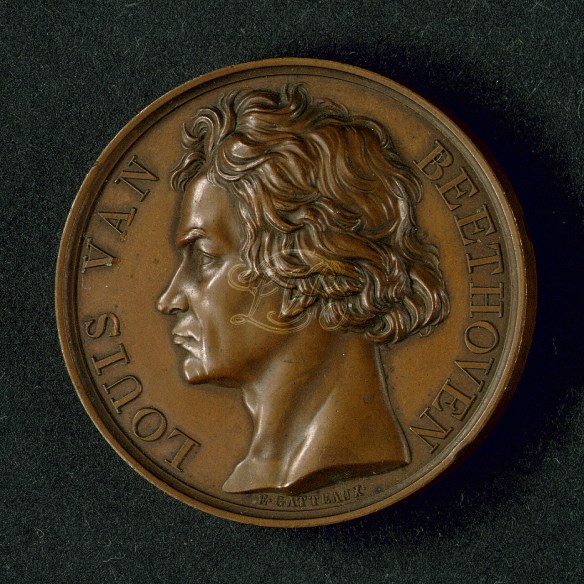
Commemorative medal for Ludwig van Beethoven – bronzed lead medal by Edouard Gatteaux, Paris © Beethoven-Haus Bonn

2 Chorale fugues, Hess 239 for keyboard (1794-5, Beethoven aged 24)

no.1 in D minor
no.2 in G major

Dedication not known
Duration 9’30”

Listen

Background and Critical Reception

As many an amateur composer will know, the art of writing a fugue is not an easy one. The rules are quite clear – you have a main theme, introduced by a specified number of parts – after which time the music develops with variants of that theme, and answers from clearly defined melodic sources.

Because of the precision often required, composers easily fell into the trap of writing dutiful, calculated music, losing the emotional content. The best fugues – Bach, Handel, the finale of Mozart’s Jupiter symphony to give just three off the cuff examples – have everything.

At this stage in his career Beethoven was more interested in the workings than the content, hence the non-publication of these fugues – but it is clear his teacher Albrechtsberger was testing him in different forms, asking him here to write two fugues based on chorale (hymn) tunes.

Thoughts

The first of the Chorale Fugues is slow and sombre. The counterpoint flows easily and the parts weave in and out of each other easily. The second piece is free of strife and its workings can be easily followed, but again it is quite a dry piece – as you would expect from music written solely as a study aid.

The second piece does have a surprise in store, however, when Beethoven moves to the key of B minor and stops for a little, as though considering his next move. Inevitably, this being ‘school’, his next move is back to the home key and a calm finish.

Recordings used

Tobias Koch (fortepiano) (Deutsche Grammophon)

Tobias Koch gives quite a deliberate performance, with the odd spotlight on key notes as they appear, but the music flows well. The second piece has a mottled texture with what seems to be the application of a dampener pedal. It gives an attractive sound.

Spotify links

Tobias Koch

You can chart the Arcana Beethoven playlist as it grows, with one recommended version of each piece we listen to. Catch up here!

Also written in 1795 GyrowetzThree Flute Quartets Op.11

Next up 3-Voice fugues Hess 237

Listening to Beethoven #66 – 6 4-voice fugues


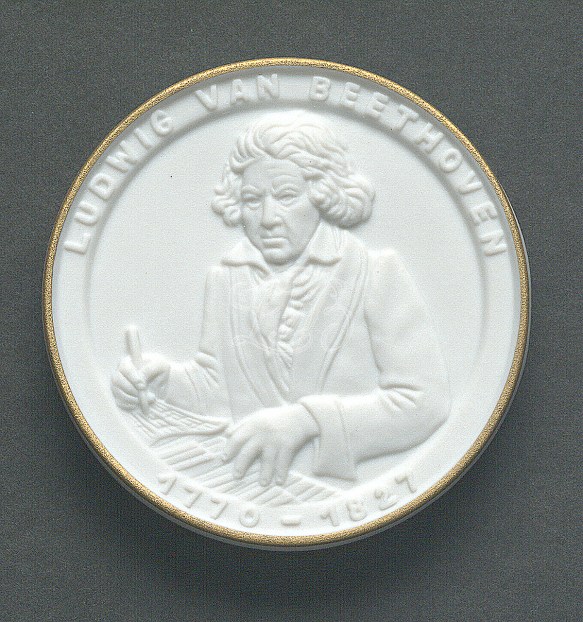
Beethoven Medal from Fürstenberg Porcelain © Beethoven-Haus Bonn

6 4-voice fugues, Hess 238 for four instruments (1794-5, Beethoven aged 24)

no.1 in E minor
no.2 in D minor
no.3 in C major
no.4 in A minor
no.5 in B flat major
no.6 in A minor

Dedication not known
Duration 9’30”

Listen

Background and Critical Reception

Presenting six more of the fruits from Beethoven’s studies with Albrechtsberger in Vienna, in which he shows himself an adapt composer of counterpoint in four voices.

Again we are indebted to Gustav Nottebohm for the assembly of these fascinating excerpts from lessons in his publication Beethovens Studien.

Thoughts

The four-part fugues show Beethoven in assertive mood, satisfying the brief set for him by his teacher. Once again the level of emotional investment is more distant, but hearing the four-part works on strings gives them a bit more colour.

The first two pieces are straight-faced, the second one with sacred undertones, ending as it does with a sweetly-voiced major chord. The third fugue is matter-of-fact, the fourth – back in a minor key – rather more plaintive. By the fifth fugue Beethoven’s music has acquired a jaunty swing, with the notes tightly knitted together before a relaxed final cadence. This and the straight faced final piece have a most natural flow, despite being little more than a minute long.

Recordings used

Covington String Quartet [Frank McKinster, Greg Pinney (violins), Luke Wedge (viola), William Hurd (cello)] Deutsche Grammophon

The Covington performances are forthright, striding forward confidently. In the minor key works less vibrato gives the overall sound a timbre towards that of a viol consort.

Spotify links

Covington String Quartet

You can chart the Arcana Beethoven playlist as it grows, with one recommended version of each piece we listen to. Catch up here!

Also written in 1795 HaydnPiano Trio in F# minor XV:26

Next up 2 chorale fugues Hess 239

Listening to Beethoven #65 – 4 3-voice fugues


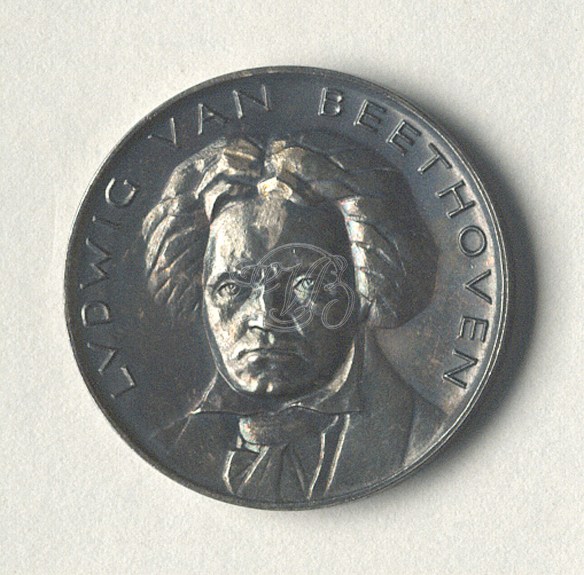
Beethoven-Medaille, große Fassung © Beethoven-Haus Bonn

4 3-voice fugues, Hess 237 for piano (1794-5, Beethoven aged 24)

no.1 in G major
no.2 in F major
no.3 in E minor
no.4 in D minor

Dedication not known
Duration 4′

Listen

Background and Critical Reception

The second collection of Beethoven’s academic studies with Albrechtsberger are the fruits of some three-part exercises. There are four of these, scored once again for piano – and once again they are drawn from Gustav Nottebohm‘s invaluable research.

The Unheard Beethoven website, a mine of information for these lesser known works, talks of Beethoven as ‘the lion condemned to a diet of only vegetable soup’. Their point is that the composer, keen to learn and broaden his technique, was prepared to write dutiful music that satisfied his teacher, but also gave him a clearer understanding of counterpoint in the long run. We would see the fruits of this work deep into his late works.

Thoughts

Again there is a fascination in hearing the results of Beethoven’s studies presented in such a bare way. The music is almost completely devoid of emotion, and you can feel the drudgery of academic learning – but there is still room for the odd surprise, such as an unexpected move to a more distant key in the first fugue.

The second is sparkier, the third on the sorrowful side and the fourth a dogged exercise but confidently worked.

Recordings used

Tobias Koch (fortepiano) Deutsche Grammophon

Tobias Koch continues with his deliberate approach, studied but accurate – reflecting the nature of the short pieces.

Spotify links

Tobias Koch

You can chart the Arcana Beethoven playlist as it grows, with one recommended version of each piece we listen to. Catch up here!

Also written in 1795 HaydnPiano Trio in G major XV:25

Next up 6 fugues for 4 voices Hess 238