Today’s nudge in the direction of an online concerts brings us to Living Room Live.
This is an exciting new initiative from a group of musicians keen to make a difference to those in isolation, led by violinist Tamsin Waley-Cohen and her composer sister Freya, together with pianist George Fu, consultant Daniel Ross and viola player Ann Beilby.
Living Room Live started just two months back but is already hosting three concerts a week through Facebook live, each concert starting at 6pm BST.
This week you can catch Zoë Martlew‘s cabaret alter-ego Nefari on Monday 18 May, then up and coming cellist Laura van der Heijden playing Bach‘s wonderful Solo Cello Suite no.4 on Wednesday 20 May. Meanwhile Friday’s concert, from violinist Amalia Hall, will feature the virtuosity of Ysaÿe, channelled through two sonatas for solo violin.
All concerts can be viewed in real time and in catch-up mode through Living Room Live’s Facebook page here
The City of London Sinfonia are continuing their half-hour sessions of Comfortable Classical at Home for all ages to enjoy while we are all stuck in isolation. The sessions offer a half-hour of musical freedom, as musicians from the orchestra educate and offer different ways of looking at the music they make. The environment is a relaxed one, with everyone welcome to get involved.
Past episodes include cellists Joely Koos and Becky Knight, clarinetist Katherine Spencer, orchestra leader Alexandra Wood, violinist Matthew Maguire and principal oboe Daniel Bates. Tomorrow – Thursday 23 April – Koos will return for a second session.
You can watch on the orchestra’s Facebook page from 11.30am – on every Tuesday and Thursday. You can also catch up on past episodes from the orchestra’s blog here.
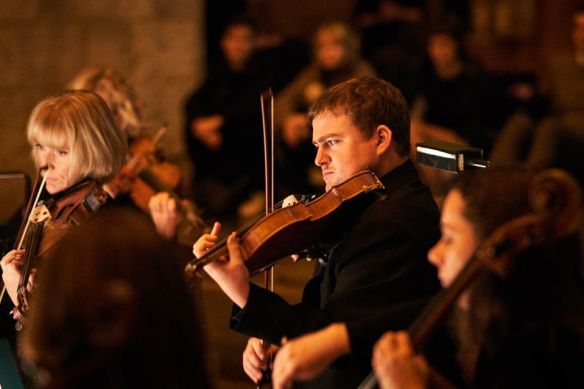
Matthew Maguire, violinist with the City of London Sinfonia
Photo by Kaupo Kikkas, 2017
The response to the coronavirus pandemic from choirs and orchestras has been nothing short of heartening over the last month. While many groups are making archive concerts available online for the first time, some are enlisting individual players to engage with their audience as performers, teachers or both.
The City of London Sinfonia is offering half-hour sessions of Comfortable Classical at Home for all ages to enjoy. From first hand experience these sessions are extremely effective, gently educating and musically stimulating. The chosen instrumentalists have been natural teachers, and the passion for what they do is evident – but they are affable and relaxed, too, offering behind the scenes insights into their own lives and homes.
Past episodes include cellists Joely Koos and Becky Knight (who played Bach in her bathroom and demonstrated a talent for a poignant haiku), clarinetist Katherine Spencer (who played Stravinsky in her back garden!), orchestra leader Alexandra Wood and principal oboe Daniel Bates. Tomorrow – Thursday 16 April – violinist Matthew Maguire will bring Bach, Blues and improvisation to his session from home.
You can watch on the orchestra’s Facebook page from 11.30am – on every Tuesday and Thursday. You can also catch up on past episodes from the orchestra’s blog here.
The Coronavirus pandemic looks set to change the way we listen to music for ever – and hopefully in a good way. Certainly if this ‘socially distanced’ concert from Tenebrae, given on BBC4 on Easter Day, is anything to go by. The 20 singers were arranged in the form of a conventional choir, to the viewer at least, but they all recorded their contributions remotely.
Thanks to this BBC4 were able to intricately stitch together a memorable half-hour sequence of music from J.S. Bach, Lobo, Purcell and Hubert Parry, an excerpt from his Songs of Farewell. Allegri’s timeless Miserere is also included.
While the togetherness and chemistry is inevitably not what it would have been had the choir been in the same room, this is an extraordinary achievement by the choir and their conductor Nigel Short. It is also one you can enjoy in your own place of lockdown for the next month, so make sure you watch in good time!
Tenebrae, conducted by Nigel Short, sing the following music: J.S. Bach Wenn ich einmal soll scheiden Lobo Versa est in luctum Allegri Miserere Purcell/Croft Thou knowest, Lord, the secrets of our hearts Parry My soul, there is a country J.S. Bach Ach Herr, lass dein lieb Engelein
Our first stop on the route to Beethoven was one of the great fathers of music, Johann Sebastian Bach. Moving on a generation, we arrive at the doorstep of his second surviving son, Carl Philipp Emmanuel.
Comparing the music of the two best known Bachs is like comparing chalk with cheese. Whereas the senior composer Johann Sebastian was notable for the order of his exemplary part writing, meticulously crafted melodies and an incredible economy of expression, Carl Philipp Emmanuel assumes the mantle of a rebellious son. As Steven Isserlis brilliantly describes it, his music is that of ‘divine disorder’.
In his best work, C.P.E. drives forward with terrific energy and unpredictability. Try this Fantasy in C major for starters, played on the fortepiano by Robert Hill:
But what was the extent of his influence on Beethoven? In his recently published biography, Jan Swafford writes how Beethoven began his studies with Christian Gottlob Neefe around 1781. “Central to Neefe’s influence on Beethoven”, he writes, “was Leipzig’s living memory of two towering composers who had lived and worked in the city: J.S. Bach…and his son C.P.E. Bach.”
He goes on to talk of how, “during his later years in Berlin and Hamburg, C.P.E. became the prime musical representative of the aesthetic called Empfindsamkeit, a cult of intimate feeling and sensitivity.” Empfindsamkeit (which can loosely translate as ‘sensitivity’) was associated with C.P.E. and a group of composers working for his employer, Frederick The Great.
Flötenkonzert Friedrichs des Großen in Sanssouci by Adolph Menzel
This approach, also known as Sturm and Drang, gained momentum through the 1760s, thanks to the output of Haydn, Mozart and an influential group of early symphonists operating in Mannheim. C.P.E. Bach was regarded as one of its pioneers, with further assertions made in his important treatise Toward the True Art of Clavier Playing. Here he declared that “moving the heart was the chief aim of music, and to do that one had to play from the heart and soul.”
In the New Oxford History of Music, Philip Radcliffe notes how “C.P.E. Bach’s richly varied range and texture in keyboard writing affected later composers such as Haydn and Beethoven. True to Empfindsamkeit, he preferred extremes, very high and very low ranges, sudden contrasts of thin and full textures or close and distant spacing. The expressiveness at the keyboard strangely did not influence his orchestration, where he showed no particular aptness in either choice or treatment of instruments.”
C.P.E.’s output includes some eye-opening moments. As well as the Fantasy above there are some fine works in the traditional style. The Cello Concerto in A minor, a substantial piece, has terrific drive to its writing in the fast movements, but also a deeply emotive lyrical side:
The keyboard works, of which there are many, strain at conventional writing. The Sonata in D minor, included in the playlist, is the opposite of conventional ‘front loaded’ works. Where the first movement would often be the dominant one, on this occasion the third of three movements is twice as long as the first two – and is a colourful and thoroughly enjoyable set of a theme and variations.
C.P.E.’s Symphonies are striking in their unbuttoned enthusiasm and power, and are on occasion misunderstood as being reckless. The keyboard works operate with a freedom glimpsed much less commonly in the works of his father – which seems to have been Beethoven’s approach too. His choral music is striking, too – the hour long oratorio Die Auferstehung und Himmelfahrt Jesu(The Resurrection and Ascension of Jesus) is a powerful utterance, while shorter pieces such as the motet Helig ist Gott are notable for their vivid responses and word painting.
This musical freedom was shared by Beethoven, so it will be interesting to see how closely the approaches of the two composers align. The respect shown by Beethoven to C.P.E.’s documentation and keyboard works shows his deep and lasting respect for the composer, and will surely extend into a willingness to challenge the norm and push down musical boundaries.
Listen
This Spotify playlist presents just a small proportion of the massive output of C.P.E. Bach. It is intended to give an idea of his fearless approach to composition and his instinctive writing for orchestra, solo keyboard and choir. As you listen you will I’m sure recognise a fierce energy and drive, and also the sense of pushing against the boundaries of much of the music around him:
Next up
Routes to Beethoven moves on to the music of Handel, a composer Beethoven greatly admired.




 Arcana.fm